 EN

Executive Summary & B2B Formulation Guidance
Qualify a CoQ10 supplier by exact form, assay, source, stability, format, documentation, and accountability—not by a sample or low kilogram price.
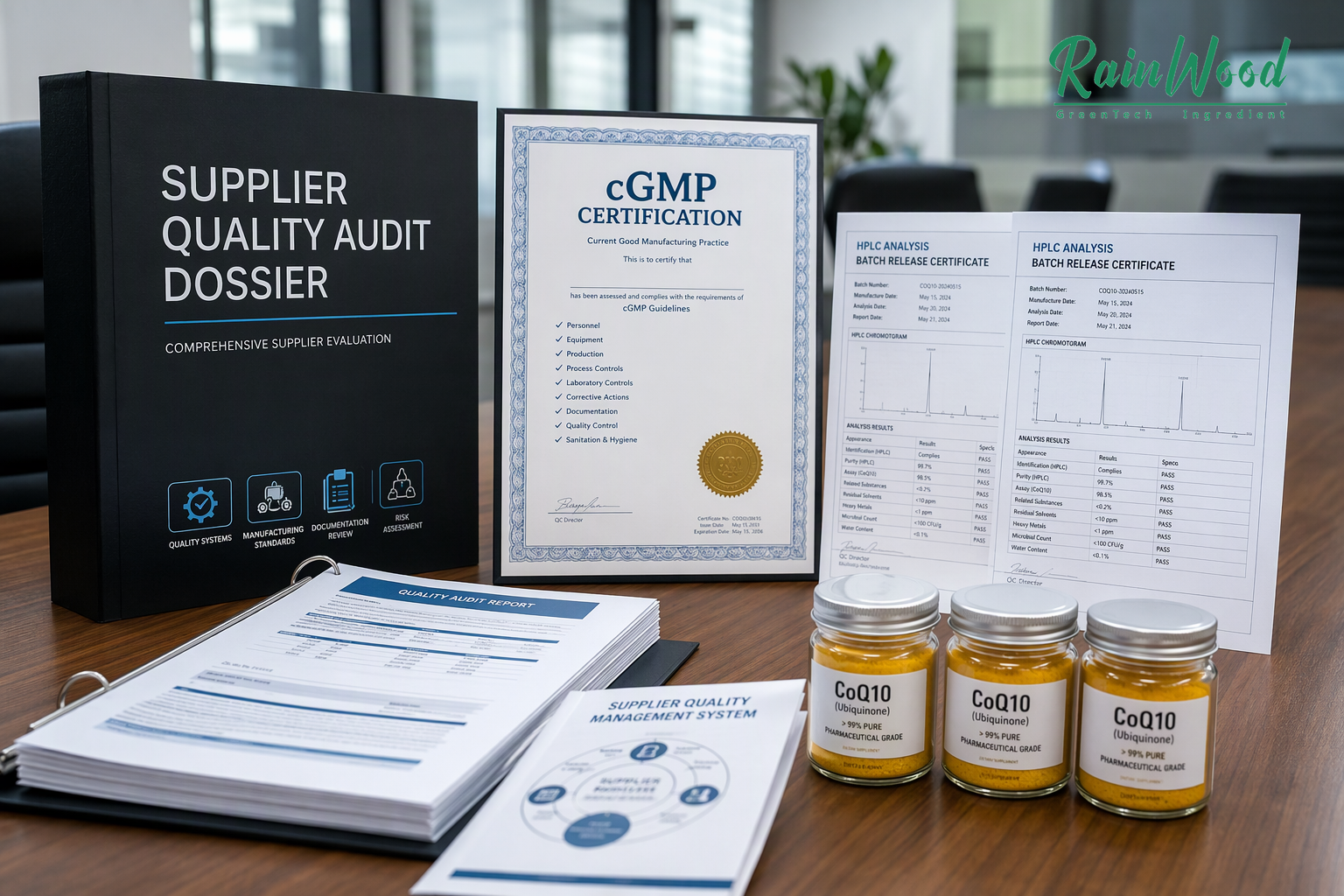
Figure 1: B2B Supplier Quality Audit Dossier, cGMP Certification Files, and Verified CoQ10 Commercial Lot Sample Jars
The supplier sends a polished sample and a competitive price. The brand approves the label, pays the deposit, and only then asks who owns the assay method, which form was quoted, and what happens if the bulk lot fails. A CoQ10 supplier should be qualified for the exact product you will sell—not for a general ingredient category.
Define the use case before rating the supplier
Write the target form, dose, format, market, package, quantity, customer channel, and claim boundary. A supplier that can provide crystalline ubiquinone powder may not be qualified for a stable ubiquinol softgel, a water-dispersible sachet, or a gummy. Qualification begins with the product decision.
Use the [INTERNAL LINK -> CoQ10 Ingredient Identity Review] to define the material and finished-product requirements. Then ask suppliers to respond to the same checklist so the comparison is fair.
Verify the legal entity and manufacturing route
Request the supplier entity, manufacturing site, role in the supply chain, source, redox form, carrier, and packaging. If a trader supplies the COA, identify the actual manufacturer and lot link. Ask how site, source, process, and package changes are communicated.
Do not treat a brochure, certificate logo, or marketplace profile as proof that the exact product or batch is covered. Verify scope, date, entity, location, and product relevance. Use the market dossier as a controlled document set rather than as a general marketing page.
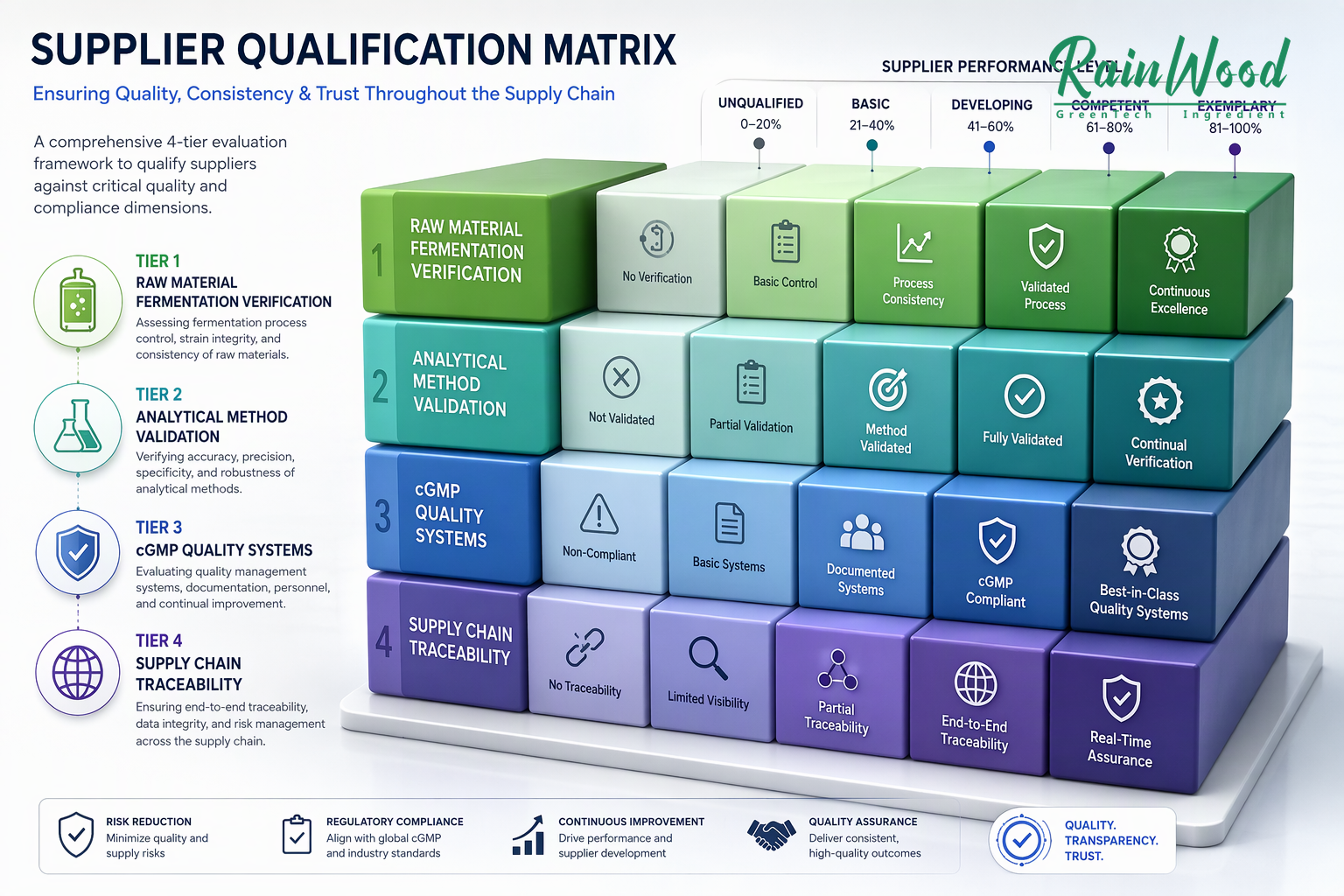
Figure 2: 3D Multi-Tier Supplier Audit Matrix: Fermentation Source Verification, Method Validation, and Batch Traceability
Review the specification and method before the sample
The specification should state identity, form, active content, assay method, carrier, moisture, contaminants, microbiology, storage, package, and shelf-life or retest. The COA should be lot-linked and report the same basis. If the label depends on ubiquinol, request reduced-form evidence rather than total CoQ10 alone.
Ask for the method description, reference standard, sample preparation, and laboratory identity. Compare methods before comparing numbers. Two similar percentages may not be equivalent when the methods use different standards or reporting bases.
Use a controlled sample-to-bulk gate
Approve the sample as a reference with lot, date, storage, and test status. Require a pre-shipment sample from the commercial lot. Compare active content, redox form, particle size, density, flow, moisture, color, odor, carrier, package, and format performance.
Run a first-article pilot with the intended equipment and package. Test beginning, middle, and end of the run. If the supplier cannot provide a commercial-lot sample or explain the difference between sample and bulk, classify the supplier as conditional.
Qualify the finished format, not only the powder
Hard capsules need fill-weight, flow, and uniformity evidence. Softgels need carrier, viscosity, shell, seam, fill, and oxidation controls. Tablets need compression, disintegration, and recovery. Gummies need heat, moisture, flavor, and active distribution. Sachets need dispersion, seal, film barrier, and moisture controls.
Ask which formats the supplier has actually piloted with the proposed CoQ10 form and dose. A general format list is not finished-product evidence. Use the [INTERNAL LINK -> CoQ10 Powder Oil or Softgel Format Guide] to make the qualification product-specific.
Check stability and logistics responsibility
Request raw and finished-product stability plans, package, storage, excursion rules, and shipping route. Confirm who investigates a failed activity or redox result after transport. Ask who pays for independent testing, retest, replacement freight, rework, or disposal.
The lowest price may transfer these costs to the brand. Normalize the quote to released active per daily serving, including yield, testing, package, stability, overage, MOQ, lead time, and expected rejection.
Review compliance and customer-facing support
The supplier should provide source, allergen, dietary, contaminant, microbiological, and market documents appropriate to the project. The brand still owns the final label, claims, customer-service script, and target-market review. A supplier's technical file cannot automatically authorize a medical claim.
Ask for a version-controlled dossier and a change-notification contact. If the product is intended for Amazon or EU distribution, request the exact documents required for the channel and jurisdiction. The [INTERNAL LINK -> CoQ10 Label and Claim Evidence Review] should be completed before listing.
How RainwoodBio can support qualification
RainwoodBio publishes requirement confirmation, raw-material supplier management, GMP production and process control, testing and release, compliance documentation, packaging, logistics, and traceability. For a private-label CoQ10 project, ask for a staged qualification: exploratory sample, conditional pilot, then approval of the exact format and market file.
RainwoodBio lists capsules, softgels, tablets, gummies, and powder sachets. Review the [INTERNAL LINK -> RainwoodBio OEM Format Options] and [INTERNAL LINK -> RainwoodBio Quality and Release Process] with the product brief.
Supplier approval checklist
Score each supplier on:
- exact form, source, and manufacturer identity;
- specification and method transparency;
- lot COA and finished-product evidence;
- sample-to-bulk controls;
- format feasibility and pilot result;
- stability, package, and logistics controls;
- documentation and market support;
- change notification and traceability;
- failed-lot, complaint, and replacement accountability;
- total cost per released daily serving.
Send the formula, COA, sample, quotation, format, market, quantity, and current supplier concern for a [INTERNAL LINK -> CoQ10 Supplier Qualification Review]. The output should identify approval status, open evidence, decision gates, and the next document or pilot required.
Review the supplier after the first commercial lot
Qualification should not end when the first sample passes. Compare the promised and actual activity, redox form, document timing, delivery condition, pilot yield, finished-product result, and response to questions. Record whether the supplier met the agreed specification and whether any deviation was explained with evidence.
Use the review to change approval status: exploratory, conditional, approved, or suspended. A supplier may be approved for a raw powder but conditional for a softgel or water-dispersible sachet. Reopen the review after a source, method, site, carrier, package, or target-market change. This staged approach gives private-label brands a practical way to scale without assuming every future SKU is already qualified.
Send the first-lot records, current scorecard, COA, format, market, and open supplier question for a [INTERNAL LINK -> CoQ10 Supplier Review Contact Us Page] assessment. Include the planned launch date and current inventory so the qualification plan reflects the cost of delay. Add the internal owner for quality, artwork, and purchasing decisions so open evidence does not remain unassigned. Include the next review date and responsible reviewer. Keep the signed record with the supplier file.
Frequently asked questions
Is a factory audit enough to qualify a CoQ10 supplier?
No. Product identity, assay, form, finished format, stability, documents, and accountability also need review.
Should every supplier provide finished-product samples?
For OEM or private-label projects, a finished pilot is often necessary because raw powder evidence does not prove format performance.
Is the lowest CoQ10 price the best offer?
Not necessarily. Compare released active, testing, package, stability, logistics, MOQ, and failure responsibility.
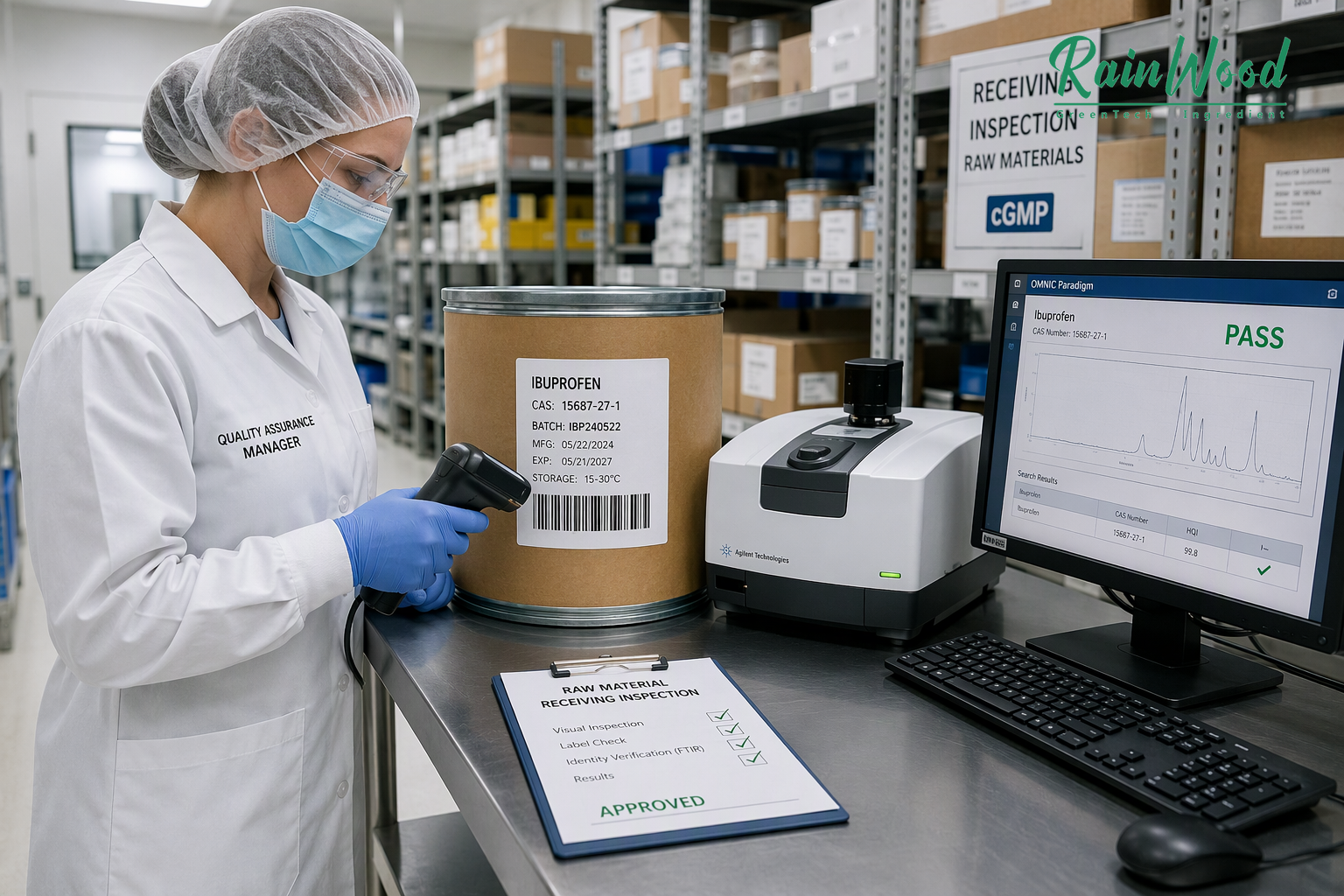
Figure 3: Quality Assurance Receiving Inspection and FTIR Raw Material Identity Verification in cGMP Pharmaceutical Warehouse
References
- Quality Control Assessment of Commercial CoQ10 Supplements: https://pmc.ncbi.nlm.nih.gov/articles/PMC2170950/
- Bioavailability Depends on Carrier Lipids and Solubilization: https://pubmed.ncbi.nlm.nih.gov/30153575/
- European Commission Food Supplements: https://food.ec.europa.eu/food-safety/labelling-and-nutrition/food-supplements_en
- RainwoodBio OEM service: https://www.rainwoodbio.com/oem
*This article is for B2B procurement and educational purposes. Supplier, product, analytical, safety, labeling, and regulatory requirements must be confirmed for the exact ingredient, finished format, and destination market.*
Explore RainwoodBio CoQ10 & Custom Formulation Capabilities
- Custom CoQ10 Hard Capsules & High-Potency Blends – Precision cGMP encapsulation for CoQ10 with PQQ, L-Carnitine, and Vitamin E co-factors.
- High-Absorption CoQ10 Softgels & Lipid Suspensions – MCT/Olive oil carrier systems with natural tocopherol stabilization.
- Water-Soluble CoQ10 Micro-Encapsulated Powders & Stick Packs – Enhanced bioavailability single-serve sachets and beverage-grade premixes.
- OEM / ODM Contract Manufacturing Services – End-to-end formulation development, pilot batch scaling, and US/EU regulatory compliance dossiers.
- Contact RainwoodBio Technical Sales – Request CoA, HPLC analytical protocols, pilot stability samples, or commercial quotation.
Table of Contents
- Define the use case before rating the supplier
- Verify the legal entity and manufacturing route
- Review the specification and method before the sample
- Use a controlled sample-to-bulk gate
- Qualify the finished format, not only the powder
- Check stability and logistics responsibility
- Review compliance and customer-facing support
- How RainwoodBio can support qualification
- Supplier approval checklist
- Review the supplier after the first commercial lot
- Frequently asked questions
- References