 EN

Executive Summary & B2B Formulation Guidance
Compare standard capsules, enteric protection, tablets, and release design for nattokinase without confusing in vitro evidence with human outcomes.
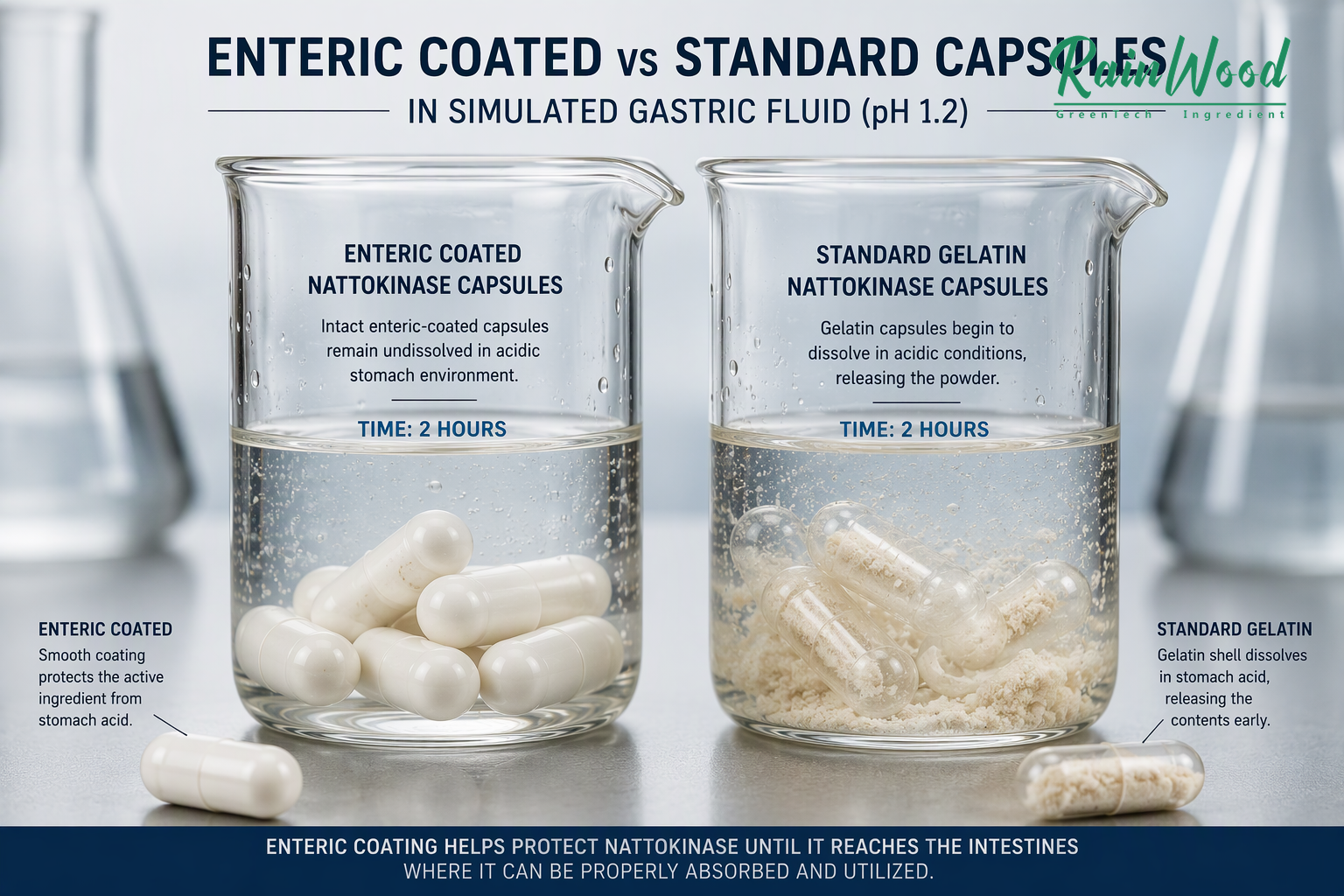
Figure 1: Macro Photography Comparing Smooth Enteric-Coated Capsules vs Standard Clear Capsules in Simulated Gastric Fluid Glassware
Format is an activity decision, not just a premium design choice
A buyer sees an enteric-coated nattokinase capsule and assumes it is automatically more effective than a standard capsule. Another supplier offers a lower-priced standard capsule and says the raw enzyme is already stable. Neither statement is enough. The correct choice depends on the enzyme grade, activity through shelf life, coating process, intended market, and evidence for the finished product.
Nattokinase can be affected by the gastric environment, and research has explored coated and encapsulated systems to protect activity in simulated conditions. That research can inform formulation. It does not automatically prove a commercial product improves a human outcome.
Standard capsules can be practical but exposed
Standard capsules may simplify filling and reduce cost. The buyer still needs activity after encapsulation, package storage, moisture control, and a customer-use plan. A capsule shell does not automatically create enteric release or guarantee that enzyme activity survives gastric conditions.
Check capsule material, fill weight, excipients, disintegration, package closure, and activity at release and stability pulls. If the label makes a specific delivery claim, the evidence must match the actual capsule and coating.
Enteric coating adds protection and process risk
Enteric coating or compression coating can delay release until a higher-pH environment. It also adds polymer, weight, equipment, coating uniformity, dissolution testing, and process recovery. A coating that protects activity in a laboratory model may not behave the same after scale-up, transport, or long storage.
The buyer should request coating specification, weight gain, disintegration or dissolution profile, activity recovery, and stability data. The [INTERNAL LINK -> Nattokinase Stability Blog] explains why package and process belong in the same activity review.
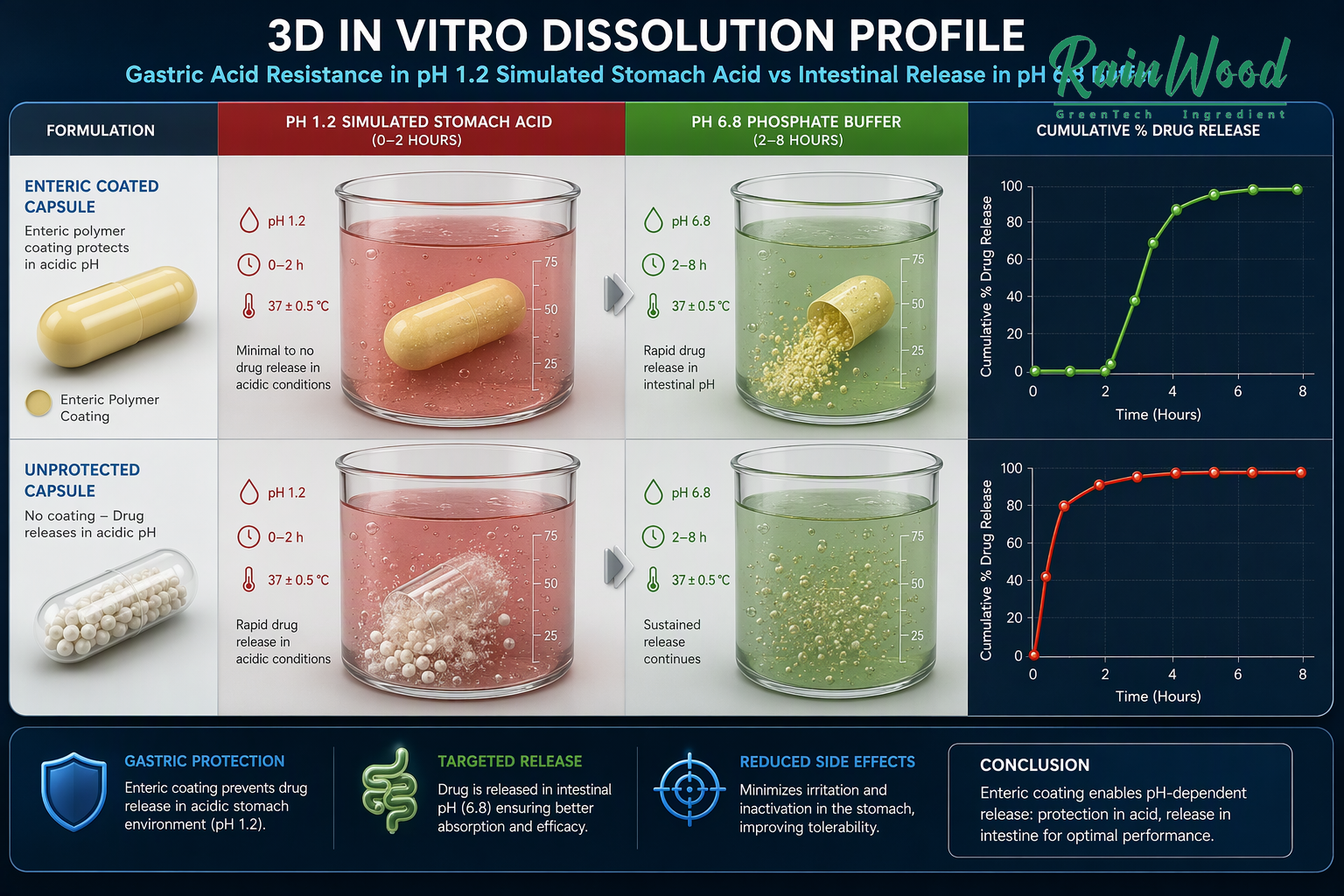
Figure 2: 3D Dissolution Profile Infographic: Gastric Acid Resistance (pH 1.2) vs Intestinal Release (pH 6.8) Comparing Enteric Barrier vs Standard Shell
The commercial loss from copying a premium format
An enteric format can raise MOQ, lead time, and cost. If the coating does not perform, the brand may have a more expensive product with no defensible benefit. A standard capsule can create the opposite risk if the buyer uses a delivery promise that the format does not support.
The finished product also needs a clear customer story. If the brand cannot explain what is tested, why the coating is used, and what the study actually showed, the premium format may look like marketing theater.
Compare formats with a decision table
Compare raw activity, activity after processing, capsule capacity, package, coating or shell, dissolution, stability, MOQ, cost, and allowed claims. Include customer use, storage, and market requirements. Ask whether the format is appropriate for a high-FU serving or a low-dose product.
Use [INTERNAL LINK -> Nattokinase FU Guide] for activity math and [INTERNAL LINK -> Nattokinase Product Format Blog] for the manufacturing comparison.
How RainwoodBio can support format feasibility
RainwoodBio publishes OEM support for hard capsules, tablets, powders, and powder stick packs, together with requirement confirmation, process control, testing and release, and packaging. These capabilities can help a brand compare standard and protected formats. Product-specific activity, coating, dissolution, and stability evidence still need confirmation.
Format approval gate
Before artwork approval, ask:
- Does the raw material retain activity through the process?
- What does the coating or capsule actually protect?
- Which in vitro tests support the format claim?
- What activity is guaranteed at release and expiry?
- Does the package protect the finished unit?
- Can the cost and MOQ support the target channel?
Request a [INTERNAL LINK -> Nattokinase Format Feasibility Review] [INTERNAL LINK -> Contact Us Page] with the target FU, capsule size, coating concept, market, and quantity.
Ask what the protection claim is supposed to prove
If the reason for enteric coating is protection from gastric conditions, define the test that supports that statement. A disintegration or dissolution result can show a release behavior under simulated conditions. An activity recovery result can show how much measured activity remains after the test. Neither result automatically proves a human clinical benefit, and neither should be summarized as “better absorption” without evidence for the exact product.
Compare the protected and standard versions using the same raw activity, package, storage, and assay. If the coating process reduces activity or creates a long lead time, the premium may not be commercially justified. The buyer should also decide whether the target customer understands the format and whether the market allows the proposed language.
Do not confuse protection with proven bioavailability
An enteric coating can be designed to delay release in simulated gastric conditions. That is a formulation attribute. Bioavailability and clinical effectiveness are separate questions that require appropriate human evidence. The buyer should use precise language: “designed for delayed release” may be supportable where “improves absorption” is not established for the exact product.
The coating also creates a sampling problem. Test units from different points in the run for weight gain, dissolution, and activity recovery. A coated capsule or tablet that passes one sample may still have process variation if the coating equipment or spray conditions are not controlled. Retain coated units for stability, not only uncoated enzyme powder.
Compare standard and enteric formats using the same activity target and package. If the protected format costs more, identify the buyer value it provides and the evidence that supports the explanation. Do not let a premium finish replace a release specification.
Make the format decision measurable
Compare standard and enteric versions using the same raw activity target, package, and storage. Measure activity after processing, dissolution or release behavior, capsule or tablet integrity, moisture, and stability. Record coating weight and process yield if a coating is used. If the enteric version requires more units, more expensive film, or a longer lead time, show those costs beside the proposed buyer benefit.
Ask the supplier to define what the finished product is designed to do and what the available test can prove. A protected release profile can be a legitimate formulation feature without being presented as a guaranteed clinical outcome. This distinction makes the product easier to explain to importers and retailers.
Build a release protocol for the chosen format
For a standard capsule, define fill-weight variation, capsule integrity, activity recovery after encapsulation, moisture, and disintegration. For an enteric capsule, add coating weight, gastric-stage resistance, intestinal-stage release, and activity recovery after the full sequence. Test units from the beginning, middle, and end of the run because coating and filling can drift as equipment warms or material flow changes.
The buyer should receive the protocol before approving artwork. It should state the number of units, acceptance limits, storage conditions, and the action when one result is out of range. If a distributor later asks why the coated version costs more, the answer can point to a defined release design rather than a vague promise of superior absorption.
Frequently asked questions
Is enteric coating always better?
No. It can add protection but also introduces process, cost, and evidence requirements.
Does one in vitro gastric test prove human delivery?
No. It supports a formulation question but does not establish a human clinical outcome.
Can standard capsules be stable?
They may be, if the enzyme, package, process, and storage are properly controlled.
Should the brand advertise “survives stomach acid”?
Only if the exact finished product and target-market wording have been adequately reviewed and supported.
Conclusion
Choose enteric or standard capsules by measurable activity, package, process, cost, and evidence—not by the premium appearance of the shell.
Disclaimer: This article is for B2B formulation and procurement planning. It is not medical advice and does not establish that nattokinase treats, prevents, or cures disease.
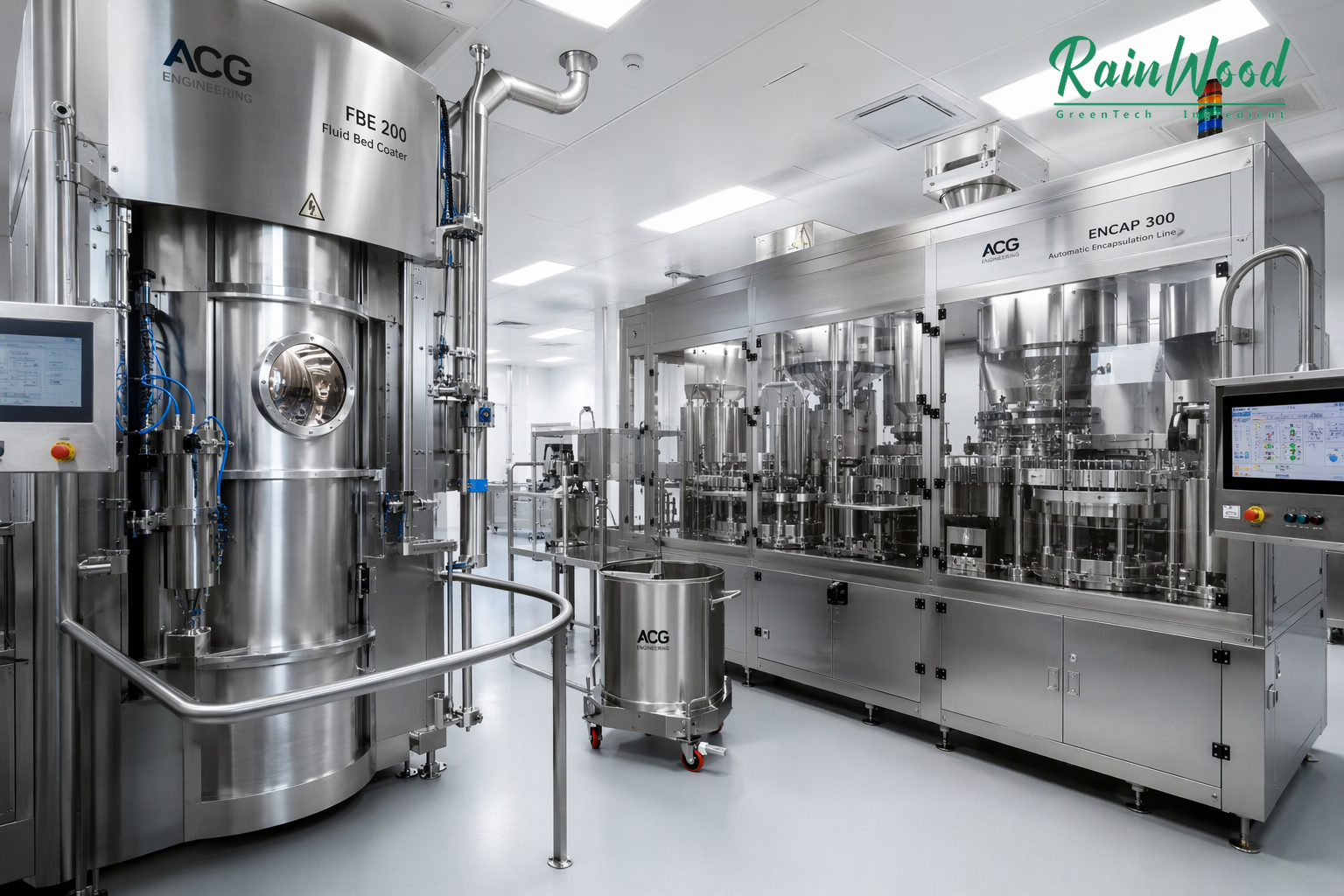
Figure 3: cGMP Fluid-Bed Capsule Enteric Coating Machine and Rotary Encapsulation Line in Modern Cleanroom Plant
References
- https://pubmed.ncbi.nlm.nih.gov/17520440/
- https://pubmed.ncbi.nlm.nih.gov/40638075/
- https://www.rainwoodbio.com/oem
Explore RainwoodBio Nattokinase & Cardiovascular OEM Solutions
- Custom Nattokinase Enteric & Delayed-Release Capsules – Gastric-acid protection preserving 2,000~20,000 FU/g enzyme activity for optimal systemic absorption.
- Nattokinase Lipid Softgels & Cardiovascular Blends – Synergistic co-formulations with CoQ10, Phytosterols, Garlic Oil, and Vitamin K2-free options.
- Nattokinase Sachet Stick Packs & Functional Powders – Convenient single-serve sachet stick packs with premium taste masking and high moisture barrier.
- OEM / ODM Contract Manufacturing Services – cGMP certified high-potency blending, blister packaging, and US/EU/Amazon regulatory compliance dossiers.
- Contact RainwoodBio Technical Sales – Request Nattokinase CoA (FU/g assay certificates), stability test protocols, pilot samples, or custom quotation.
Table of Contents
- Format is an activity decision, not just a premium design choice
- Standard capsules can be practical but exposed
- Enteric coating adds protection and process risk
- The commercial loss from copying a premium format
- Compare formats with a decision table
- How RainwoodBio can support format feasibility
- Format approval gate
- Ask what the protection claim is supposed to prove
- Do not confuse protection with proven bioavailability
- Make the format decision measurable
- Build a release protocol for the chosen format
- Frequently asked questions
- Conclusion
- References