 EN

Executive Summary & B2B Formulation Guidance
Learn why nattokinase fibrinolytic units and powder weight are different measurements before comparing suppliers or approving a label.
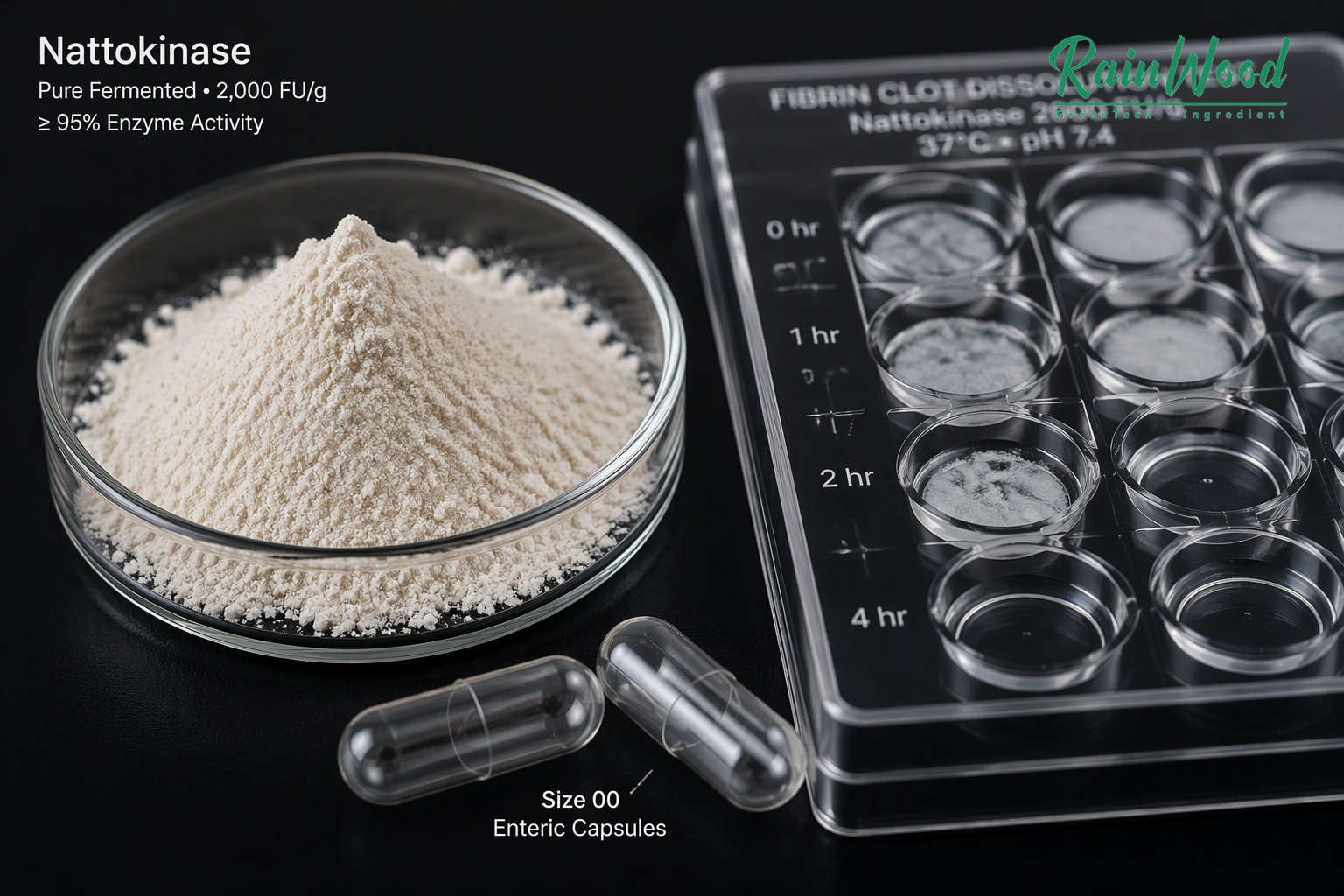
Figure 1: Analytical Macro Photography of Pure Fermented Nattokinase Powder, Size 00 Enteric Capsules, and Fibrinolytic Test Plate
The number that sells the bottle is not the number that weighs the powder
A supplier quotes 200 mg nattokinase powder. A competitor advertises 2,000 FU per capsule. A buyer compares the numbers and concludes that the products are far apart. The comparison is invalid because milligrams describe material weight while FU describes measured enzyme activity under a defined assay.
For nattokinase, the buyer needs both numbers. Powder weight helps with capsule capacity, shipping, and formula economics. FU helps describe functional enzyme activity. Neither number proves the other. A small amount of high-activity material can deliver more FU than a larger amount of lower-activity powder.
The [INTERNAL LINK -> Nattokinase Product Page] should show the activity per serving and the material amount separately when both are relevant.
What FU is intended to measure
Fibrinolytic units are activity units defined by the conditions of an assay. The method may use fibrin or a synthetic substrate and a specified temperature, pH, reaction time, sample preparation, and calculation. A unit is meaningful only within the method that defines it. The supplier should state the method and basis, not simply print a large FU number.
The activity can be reported per gram, per milligram, per capsule, or per daily serving. These are different statements. A product with 10,000 FU/g may provide 2,000 FU only if the serving contains the appropriate amount of material and the formula preserves the activity.
Why powder weight still matters
A high-FU powder may require a carrier or a different filling approach. A low-FU powder may need a larger amount per capsule or sachet. Moisture, drying, and storage can alter the relationship between material weight and measured activity. The buyer should calculate the input amount using the lot activity and the target finished-unit activity.
If the product is a 2,000 FU capsule, define whether that is a release target or a minimum at the end of shelf life. If the product contains a blend, show how much nattokinase material and carrier are inside the serving. The [INTERNAL LINK -> Nattokinase Dose Calculation Blog] covers this math.
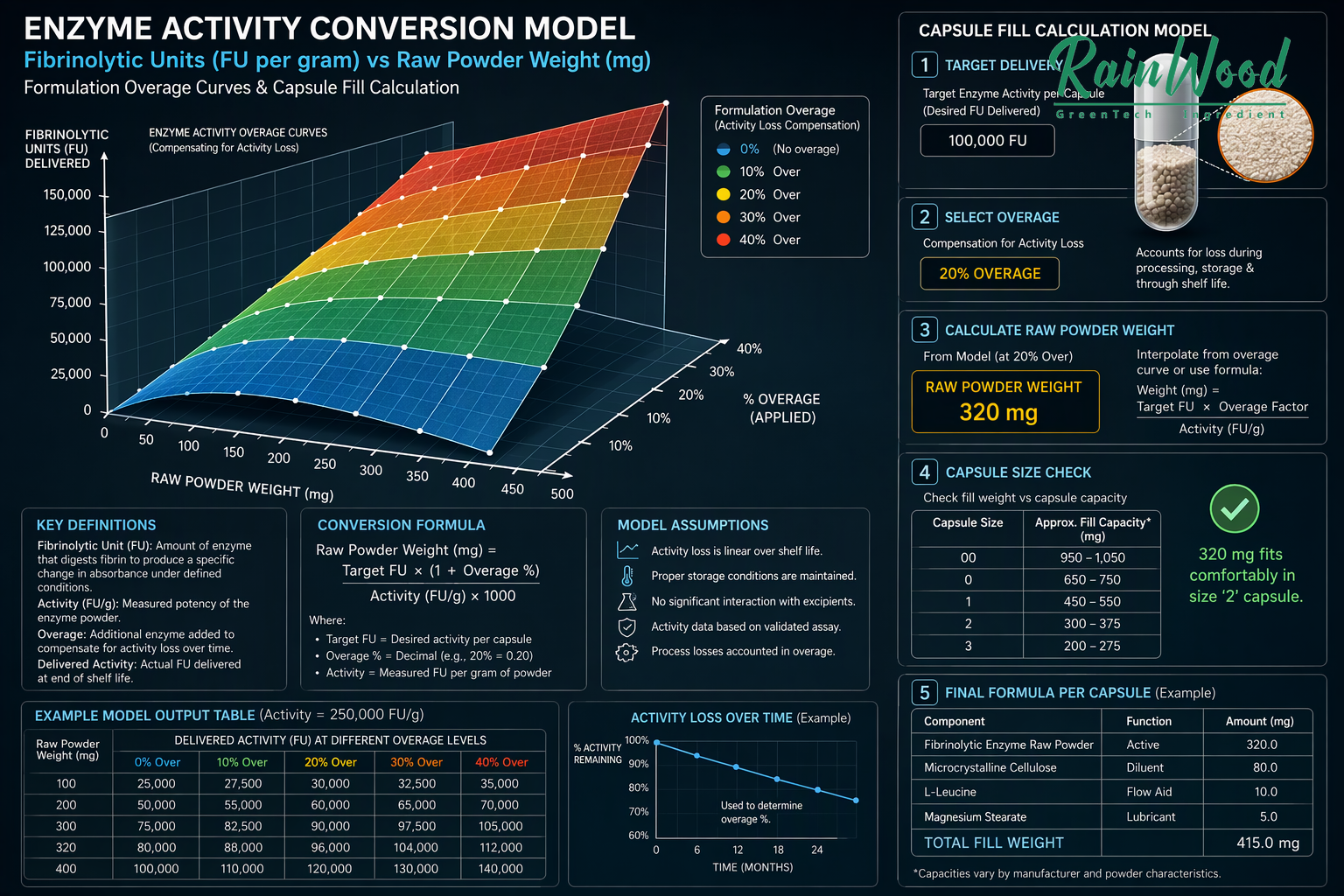
Figure 2: 3D Enzyme Activity Conversion Model: Fibrinolytic Units (FU/g) vs Raw Material Weight (mg) and Loading Overage
The commercial loss from confusing units
The brand may underdose a product while believing it meets the gram target, or overfill a capsule while chasing a FU claim. The result can be a larger serving, higher cost, poor customer experience, or a label that cannot be defended. A distributor may also reject the product when the COA reports FU/g but the packaging claims FU per capsule without a calculation.
Confusion creates price distortion. One supplier may quote powder by kilogram and another may quote activity by total FU. Normalize both to cost per million FU delivered in a released finished product, including testing, packaging, and expected activity loss.
Build an activity calculation sheet
Record supplier assay in FU/g, target FU per unit, target units per serving, planned overage, expected yield, and activity at release and expiry. Calculate material grams per unit and total material for the order. Then add capsule or sachet capacity, carrier, package, and storage conditions.
Ask whether the activity method measures fibrinolytic performance or another protease response. If two suppliers use different methods, do not compare the raw numbers without method bridging. The [INTERNAL LINK -> Nattokinase Assay Method Blog] explains why method names alone cannot establish equivalence.
How RainwoodBio can support activity-to-format planning
RainwoodBio publishes requirement confirmation, sample development, process control, testing and release, and OEM formats including capsules, powder stick packs, and tablets. These capabilities are relevant when a brand must convert a raw FU result into a stable finished product. The buyer should still request the exact method, lot assay, formula calculation, and finished-unit data.
Activity approval gate
Before approving the quote, ask:
- Is FU reported per gram, serving, capsule, or day?
- What assay conditions define the unit?
- Is the number guaranteed at release or through shelf life?
- How much powder delivers the claimed FU?
- Are methods comparable across suppliers?
Request a [INTERNAL LINK -> Nattokinase Activity and Cost Calculation] [INTERNAL LINK -> Contact Us Page] with the COA, target FU, serving, package, and quantity.
Normalize the number before comparing suppliers
Use a four-step normalization table. First record the supplier's raw activity in FU per gram and the assay method. Second record the amount of raw material placed in one capsule or stick. Third calculate the theoretical activity per unit before process loss and overage. Fourth confirm the finished-product result and the activity basis used at release.
This table prevents a common negotiation mistake: treating a high FU/g quotation as automatically cheaper. A higher potency material may require less powder, but it may also cost more, need a more protective package, or have a shorter open-time window. A lower potency material may be economical for a large sachet but impossible to fit into a capsule. The right decision depends on released activity per unit.
Ask the supplier to state whether FU is measured on an as-is or dry basis. If water changes between lots, the apparent activity per gram can change even when the dry material is comparable. Keep the calculation basis in the purchase order and label file.
A commercial activity example
Imagine two raw materials. Material A is reported at 10,000 FU/g and Material B at 5,000 FU/g. If the target is 2,000 FU per capsule, the theoretical input is 200 mg of A or 400 mg of B before overage and processing loss. The capsule may not have room for B, while A may need a carrier to flow correctly. The lower price per kilogram therefore does not answer the formulation question.
Now add shelf life. If the activity is guaranteed only at release, the brand must decide whether the label is a release claim or a through-expiry claim. If the activity falls during storage, adding more powder at the beginning may protect the number, but it also changes fill weight and customer exposure. A package or process improvement may be better than an arbitrary overage.
The buyer should ask for a release-to-expiry activity trend, the method used for each pull, and the basis of the number. Trend data are more useful than one attractive COA because they show whether the commercial formula remains within its agreed range.
Frequently asked questions
Is more powder always more active?
No. Activity depends on potency, not weight alone.
Can 2,000 FU be compared across brands?
Only when the activity definition and assay basis are comparable.
Should the label show milligrams?
It should show the information required by the target market, while the technical file should retain both material weight and activity calculation.
Is FU a measure of purity?
No. FU measures activity under an assay. Identity, impurities, moisture, and contaminants require separate controls.
Conclusion
Milligrams tell you how much powder you weigh. FU tells you how much activity the agreed method measures. A credible nattokinase product needs both numbers connected by a transparent formula and release calculation.
Disclaimer: This article is for B2B procurement and formulation information. It is not medical advice and does not establish that nattokinase treats, prevents, or cures disease.
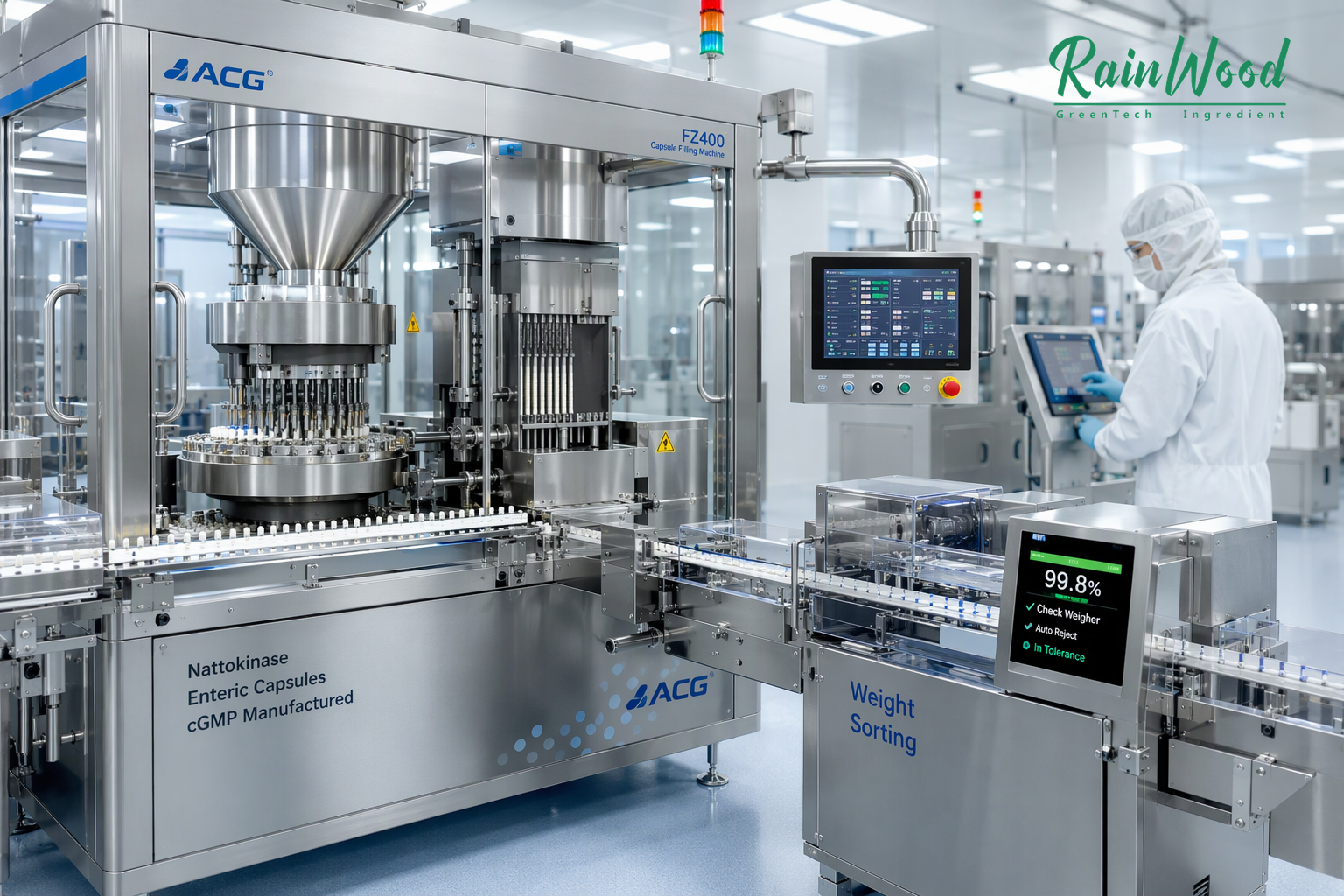
Figure 3: Automated High-Speed Capsule Encapsulation Line in cGMP Cleanroom Processing Nattokinase Enteric Capsules
References
- https://pmc.ncbi.nlm.nih.gov/articles/PMC9312984/
- https://www.fda.gov/food/dietary-supplements-guidance-documents-regulatory-information/dietary-supplement-labeling-guide
- https://www.rainwoodbio.com/oem
Explore RainwoodBio Nattokinase & Cardiovascular OEM Solutions
- Custom Nattokinase Enteric & Delayed-Release Capsules – Gastric-acid protection preserving 2,000~20,000 FU/g enzyme activity for optimal systemic absorption.
- Nattokinase Lipid Softgels & Cardiovascular Blends – Synergistic co-formulations with CoQ10, Phytosterols, Garlic Oil, and Vitamin K2-free options.
- Nattokinase Sachet Stick Packs & Functional Powders – Convenient single-serve sachet stick packs with premium taste masking and high moisture barrier.
- OEM / ODM Contract Manufacturing Services – cGMP certified high-potency blending, blister packaging, and US/EU/Amazon regulatory compliance dossiers.
- Contact RainwoodBio Technical Sales – Request Nattokinase CoA (FU/g assay certificates), stability test protocols, pilot samples, or custom quotation.
Table of Contents
- The number that sells the bottle is not the number that weighs the powder
- What FU is intended to measure
- Why powder weight still matters
- The commercial loss from confusing units
- Build an activity calculation sheet
- How RainwoodBio can support activity-to-format planning
- Activity approval gate
- Normalize the number before comparing suppliers
- A commercial activity example
- Frequently asked questions
- Conclusion
- References