 EN

Executive Summary & B2B Formulation Guidance
Protect nattokinase activity by linking heat, moisture, light, pH, packaging, transport, and finished-product stability controls.
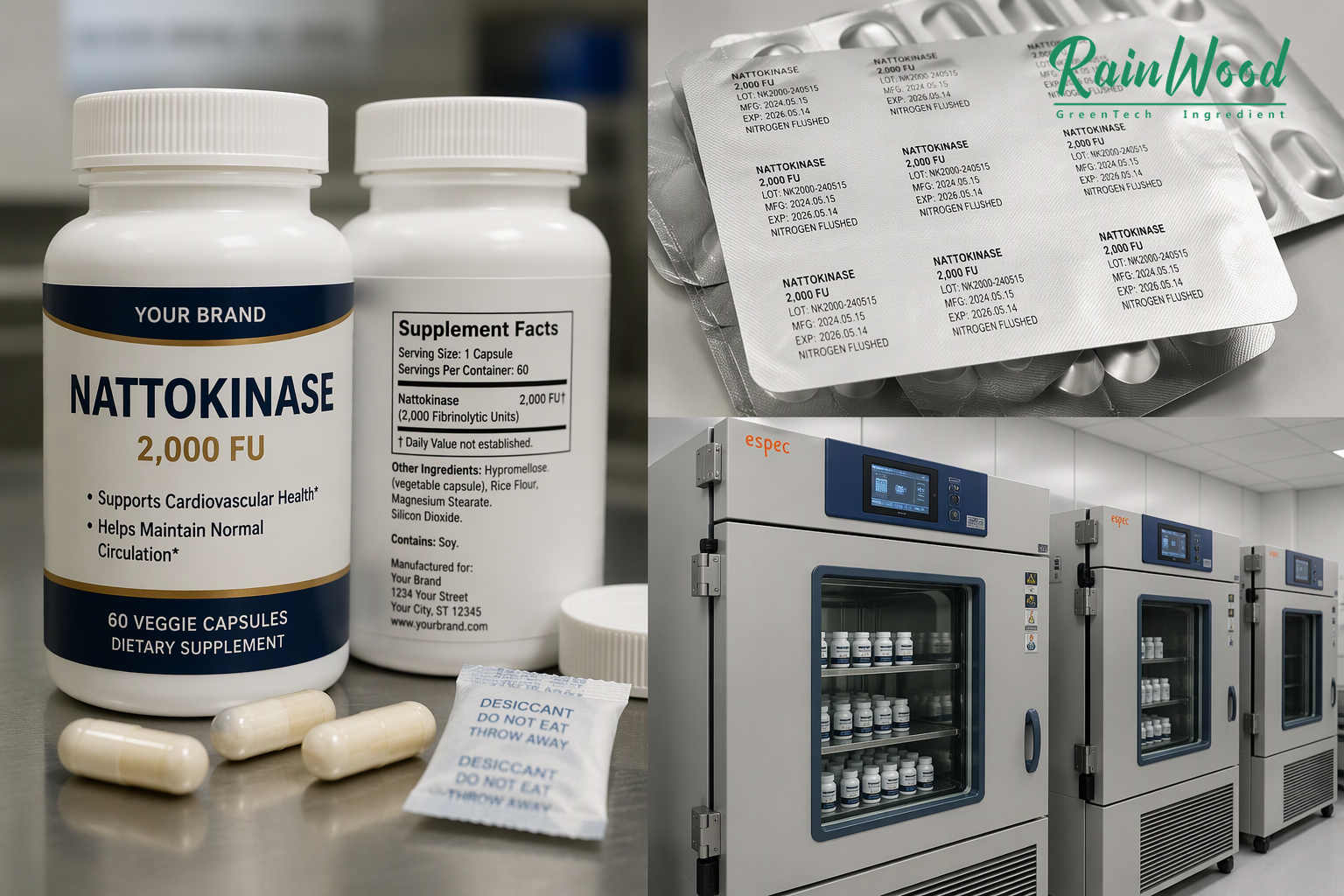
Figure 1: Commercial Laboratory Photography of Nattokinase Bottles with Desiccants, Nitrogen-Flushed Foil Blisters, and Stability Chambers
The activity can disappear before the bottle looks damaged
Nattokinase powder can remain visually acceptable while its measured activity changes. A shipment may experience heat at a port, humidity in a warehouse, or repeated opening during filling. A customer may store the bottle in a warm room. The capsule still looks normal, but the activity claim now depends on an environment the original COA never represented.
Nattokinase is an enzyme, so stability must be treated as an activity problem rather than only a purity or appearance problem. The buyer needs a package and storage plan connected to the exact raw material and finished format.
What can reduce activity
Heat can accelerate denaturation or other changes in the protein. Moisture can affect powder handling and create a local environment that reduces stability. Light and oxygen may contribute to changes depending on the formulation and package. pH is especially important in liquid or reconstituted products. A finished product may face all of these factors at different stages.
The supplier should define recommended temperature, humidity, package barrier, opening time, and shipping conditions. A raw powder shelf life cannot automatically be copied onto a capsule, tablet, or stick pack. The [INTERNAL LINK -> Nattokinase Format Blog] explains why dosage form changes the exposure profile.
The buyer loss from a false shelf-life assumption
If activity falls before expiry, the brand may have to hold inventory, retest retained samples, replace stock, or change the label. A retailer can reject a product that no longer matches the declared FU. A customer may complain that the powder has changed, even when visual inspection finds nothing dramatic.
The cost is larger for a high-volume product because a stability issue can affect many cartons at once. The brand may also need to prove whether the loss happened during manufacturing, transport, storage, or customer use.
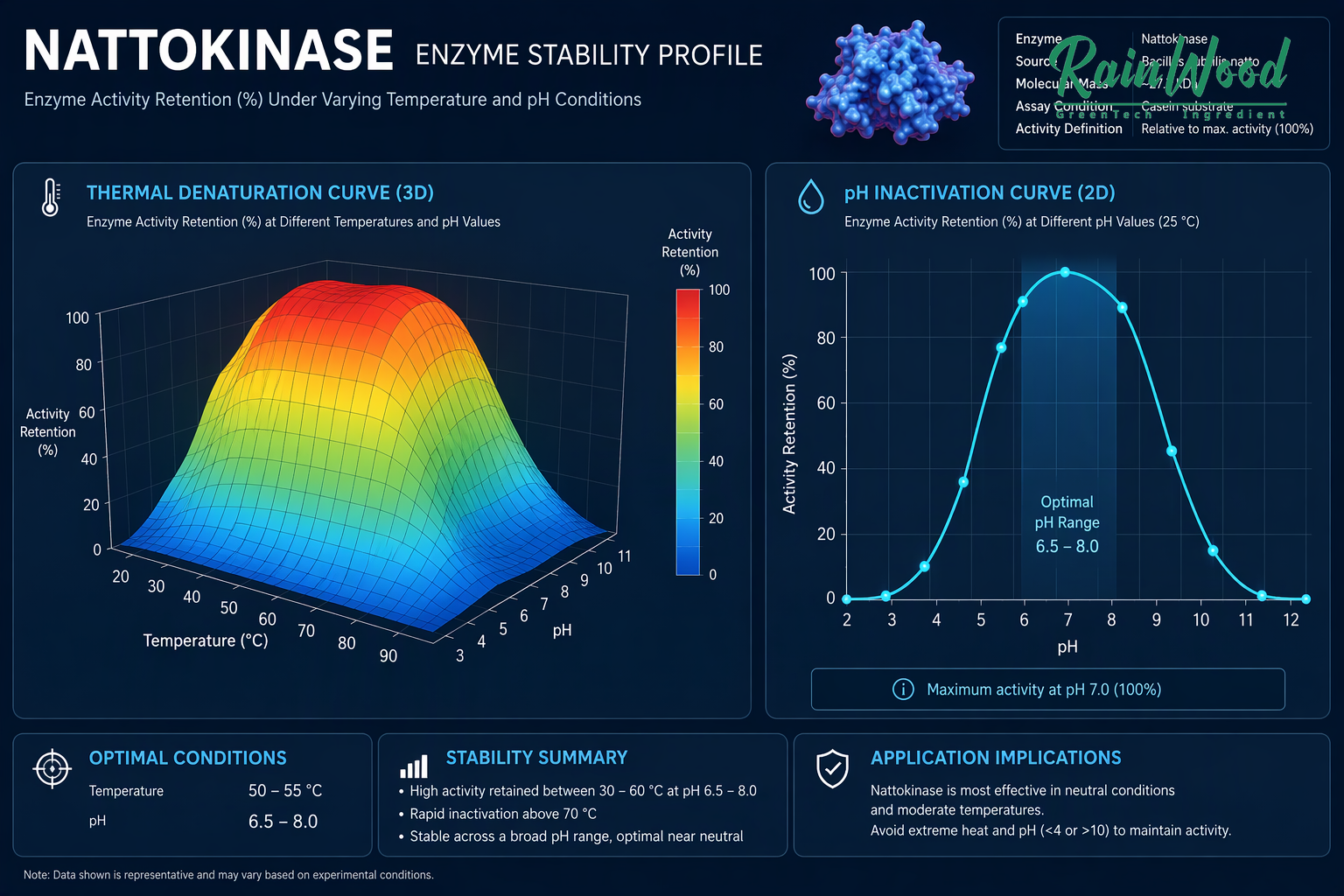
Figure 2: 3D Enzyme Thermal Denaturation and pH Inactivation Kinetic Curve: Activity Retention vs Temperature (25°C to 60°C) and pH
Build a stability matrix
Test the raw material in its commercial package and the finished product in its intended package. Track activity, moisture, appearance, odor, capsule or tablet performance, and relevant impurities. Use real-time and accelerated conditions appropriate to the target market and product. If the product is reconstituted, include pH, hold time, and use condition.
Record manufacturing date, package lot, opening date, storage, and test method. If the supplier recommends refrigeration or special handling, clarify whether the logistics route can maintain it and how the label communicates it.
Packaging is an activity control
A bottle, blister, sachet, foil pouch, and bulk liner create different exposure. Desiccants can help but do not solve a weak closure or repeated humidity exposure. A high-barrier film may protect a stick pack but needs seal validation. A capsule shell may protect taste while still allowing moisture movement through the bottle headspace.
Use [INTERNAL LINK -> Nattokinase COA Blog] to ensure the release report states activity basis, and use [INTERNAL LINK -> Nattokinase Sample Bulk Blog] to control exposure between approved sample and commercial lot.
How RainwoodBio can support stability planning
RainwoodBio publishes requirement confirmation, process control, testing and release, packaging, logistics, and traceability. It also offers multiple OEM formats. These capabilities are relevant to a stability plan, but the buyer should request product-specific data for the nattokinase form, activity, package, and target shelf life.
Stability approval gate
Before printing expiry, require:
- activity method and acceptance limit;
- package and closure specification;
- storage and transport conditions;
- raw and finished-product stability data;
- opening and in-use instructions;
- retained samples and complaint investigation plan.
Request a [INTERNAL LINK -> Nattokinase Stability Review] [INTERNAL LINK -> Contact Us Page] with the target FU, package, market, and proposed shelf life.
Separate raw-material stability from in-use stability
The sealed drum, finished bottle, and opened daily-use package create different exposures. A stability plan should identify which one supports the printed expiry and which one supports the customer instruction. If the product is a powder stick pack, include film and seal data. If it is a bottle, include repeated opening and closure. If it is a reconstituted drink, define the time between mixing and consumption.
Use activity as the primary stability marker when the product is sold by FU. Add water, appearance, odor, and unit performance to help explain a failure. A passing appearance result cannot rescue a failed activity claim, and a small activity change cannot be interpreted without knowing the method and variability.
Build a failure-investigation sequence
When a stability pull shows lower FU, confirm sample identity and method first. Then check package seals, desiccant, storage temperature, transport exposure, opening history, and moisture. Test a retained raw sample and a finished unit if available. Review related attributes such as odor, color, water, and disintegration to determine whether the problem began before or after filling.
Do not solve every activity loss by adding more overage. If the package allowed moisture ingress, more enzyme may only delay the same failure. If the assay method is not comparable, the apparent loss may be analytical. If the finished format is exposing the enzyme to heat or pH, the process may need redesign.
The investigation should end with a documented decision: release, rework, replace, shorten shelf life, change package, or reject. Retain the evidence and communicate the change to sales and customer service.
Design the stability study around the logistics route
Identify the real path from production to customer: factory warehouse, inland transport, port, sea or air shipment, importer warehouse, filling room, and consumer storage. Record the temperature and humidity risks at each step. A study that uses only ideal sealed storage may not explain a failure after a hot shipment or repeated package opening.
Use retained units from the same commercial lot. Test activity at scheduled pulls and record package condition, water, appearance, odor, and unit performance. If a product uses a desiccant or high-barrier film, confirm that the closure remains effective after transport and handling. These details turn a shelf-life claim into a controlled commercial promise.
Define the excursion rule before shipping
Transport instructions should state the acceptable temperature and humidity range, the maximum excursion duration, and who must be notified. If a container sits in a hot port or a warehouse loses power, the team needs a decision rule, not a promise that the product is “stable.” A retained sample from the affected lot can be tested against the approved activity method, while package inspection checks for seal or moisture damage.
Use separate instructions for raw powder, filled capsules, and consumer packs. The raw drum may be opened in a controlled room, while a bottle can be opened daily by a consumer. A high-barrier stick pack may protect one dose but still fail if the seal is weak. Linking each instruction to a real package makes the shelf-life and complaint response easier to defend.
Frequently asked questions
Does refrigeration solve every activity problem?
No. It may reduce some exposure but does not replace package, handling, method, and finished-product controls.
Can a raw-material COA prove expiry stability?
No. Stability requires time, conditions, package, and activity evidence.
Is powder always more stable than liquid?
Not automatically. The product form, water activity, package, and storage determine the result.
Should the customer be told to store it cold?
Only after the product and logistics plan support that instruction and the target market permits it.
Conclusion
For nattokinase, shelf life is an activity promise. Connect heat, moisture, light, pH, package, transport, and testing before the expiry date becomes a liability.
Disclaimer: This article is for B2B stability and procurement planning. It is not medical advice and does not establish that nattokinase treats, prevents, or cures disease.

Figure 3: Automated High-Barrier ALU-ALU Blister Packaging and Induction Foil Bottle Sealing Line in Humidity-Controlled Cleanroom
References
- https://pubmed.ncbi.nlm.nih.gov/17520440/
- https://pubmed.ncbi.nlm.nih.gov/40638075/
- https://www.rainwoodbio.com/oem
Explore RainwoodBio Nattokinase & Cardiovascular OEM Solutions
- Custom Nattokinase Enteric & Delayed-Release Capsules – Gastric-acid protection preserving 2,000~20,000 FU/g enzyme activity for optimal systemic absorption.
- Nattokinase Lipid Softgels & Cardiovascular Blends – Synergistic co-formulations with CoQ10, Phytosterols, Garlic Oil, and Vitamin K2-free options.
- Nattokinase Sachet Stick Packs & Functional Powders – Convenient single-serve sachet stick packs with premium taste masking and high moisture barrier.
- OEM / ODM Contract Manufacturing Services – cGMP certified high-potency blending, blister packaging, and US/EU/Amazon regulatory compliance dossiers.
- Contact RainwoodBio Technical Sales – Request Nattokinase CoA (FU/g assay certificates), stability test protocols, pilot samples, or custom quotation.
Table of Contents
- The activity can disappear before the bottle looks damaged
- What can reduce activity
- The buyer loss from a false shelf-life assumption
- Build a stability matrix
- Packaging is an activity control
- How RainwoodBio can support stability planning
- Stability approval gate
- Separate raw-material stability from in-use stability
- Build a failure-investigation sequence
- Design the stability study around the logistics route
- Define the excursion rule before shipping
- Frequently asked questions
- Conclusion
- References