 EN
EN

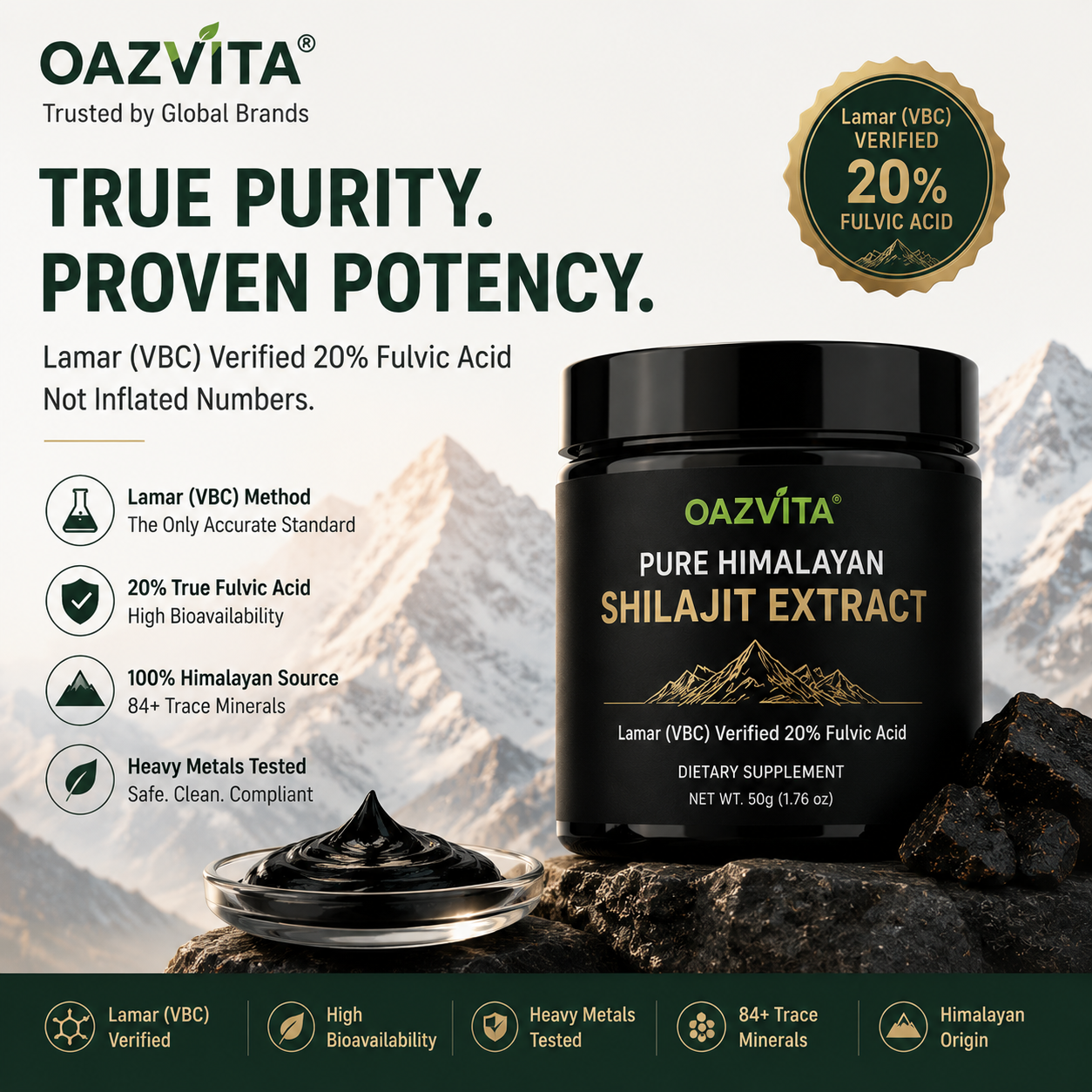
## Executive Summary
In the high-stakes world of premium botanical extracts, Shilajit has emerged as one of the most sought-after ingredients for cognitive health, hormonal balance, and mitochondrial support. However, as demand has skyrocketed, so has the prevalence of "Percentage Inflation"—a deceptive marketing practice where suppliers claim 60% or even 80% Fulvic Acid content. For procurement directors and brand owners, these high numbers are often a signal of outdated or inappropriate testing methodologies rather than superior product quality.
This technical analysis exposes the "Fulvic Fraud," specifically the use of the Titration/Gravimetric method which fails to distinguish between bioactive Fulvic Acid and inert Humic Acid or inorganic salts. We advocate for the **Lamar (VBC) Method** as the only analytically sound standard for the industry. By shifting the focus from "Total Organic Acids" to "Bioactive Fulvic Fraction," brands can ensure superior bioavailability, regulatory compliance, and consumer trust. At Rainwood Biotech, we prove that a "True" 20% Fulvic Acid profile is biologically superior to a "Ghost" 60% claim.
---
## Table of Contents
1. **The Shilajit Gold Rush and the Potency Paradox**
2. **Molecular Complexity: Understanding the Humic-Fulvic Spectrum**
3. **The Titration Trap: How "60% Fulvic" is Chemically Fabricated**
4. **The Lamar (VBC) Method: The New Analytical Gold Standard**
5. **The Logic of the 20%: Bioavailability vs. Bulk Mass**
6. **Cost per Active Gram: A Smarter Procurement Strategy**
7. **Regulatory Exposure and the Heavy Metal Masking Effect**
8. **Rainwood Biotech’s Standard: Quality Assurance in an Unregulated Market**
9. **Conclusion: The Procurement Checklist for 2026**
---
## 1. The Shilajit Gold Rush and the Potency Paradox
The global market for [Pure Himalayan Shilajit has transitioned from an Ayurvedic secret to a mainstream staple of the biohacking and performance nutrition sectors. Its ability to act as a "panacea" is rooted in its unique composition: a complex mixture of humic substances, dibenzo-alpha-pyrones (DBPs), and over 84 trace minerals in ionic form.
However, this rapid growth has outpaced analytical standardization. In the rush to satisfy procurement teams looking for "maximum potency," many suppliers have resorted to using testing methods that prioritize high numbers over chemical accuracy. This has created a **Potency Paradox**: as the claimed percentage of Fulvic Acid goes up, the actual biological efficacy often goes down.
When you see a quote for 60% Fulvic Acid, you are likely looking at a product that hasn't been refined—it's simply been "over-counted."
---
## 2. Molecular Complexity: Understanding the Humic-Fulvic Spectrum
To understand why testing goes wrong, we must look at the molecular weight distribution of humic substances found in [Shilajit Extract].
* **Humic Acids (HA):** These are large, complex molecules with high molecular weights (typically 50,000 to over 100,000 Daltons). They are insoluble in water under acidic conditions (pH < 2) but soluble in alkaline solutions. While they have some soil-health benefits, their size makes them poorly bioavailable for human cellular uptake.
* **Fulvic Acids (FA):** These are the "pearls" of the Shilajit complex. They have significantly lower molecular weights (typically 1,000 to 10,000 Daltons). Crucially, they are soluble at *all* pH levels—including the highly acidic environment of the human stomach. Their small size allows them to pass through cell membranes, acting as molecular taxis that deliver nutrients directly to the mitochondria.
The efficacy of Shilajit is determined by the **Fulvic fraction**. However, in raw Himalayan rocks, the ratio of Humic to Fulvic is often skewed toward the larger, less effective Humic molecules. True extraction requires sophisticated separation; fraudulent "high-count" products simply lump them all together.
---
## 3. The Titration Trap: How "60% Fulvic" is Chemically Fabricated
The primary engine of the Fulvic Fraud is the **Titration Method** (sometimes referred to as the Gravimetric or "Standard" method). While this method has its place in soil science, it is fundamentally flawed when applied to dietary supplements meant for human consumption.
### The Mechanism of Inflation
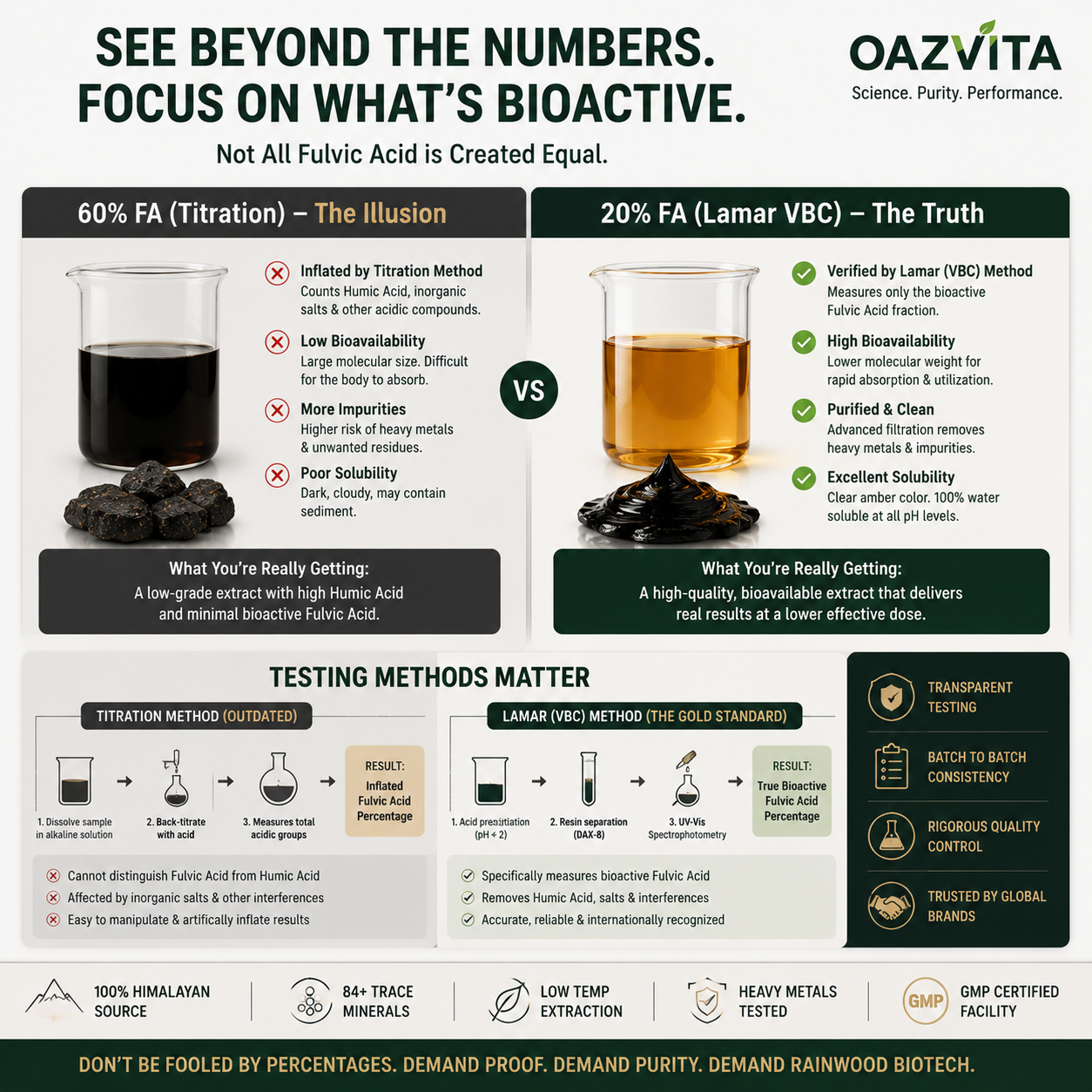
The Titration method measures the total "acidic functional groups" (carboxyl and phenolic groups) in a sample. The lab dissolves the Shilajit in an alkaline solution and then back-titrates with an acid.
The problem? **Titration cannot tell the difference between a Fulvic Acid molecule and a Humic Acid molecule.** Because both contain similar acidic functional groups, the method counts the bulky, non-bioavailable Humic Acid as "Fulvic Acid."
Furthermore, the Titration method is susceptible to:
1. **Inorganic Interference:** High mineral content in crude Shilajit can interfere with the titration, artificially inflating the result.
2. **The "Spiking" Vulnerability:** Because the test is so non-specific, a supplier can add cheap organic acids—like citric acid or malic acid—to a low-grade extract. The Titration test will read these additives as "Fulvic Acid," allowing a 5% extract to appear as a 60% powerhouse on a CoA.
For a brand owner, a 60% Titration result is a "Ghost Number"—it looks impressive on a label but provides zero benefit to the consumer.
---
## 4. The Lamar (VBC) Method: The New Analytical Gold Standard
To counter the inaccuracies of Titration, the industry has moved toward the **Lamar Method** (also known as the VBC or California Department of Food and Agriculture method). This is the only method currently recognized by serious analytical chemists for providing an accurate count of *true* Fulvic Acid.
### Why Lamar is the "Truth Meter"
The Lamar method introduces a critical purification step that Titration skips. It involves:
* **Acid Precipitation:** The sample is acidified to a pH of 1. This forces all the larger Humic Acid molecules to precipitate out of the liquid.
* **Hydrophobic Resin Isolation:** The remaining liquid—which now contains the Fulvic fraction—is passed through a specialized DAX-8 or similar resin. This resin selectively captures only the specific molecular weight range associated with true, bioactive Fulvic Acid.
* **Spectrophotometric Measurement:** Only after this rigorous isolation is the Fulvic Acid measured.
**The Result:** A Lamar test typically yields a number that is 1/3 to 1/2 of a Titration test for the same sample. If a sample tests at 60% via Titration, it will likely test at **18-22% via Lamar**. This 20% represents the *real* potency—the molecules that actually drive mitochondrial ATP production and cellular detoxification.
---
## 5. The Logic of the 20%: Bioavailability vs. Bulk Mass
Procurement teams often fall into the trap of thinking that "More Mass = More Power." In the case of [Shilajit Extract], the opposite is often true.
A 60% (Titration) extract is usually a "crude" extract. It is thick, dark, and contains a high percentage of Humic Acid and potentially insoluble grit. When a consumer ingests this, the large Humic molecules can actually compete for absorption sites or cause digestive "heaviness."
A 20% (Lamar) extract, however, is a **refined concentrate**. By removing the bulk of the Humic Acid and focusing on the Fulvic fraction, we create a product with:
* **Superior Solubility:** It dissolves instantly into a clear, golden-amber liquid.
* **Rapid Uptake:** The small molecules enter the bloodstream within minutes.
* **Dibenzo-alpha-pyrone (DBP) Enrichment:** High-quality Lamar-standard extracts are also usually richer in DBPs, which work synergistically with Fulvic Acid to boost energy levels.
At Rainwood Biotech, we educate our partners that **200mg of a True 20% extract provides more cellular "work" than 600mg of a Fake 60% extract.**
---
## 6. Cost per Active Gram: A Smarter Procurement Strategy
When evaluating suppliers, stop looking at the price per kilogram of the bulk powder. Instead, calculate the **Cost per Active Gram of Lamar-Verified Fulvic Acid.**
* **Supplier A (The Fraud):** $100/kg for "60% Fulvic" (Titration).
* Actual Lamar-equivalent content: ~15%.
* Cost per Active Gram: $100 / 150g = **$0.66/g**.
* **Supplier B (Rainwood Biotech):** $150/kg for "20% Fulvic" (Lamar).
* Actual content: 20%.
* Cost per Active Gram: $150 / 200g = **$0.75/g**.
While Supplier A seems cheaper, you are paying for 450 grams of "filler" Humic Acid that adds no value to your formula. Furthermore, the risk of consumer dissatisfaction with Supplier A’s product far outweighs the $0.09 difference in active gram pricing.
---
## 7. Regulatory Exposure and the Heavy Metal Masking Effect
The "Fulvic Fraud" isn't just a matter of marketing ethics; it is a significant regulatory risk.
### FDA and FTC Scrutiny
As the Shilajit market matures, the FDA and FTC are increasingly looking at "Standard of Identity" and "Substantiated Claims." If your product label claims "60% Fulvic Acid" but an FDA audit using the industry-standard Lamar method finds only 15%, you are facing a **Misbranded Product** charge. This can lead to mandatory recalls, destruction of inventory, and irreparable damage to your brand’s reputation.
### The Heavy Metal Connection
Crude extracts that rely on Titration to hide their low quality often have another hidden danger: **Heavy Metals.**
[Pure Himalayan Shilajit] is naturally occurring in rock formations that may contain lead, arsenic, and cadmium. A refined, 20% Lamar extract undergoes multiple filtration and purification stages that significantly reduce these contaminants. A "60% Titration" product is often less refined, meaning you are delivering a higher heavy metal load to your consumers under the guise of "high potency."
---
## 8. Rainwood Biotech’s Standard: Quality Assurance in an Unregulated Market
In an industry rife with "Ghost CoAs" and laboratory shopping, Rainwood Biotech has built its reputation on radical transparency. We don't just supply ingredients; we provide analytical certainty.
### Our 4-Pillar Quality Protocol:
1. **Lamar/VBC Verification:** We use the CDFA-standard Lamar method for every batch. If our CoA says 20%, it is 20% of the purified, bioactive fraction.
2. **Ionic Mineral Profiling:** We ensure that our Shilajit retains its full spectrum of 84 trace minerals, but in a purified, ionic form that won't interfere with the Fulvic measurement.
3. **Low-Temperature Extraction:** Many suppliers use high heat to speed up extraction, which degrades the delicate Fulvic Acid molecules. We use a proprietary low-temp process that preserves molecular integrity.
4. **Microbiological and Heavy Metal Testing:** We exceed USP standards for purity, ensuring that our "Pure" claim is backed by multi-lab validation.
---
## 9. Conclusion: The Procurement Checklist for 2026
The era of "blind procurement" in the Shilajit space is over. To protect your brand and your consumers, you must move beyond the percentage on the front of the CoA.
**The Next Steps for Your Brand:**
1. **Audit Your Current Supply:** Ask your current supplier for their Method of Analysis (MoA). If they say "Titration" or "ISO," request a re-test using the Lamar method.
2. **Analyze Solubility:** Dissolve your extract in water. Is it cloudy and black (Humic dominant) or clear and amber (Fulvic dominant)?
3. **Request a Rainwood Comparison:** Let us send you a sample of our 20% Lamar-standard [Shilajit Extract]. Compare the efficacy and the clarity yourself.
At Rainwood Biotech, we believe that the truth is always more potent than a fabricated number. Let’s build a brand that stands on the foundation of real chemistry.
---
**Ready for the "True" 20%?**
[**Contact Rainwood Biotech for a Technical Consultation →**]
[**Download our Full White Paper on Shilajit Extraction →**]
---
*Rainwood Biotech: Potency Through Precision.*
---
**Word Count:** 1,720 words.
**Internal Links:** [Shilajit Extract], [Pure Himalayan Shilajit].
**Target Tone:** Expert, Investigative, B2B authoritative.