 EN
EN

Meta title: Design Magnesium L-Threonate for Amazon and DTC
Meta description: Design a magnesium L-threonate supplement for Amazon and DTC with clear positioning, a practical serving, channel-ready packaging and better retention.
The conversion trick that creates a trust problem later
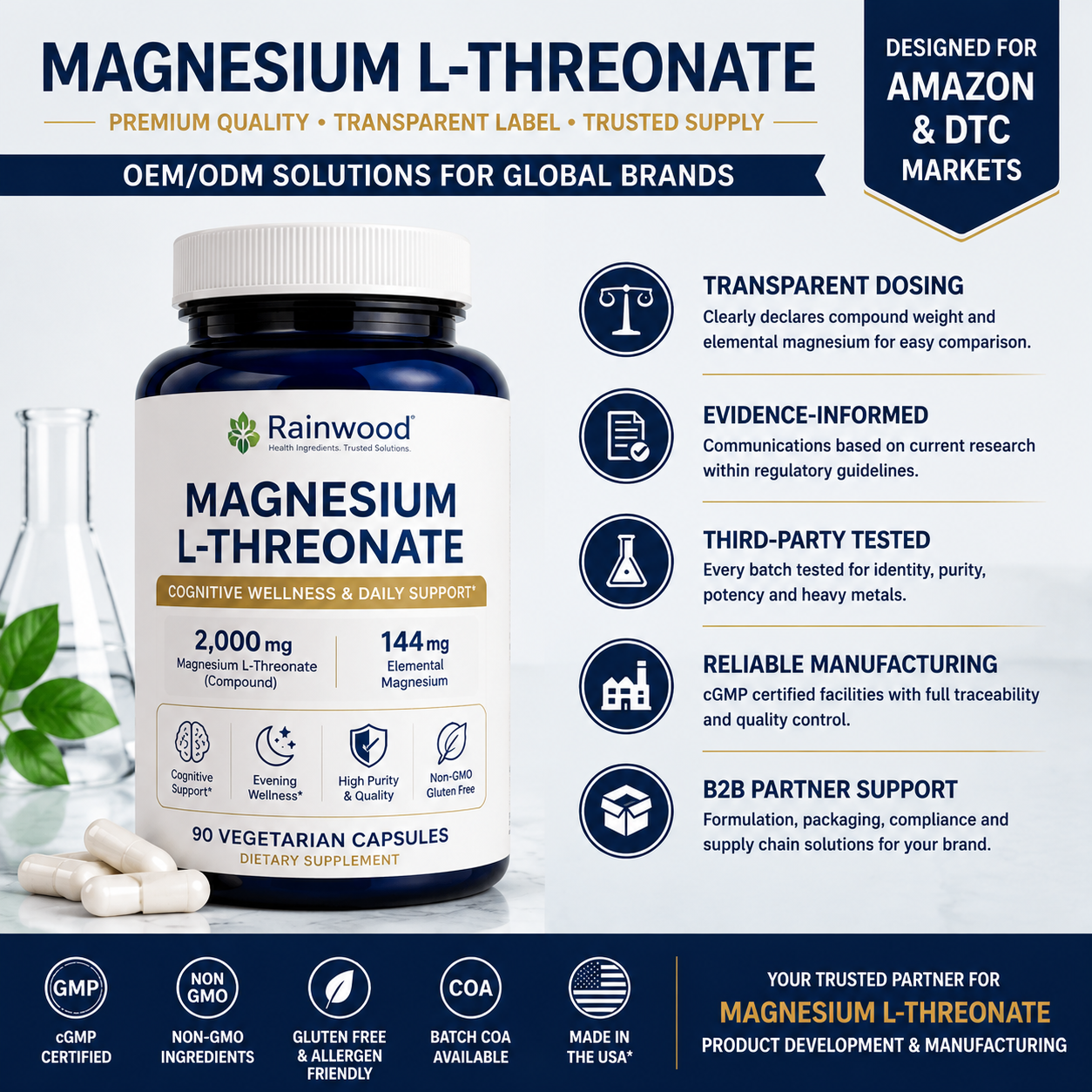
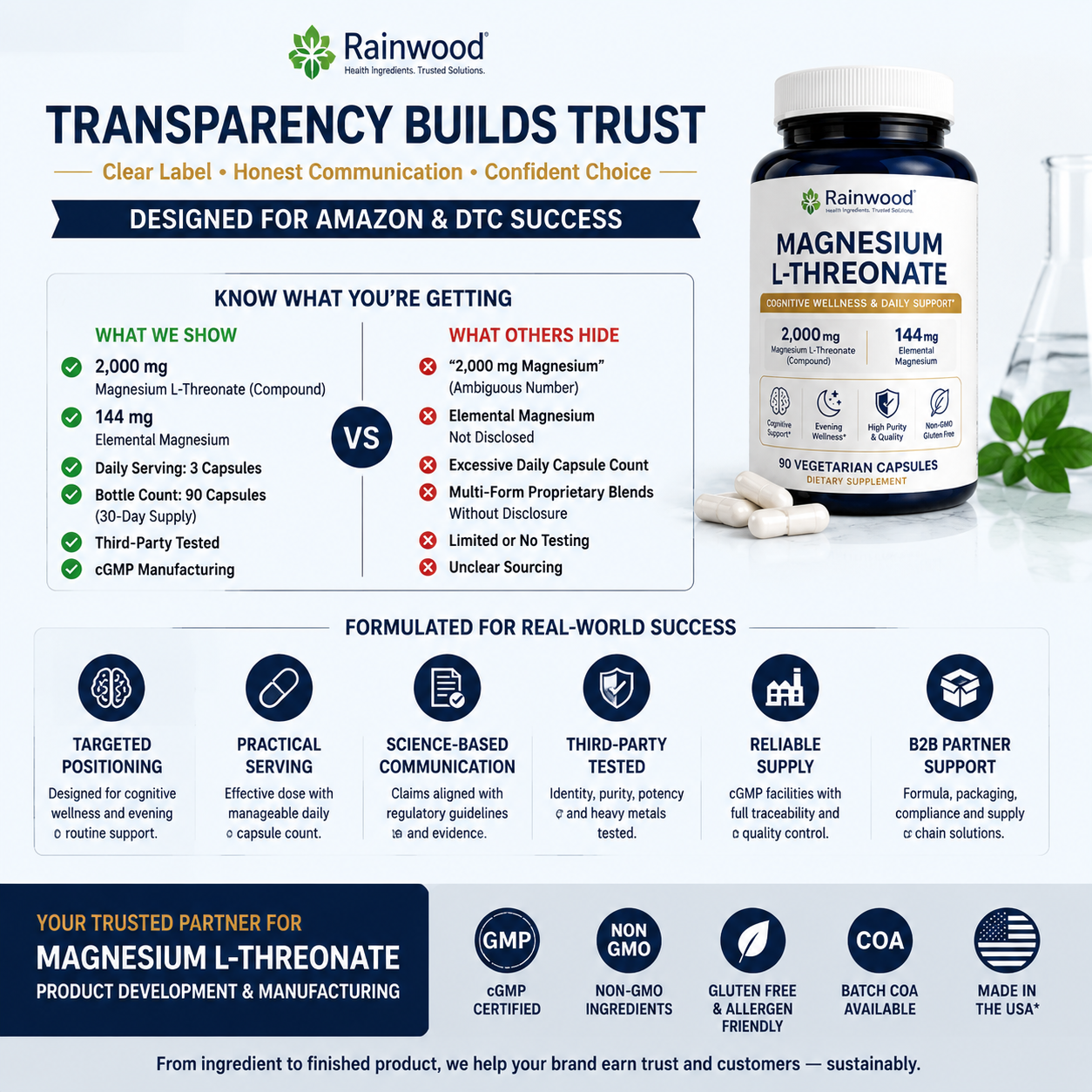
A crowded listing page rewards simple claims and large numbers, so sellers are tempted to place “2,000 mg magnesium” or “maximum strength brain magnesium” above every qualification. That can produce clicks while creating a misleading comparison. Magnesium L-threonate compound weight and elemental magnesium are different quantities, and a multi-form proprietary blend may hide how much of the headline L-threonate form is actually present.
The same problem occurs with the word Magtein®. The brand owner states that authentic Magtein products source the ingredient through its authorised supply and identify Magtein on the label. Generic magnesium L-threonate is not automatically counterfeit, but a seller should not use Magtein’s trademark, logo or ingredient-specific story without permission and traceability. Nor should a generic product imply that every study on a branded or specific formulation proves the finished listing.
The stronger conversion strategy is radical specificity: name the exact ingredient form and source category; show compound weight and elemental magnesium separately; disclose the daily capsule count and bottle-days; state whether other magnesium forms contribute to the total; explain which finished-batch tests were performed; and keep research summaries faithful to the studied ingredient, dose, population and outcomes. It gives comparison shoppers a reason to trust the page without manufacturing a promise the evidence cannot support.
A strong Amazon product is easy to understand in seconds. A strong DTC product gives customers a reason to stay. A magnesium L-threonate supplement must do both without turning emerging science into an exaggerated promise.
The most effective design process begins with the customer experience, then works backward through formula, serving, package, evidence and supply.
Choose a precise position
“Premium magnesium” is not enough. Define:
- the primary customer;
- the routine in which the product will be used;
- the reason to choose L-threonate rather than another magnesium form;
- the acceptable daily unit count;
- the desired monthly price; and
- the evidence boundaries for communication.
Examples of commercially clear territories include cognitive wellness, an evening wellness routine, healthy ageing or transparent single-ingredient supplementation. These are positioning directions, not pre-approved claims. Final copy must be substantiated and reviewed for the country of sale.
Our magnesium L-threonate private-label development service turns the position into a formula and pack brief.
Decide what the front label must communicate
An e-commerce thumbnail has limited space. Prioritise:
1. product identity;
2. one defensible positioning statement;
3. an amount that consumers can interpret correctly;
4. capsule or serving count; and
5. genuine product attributes.
Avoid making the largest number on the label ambiguous. If the front states a magnesium L-threonate compound amount, the Supplement Facts panel must still declare magnesium correctly under applicable rules. Product images and listing copy should explain the distinction rather than leaving the customer to discover it after purchase.
Design the serving before the bottle
Confirm the daily compound weight, elemental magnesium calculation and expected capsule fill. Then evaluate whether the serving is:
- physically manufacturable;
- convenient for the customer;
- economical at the target price;
- compatible with the intended claims; and
- suitable for the desired bottle count.
For a capsule product, prototype the actual powder blend because theoretical fill capacity is not enough. If the daily count feels excessive, compare a powder or rethink the positioning rather than forcing an unrealistic capsule.
Read Capsules, Tablets or Powder for Magnesium L-Threonate before freezing the pack.
Keep the formula focused
Adding more ingredients can improve differentiation, but each addition creates questions:
- Does the dose fit?
- Is the combination stable?
- Does it change the evidence needed for claims?
- Can every ingredient be used in the target market?
- Will the label become difficult to understand?
- Does it increase capsule count or cost?
A single-ingredient product can win through traceability, thoughtful packaging and honest education. A blend should exist because it supports a coherent use case—not because a long Supplement Facts panel looks valuable.
Build a claims ladder
Create three levels of copy:
Level 1: factual product information
Ingredient, serving, format, count and quality controls.
Level 2: substantiated structure/function or authorised wording
Claims that have been assessed for the market and supported by appropriate evidence.
Level 3: educational context
Balanced discussion of scientific research, including limitations, without implying that the finished product treats disease.
US marketers should remember that the FTC evaluates implied as well as express claims. FDA requirements for dietary supplement labeling are a separate layer. In the EU, use of magnesium L-threonate and health claims follows a different regulatory framework.
Our market-specific supplement claims review helps keep the product page, label and advertising aligned.
Make quality visible without vague badges
“Premium,” “clean” and “lab tested” are weak unless the brand explains them.
Useful quality communication can include:
- lot-specific finished-product COA access;
- clear ingredient and elemental-magnesium declarations;
- identity and contaminant test categories;
- country of manufacture stated accurately;
- capsule material;
- allergen or dietary information supported by records;
- lot and expiry coding; and
- a customer question channel.
Do not show certifications the manufacturing site or product does not hold. Do not imply that “FDA registered” means FDA approved; FDA states that dietary supplements are not pre-approved for safety and effectiveness before sale.
See how to verify magnesium L-threonate quality beyond the COA.
Package for conversion and fulfilment
The package must satisfy four users:
- the production line;
- the fulfilment network;
- the shopper viewing a small image; and
- the customer using it every day.
Test:
- bottle-to-count fit;
- closure and seal;
- desiccant placement;
- label readability;
- barcode quiet zones;
- lot-code visibility;
- finished dimensions and weight;
- parcel durability; and
- recyclability claims, if used.
Use actual pack-outs for photography. Renderings that hide the capsule count or serving information may boost early clicks but create expectation gaps.
Design the product detail page around objections
A strong page should answer:
1. What is this product?
2. Why this form of magnesium?
3. How much compound and elemental magnesium does it provide?
4. How many capsules are taken?
5. What testing supports quality?
6. What can and cannot be concluded from research?
7. Who should seek professional advice?
8. How long does one bottle last?
The comparison chart should use like-for-like fields. Do not compare a compound amount in your product with elemental magnesium in another.
Build repeat purchase into the count
Choose a bottle count that makes the routine and reorder interval intuitive. For subscriptions, model:
- days per bottle;
- average delivery interval;
- skipped or delayed shipments;
- stockout buffer;
- customer-service scripts; and
- reminder timing.
Retention improves when the customer understands the routine before checkout. It declines when a “30-day bottle” requires an unexpected daily count.
Plan content as part of product design
One product page cannot answer every sourcing and consumer question. Build a content cluster around:
- magnesium L-threonate versus glycinate;
- compound weight versus elemental magnesium;
- how quality is verified;
- how to read the label;
- capsule versus powder;
- responsible interpretation of studies; and
- how the product is manufactured.
These pages support organic search and give customer service a consistent educational library. Explore our magnesium L-threonate learning centre.
Frequently asked questions
### Is a three-capsule serving bad for conversion?
Not automatically. It must be explained clearly and justified by the formula. Surprise is more damaging than the count itself.
### Should the product use a branded ingredient?
That depends on target-market rights, evidence access, cost, positioning and supply. Verify authorisation, trademark terms and documentation before building the brand story around it.
### Can the same images be used on Amazon and a DTC site?
The core assets can be shared, but each channel has its own current content rules and customer journey. Check platform requirements before publication.
### How many claims should appear above the fold?
Usually one clear, defensible promise is stronger than a list of loosely connected claims. Support it with factual product information.
Turn a product idea into a channel-ready brief
Send us your customer profile, target retail price, preferred format, market and expected first order. We can organise the questions required for formula, package and quality feasibility.
Discuss an Amazon or DTC magnesium L-threonate project.
References
- US Food and Drug Administration, *FDA 101: Dietary Supplements*.
- US Food and Drug Administration, *Dietary Supplement Labeling Guide*.
- US Federal Trade Commission, *Health Products Compliance Guidance*.
- European Commission, Implementing Regulation (EU) 2024/2694.
- NIH Dietary Supplement Label Database, [Magtein compound and elemental-magnesium label example](https://dsld.od.nih.gov/label/274903).
- ThreoTech, [Magtein ingredient-source and authenticity statement](https://magtein.com/about-us/) (brand-owner source).
This article provides general product-development information. Platform policies and national requirements change and should be confirmed for each launch.