 EN
Executive Summary & B2B Formulation Guidance
How to review a nattokinase COA for activity, identity, source, assay basis, impurities, lot linkage, and finished-product relevance.
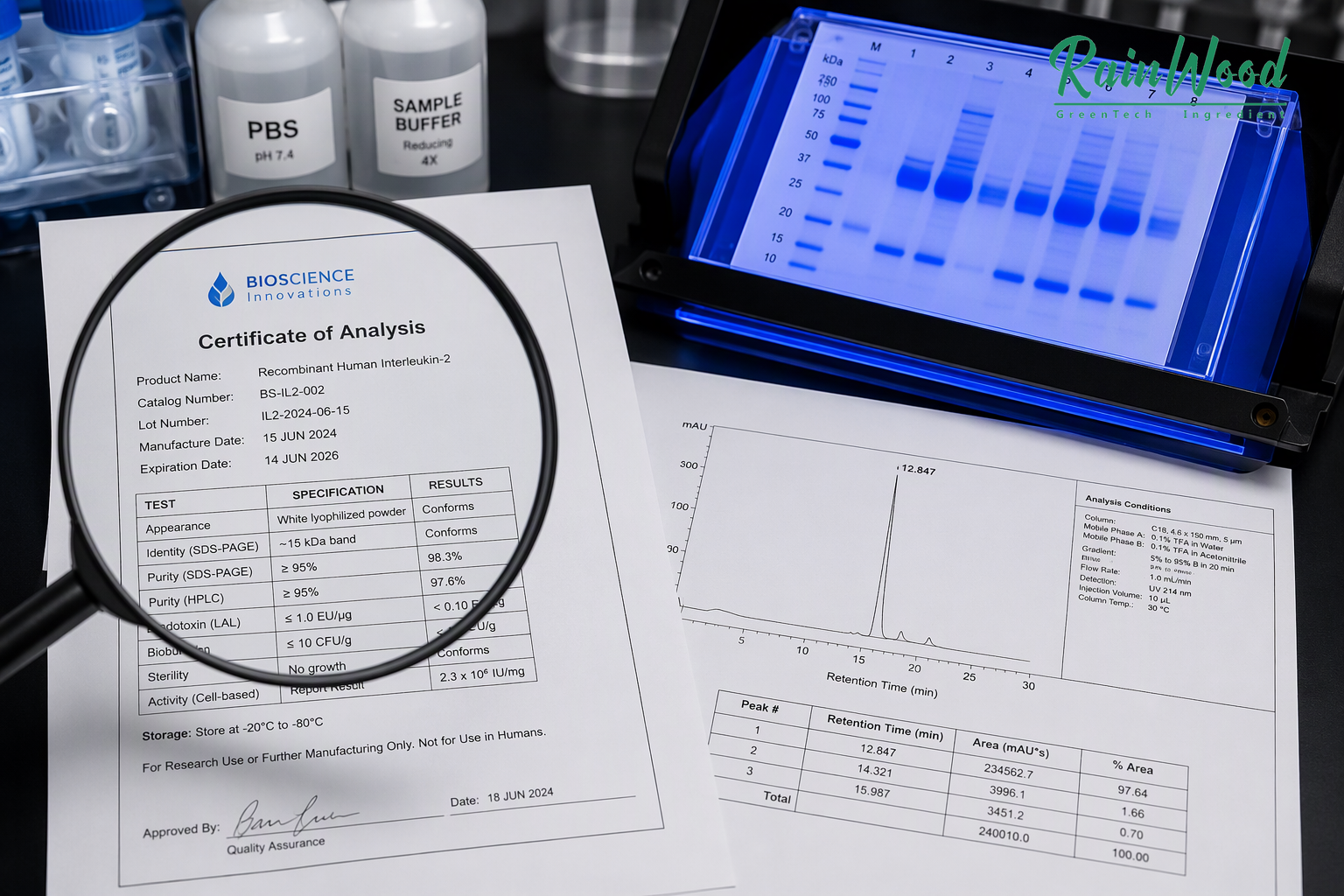
Figure 1: Certificate of Analysis (CoA) Document Under Magnifying Glass Beside SDS-PAGE Gel Illuminator and HPLC Chromatograms
A high FU result can still leave the identity question open
The COA shows a strong fibrinolytic activity result. The supplier highlights the number and the buyer moves toward a purchase order. But what did the laboratory actually prove? An activity result shows that the sample produced a response under a defined assay. It does not automatically prove that the material is the intended nattokinase, that the source is the declared fermentation route, or that the finished capsule will retain the same activity.
The buyer should separate activity, identity, purity, contaminants, and stability. A professional COA can connect these questions, but one line should not be forced to answer all of them.
Read the COA from the lot line first
Confirm product name, lot number, manufacturing date, test date, sample identity, laboratory, specification revision, and package. A trader's generic COA may not be linked to the lot delivered. A sample report may be from an earlier batch. If the document does not establish the connection, request a controlled report before release.
Then read the activity line. Is the result FU/g or FU per serving? Is the basis as-is or dry? What assay method and conditions are used? Is the result a release minimum, a typical value, or a calculation from a supplier's certificate?
Use [INTERNAL LINK -> Nattokinase Identity Blog] to compare the exact material description with the activity report.
Activity does not replace identity evidence
The activity may be measured by a fibrin plate, fibrinolysis, or synthetic peptide method. These tests can be useful, but the result depends on method specificity and conditions. A different protease or extract component may contribute to a response. Identity evidence may require additional chromatographic, electrophoretic, spectroscopic, microbiological, or source documentation depending on the grade.
Do not assume that a method name such as HPLC proves the enzyme identity. Ask what is separated, what reference standard is used, and whether the method is validated or verified for the material. A total protein assay is not the same as a nattokinase identity test.
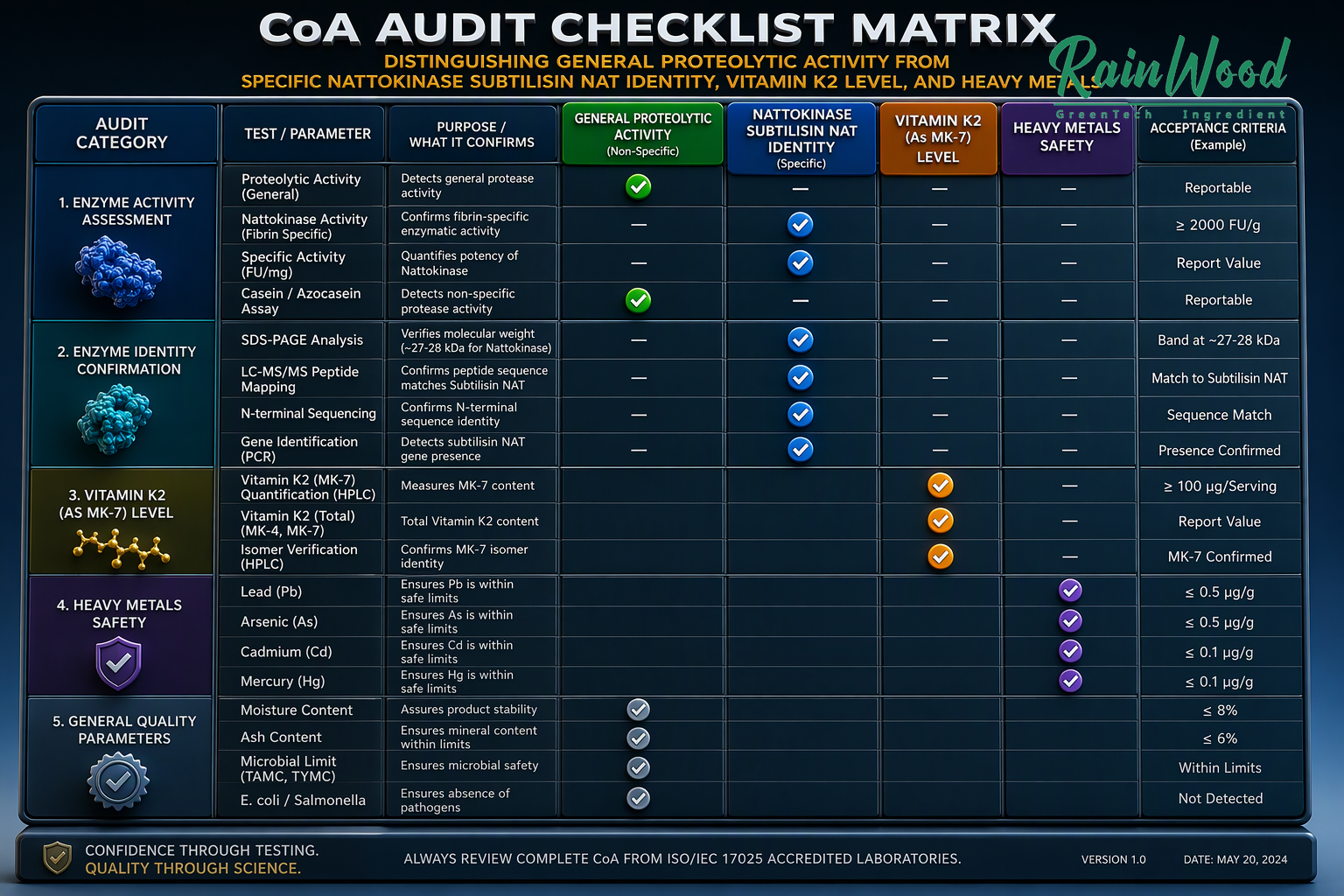
Figure 2: 3D Scientific CoA Audit Matrix: Distinguishing Proteolytic Response from Specific Subtilisin NAT Identity and K2 Levels
Related attributes belong in the release file
Ask for moisture, residual solvents or process aids where relevant, heavy metals, microbiological limits, soy and allergen information, appearance, storage, and shelf life. The actual panel depends on source, route, market, and format. If the product uses a carrier, show the carrier and activity basis.
For finished capsules, test activity after encapsulation and storage. For enteric-coated formats, verify the coating process and activity after simulated gastric exposure if the product claim relies on protection. The [INTERNAL LINK -> Nattokinase Stability Blog] explains why raw-material activity cannot automatically prove finished-product activity.
The buyer loss from a one-line COA
The brand may release a material that passes FU but fails the intended identity or source requirement. A finished product can then require a hold, retest, rework, relabeling, or replacement. If the product is already sold, the brand may face platform questions and customer complaints.
The lack of method detail also makes supplier switching dangerous. A new supplier can report the same FU number by a different method, and the buyer may mistake it for equivalence. Method and identity belong in the specification before price negotiations.
Build a COA review table
Create columns for requirement, reported result, method, basis, lot link, acceptance limit, and buyer decision. Flag missing methods, missing standards, typical values, unexplained abbreviations, and results that refer to a different product name. Keep the reviewed COA with the retained sample and release decision.
How RainwoodBio can support a release package
RainwoodBio publishes raw-material supplier management, requirement confirmation, quality testing and release, compliance documentation, and traceability. These published capabilities provide a useful framework for a nattokinase project. Product-level evidence still needs to confirm the exact enzyme, activity method, lot, package, and finished product.
COA approval gate
Before release, require:
- exact identity and source description;
- lot-specific activity with method and basis;
- identity evidence separate from activity;
- impurity, moisture, allergen, and microbiology controls;
- package and storage conditions;
- finished-product activity plan.
Request a [INTERNAL LINK -> Nattokinase COA Gap Review] [INTERNAL LINK -> Contact Us Page] with the COA, specification, target FU, format, and market.
Turn the COA into a release decision
Use four columns: requirement, reported result, method or evidence, and buyer decision. Flag missing lot links, missing activity basis, missing reference information, typical values presented as guarantees, and product names that do not match the purchase order. Keep the reviewed COA with the sealed sample and batch release record.
For a new supplier or high-value lot, compare the supplier result with a buyer or independent laboratory result using a retained sample. The purpose is to understand method comparability and establish a baseline, not to create an automatic accusation. Once the system is stable, the buyer can set a risk-based testing frequency.
Add a COA-to-specification reconciliation
Before release, compare the COA line by line with the approved specification and purchase order. Confirm the material name, grade, lot, manufacture date, expiry or retest date, activity unit, method, result basis, moisture, microbiology, contaminants, allergen statement, and storage. A blank line is not a passing result; it is an unresolved requirement that needs an owner and due date.
If identity is important to the label, attach the supporting identity document rather than relying on the COA title. Depending on the grade, that may include a source statement, chromatographic or protein evidence, reference standard information, or another qualified method. Keep the raw-material review separate from finished-capsule release so a good raw COA does not hide a loss of activity during processing.
Store the evidence where production can find it
Quality, procurement, and production should use the same controlled specification and reviewed COA. A document hidden in an email thread cannot reliably prevent a wrong grade from being filled, relabeled, or approved. Keep the approved version searchable by lot number, product code, and supplier name for every release decision now.
Frequently asked questions
Does a high FU result prove pure nattokinase?
No. It proves a measured response under the stated assay. Identity and purity need additional evidence.
Is a manufacturer COA enough?
It may support release, but the buyer must confirm lot linkage, method suitability, and the needs of the target market.
Should activity be tested in the finished capsule?
When the label depends on finished-unit activity, yes, the release plan should include finished-product evidence.
Can two COAs with the same FU be compared?
Only after the methods, units, basis, standards, and sample preparation are shown to be comparable.
Conclusion
The COA is valuable when it answers the right questions. Keep activity, identity, source, impurities, lot linkage, and finished-product stability separate and connected before you release nattokinase.
Disclaimer: This article is for B2B quality and procurement planning. It is not medical advice and does not establish that nattokinase treats, prevents, or cures disease.

Figure 3: Quality Assurance Release Director Signing Batch Release Certificates in cGMP Analytical Documentation Suite
References
- https://pmc.ncbi.nlm.nih.gov/articles/PMC9312984/
- https://pubmed.ncbi.nlm.nih.gov/33843667/
- https://www.rainwoodbio.com/
Explore RainwoodBio Nattokinase & Cardiovascular OEM Solutions
- Custom Nattokinase Enteric & Delayed-Release Capsules – Gastric-acid protection preserving 2,000~20,000 FU/g enzyme activity for optimal systemic absorption.
- Nattokinase Lipid Softgels & Cardiovascular Blends – Synergistic co-formulations with CoQ10, Phytosterols, Garlic Oil, and Vitamin K2-free options.
- Nattokinase Sachet Stick Packs & Functional Powders – Convenient single-serve sachet stick packs with premium taste masking and high moisture barrier.
- OEM / ODM Contract Manufacturing Services – cGMP certified high-potency blending, blister packaging, and US/EU/Amazon regulatory compliance dossiers.
- Contact RainwoodBio Technical Sales – Request Nattokinase CoA (FU/g assay certificates), stability test protocols, pilot samples, or custom quotation.
Table of Contents
- A high FU result can still leave the identity question open
- Read the COA from the lot line first
- Activity does not replace identity evidence
- Related attributes belong in the release file
- The buyer loss from a one-line COA
- Build a COA review table
- How RainwoodBio can support a release package
- COA approval gate
- Turn the COA into a release decision
- Add a COA-to-specification reconciliation
- Store the evidence where production can find it
- Frequently asked questions
- Conclusion
- References