 EN
EN
Executive Summary
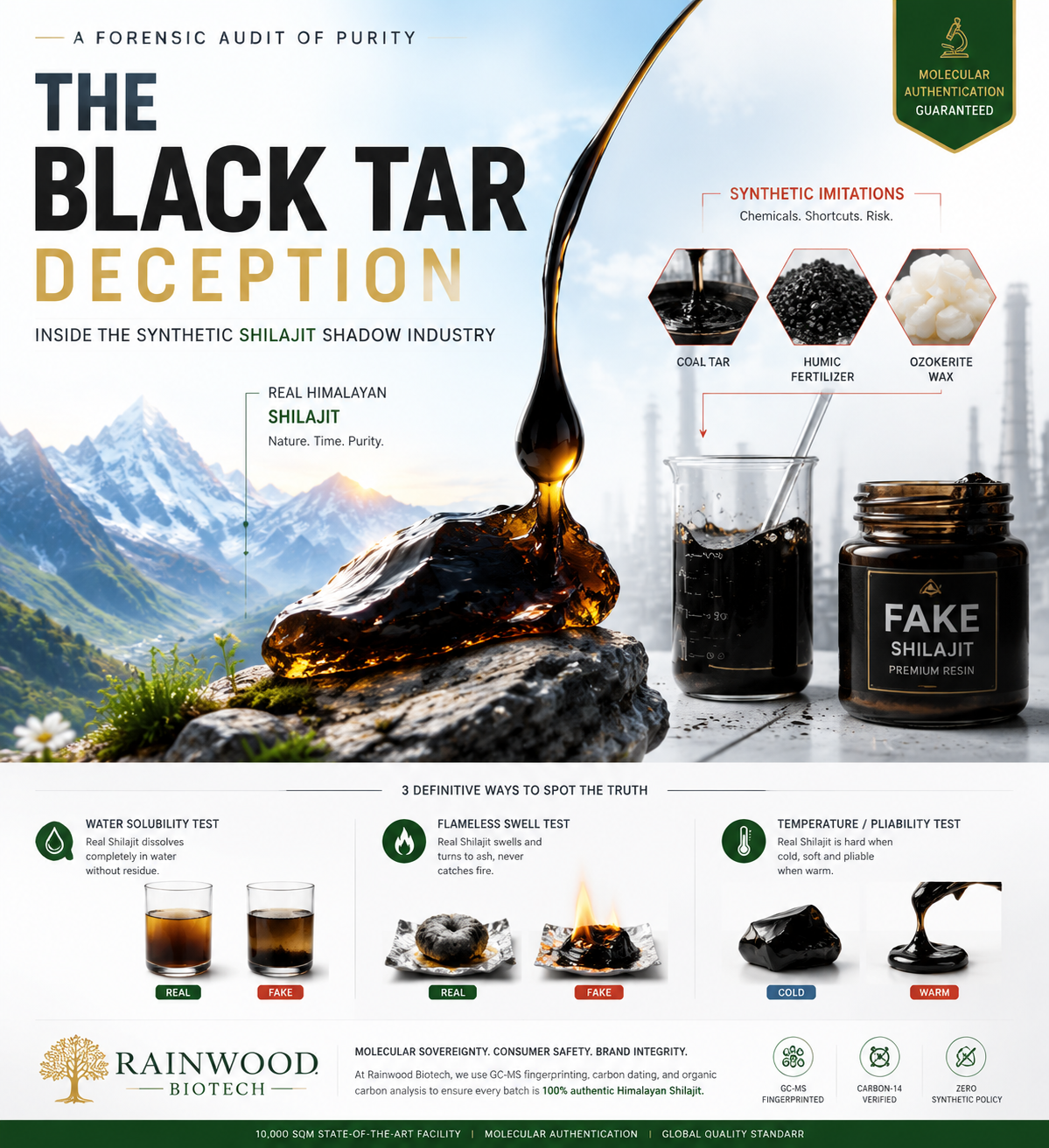
As Shilajit's popularity skyrockets, a dangerous 'Shadow Industry' has emerged—creating synthetic resins from coal tar, humic fertilizers, and ozokerite. These toxic substitutes are designed to mimic the appearance of Himalayan resin but lack its biological soul. This forensic audit reveals the industry's darkest secrets and provides 3 definitive 'Home-and-Lab' experiments to unmask synthetic fraud. Secure your brand's integrity with Rainwood Biotech’s molecularly authenticated standards.
The 'Black Tar' Industrial Mirage
The global Shilajit market has reached a point of 'Commodity Madness.' While demand for Pure Himalayan Shilajit is at an all-time high, the actual annual harvest from the high-altitude rocks of the Himalayas is finite. This supply-demand gap has created a vacuum filled by 'Synthetic Alchemists'—brokers who manufacture 'Shilajit' in urban labs using industrial waste products.
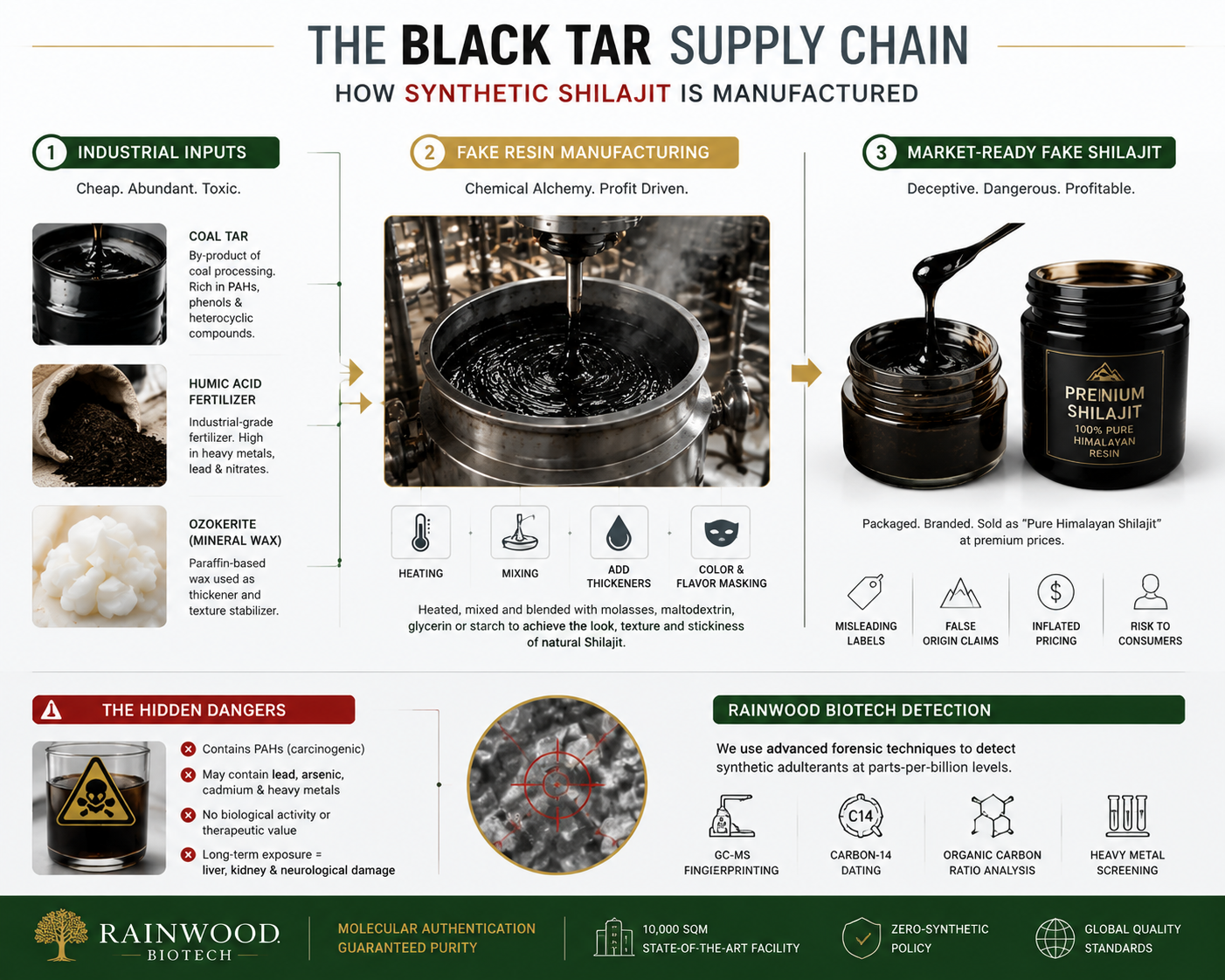
In these facilities, you won't find ancient minerals or fulvic-rich biomass. Instead, you'll find barrels of coal tar, low-grade humic fertilizers, and ozokerite (mineral wax). By heating these materials and adding thickeners like maltodextrin or molasses, brokers can create a pitch-black, sticky resin that looks identical to a premium Shilajit resin. To the untrained eye of a procurement manager, it’s a 'good deal.' To the consumer, it’s a slow-acting poison.
At Rainwood Biotech, we dismantle these mirages. We don't just 'look' at the resin; we audit its organic carbon signature. If it didn't spend 500 years in a Himalayan rock cleft, it has no place in your brand's bottle.
The Coal Tar Alchemy: Why Adulterants are Deadly
Why use coal tar? Because it is cheap, black, and viscous. When refined, coal tar can be made to look like a high-grade Shilajit Extract. However, coal tar is a complex mixture of phenols, polycyclic aromatic hydrocarbons (PAHs), and heterocyclic compounds. It is a known carcinogen and a potent neurotoxin when ingested.
Worse yet is the use of 'Humic Acid Fertilizers.' Brokers buy industrial-grade fertilizers meant for agricultural soil, mix them with brown sugar and thickeners, and label them as 'Pure Himalayan Resin.' These fertilizers are often contaminated with high levels of lead and synthetic nitrates. They provide a high 'Fulvic Acid' reading on a cheap titration test (see our previous audit on the Fulvic Fraud), but they provide zero biological benefits. You are effectively selling a bottle of high-priced dirt and chemicals.
Rainwood Biotech maintains a 'Zero-Synthetic' policy. Our 10,000 sqm Xi'an facility is equipped with GC-MS (Gas Chromatography-Mass Spectrometry) systems that can detect the molecular 'fingerprint' of coal tar in parts per billion. We ensure that your supply chain is free from the 'Black Tar' deception.
Experiment 01: The Water Solubility 'Ghost' Test
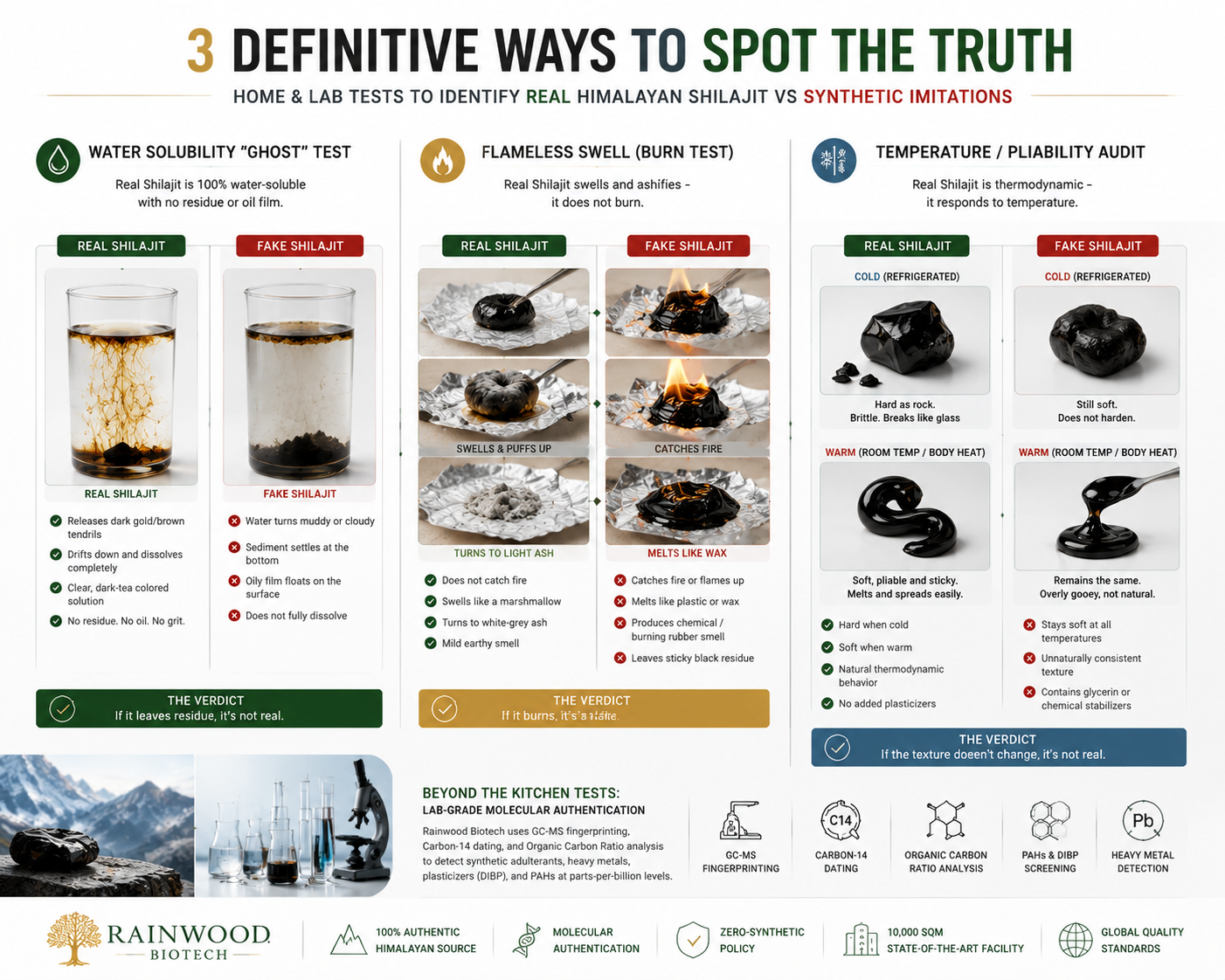
Real Shilajit is a unique biomass—it is 100% water-soluble. Because it consists of low-molecular-weight organic acids and ionic minerals, it should dissolve completely in room-temperature water without leaving a trace of grit, sand, or oil.
How to perform the audit: Drop a small pea-sized amount of the resin into a glass of warm water. **Do not stir.** Real Pure Himalayan Shilajit will slowly release 'tendrils' of dark gold or brown liquid that drift to the bottom, eventually dissolving into a clear, dark-tea-colored solution. If the water becomes 'muddy,' if there is sediment at the bottom, or if an oily film appears on the surface, you are dealing with an adulterated product. Coal tar and ozokerite-based fakes will leave a gritty residue or an unmistakable chemical sheen on the water's surface.
Rainwood Biotech's resin passes this test with 100% clarity. We don't hide behind fillers; our solubility is our signature of purity.
Experiment 02: The 'Flameless Swell' (Burn Test)
One of the most definitive ways to identify a synthetic substitute is through a flame test. Real Shilajit has a very specific reaction to high heat due to its mineral and organic acid matrix. It does not burn like wood or catch fire like oil.
How to perform the audit: Place a sample of the resin on a piece of aluminum foil and apply a torch or a lighter to it. Real Shilajit will not produce a flame. Instead, it will 'swell' and puff up like a marshmallow as the organic gasses escape, eventually turning into a light, white-grey ash. If the sample melts like wax, produces a strong 'chemical' or 'burning rubber' smell, or—most importantly—**catches fire**, it is a fake. Coal tar and paraffin-based 'Shilajit' are flammable. Real Himalayan resin is not.
We encourage our partners to perform this 'Burn Audit.' It is a simple, visceral way to prove to your customers that your Shilajit is a geological product, not a chemical one.
Experiment 03: The Temperature/Pliability Audit
Real Shilajit resin is a 'Thermodynamic Solid.' It responds to temperature in a very specific, linear way. When cold (refrigerated), it should become as hard as a rock—you should be able to break it like glass. When warm (room temperature or body heat), it becomes soft, pliable, and sticky.
Synthetic fakes often use glycerin or plasticizers to maintain a 'perfectly gooey' texture regardless of the temperature. If your Shilajit resin stays soft and easy to scoop in the refrigerator, it has been adulterated with non-mineral stabilizers. This is a common trick used by brokers to make the product 'easier to use,' but it compromises the molecular integrity and authenticity of the resin.
At Rainwood Biotech, we respect the laws of physics. Our Shilajit resin is a living material that changes with the environment—a mark of its true Himalayan soul.
Molecular Sovereignty: Beyond the Kitchen Experiments
While home experiments are useful for initial vetting, the final word must come from the laboratory. At Rainwood Biotech, we go beyond the burn test. We utilize **Carbon-14 Dating** and **Organic Carbon Ratio** analysis to verify the age and origin of the biomass. We look for the presence of DIBP (plasticizers) and PAHs (combustion byproducts) to ensure that no 'industrial shortcuts' were taken.
In the 2026 market, the 'Black Tar' secret is being exposed. Brands that continue to source from opaque trading companies are standing on thin ice. Secure your brand's future by anchoring your supply chain in 10,000 square meters of industrial truth.
Don't let your legacy be buried under a layer of coal tar. Join Rainwood Biotech and master the forensic truth of Shilajit.
About Rainwood Biotech
Rainwood Biotech is a premier, asset-heavy global manufacturer dedicated to the molecular authentication of Ayurvedic substances. Operating a 10,000 sqm state-of-the-art facility, we utilize forensic-level GC-MS fingerprinting to eliminate synthetic adulterants from the supply chain. Our commitment to pure, Himalayan-sourced Shilajit makes us the strategic partner of choice for brands that prioritize consumer safety and biological truth.
Table of Contents
- Executive Summary
- The 'Black Tar' Industrial Mirage
- The Coal Tar Alchemy: Why Adulterants are Deadly
- Experiment 01: The Water Solubility 'Ghost' Test
- Experiment 02: The 'Flameless Swell' (Burn Test)
- Experiment 03: The Temperature/Pliability Audit
- Molecular Sovereignty: Beyond the Kitchen Experiments
- About Rainwood Biotech