 EN
EN

Executive Summary
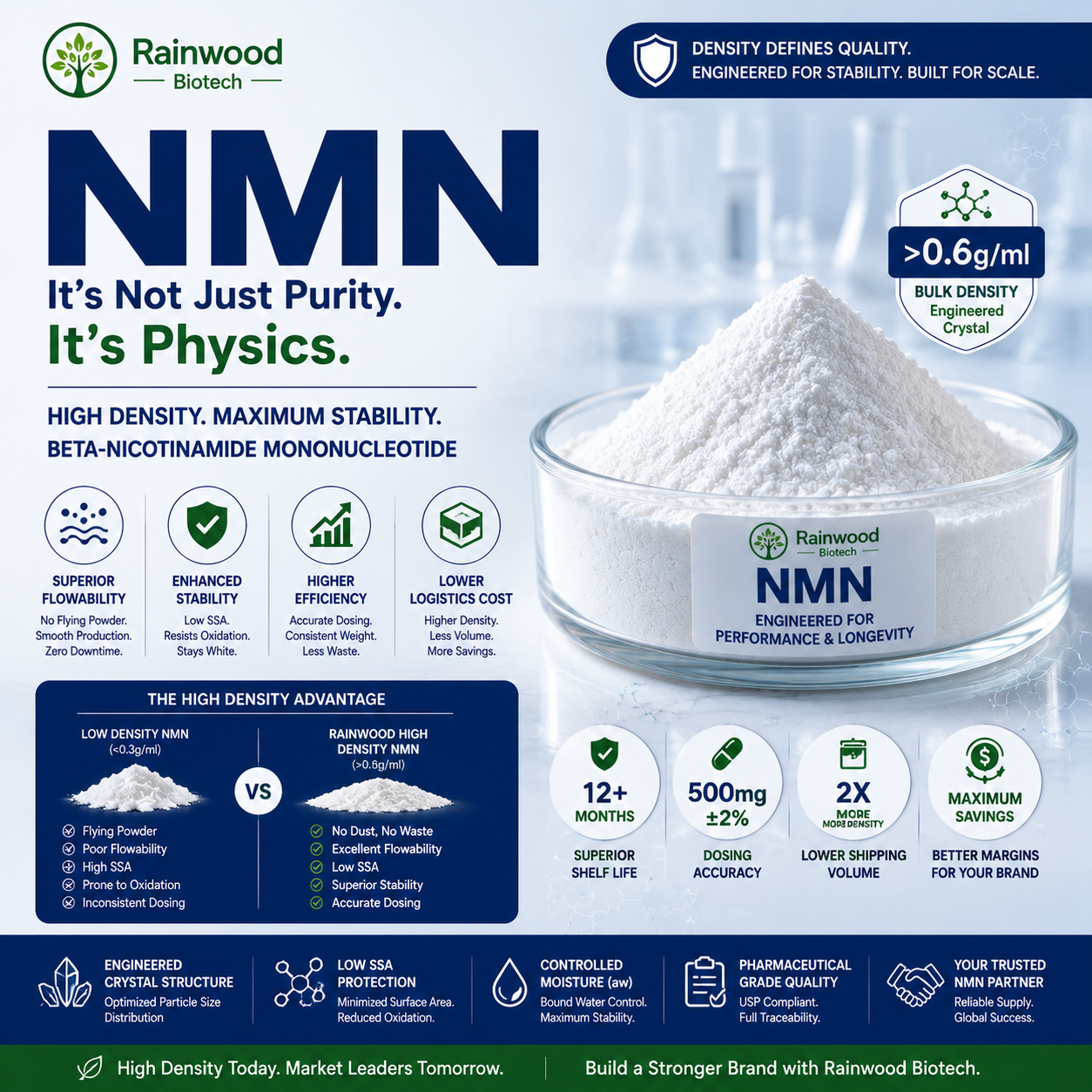
In the NMN industry, purity is the price of entry, but bulk density is the key to longevity. This audit explores why low-density NMN is a 'ticking time bomb' for stability and how Rainwood Biotech’s engineered crystals ($>0.6g/ml$) solve the twin challenges of encapsulation efficiency and oxidation-induced degradation.
The 'Flying Powder' Disaster: A Factory Floor Nightmare
If you’ve ever managed a high-speed encapsulation floor, you’ve likely experienced the 'Fluffy NMN' disaster. You open a drum of high-purity Beta-Nicotinamide Mononucleotide, only to find it has the consistency of powdered sugar. As soon as the machine starts, a cloud of fine dust—'flying powder'—begins to coat the sensors, clog the dosing disks, and create a static-charged mess that grinds production to a halt.
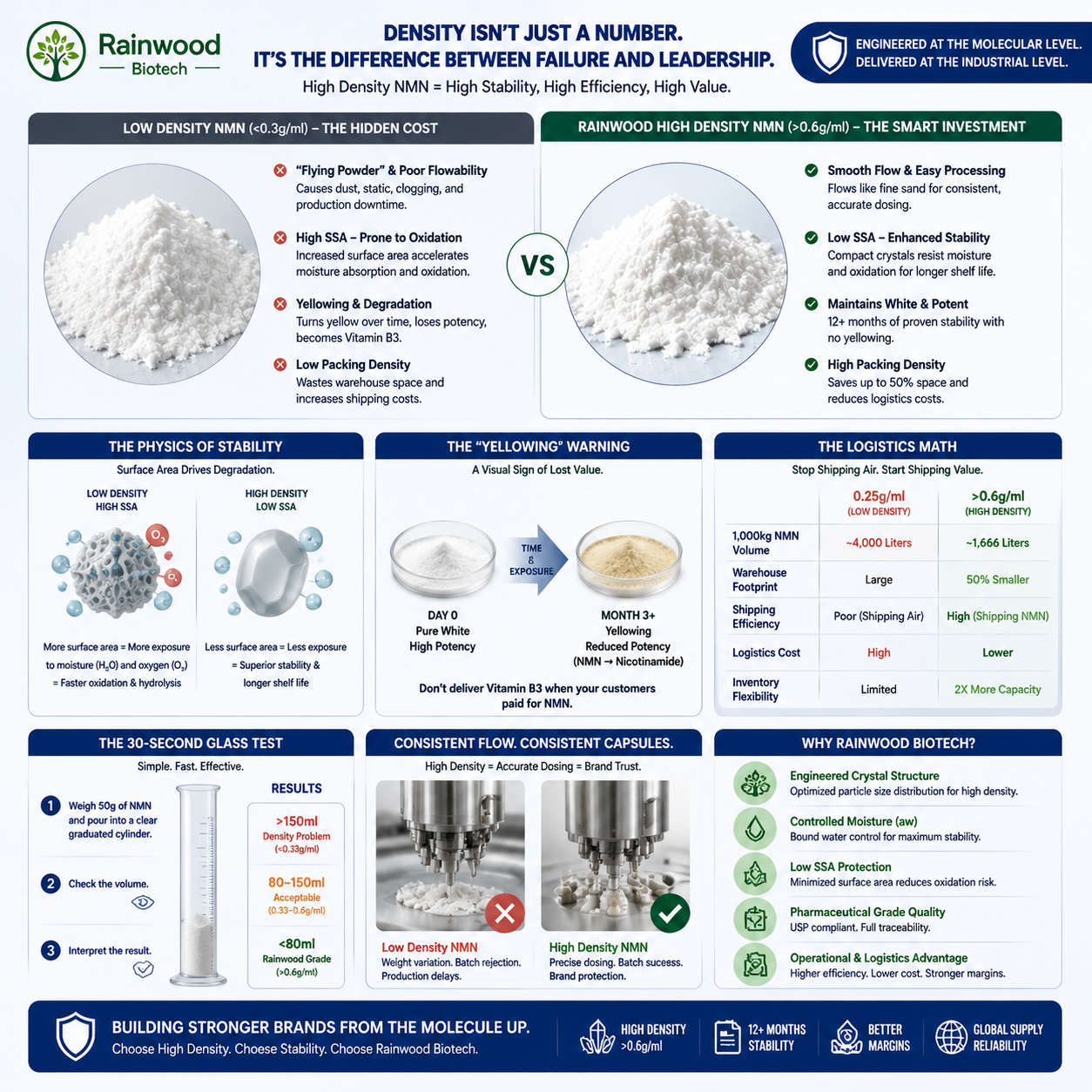
This isn't just an operational annoyance; it's a massive financial leak. When your NMN has a bulk density of less than 0.3g/ml, you aren't just losing product to the air; you are losing consistency. Capsule weights begin to drift, leading to rejected batches and regulatory headaches. Many brands learn the hard way that 'pure' but 'fluffy' NMN is a shortcut to a manufacturing nightmare.
At Rainwood Biotech, we talk to production managers who have lost days of uptime to substandard material. That’s why we engineered our Beta-Nicotinamide Mononucleotide to have a consistent, high-flow bulk density of $>0.6g/ml$. It flows like fine beach sand, ensuring that your $500mg$ claim is exactly $500mg$ in every single capsule.
Specific Surface Area (SSA): The Physics of Oxidation
To understand why bulk density matters for stability, you have to look at the physics of Surface Area. A 'fluffy' powder is essentially a mountain of air gaps. The smaller and more irregular the particles, the higher the Specific Surface Area (SSA) per gram. In the world of chemistry, high SSA is an invitation for trouble.
NMN is a sensitive molecule. It hates moisture and it fears oxygen. When you use a low-density Nicotinamide Mononucleotide, you are effectively maximizing the contact points between the molecule and its environment. Moisture in the air acts as a catalyst for hydrolysis, while oxygen drives the oxidation that turns your pristine white powder into a yellow, degraded mess.
By increasing the bulk density through our proprietary physical modification process, we reduce the SSA. Our crystals are dense and compact, creating a 'natural protective shell' that limits environmental exposure. This isn't just theory—stability tests show that our high-density NMN maintains its white color and potency up to 12 months longer than 'fluffy' alternatives on the shelf.
The 'Yellowing' Warning: What Your Inventory is Trying to Tell You
Ever seen NMN capsules turn slightly yellow after three months in the warehouse? That’s not 'natural aging.' It’s the visual sign of NMN degrading into Nicotinamide—a process accelerated by the poor physical integrity of low-density powder. When NMN begins to yellow, it loses its biological activity. You are no longer selling a premium longevity supplement; you are selling expensive B-vitamins.
A brand's legacy is built on the final dose, not the raw material COA. If your Nicotinamide Mononucleotide arrives at the consumer's door in a degraded state because the physical form couldn't withstand the shipping and storage cycle, your brand reputation takes the hit. This is why B2B buyers are increasingly demanding 'Stability-Optimized' NMN rather than just 'Pure' NMN.
Rainwood Biotech's high-density crystals are designed to resist this 'Yellowing Effect.' We control the water activity ($a_w$) during the crystallization phase to ensure that the moisture content is not just low, but 'bound,' making it virtually impossible for the molecule to initiate the degradation cycle.
The Logistics Math: Shipping Air vs. Shipping NMN
From a supply chain perspective, low density is a waste of money. When you buy 1,000kg of NMN with a density of $0.25g/ml$, you are paying to ship and store 4,000 liters of volume. You are effectively paying for air. Your warehouse costs quadruple, and your DDP (Delivered Duty Paid) freight flat-rates become much harder to negotiate.
By switching to Rainwood Biotech's $>0.6g/ml$ Beta-Nicotinamide Mononucleotide, you effectively halve your storage and shipping footprint. You can store 2x the inventory in the same square footage. In the volatile 2026 logistics market, these operational efficiencies are the difference between a profitable quarter and a margin-squeezed disaster.
For global brands, this operational sovereignty is critical. Being able to store more stable, compact material allows you to hedge against supply chain disruptions without needing to expand your physical warehouse space.
Audit Your Density: The 30-Second 'Glass Test'
You don't need a lab to spot a low-quality supplier. Take a clear glass or graduated cylinder. Fill it with 50g of your supplier's NMN. If the volume exceeds 150ml, you have a density problem ($<0.33g/ml$). If it’s below 80ml, you have a Rainwood-grade engineered crystal.
Also, observe the flow. If the powder sticks to the sides of the glass or forms 'clumps,' it is a static-prone, low-density material that will fail your production manager. Premium Beta-Nicotinamide Mononucleotide should flow with zero resistance, like salt.
If your current supplier makes excuses about 'natural variation,' remind them that in modern pharmacology, physical consistency is a requirement, not a suggestion. At Rainwood Biotech, we don't allow for 'variation' in our density spec—we enforce it.
Conclusion: Designing for the Final Consumer
Ultimately, the goal of a longevity brand is to deliver a functional molecule to the consumer's cells. That journey starts with the physical form of the raw material. A high-density, stable, and easy-to-fill NMN is the only foundation for a world-class brand.
Don't let your brand legacy be killed by a 'fluffy' powder. Join the experts who prioritize the physics of stability. Join Rainwood Biotech and secure the future of your longevity products.
About Rainwood Biotech
Rainwood Biotech is a premier global manufacturer specializing in the physical and chemical optimization of longevity ingredients. Based in a 10,000 sqm state-of-the-art facility, we go beyond simple purity to deliver engineered molecules that solve real-world manufacturing challenges. Our commitment to high-density, ultra-stable Beta-Nicotinamide Mononucleotide makes us the strategic anchor for the world's most demanding supplement brands.
Table of Contents
- Executive Summary
- The 'Flying Powder' Disaster: A Factory Floor Nightmare
- Specific Surface Area (SSA): The Physics of Oxidation
- The 'Yellowing' Warning: What Your Inventory is Trying to Tell You
- The Logistics Math: Shipping Air vs. Shipping NMN
- Audit Your Density: The 30-Second 'Glass Test'
- Conclusion: Designing for the Final Consumer
- About Rainwood Biotech