 EN

Executive Summary & B2B Formulation Guidance
“Water-soluble CoQ10” can describe a delivery system, not a changed molecule. Verify dispersion, carrier, dose, stability, and evidence before marketing.
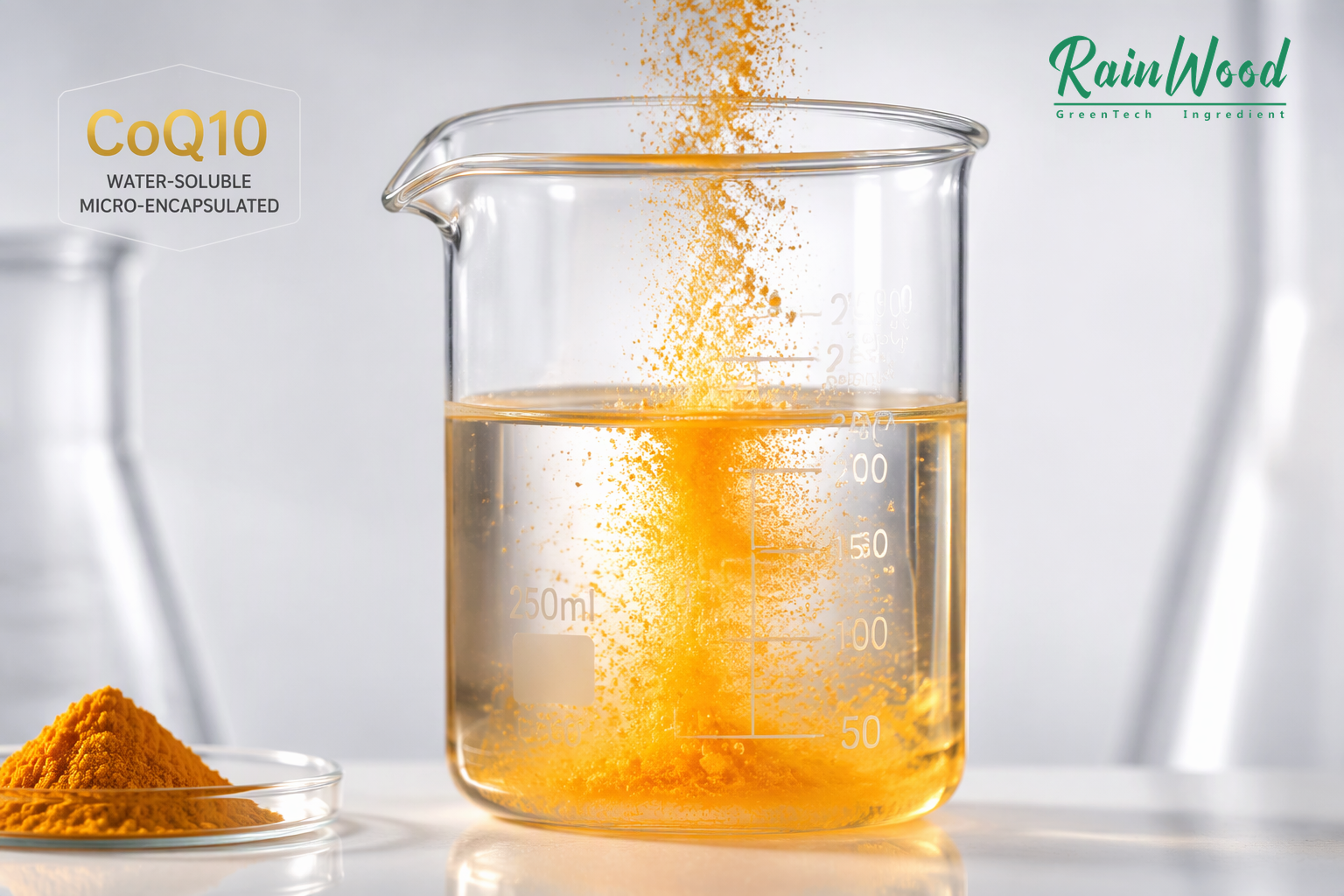
Figure 1: Water-Soluble CoQ10 Micro-Encapsulated Golden Powder Rapidly Dispersing in Analytical Glassware
“Water-soluble CoQ10” attracts clicks because it appears to solve a familiar problem. But the phrase can hide several different technologies: a dry emulsion, a cyclodextrin complex, a nanoemulsion, a carrier-based dispersion, or a marketing description for a powder that still floats in water. If the buyer does not define what the phrase means, the customer may receive a product that fails its first use test.
CoQ10 remains a lipophilic molecule
CoQ10 is naturally lipophilic. A formulation may improve wetting, dispersion, apparent solubility, release, or absorption without changing the underlying molecule into an ordinary water-soluble nutrient. That distinction matters for claims, specifications, and comparison with crystalline powder.
Use the [INTERNAL LINK -> CoQ10 Ingredient Identity Review] to separate molecular identity from formulation behavior. Ask whether the product is pure CoQ10, a complex, a premix, or a finished delivery system. The buyer should not pay a premium for a term that has no measurable acceptance criteria.
Define the performance the buyer actually wants
Does “water-soluble” mean no visible sediment, rapid dispersion, transparent solution, high release in a test medium, or higher human bioavailability? These are different outcomes. A powder can disperse but settle later. A cloudy emulsion can be acceptable for a beverage but not for a clear shot. A laboratory release result cannot automatically prove a human outcome.
Write the test into the specification: water volume, temperature, mixing energy, time, sample amount, visual limit, particle size, sediment limit, and active recovery. If the target is bioavailability, identify the evidence for the exact formulation rather than borrowing a study from another product.
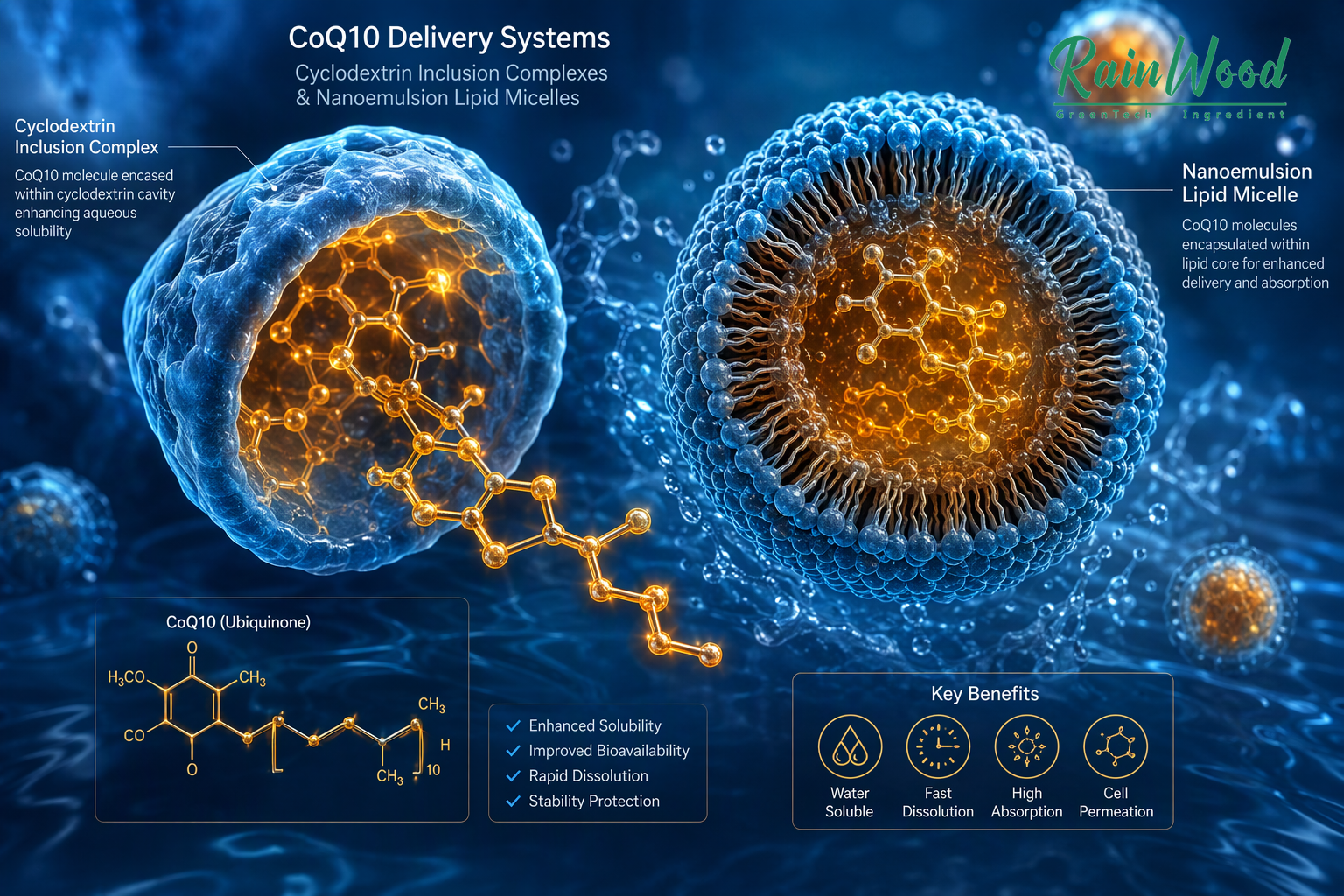
Figure 2: 3D Molecular Delivery Model: Cyclodextrin Inclusion Complex and Nanoemulsion Micelle Dispersion Mechanism
Carrier and excipient disclosure matters
Water-dispersible CoQ10 may contain cyclodextrin, starch, gum, emulsifier, sugar, protein, or other carriers. Those ingredients affect the declared active amount, allergen statement, flavor, calorie content, vegan status, and regulatory review. A “100 mg CoQ10 powder” may require a much larger serving than 100 mg pure crystalline CoQ10.
Request the complete composition and active basis. Ask whether the carrier is part of the label serving, whether it affects the package moisture load, and whether it is suitable for the target market. The [INTERNAL LINK -> CoQ10 Label Math and Dose Calculator] should include carrier weight and processing recovery.
Compare dispersibility with the actual customer routine
Run a use test with the water volume, temperature, cup, shaker, and waiting time a customer will use. Test after storage, not only immediately after production. Record floating oil, sediment, clumps, color, odor, taste, and active recovery after mixing. If the product is intended for a smoothie, coffee, or sports drink, test that matrix separately.
A laboratory beaker with vigorous stirring may produce a result no customer can reproduce. The buyer loss is a wave of reviews saying the product does not mix, even though the COA is acceptable. A clear instruction and a realistic test are part of the product, not an afterthought.
Do not confuse dispersion with absorption
A dispersible formulation may change how CoQ10 behaves in a test medium, but that alone does not establish higher human bioavailability. Human studies can differ by dose, food intake, carrier, redox form, and participant characteristics. A result for a branded delivery system cannot automatically be used for an unbranded premix.
Keep claim language narrow: describe the observed formulation property and the test conditions. Avoid “absorbs better” or “works faster” unless the exact product and claim are supported. The [INTERNAL LINK -> CoQ10 Evidence and Claim Review] should connect the study material, commercial ingredient, batch, finished format, and customer statement.
Stability can be harder in a dispersible system
Emulsifiers, oils, moisture, and high surface area can create new stability questions. A dry powder may absorb moisture or cake. A liquid may separate or support oxidation. A complex may change dispersibility during storage. Test active content, redox form where relevant, moisture, water activity, particle behavior, and package integrity over time.
Ask for the package barrier and reconstitution instructions. If the consumer opens a multi-dose pouch repeatedly, the stability exposure differs from a sealed single-dose sachet. The [INTERNAL LINK -> CoQ10 Stability and Packaging Blog] should be specific to the chosen carrier and package.
How RainwoodBio can support a water-dispersible project
RainwoodBio publishes powder sachet, hard capsule, softgel, and tablet OEM options, plus requirement confirmation, production control, testing and release, packaging, and traceability. For a dispersible CoQ10 project, the buyer should request a feasibility review that states the carrier, active basis, dispersion test, package, and target claim. The company capability is a project starting point; product and batch evidence still need to be confirmed.
Review the [INTERNAL LINK -> RainwoodBio Powder Sachet Service] and RainwoodBio quality and release process information with the target water volume, dose, flavor, package, market, and quantity.
Water-dispersible approval checklist
Before using the phrase “water-soluble” or “water-dispersible,” confirm:
- exact molecular form and carrier system;
- active CoQ10 per serving and total powder weight;
- dispersion or dissolution test conditions;
- sediment, clumping, and active-recovery limits;
- flavor, color, odor, and intended mixing matrix;
- moisture, package barrier, and shelf-life data;
- evidence for any bioavailability or absorption statement;
- target-market label and claim review.
Send RainwoodBio the proposed ingredient, technical sheet, label wording, target drink or format, package, and market for a [INTERNAL LINK -> CoQ10 Dispersibility and Claim Review]. The goal is to turn a vague phrase into a measurable specification.
Set a customer-use acceptance test
Write the intended use as a repeatable test: water volume, temperature, mixing method, time, serving amount, and observation window. Include a pass/fail limit for visible clumps, floating oil, sediment, color, taste, and active recovery. Repeat the test after storage and after a realistic shipping excursion if the package is sensitive to heat or moisture.
Use the same instructions in the label, product page, sales sheet, and distributor training. If the product requires a shaker or warm liquid, say so clearly rather than relying on the phrase “water-soluble.” A customer-use test turns a marketing adjective into a measurable product promise.
Send the technical sheet, formula, draft instructions, package, market, and target beverage for a [INTERNAL LINK -> CoQ10 Dispersion Contact Us Page] review.
Frequently asked questions
Is water-dispersible the same as water-soluble?
No. Dispersion may mean suspended or emulsified particles, while true solubility is a different property. Define the test and the customer experience.
Does a dispersible powder automatically have higher absorption?
No. A human study for the exact formulation is needed for a bioavailability conclusion.
Can a pure CoQ10 powder be marketed as water-soluble?
Only if the wording is accurate for the formulation and supported by appropriate evidence and market review.

Figure 3: Industrial High-Speed Fluidized Bed Spray Drying Cleanroom in cGMP Biotechnology Plant
References
- Physicochemical and Pharmacokinetic Characterization of Water-Soluble CoQ10 Formulations: https://www.sciencedirect.com/science/article/pii/S0378517308005231
- Bioavailability of CoQ10 Supplements: https://pmc.ncbi.nlm.nih.gov/articles/PMC7278738/
- Comparative Bioavailability in Healthy Elderly Individuals: https://pmc.ncbi.nlm.nih.gov/articles/PMC7146408/
- RainwoodBio OEM service: https://www.rainwoodbio.com/oem
*This article is for B2B procurement and educational purposes. Product identity, formulation, analytical, safety, labeling, and regulatory requirements must be confirmed for the exact ingredient, finished product, and destination market.*
Explore RainwoodBio CoQ10 & Custom Formulation Capabilities
- Custom CoQ10 Hard Capsules & High-Potency Blends – Precision cGMP encapsulation for CoQ10 with PQQ, L-Carnitine, and Vitamin E co-factors.
- High-Absorption CoQ10 Softgels & Lipid Suspensions – MCT/Olive oil carrier systems with natural tocopherol stabilization.
- Water-Soluble CoQ10 Micro-Encapsulated Powders & Stick Packs – Enhanced bioavailability single-serve sachets and beverage-grade premixes.
- OEM / ODM Contract Manufacturing Services – End-to-end formulation development, pilot batch scaling, and US/EU regulatory compliance dossiers.
- Contact RainwoodBio Technical Sales – Request CoA, HPLC analytical protocols, pilot stability samples, or commercial quotation.
Table of Contents
- CoQ10 remains a lipophilic molecule
- Define the performance the buyer actually wants
- Carrier and excipient disclosure matters
- Compare dispersibility with the actual customer routine
- Do not confuse dispersion with absorption
- Stability can be harder in a dispersible system
- How RainwoodBio can support a water-dispersible project
- Water-dispersible approval checklist
- Set a customer-use acceptance test
- Frequently asked questions
- References