 EN
EN
Executive Summary
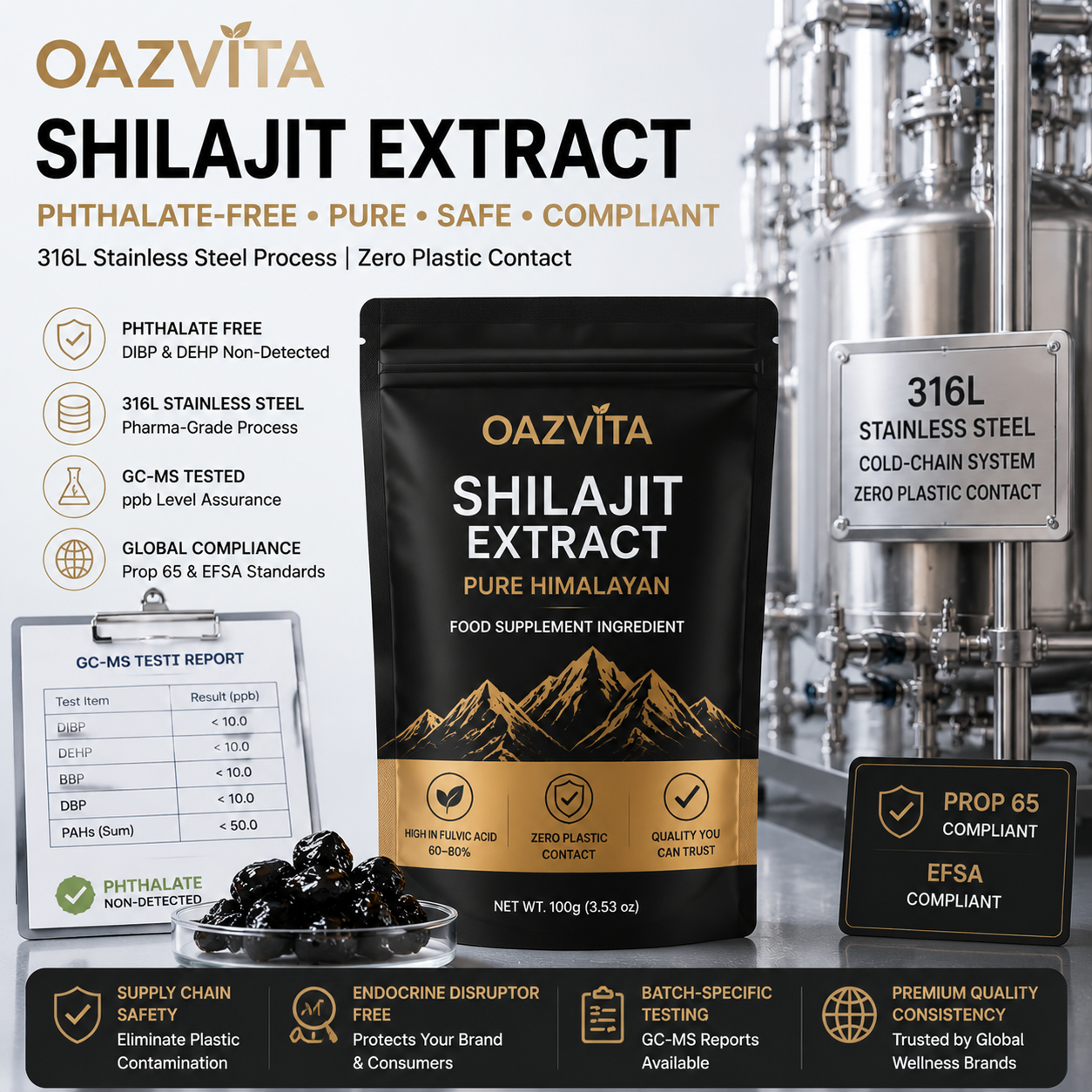
In the high-stakes world of premium supplements, "Himalayan" origin has become a shorthand for quality. However, for QA managers and brand owners, this geographic label often masks a catastrophic supply chain vulnerability: Phthalate contamination. Due to the high Fulvic and Humic acid content (reaching up to 60-80%), Shilajit Resin acts as a natural organic solvent. When raw material is collected or stored in industrial-grade plastic (PE/PP/PVC), it aggressively leaches Diisobutyl phthalate (DIBP) and DEHP directly into the resin. This investigative report explores the "Plastic Bucket Trap," the technical mechanisms of leaching, and how Rainwood Biotech’s 316L stainless steel protocol ensures compliance with Prop 65 and EFSA standards.
Table of Contents
- The Solvent Paradox: Why Shilajit Corrodes Plastic
- The "Plastic Bucket Trap": A Supply Chain Post-Mortem
- The Toxic Trio: DIBP, DEHP, and the Endocrine Disruptor Profile
- Sensory Forensics: Identifying Tainted Resin via Organoleptic Checks
- The Rainwood Solution: Pharma-grade 316L Stainless Steel Cold-Chain
- Compliance and Testing: Navigating Prop 65 & EFSA with GC-MS
- Conclusion: Protecting Brand Equity
1. The Solvent Paradox: Why Shilajit Corrodes Plastic
To understand the risk of contamination, one must first understand the chemistry of the material. Shilajit is not a simple mineral pitch; it is a complex molecular matrix dominated by Fulvic Acid and Humic Acid.
Fulvic acid is a low-molecular-weight organic acid. In the world of chemistry, these are known for their high reactivity and "chelating" properties—the ability to bind to other molecules and carry them into solution. Because Pure Himalayan Shilajit contains such a high concentration of these acids, it possesses what we call a "solvent-like nature."
While a plastic bucket might safely hold water or even mild oils, the acidic pH and molecular structure of Shilajit create a corrosive environment for synthetic polymers. The acids interact with the polymer chains of plastic containers, breaking down the integrity of the material and "pulling" the chemical additives—specifically plasticizers—out of the plastic and into the resin. If your resin has touched plastic for even 48 hours at high altitude temperatures, the leaching process has already begun.
2. The "Plastic Bucket Trap": A Supply Chain Post-Mortem
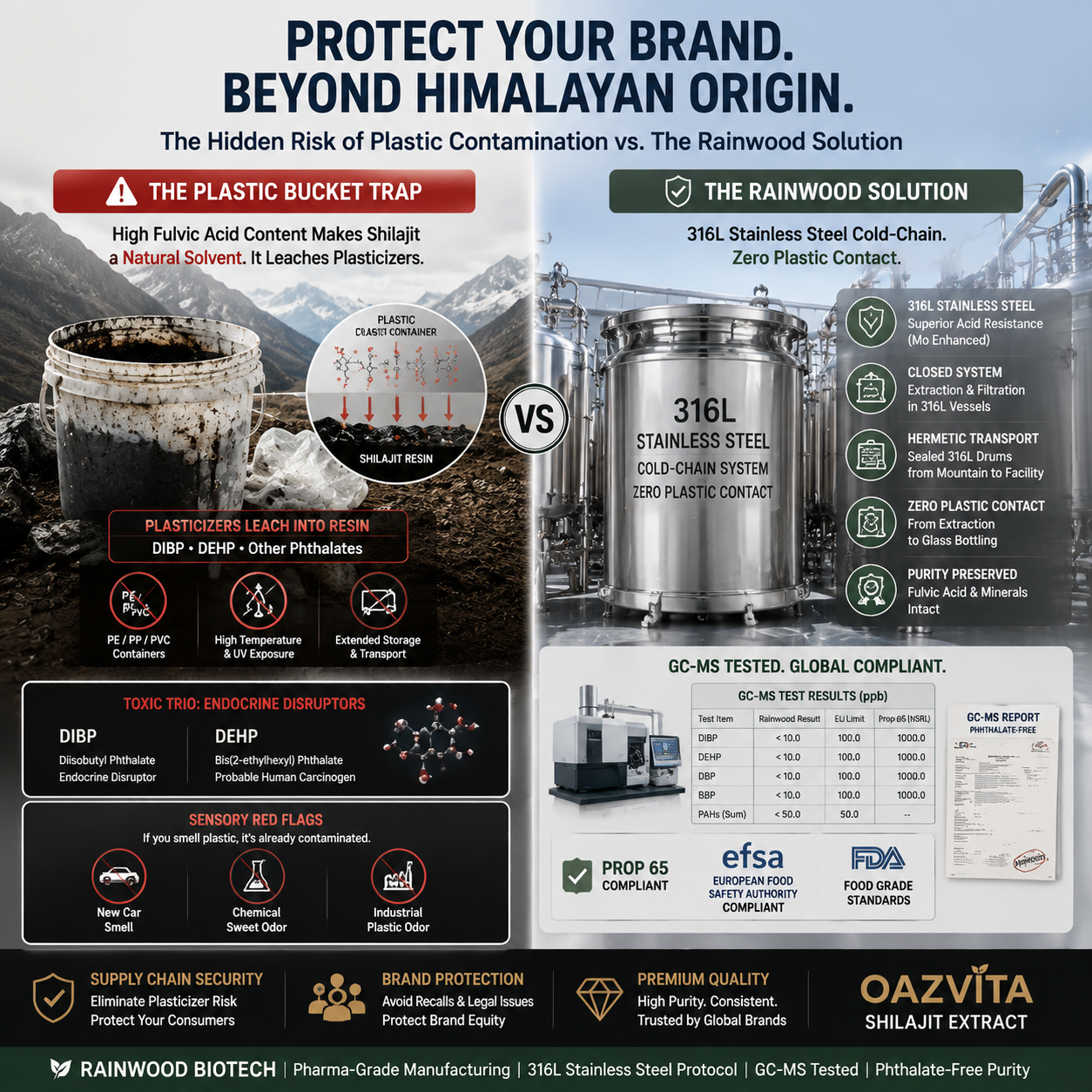
The "Plastic Bucket Trap" is the dirty secret of the Himalayan supply chain. At 14,000 feet, where raw Shilajit is harvested from rock faces, logistics are primitive. Collectors, often local villagers or small-scale contractors, prioritize lightweight, cheap, and durable equipment.
They use:
- Recycled PE (Polyethylene) Buckets: Often sourced from industrial chemical or food-service waste.
- PVC (Polyvinyl Chloride) Bags: Used for initial transport down the mountain.
- PP (Polypropylene) Tubs: Used during the rudimentary "sun-drying" or filtration phases.
These plastics are loaded with phthalates to make them flexible. When the raw, acidic Shilajit sits in these containers under the intense UV radiation and temperature fluctuations of the Himalayas, the plastic "sweats" phthalates directly into the resin. By the time a Western brand receives a "Certificate of Analysis" from a local middleman, the DIBP levels are often already exceeding safety thresholds, but they are rarely tested for at that stage.
3. The Toxic Trio: DIBP, DEHP, and the Endocrine Disruptor Profile
For a Brand Owner, phthalates are not just "impurities"—they are legal and medical liabilities.
- DIBP (Diisobutyl phthalate): Frequently used as a plasticizer. In Shilajit, DIBP is the most common contaminant found during GC-MS testing. It is a known endocrine disruptor that mimics estrogen and can interfere with the human hormonal system.
- DEHP (Bis(2-ethylhexyl) phthalate): Categorized by the EPA and EFSA as a "probable human carcinogen." It is notorious for migrating easily from PVC into oily or acidic substances.
These chemicals are classified as SVHCs (Substances of Very High Concern). For a supplement marketed for "vitality" and "testosterone support" (common claims for Shilajit), the presence of estrogenic endocrine disruptors like DIBP creates a paradoxical and potentially harmful product that can damage a brand's reputation overnight.
4. Sensory Forensics: Identifying Tainted Resin via Organoleptic Checks
While lab testing is the gold standard, QA managers can often identify high-risk batches through a "Sensory Alert" protocol.
Authentic Shilajit Resin should have a pungent, earthy, almost "smoky" or "bituminous" aroma. It should smell like the ancient earth.
The Red Flag: If the resin carries a faint "new car" smell, a chemical-sweet undertone, or a distinct "industrial plastic" odor, it is a sign of severe leaching. These odors are the volatile organic compounds (VOCs) of the plasticizers themselves. If your nose can detect it, the concentration is likely in the hundreds of parts per million (ppm), far exceeding safety limits.
5. The Rainwood Solution: Pharma-grade 316L Stainless Steel Cold-Chain
At Rainwood Biotech, we recognized early on that the only way to eliminate plasticizer risk was to eliminate plastic from the entire lifecycle of the product.
We implemented the 316L Protocol:
- Extraction & Filtration: All raw material processing is conducted in 316L stainless steel vats. Unlike 304 stainless, 316L contains Molybdenum, which provides superior resistance to organic acids (like Fulvic acid) and prevents "pitting" or metallic leaching.
- Cold-Chain Storage: Our resin is moved from the mountain to our facility in hermetically sealed 316L stainless steel drums.
- Zero-Plastic Contact: From the moment of extraction to the final glass bottling, the resin never touches PE, PP, or PVC.
This is not just "better" manufacturing; it is the only way to guarantee a phthalate-free product in an acidic matrix.
6. Compliance and Testing: Navigating Prop 65 & EFSA with GC-MS
Regulatory scrutiny on plasticizers is tightening globally.
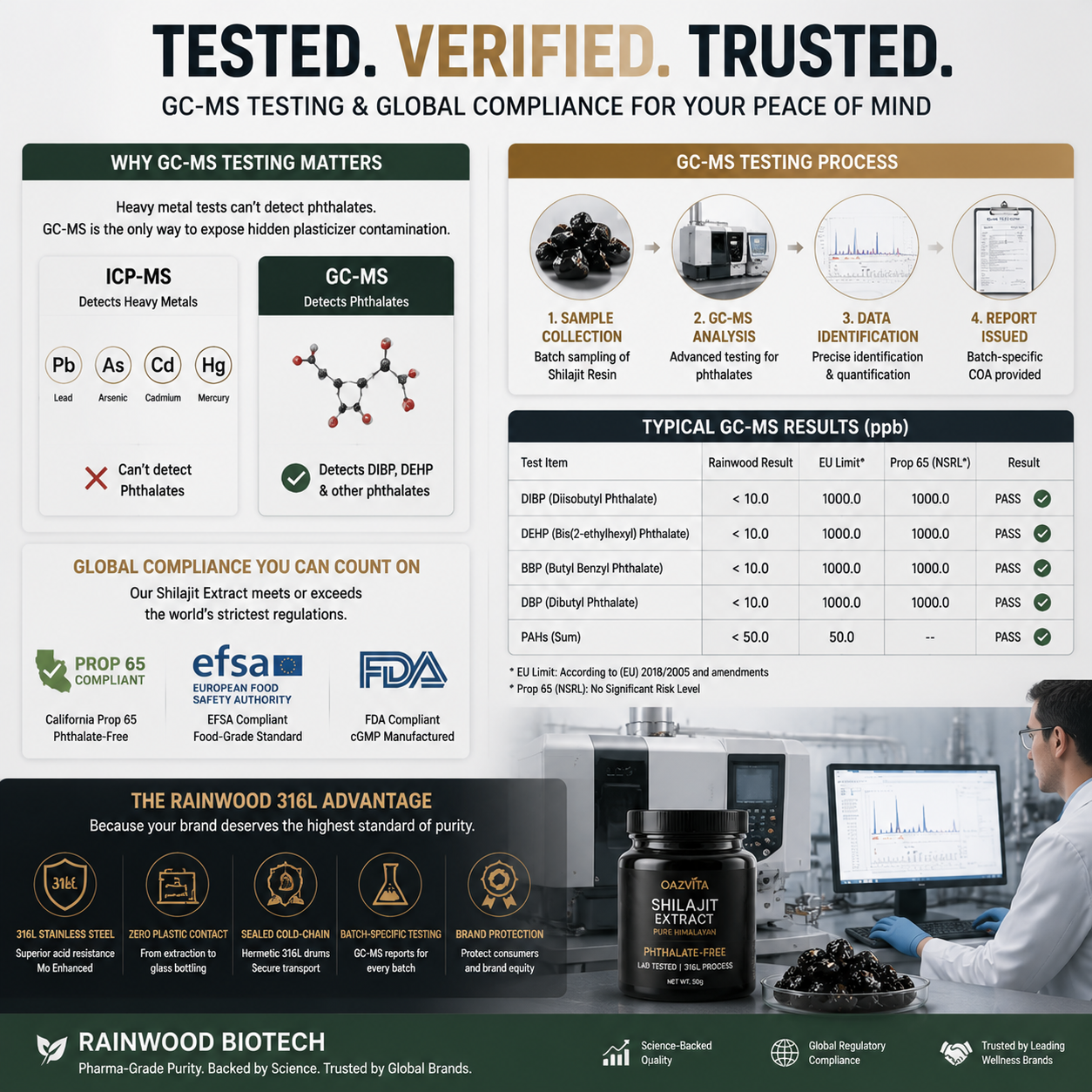
- California Prop 65: Requires clear warnings if a product contains DEHP above the "No Significant Risk Level" (NSRL). Given the daily dosage of Shilajit, even trace contamination can trigger a Prop 65 violation.
- EFSA (European Food Safety Authority): Has set strict Tolerable Daily Intakes (TDIs) for phthalates, with DIBP and DEHP being primary targets for inspectors.
The GC-MS Protocol: Rainwood Biotech utilizes Gas Chromatography-Mass Spectrometry (GC-MS) for every batch. Unlike standard heavy metal testing (ICP-MS), GC-MS is required to detect the specific molecular signatures of phthalates. We test down to the parts-per-billion (ppb) level to ensure our customers can enter any global market without the fear of a recall or a "toxic" label.
7. Conclusion: Protecting Brand Equity
As a Brand Owner, your greatest asset is the trust of your consumers. Selling a "natural" product that contains synthetic endocrine disruptors is more than a compliance failure; it is a breach of that trust.
The Himalayan origin of your Shilajit is only half the story. The other half is how that resin was handled. By choosing a partner like Rainwood Biotech that understands the "solvent nature" of Pure Himalayan Shilajit and invests in 316L stainless steel infrastructure, you are not just buying a raw material—you are buying insurance for your brand’s future.
Ready to upgrade your supply chain?
Contact Rainwood Biotech today for a technical consultation and a copy of our latest Phthalate-Free GC-MS Report.