 EN

Executive Summary & B2B Formulation Guidance
A high CoQ10 assay can still leave form, carrier, method, and stability questions unanswered. Learn how private-label buyers should review the COA.
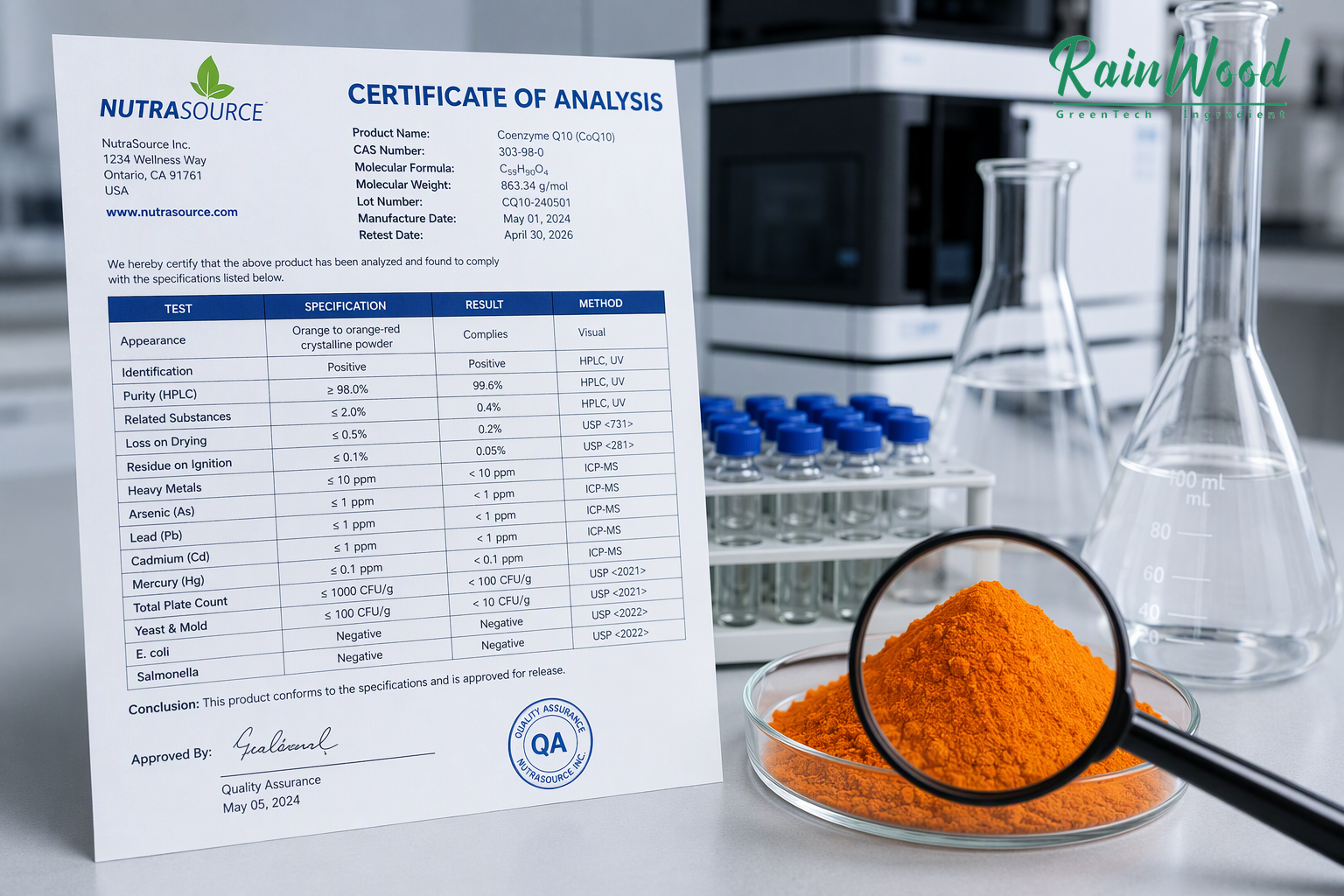
Figure 1: Commercial Inspection of CoQ10 Certificate of Analysis (CoA) with HPLC Vial Racks and Optical Magnification
The COA reports “CoQ10: 99.5%.” Procurement feels safe. Quality asks a follow-up question: 99.5% of what, measured how, and in which redox form? If the answer is unclear, the document may support a number while failing to support the product you plan to sell. This is how a clean-looking COA becomes an expensive formula change after the purchase order.
The assay line is only one part of identity
CoQ10 materials can be identified by a commercial name, a chemical name, a redox form, a physical form, and a carrier system. A COA that lists only “Coenzyme Q10” may not tell the buyer whether the material is ubiquinone or ubiquinol. It may also omit whether the result is as-is, dry basis, or calculated after a conversion step.
The buyer loss is not limited to a technical disagreement. The wrong form can alter package requirements, storage instructions, color, fill weight, marketing copy, and the supporting evidence file. Use the [INTERNAL LINK -> CoQ10 Ingredient Identity Review] to create a four-column review: purchase requirement, COA result, method/evidence, and release decision.
Ask what the method can actually prove
HPLC is a technique family, not a complete method description. The buyer needs the column, mobile phase, detector, standard, sample preparation, run conditions, system suitability, calculation, and reporting basis. If the method separates ubiquinone and ubiquinol, ask for the form-specific result. If it reports total CoQ10 after reduction or oxidation, the report should say so.
Do not equate a high peak with identity without checking retention, reference standard, and method suitability. Do not assume that “UV” or “HPLC” means the same method across suppliers. The [INTERNAL LINK -> CoQ10 HPLC Method Comparison] helps a buyer decide whether two COAs are comparable or require a method bridge.
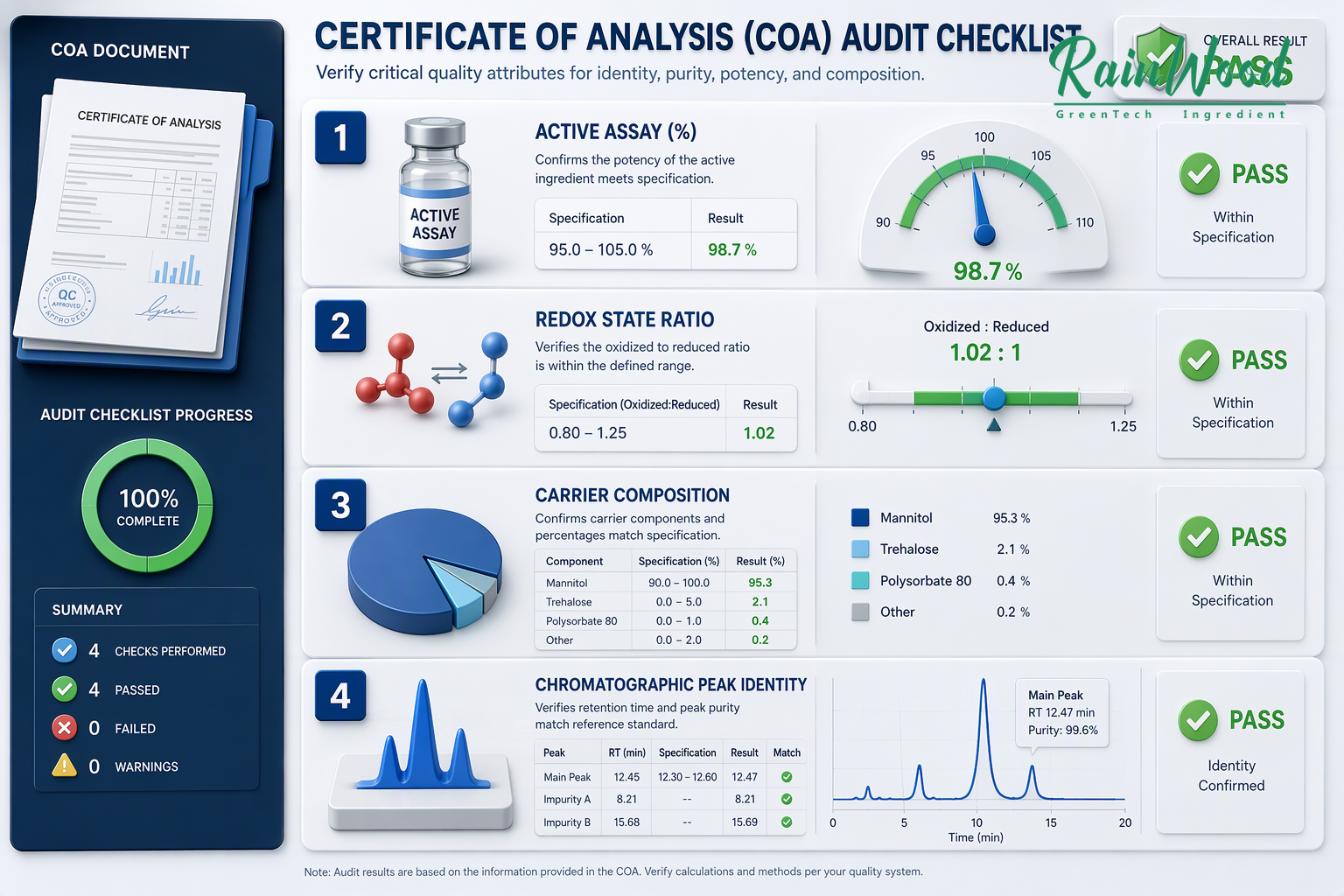
Figure 2: 3D CoA Gap Audit Matrix: Comparing Active Assay, Redox State Ratio, Carrier Composition, and Method Specificity
A COA can miss the carrier question
Premixes and water-dispersible systems may contain starch, cyclodextrin, gum, oil, emulsifier, or other excipients. The active assay may be correct on the active fraction while the product is still unsuitable for your capsule, tablet, or powder stick pack. Request a full composition or carrier statement and verify whether the quoted price is per active kilogram or per premix kilogram.
Ask whether the carrier changes the declared allergen, vegan, non-GMO, or market-specific statement. If the raw material is oil-based, request the oil identity, oxidation controls, and compatibility with the softgel shell. If it is a dry powder, ask for water activity, flow, particle size, and dispersibility where those attributes affect production.
Identity and stability must be read together
Ubiquinol is especially vulnerable to oxidation into ubiquinone during storage and processing. A COA at release may show an acceptable reduced-form result while the finished capsule loses that balance during transport. Conversely, a total CoQ10 result may remain high while the redox ratio changes. The label and evidence file must state which property matters for the marketed product.
Request stability data in the intended package, not only an open laboratory bottle. Ask for oxygen exposure, light conditions, temperature, humidity, time points, and finished-unit assay. If the supplier has only raw powder stability, do not treat it as proof of a softgel or tablet shelf life. Read the [INTERNAL LINK -> CoQ10 Stability and Packaging Blog] before accepting a generic expiry statement.
Use a COA gap review before payment
Mark each field as pass, clarify, or missing:
- exact material name and redox form;
- manufacturer and manufacturing site;
- lot number, manufacture date, and retest/expiry date;
- active assay and method details;
- total CoQ10 versus form-specific content;
- carrier, excipient, and allergen statement;
- moisture, contaminants, and microbiology;
- package and storage requirements;
- stability evidence and sample retention;
- change notification and failed-lot terms.
If three or more critical fields are missing, classify the quote as provisional. Do not let the presence of a signature or company stamp create false certainty. The quality decision should depend on whether the document answers the purchase specification.
How RainwoodBio can support the document review
RainwoodBio publishes a project workflow that includes requirement confirmation, supplier management, testing and release, compliance documentation, and traceability. For a CoQ10 buyer, the useful request is a product-specific document package: identity definition, form, assay basis, carrier statement, target format, stability plan, and market file. Those documents still need to be reviewed against the exact batch and finished product.
RainwoodBio also lists multiple OEM formats. This matters because the COA review should not stop at the raw powder; the buyer should decide how the same material behaves in a hard capsule, softgel, tablet, or sachet. Use the [INTERNAL LINK -> RainwoodBio Quality and Release Process] and [INTERNAL LINK -> CoQ10 OEM Format Comparison] to frame the request.
The decision gate
Approve the COA only when the material named on the document matches the material on the purchase order, the assay method answers the intended question, and the carrier and stability requirements fit the selected format. If the redox form is not relevant to the label, document why. If it is relevant, require form-specific evidence.
Send RainwoodBio the COA, specification, proposed label, target market, format, and quotation for a [INTERNAL LINK -> CoQ10 COA Gap Review]. The deliverable should separate what the document proves from what still needs a sample, method bridge, stability pull, or finished-product test.
Store the COA with the decision, not only the shipment
Quality, procurement, and production should use the same controlled specification and reviewed COA. Record the reviewer, decision, open questions, and related sample or finished-batch record. A document hidden in an email thread cannot reliably prevent a wrong form from being filled, relabeled, or approved.
When a new COA arrives, compare it with the previous version and approved method. Look for changes in form, basis, carrier, laboratory, standard, storage, or reporting language. If the result is not comparable, hold the release decision until the method or sample question is resolved.
Send the COA, specification, label, form, format, market, and supplier quotation for a [INTERNAL LINK -> CoQ10 COA Contact Us Page] gap review. Include the planned release date and whether the document is for raw material, pilot, or finished product.
Frequently asked questions
Does a 99% CoQ10 assay prove ubiquinol?
No. The report must identify the redox form and use a method capable of supporting that result.
Is HPLC automatically enough for a CoQ10 identity claim?
No. HPLC is an instrument technique. Suitability depends on standards, separation, sample preparation, and reporting.
Can a raw-material COA support a finished softgel expiry?
Not by itself. Finished format, package, storage, and time-point evidence are needed.
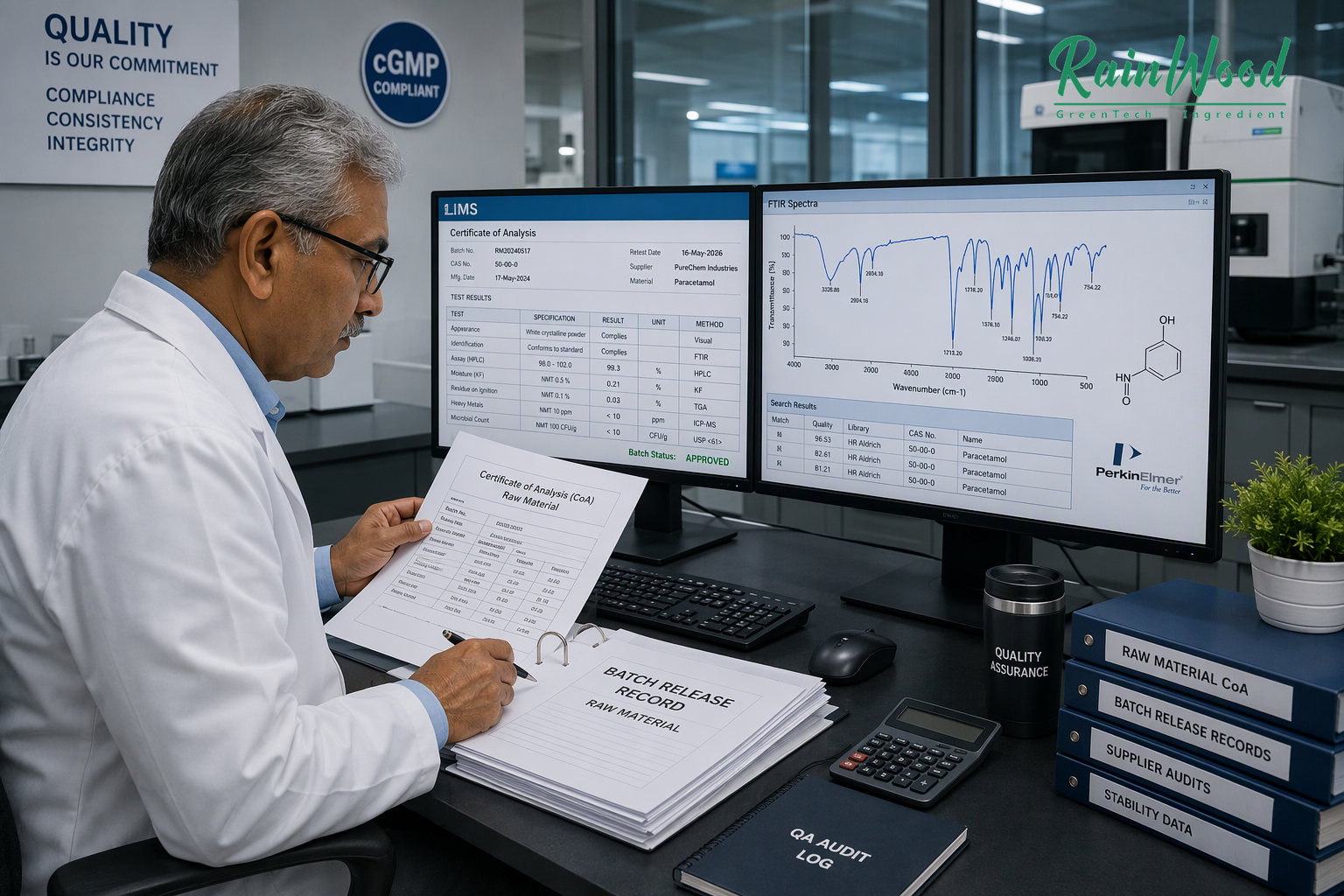
Figure 3: Senior QA Compliance Auditor Reviewing Raw Material CoA Release Records and FTIR Spectroscopy Charts
References
- Stability of Reduced and Oxidized Coenzyme Q10 in Finished Products: https://pubmed.ncbi.nlm.nih.gov/33673604/
- Quality Control Assessment of Commercial CoQ10 Supplements: https://pmc.ncbi.nlm.nih.gov/articles/PMC2170950/
- Ubiquinone-Ubiquinol Redox Cycle Overview: https://pubmed.ncbi.nlm.nih.gov/38928470/
- RainwoodBio homepage: https://www.rainwoodbio.com/
*This article is for B2B procurement and educational purposes. Product identity, analytical, safety, labeling, and regulatory requirements must be confirmed for the exact ingredient, finished product, and destination market.*
Explore RainwoodBio CoQ10 & Custom Formulation Capabilities
- Custom CoQ10 Hard Capsules & High-Potency Blends – Precision cGMP encapsulation for CoQ10 with PQQ, L-Carnitine, and Vitamin E co-factors.
- High-Absorption CoQ10 Softgels & Lipid Suspensions – MCT/Olive oil carrier systems with natural tocopherol stabilization.
- Water-Soluble CoQ10 Micro-Encapsulated Powders & Stick Packs – Enhanced bioavailability single-serve sachets and beverage-grade premixes.
- OEM / ODM Contract Manufacturing Services – End-to-end formulation development, pilot batch scaling, and US/EU regulatory compliance dossiers.
- Contact RainwoodBio Technical Sales – Request CoA, HPLC analytical protocols, pilot stability samples, or commercial quotation.
Table of Contents
- The assay line is only one part of identity
- Ask what the method can actually prove
- A COA can miss the carrier question
- Identity and stability must be read together
- Use a COA gap review before payment
- How RainwoodBio can support the document review
- The decision gate
- Store the COA with the decision, not only the shipment
- Frequently asked questions
- References