 EN
Executive Summary & B2B Formulation Guidance
Avoid costly CoQ10 identity mistakes. Compare ubiquinone, ubiquinol, source, assay, stability, and documentation before you quote a private-label product.
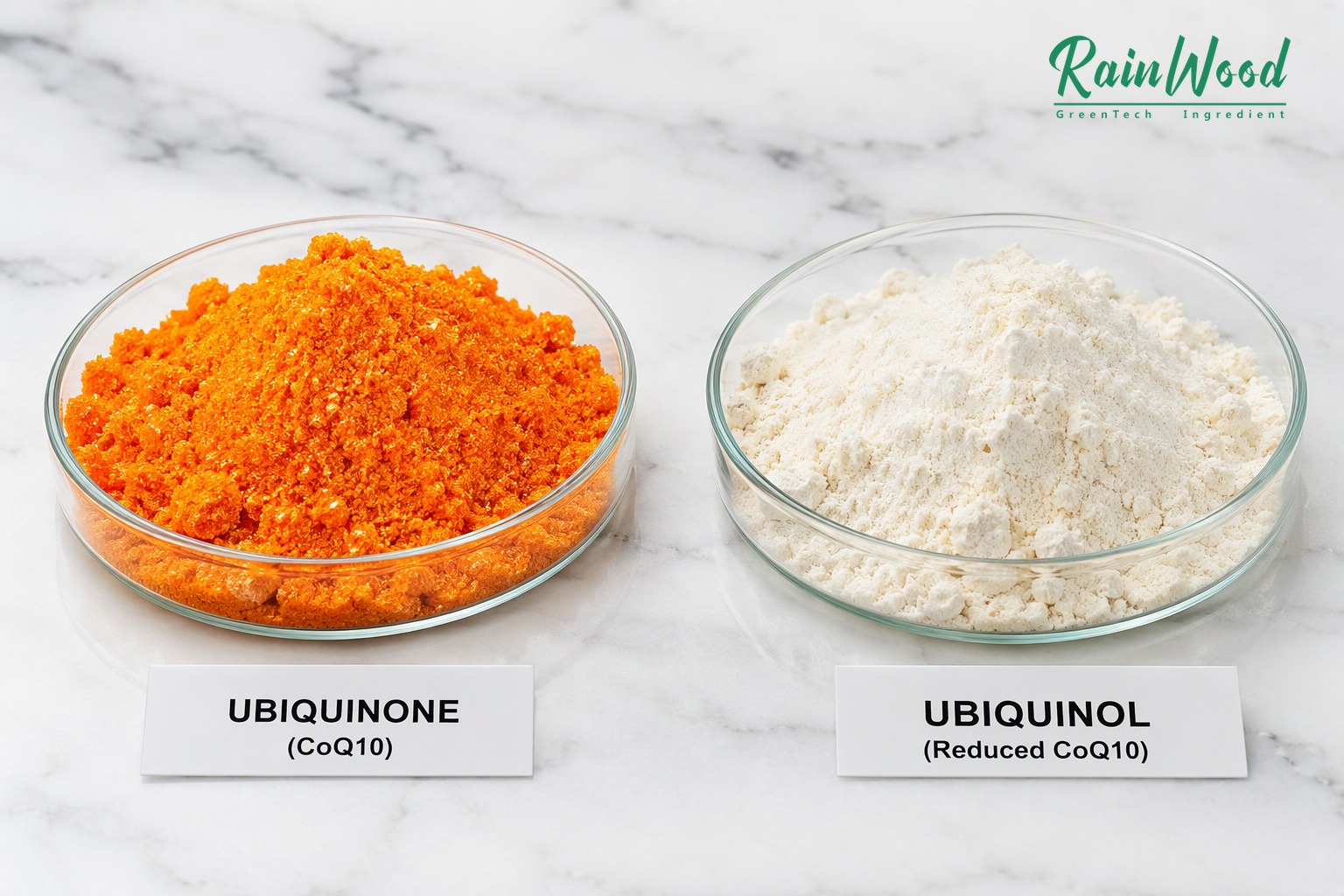
Figure 1: Analytical Comparison of Orange Ubiquinone Crystalline Powder vs Pristine Off-White Ubiquinol Active Powder
Your quotation says “CoQ10,” but your customer asks one question the quote may not answer: which CoQ10? Ubiquinone and ubiquinol are interconvertible redox forms, yet they are not interchangeable purchase specifications. They can differ in color, stability, processing, packaging, testing, and price. If your brand artwork is approved before the exact form is locked, the same order can create a labeling problem, a stability problem, or a margin problem.
The name CoQ10 is too broad for a purchase order
Coenzyme Q10 is a molecule family name used in scientific, commercial, and consumer conversations. Ubiquinone is the oxidized form; ubiquinol is the reduced form. A supplier may also offer crystalline powder, oil suspension, solubilized material, water-dispersible powder, or a premix. Each description answers a different question.
The buyer loss is simple: a broad name can hide a different material. A price per kilogram may look attractive because the supplier quoted a lower-cost ubiquinone powder while the product page promises a premium ubiquinol softgel. Or a formulation team may calculate a capsule around a pure powder while purchasing receives a carrier-based premix. The [INTERNAL LINK -> CoQ10 Ingredient Identity Review] should be completed before a sample is treated as a commercial specification.
Ubiquinone and ubiquinol are not two marketing colors
Ubiquinone and ubiquinol participate in a redox cycle in the body, but their commercial handling can be different. Ubiquinol is generally more sensitive to oxidation during storage and processing. Ubiquinone can also change during storage, especially when the product matrix, oxygen exposure, light, or method allows conversion or degradation. Therefore, “reduced form” is not enough information for a release plan.
Ask the supplier to state the form on the specification, COA, purchase order, formula, label, and finished-product release record. Ask whether the reported amount is the declared form alone or total CoQ10 after conversion and calculation. If the supplier reports a single number without explaining the redox basis, your quality team cannot compare it reliably with another quote.
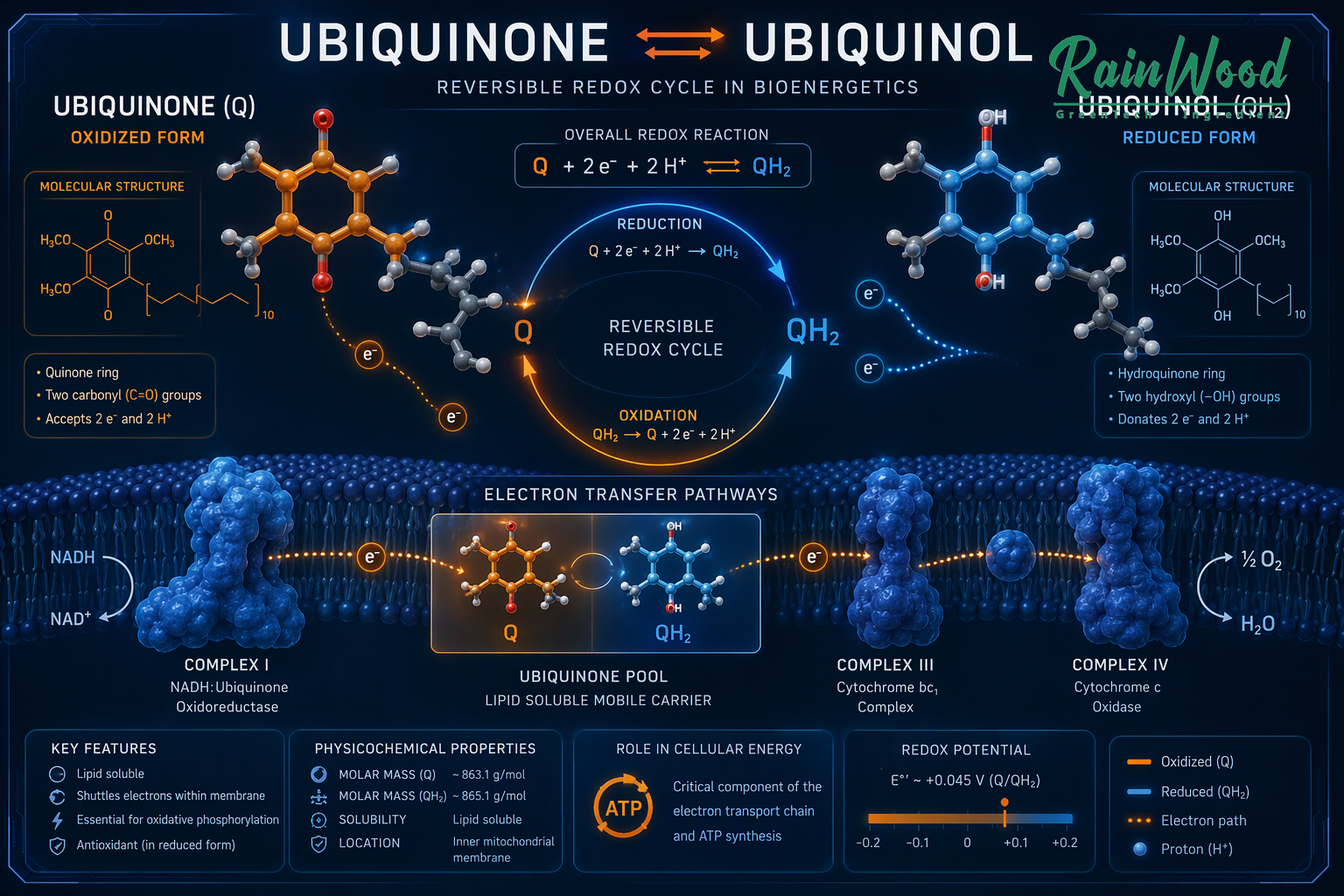
Figure 2: 3D Molecular Redox Transition Model: Biochemical Interconversion Cycle Between Ubiquinone and Ubiquinol
A carrier can change the commercial identity
Many CoQ10 products contain oil, emulsifiers, cyclodextrin, starch, gum, or other carriers. A “100 mg CoQ10 powder” may contain 100 mg of a premix that delivers less than 100 mg of CoQ10. A “water-dispersible CoQ10” may be a solid formulation designed to disperse in water, not a molecule that has become intrinsically water-soluble.
Request a composition statement that separates active CoQ10 from carrier and processing aids. Confirm the active basis: as-is, dry basis, or a declared content after assay correction. The [INTERNAL LINK -> CoQ10 Label Math and Dose Calculator] can be used to reconcile raw-material potency with the finished serving.
Do not let the sample decide the form by appearance
Color and texture are useful observations, not identity proof. A yellow-orange powder, an amber oil, or an off-white premix may be consistent with more than one grade. A softgel filled with oil may look premium while carrying the same active amount as a lower-cost hard capsule. The sample must be connected to a lot number, manufacturing date, specification, and test report.
For a new supplier, ask for two documents before a commercial quote: a product specification that names the redox form and a sample COA that reports the form-specific method or calculation. If the supplier uses a trademarked or branded raw material, request authorization and scope documents rather than copying the brand name into your artwork.
Make the redox form part of change control
Changing from ubiquinone to ubiquinol is not a simple raw-material substitution. Recalculate the input weight, capsule fill, carrier ratio, antioxidant system, package barrier, shelf-life target, warning language, and marketing copy. If the form changes after artwork approval, the product may require a new pilot and a new stability review.
Record the approved form in a controlled material code. The code should distinguish raw powder from oil suspension, pure active from premix, and ubiquinone from ubiquinol. This helps warehouse, production, quality, and customer service use the same language. It also makes supplier comparison faster because the buyer is comparing like with like.
How RainwoodBio can support the identity decision
RainwoodBio publishes a workflow covering requirement confirmation, raw-material supplier management, production control, testing and release, compliance documentation, warehousing, logistics, and traceability. For a CoQ10 project, those capabilities should be converted into a product-specific identity package rather than presented as a generic quality slogan. The buyer can ask for the exact form, activity or content basis, carrier statement, package, target market, and finished-format plan before a quote is finalized.
RainwoodBio also publishes OEM support for hard capsules, softgels, tablets, powder sachets, and other formats. That allows a buyer to compare form and dosage format together instead of choosing an ingredient first and discovering later that the package or process cannot protect it. Review the [INTERNAL LINK -> CoQ10 OEM Format Comparison] and [INTERNAL LINK -> RainwoodBio Quality and Release Process] before approving a production route.
The buyer decision gate
Do not approve the quote until these fields are complete:
- exact form: ubiquinone, ubiquinol, or another qualified derivative;
- active content versus carrier or premix weight;
- assay method, standard, sample preparation, and reporting basis;
- source and manufacturer identity;
- package, storage, and shelf-life target;
- finished format and intended daily serving;
- target market and permitted customer-facing language;
- change-notification and failed-lot replacement terms.
Send RainwoodBio your current COA, proposed label, target market, dose, format, quantity, and supplier quotation for a [INTERNAL LINK -> CoQ10 Specification and Quotation Review]. The useful output is not another general price; it is a side-by-side comparison showing which material the price actually covers.
Make the quote answer the identity question
Ask every supplier to place the exact form, active basis, carrier, package, MOQ, lead time, and test panel directly on the quotation. If the quotation only says “CoQ10 powder,” mark it as incomplete and request a revised version. This protects finance from comparing different materials and protects the label team from building a product around an unconfirmed form.
When the quote is revised, compare the new version with the sample COA and specification. Record which fields changed and whether a new sample or pilot is needed. A small wording change from ubiquinol to CoQ10 can signal a real material change, not a copy-editing preference.
Send the quote, COA, target form, format, market, and label draft for a [INTERNAL LINK -> CoQ10 Identity Contact Us Page] review before approval.
Frequently asked questions
Is ubiquinol always better than ubiquinone?
No automatic conclusion is justified. Formulation, carrier, dose, stability, and the evidence for the exact finished product all matter.
Can a CoQ10 COA use “CoQ10” without naming the redox form?
It may be insufficient for a purchase specification when the label or formulation depends on a specific form. Request clarification and supporting identity evidence.
Can a supplier switch forms without changing the label?
Not without a documented change assessment. The switch may affect dose math, stability, claims, package, and target-market review.

Figure 3: cGMP Cleanroom Analytical Chemistry Lab with Dual-Column HPLC Inspecting Redox State Purity
References
- NCBI LiverTox, Coenzyme Q10: https://www.ncbi.nlm.nih.gov/books/NBK603562/
- The Ubiquinone-Ubiquinol Redox Cycle and Its Clinical Consequences: https://pubmed.ncbi.nlm.nih.gov/38928470/
- RainwoodBio homepage: https://www.rainwoodbio.com/
- RainwoodBio OEM service: https://www.rainwoodbio.com/oem
*This article is for B2B procurement and educational purposes. Product identity, analytical, safety, labeling, and regulatory requirements must be confirmed for the exact ingredient, finished product, and destination market.*
Explore RainwoodBio CoQ10 & Custom Formulation Capabilities
- Custom CoQ10 Hard Capsules & High-Potency Blends – Precision cGMP encapsulation for CoQ10 with PQQ, L-Carnitine, and Vitamin E co-factors.
- High-Absorption CoQ10 Softgels & Lipid Suspensions – MCT/Olive oil carrier systems with natural tocopherol stabilization.
- Water-Soluble CoQ10 Micro-Encapsulated Powders & Stick Packs – Enhanced bioavailability single-serve sachets and beverage-grade premixes.
- OEM / ODM Contract Manufacturing Services – End-to-end formulation development, pilot batch scaling, and US/EU regulatory compliance dossiers.
- Contact RainwoodBio Technical Sales – Request CoA, HPLC analytical protocols, pilot stability samples, or commercial quotation.
Table of Contents
- The name CoQ10 is too broad for a purchase order
- Ubiquinone and ubiquinol are not two marketing colors
- A carrier can change the commercial identity
- Do not let the sample decide the form by appearance
- Make the redox form part of change control
- How RainwoodBio can support the identity decision
- The buyer decision gate
- Make the quote answer the identity question
- Frequently asked questions
- References