 EN
EN

### Executive Summary
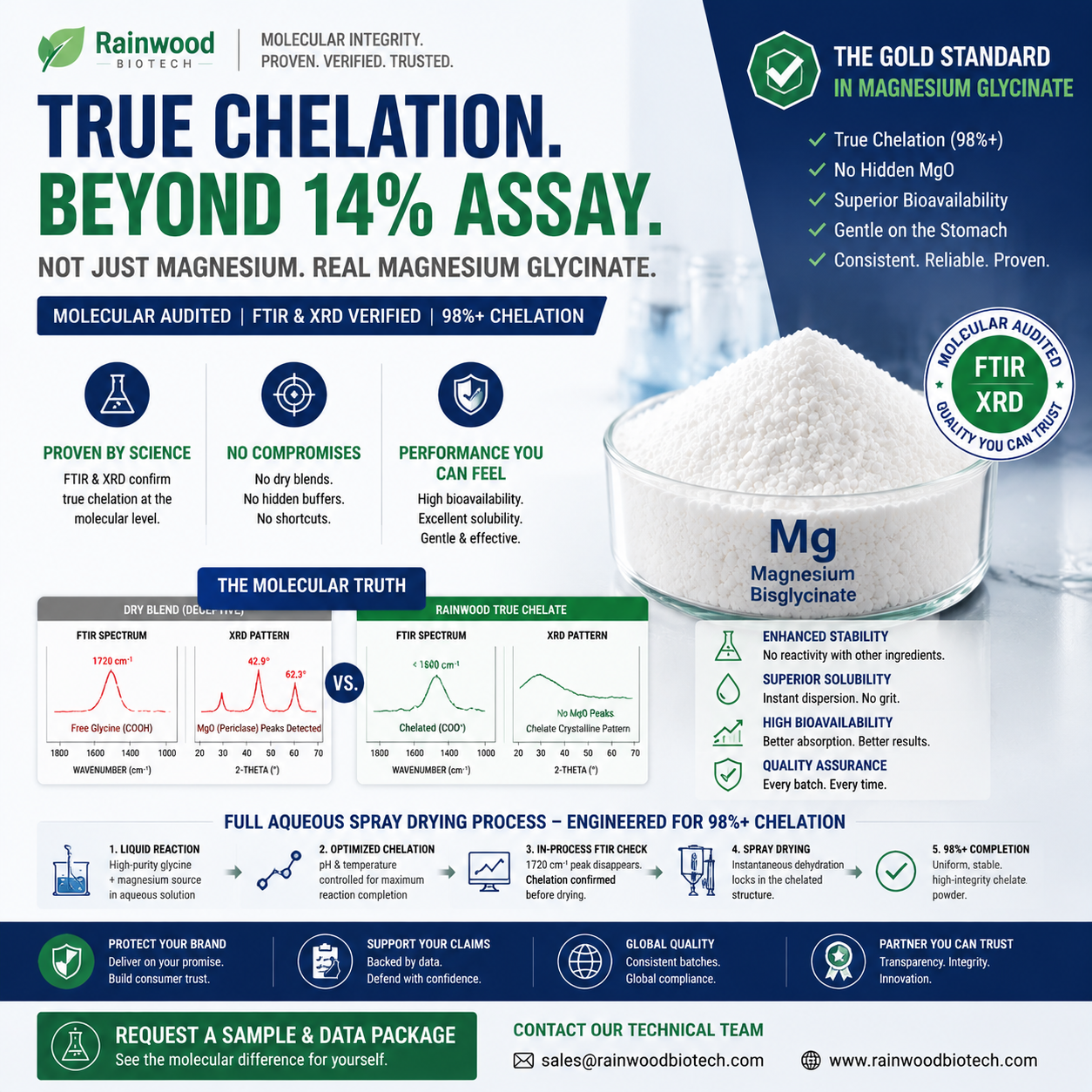
In the dietary supplement industry, "Magnesium Glycinate" is often treated as a commodity defined by a single number: 14% elemental magnesium. However, for R&D and QA professionals, this elemental assay is a dangerous oversimplification. A product can easily pass a titration or ICP-MS test while being nothing more than a "dry blend" of Magnesium Oxide and unreacted Glycine. This article explores the "Molecular Audit"—using Fourier Transform Infrared Spectroscopy (FTIR) and X-Ray Diffraction (XRD) to prove true chelation. We examine why simple dry blends fail these tests and how Rainwood Biotech’s "Full Aqueous Spray Drying" process ensures 98%+ chelation, providing the only valid "Gold Standard" for high-integrity supply chains.
---
### Table of Contents
1. The 14% Illusion: Why Elemental Assay is Not Enough
2. FTIR Analysis: The Vibrational Fingerprint of Chelation
- The Carboxylic Acid Shift: From 1720 cm⁻¹ to <1600 cm⁻¹
3. XRD Logic: Mapping the Crystalline Landscape
- Identifying the "Periclase" Ghost: The MgO Signature
4. The "Buffered" Deception: How Dry Blends Fail the Molecular Test
5. Rainwood’s Solution: Full Aqueous Spray Drying and 98% Completion
6. Establishing the Gold Standard: Batch-Specific Molecular Audits
7. Conclusion & Call to Action
---
1. The 14% Illusion: Why Elemental Assay is Not Enough
For most procurement departments, the quality check for Magnesium Glycinate begins and ends with an elemental assay. If the lab returns a value of 14.1% Magnesium, the batch is approved. This is the "14% Illusion."
Elemental assays (via ICP-MS or EDTA titration) measure the amount of magnesium present, but they are entirely blind to the state of that magnesium. Magnesium Oxide (MgO), which contains roughly 60% elemental magnesium, is frequently used to "buffer" or simply dilute glycine to reach the target 14%. To a standard titration test, a physical mixture of 23% MgO and 77% Glycine looks identical to pure, fully-reacted Magnesium Bisglycinate.
However, the physiological performance is worlds apart. True chelation—where the magnesium ion is chemically bonded to two glycine ligands—protects the mineral from reacting with phytates in the gut, prevents laxative effects, and ensures superior bioavailability. For a brand owner, the risk of using a dry blend isn't just a label claim issue; it's a performance failure that damages consumer trust. To solve this, we must look past the atoms and examine the molecules.
### 2. FTIR Analysis: The Vibrational Fingerprint of Chelation
Fourier Transform Infrared Spectroscopy (FTIR) is the primary tool for verifying the chemical bond in Magnesium Glycinate. It works by passing infrared radiation through a sample and measuring the frequencies at which the molecules vibrate.
#### The Carboxylic Acid Shift: From 1720 cm⁻¹ to <1600 cm⁻¹
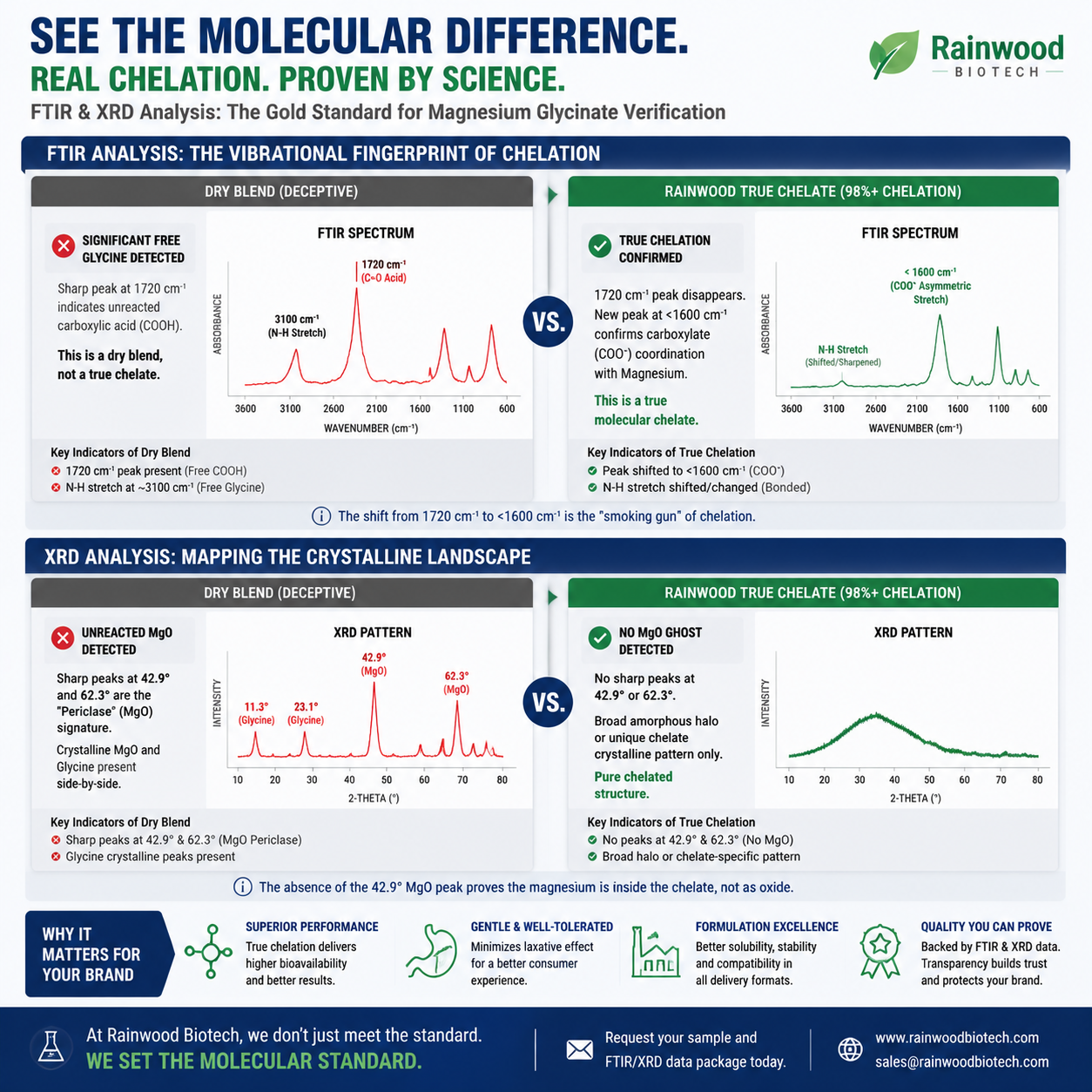
The defining feature of a glycine molecule is its carboxylic acid group (-COOH). In its free, unreacted state, the C=O (carbonyl) bond in glycine vibrates at a specific frequency, typically appearing as a sharp, intense peak at 1720 cm⁻¹. This is the "acid" signal.
When a true chelation reaction occurs, the magnesium ion displaces the hydrogen atom on the glycine’s carboxyl group. This transforms the carboxylic acid into a carboxylate group (-COO⁻) that is now coordinate-bonded to the metal. This chemical change significantly alters the bond’s vibration. The delocalization of electrons across the O-C-O system effectively "softens" the bond, lowering its vibrational frequency.
In a fully reacted Rainwood Biotech sample, the peak at 1720 cm⁻¹ disappears. It is replaced by a new, broad peak at below 1600 cm⁻¹ (typically between 1580 and 1595 cm⁻¹). This shift is the "smoking gun" of chelation. If an FTIR spectrum of a "Magnesium Glycinate" product shows a significant peak at 1720 cm⁻¹, it is a definitive indication of free, unreacted glycine—a hallmark of a dry blend.
Furthermore, we look for the N-H stretching vibrations of the amino group. In free glycine, these appear around 3100 cm⁻¹. Upon chelation with magnesium, these peaks often shift or sharpen as the nitrogen's lone pair becomes involved in a coordinate covalent bond with the magnesium center, forming a stable five-membered ring structure. This dual-point attachment (bidentate chelation) is what provides the stability required for gastric bypass. Without the shift in both the carboxyl and amino regions, you are simply looking at a mixture of ingredients, not a molecular entity.
### 3. XRD Logic: Mapping the Crystalline Landscape
While FTIR identifies the bonds, X-Ray Diffraction (XRD) identifies the structure. Every crystalline substance has a unique XRD pattern, much like a fingerprint, based on how its atoms are arranged in space. In the world of mineral chelates, XRD is our most powerful tool for detecting "uninvited guests" like unreacted oxides.
#### Identifying the "Periclase" Ghost: The MgO Signature
The most common "buffer" used in low-grade magnesium products is Magnesium Oxide. MgO has a very distinct crystalline structure known as Periclase. On an XRD graph, Periclase produces sharp, unmistakable peaks at specific 2-theta angles—most notably at 42.9° and 62.3°.
When we analyze a pure, spray-dried Magnesium Bisglycinate chelate, the XRD pattern should show the unique crystalline phase of the chelate itself. True Magnesium Bisglycinate typically exhibits a more complex, multi-peak pattern at lower angles or, if spray-dried correctly into an amorphous state, a broad "halo" with no sharp crystalline spikes.
In a "deceptive" dry blend, the XRD pattern will clearly show the "spikes" of MgO and the characteristic peaks of crystalline Glycine sitting side-by-side. For an R&D manager, seeing a peak at 42.9° (2nd theta) is an immediate red flag. It means the magnesium isn't inside a glycine ring; it’s still in its oxide form, likely resulting in poor solubility and the "gritty" mouthfeel often associated with inferior powders. This is not just a quality issue; it is a fundamental breakdown in the promised molecular delivery system. By the time that MgO reaches the acidic environment of the stomach, it will dissociate into MgO and HCl reaction products, losing the "stealth" benefits of the glycinate carrier.
### 4. The "Buffered" Deception: How Dry Blends Fail the Molecular Test
The term "Buffered Magnesium Glycinate" is often used in the industry to describe a product where Magnesium Oxide is intentionally added to the chelate. While this is a legitimate product category if disclosed, the problem arises when "Pure" Magnesium Glycinate is secretly buffered or is simply a dry blend masquerading as a chelate.
A dry blend is a mechanical mixture. No matter how finely you mill it, the magnesium and glycine molecules are just neighbors—they haven't "shaken hands" chemically. These products fail the "Molecular Audit" because:
1. Solubility is Biphasic: The glycine dissolves instantly, while the MgO remains suspended or precipitates, leading to inconsistent dosing in liquid applications. This is particularly problematic for RTD (Ready-to-Drink) formulators who find white sediment at the bottom of their bottles despite "meeting assay."
2. Stability is Low: Without the protection of the chelate ring, the mineral is prone to reacting with other ingredients in a formulation. Free Magnesium ions are highly reactive. They can catalyze the oxidation of sensitive vitamins or form insoluble complexes with botanical polyphenols, leading to darkening of the powder or "spotting" in tablets.
3. Bioavailability is Compromised: The body treats a dry blend as Magnesium Oxide. This means the Mg²+ ion is released too early in the digestive tract, where it can cause osmotic pressure changes, leading to the very laxative effect that consumers take Magnesium Glycinate to avoid.
### 5. The Thermodynamics of Real Chelation: Why Dry Mixing Isn't Enough
Many manufacturers attempt to "react" magnesium and glycine in a semi-dry state (granulation) to save on energy costs. However, chelation is a sensitive thermodynamic process. It requires a specific molar ratio, a controlled aqueous environment, and sufficient time for the ligands to coordinate around the metal ion.
In a dry or semi-dry state, the "mean free path" of the molecules is too short. The magnesium ions simply cannot migrate effectively to the glycine sites. This results in "partial chelation"—a messy hybrid where some glycine is bonded, some is free, and a core of MgO remains unreacted. Only in a full aqueous solution, where both reactants are fully solvated, can the reaction reach its equilibrium point of maximum chelation. This is where Rainwood Biotech refuses to cut corners.
### 6. Rainwood’s Solution: Full Aqueous Spray Drying and 98% Completion
At Rainwood Biotech, we believe that chelation is a process, not just a label. Our "Full Aqueous Spray Drying" process is designed to ensure that the reaction goes to thermodynamic completion.
1. The Liquid Phase Reaction: We do not dry-blend. We begin by dissolving glycine in purified water and introducing the magnesium source into a high-energy liquid environment. This allows the molecules to move freely and find their coordinate positions. We use high-shear mixing to ensure total dispersion.
2. pH and Temperature Control: Chelation is pH-dependent. We carefully monitor the solution to ensure the glycine is in its anionic form, optimized for binding to the Mg²⁺ cation. Temperature is maintained to overcome the activation energy barrier of the coordination bond without degrading the amino acid.
3. In-Process Validation: Unlike others who check quality only at the end, we perform in-process checks. If the FTIR signature doesn't show the disappearance of the 1720 cm⁻¹ peak in the liquid phase, the batch doesn't move to the dryer.
4. Instantaneous Dehydration: Once the reaction reaches 98%+ completion, the solution is spray-dried. This "locks" the chelated structure into a stable, amorphous or micro-crystalline powder. The rapid evaporation of water prevents the "de-chelation" that can occur during slow tray drying.
The result is a product that is molecularly homogenous. Every single particle of Rainwood Magnesium Glycinate is a chelate, not a mixture of two different powders. This homogeneity translates to perfect flowability in manufacturing and perfect performance in the consumer's body.
### 7. Establishing the Gold Standard: Batch-Specific Molecular Audits
In an era of increasing regulatory scrutiny and "Amazon-ready" brand competition, "trust me" is no longer a viable supply chain strategy. Rainwood Biotech is moving the industry toward a new "Gold Standard."
We don't just provide a Certificate of Analysis (CoA) with elemental numbers. We offer Batch-Specific FTIR and XRD overlays upon request. We show our customers the disappearing 1720 cm⁻¹ peak and the absence of the 42.9° MgO peak. This level of transparency is rare in the mineral industry, but we believe it is necessary to protect our partners' brands.
For a QA Manager, this documentation is the ultimate insurance policy. It proves that the product you are putting into your capsules is exactly what you claim on the label: a premium, high-bioavailability mineral chelate. In the event of a regulatory audit or a "clean label" challenge, having a molecular fingerprint of your raw material is an unassailable defense.
### 8. Conclusion & Call to Action
The difference between a "14% Magnesium" dry blend and a 98% reacted Magnesium Glycinate is the difference between a commodity and a premium health solution. As R&D and QA professionals, your reputation depends on the molecular integrity of your ingredients. The "Molecular Audit" is not just a laboratory exercise; it is the foundation of product efficacy.
Don't be fooled by the "Elemental Illusion." Demand the data that proves the bond.
**Ready to see the data for yourself?**
Contact Rainwood Biotech today to request a sample of our Magnesium Bisglycinate and our comprehensive FTIR/XRD technical dossier. Let us show you what true chelation looks like under the microscope. We invite you to challenge our batch-to-batch consistency with your own third-party testing—we are confident the "Molecular Audit" will bear out the Rainwood difference.
Rainwood Biotech: Molecular Integrity by Design.