 EN
EN
![[Perspective 04: The Lead Trap] - Is Your Magnesium Source a Liability in California?](https://shopcdnalpha.grainajz.com/category/424057/3081/525fab33961160962dfc74771b9e18f0/Magnesium_Glycinate_%E4%B8%BB%E5%9B%BE1.png)
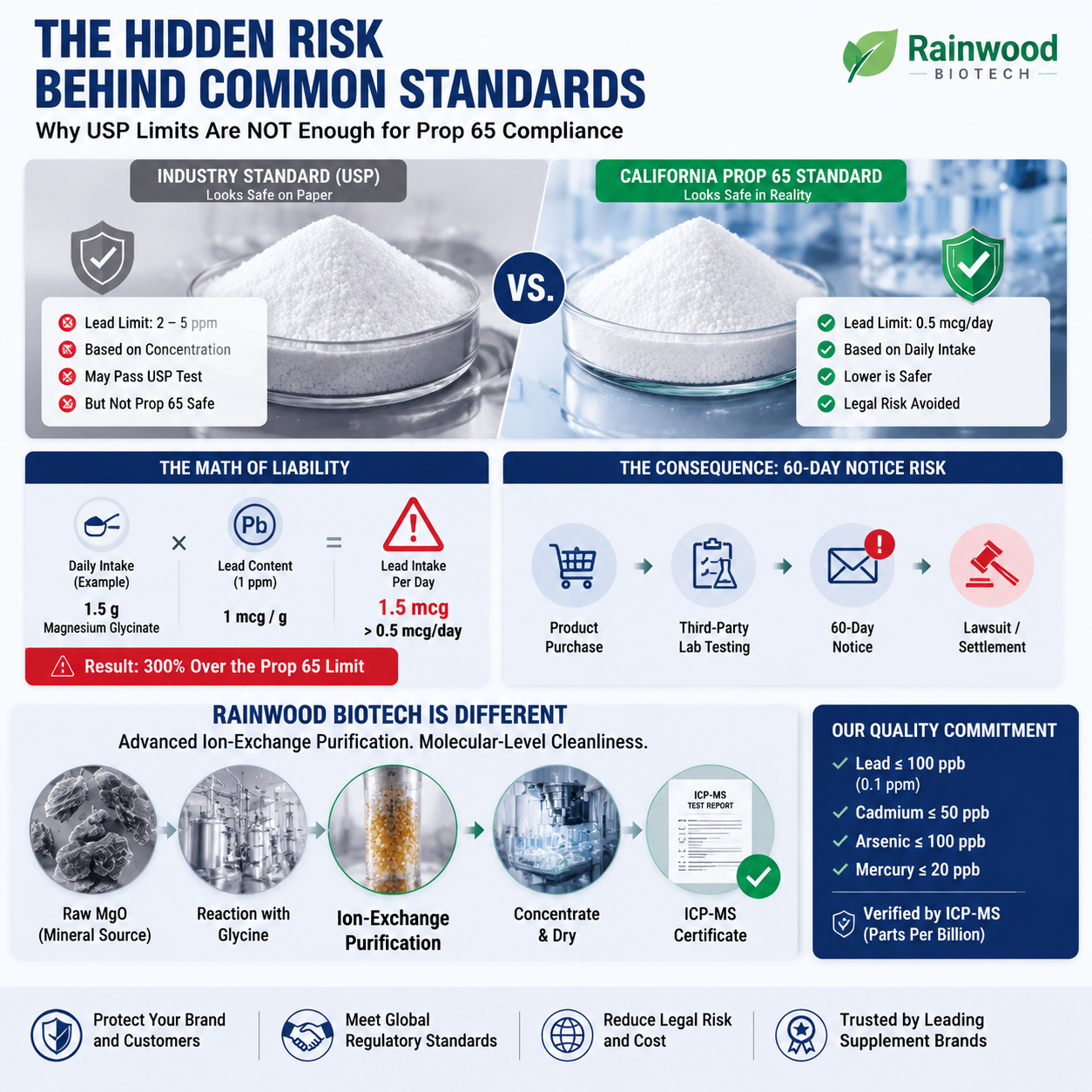
Executive Summary: Magnesium Glycinate is currently the gold standard for bioavailability in the global nutraceutical market. However, for Compliance Officers and QA Directors, this success is shadowed by a significant regulatory vulnerability: the pervasive presence of geological heavy metals—specifically lead—found in Magnesium Oxide (MgO) precursors. While most manufacturers rely on USP standards (2–5 ppm) for batch release, these benchmarks are fundamentally inadequate for meeting California's Proposition 65 'Safe Harbor' level of 0.5 mcg/day. This investigative report explores the geological origins of this contamination, the math of the 'USP vs. Prop 65' gap, the catastrophic financial impact of '60-Day Notices,' and Rainwood Biotech's advanced solution: a liquid-phase Ion-Exchange resin purification process that eliminates lead at the molecular level, ensuring that your Magnesium Glycinate is not just a high-quality ingredient, but a legally defensible asset.
Table of Contents
- 1. The Global Magnesium Boom and the Regulatory Blind Spot
- 2. The Geological Legacy: Why Magnesium Oxide is Naturally 'Dirty'
- 3. The Regulatory Divergence: USP vs. Proposition 65
- 4. The Math of Liability: Why 1 PPM is Still Too High
- 5. The '60-Day Notice' Nightmare: Anatomy of a Lawsuit
- 6. Beyond Filtration: Rainwood Biotech's Ion-Exchange Solution
- 7. The New Standard for Verification: Batch-Specific ICP-MS at PPB Levels
- 8. Conclusion: Strategic Compliance for the Long Term
1. The Global Magnesium Boom and the Regulatory Blind Spot
In the last decade, magnesium has moved from a basic commodity mineral to a high-premium functional ingredient. Among the various forms, Magnesium Glycinate (Bisglycinate) has emerged as the clear leader for premium brands. Its superior bioavailability, minimal laxative effect, and high chelation stability make it the cornerstone for sleep, stress-relief, and cardiovascular formulations. However, this massive growth has outpaced the industry's focus on trace-level purity.
For most of the world, a Magnesium Glycinate此处插入内链 with "Non-Detected" heavy metals at a parts-per-million (ppm) level is considered excellent. But for brands distributing in the United States—and specifically California—the standard is different. California’s Safe Drinking Water and Toxic Enforcement Act of 1986 (Proposition 65) has created a unique, high-stakes environment where compliance is not measured by common sense or 'industry standards,' but by infinitesimal toxicological thresholds. In this litigious landscape, the lead that naturally resides in the earth's crust becomes a 'trap' for supplement manufacturers.
2. The Geological Legacy: Why Magnesium Oxide is Naturally 'Dirty'
To solve the problem of lead in Magnesium Glycinate, one must first accept that the problem is geological, not just industrial. The primary raw material for almost all Magnesium Glycinate is Magnesium Oxide (MgO). MgO is generally obtained from one of two sources: mineral mining or seawater/brine extraction.
Magnesite Mining and Calcination
The majority of the world's magnesium is derived from magnesite (magnesium carbonate) or brucite. These minerals are extracted from open-pit or underground mines. Because lead, arsenic, and cadmium are also naturally occurring elements in the earth's crust, they are often found in the same mineral deposits as magnesium. When magnesite is heated to extremely high temperatures (calcination) to produce MgO, the magnesium is concentrated—but so are the heavy metals. The 'dirty' nature of MgO is an inherent trait of its geological origin.
Seawater and Brine Extraction
Some brands claim that seawater-derived magnesium is 'cleaner.' While seawater itself has lower concentrations of certain heavy metals than raw ore, the extraction process involves massive volumes of water. Any trace contamination in the water source, or in the reagents used for precipitation, is concentrated during the recovery process. The result is the same: a Magnesium Oxide precursor that likely contains lead in the range of 1 to 10 ppm.
When this MgO is reacted with glycine to form Magnesium Glycinate, the lead does not simply disappear. Unless the manufacturer has a specific, high-tech purification step, the lead remains bound or suspended within the final chelate product.
3. The Regulatory Divergence: USP vs. Proposition 65
The fundamental crisis for QA Directors is the 'gap' between federal standards and California law. For decades, the United States Pharmacopeia (USP) has been the arbiter of quality. A Magnesium Glycinate batch that meets the USP monograph is typically considered 'high purity.'
The USP limits for heavy metals in minerals generally range from 2 to 5 ppm for lead. However, Proposition 65 does not use ppm (concentration) as its benchmark. Instead, it uses a Maximum Allowable Dose Level (MADL) expressed in micrograms (mcg) per day. For lead, the MADL is 0.5 mcg per day.
This is a critical distinction. USP is concerned with the safety of the material as a substance; Prop 65 is concerned with the consumer's total daily exposure. Because Magnesium Glycinate is often taken in large dosages (up to several grams of powder per day), the concentration of lead that is 'safe' under USP is actually 'dangerous' (legally speaking) under Prop 65.
|
Standard |
Threshold Type |
Limit for Lead |
|
USP (Federal) |
Concentration |
2,000 to 5,000 ppb (2-5 ppm) |
|
EU Food Standard |
Concentration |
3,000 ppb (3 ppm) |
|
California Prop 65 |
Daily Intake (Absolute) |
0.5 mcg (0.0005 mg) |
4. The Math of Liability: Why 1 PPM is Still Too High
Let’s examine the mathematical reality that results in 60-Day Notices. Consider a brand selling a high-potency Magnesium Glycinate powder. The serving size might be 1.5 grams of the ingredient to deliver 200 mg of elemental magnesium.
If the raw material has a lead content of 1 ppm (which is exceptionally clean by USP standards):
Calculation: 1 ppm lead = 1.0 microgram (mcg) of lead per gram of material.
Exposure: 1.5 grams (daily dose) x 1.0 mcg/g = 1.5 mcg of lead per day.
In this scenario, the product is 300% over the Prop 65 limit, even though the COA says it is perfectly clean according to USP. The brand owner is unknowingly selling a product that requires a 'Cancer and Reproductive Harm' warning label in California. Failure to provide that label is a violation of state law.
5. The '60-Day Notice' Nightmare: Anatomy of a Lawsuit
In California, any citizen can act as a 'private enforcer' and sue a brand on behalf of the public. These entities—often law firms specializing in Prop 65—operate by purchasing supplements, testing them at specialized labs, and then serving a '60-Day Notice of Violation' to the brand, the distributor, and the retailer (e.g., Amazon, Whole Foods, or CVS).
The Cost of a Notice
Once you receive a notice, the legal machinery begins. The average cost to resolve a single notice for a single SKU is between $35,000 and $100,000. This includes civil penalties (25% goes to the state, 75% to the enforcer) and the enforcer's 'reasonable' attorney fees. For a small to mid-sized supplement brand, this can erase an entire year's profit for that SKU.
The Hidden Damage
Beyond the direct financial cost, there is the 'Listing' problem. Many major retailers now require brands to sign indemnification agreements. If your Magnesium Glycinate leads to a notice, the retailer may de-list your entire brand to protect their own liability. Furthermore, if you settle, you are often required to place a warning label on your product for all future sales in California, which significantly impacts conversion rates and brand trust.
6. The Stability Paradox: Why Chelation Purity Matters
There is a common misconception that once a mineral is 'chelated,' it is somehow inherently safer. While chelation improves absorption into the body, it can also 'lock in' contaminants if they are present during the reaction. Magnesium Glycinate is formed when two molecules of glycine are bound to one atom of magnesium. If that magnesium atom is part of a complex that also contains lead, the resulting 'chelate' is actually a highly stable carrier for that lead.
Furthermore, if the chelation reaction is incomplete (a common issue in lower-grade 'blended' Magnesium Glycinates), you end up with a mixture of Magnesium Glycinate, free glycine, and unreacted Magnesium Oxide. The unreacted MgO is often where the highest concentrations of geological heavy metals reside. For a brand owner, using a fully reacted, purified chelate is the only way to ensure that the lead isn't just hidden in a 'blend' but is actually removed from the system.
7. FAQ for Compliance Officers: Navigating the Prop 65 Landscape
In our conversations with hundreds of QA Directors, several recurring questions arise regarding the 'Lead Trap.' Here are our technical perspectives on the most common compliance hurdles:
Q: If we have a 'Safe Harbor' warning on our label, are we 100% safe from litigation?
A: Technically, yes. A Prop 65 warning provides 'safe harbor' from a failure-to-warn lawsuit. However, from a marketing perspective, most premium brands view the warning as a 'poison pill.' Consumers associate the label with cancer and reproductive harm, which can decimate the sales of a product marketed for health and wellness. Our goal at Rainwood Biotech is to provide a material that allows you to confidently *avoid* the label entirely by staying below the 0.5 mcg MADL threshold.
Q: Can we 'dilute' our way out of a Prop 65 violation by blending with other ingredients?
A: Prop 65 is based on the *daily dose* of the final product, not the concentration of a single ingredient. If your Magnesium Glycinate has high lead, but it only makes up 10% of a multi-ingredient capsule, your total exposure might stay below 0.5 mcg. However, as the lead-containing ingredient becomes a larger part of the formulation (as in pure magnesium capsules), the risk increases exponentially. Relying on dilution is a dangerous game; it's better to start with a purified source.
Q: Does a 'Natural' or 'Organic' label exempt us from Prop 65?
A: No. In fact, 'natural' minerals are often the most common targets for Prop 65 enforcers because they are minimally processed and more likely to contain geological heavy metals. Being 'Natural' does not mean 'Lead-Free.'
8. Beyond Filtration: Rainwood Biotech's Ion-Exchange Solution
Most manufacturers try to solve this by 'buying cleaner MgO' or using simple mechanical filtration. But at Rainwood Biotech, we know that lead is often present at a molecular level that cannot be filtered out by traditional mesh or carbon filters. Our approach to Magnesium Glycinate此处插入内链 is investigative and transformative.
Liquid-Phase Purification
The secret to our purity lies in the 'Liquid Phase' of our manufacturing process. During the synthesis of Magnesium Glycinate, while the magnesium and glycine are in an aqueous solution, we introduce a proprietary Ion-Exchange Resin step. These resins are specifically engineered with functional groups that have an extremely high affinity for lead (Pb2+) and other heavy metal ions. As the solution passes through these resin beds, the lead ions are selectively 'captured' and removed from the stream.
Molecular Specificity
Unlike carbon filters that can accidentally strip out beneficial minerals or have a limited capacity, our Ion-Exchange technology is targeted. It allows the magnesium and the glycine to remain untouched while removing the toxic impurities. By the time the solution enters the spray-drying stage, the lead content has been reduced to levels that were previously unattainable in commercial-scale production. This isn't just a 'cleaner' product; it is a molecularly purified ingredient.
7. The New Standard for Verification: Batch-Specific ICP-MS at PPB Levels
A COA is only as good as the lab that generated it. For QA Directors at brands targeting California, reporting in Parts Per Million (ppm) is an outdated practice that hides risk. If your lab reports lead at '
Rainwood Biotech sets the industry standard by using Inductively Coupled Plasma Mass Spectrometry (ICP-MS) to test every single batch at the Parts Per Billion (ppb) level. We don't just tell you it's 'clean'; we provide the exact count. For example, our premium batches of Magnesium Glycinate typically show lead levels below 100 ppb (0.1 ppm). This precision allows your compliance team to calculate the daily dose exposure with 100% confidence, creating a 'Safe Harbor' defense that can withstand the scrutiny of even the most aggressive private enforcer.
10. The Strategic QA Perspective: Why 'Cheapest' MgO is the Most Expensive Risk
The cost difference between a standard Magnesium Glycinate and a purified one from Rainwood Biotech is measured in pennies per dose. However, the cost of a single Prop 65 violation—including the settlement, the legal fees, the time lost by the QA and Compliance teams, and the damage to the brand's reputation—can run into the tens or even hundreds of thousands of dollars.
For a CFO or a Purchasing Manager, the 'cheapest' material looks better on the balance sheet today. But for a QA Director, the cheapest material is the most expensive risk. By choosing a purified source, you are essentially 'pre-paying' for your legal defense. You are ensuring that the foundation of your product—the magnesium itself—is not the weak point that collapses your entire brand's market share in California.
Prop 65 Compliance Summary Table
|
Risk Level |
Lead Concentration |
Daily Intake (2g dose) |
Outcome |
|
High Risk |
3.0 ppm (USP Max) |
6.0 mcg |
12x Prop 65 Limit (Violation Likely) |
|
Moderate Risk |
1.0 ppm (Clean USP) |
2.0 mcg |
4x Prop 65 Limit (Violation Likely) |
|
Low Risk |
0.3 ppm (Typical Pure) |
0.6 mcg |
1.2x Prop 65 Limit (On the Border) |
|
Rainwood Standard |
< 0.1 ppm (100 ppb) |
< 0.2 mcg |
Safe Harbor Compliant |
11. Conclusion: Strategic Compliance for the Long Term
The era of 'good enough' mineral sourcing is over. As the regulatory environment in California continues to set the standard for the rest of the world, supplement brands must decide if they want to be reactive or proactive. A '60-Day Notice' is not an inevitability; it is the result of a supply chain that hasn't adapted to modern requirements.
Rainwood Biotech offers more than just a raw material; we offer a defensive strategy. By combining our liquid-phase Ion-Exchange purification with our ppb-level ICP-MS verification, we provide a Magnesium Glycinate此处插入内链 that is built for the world's toughest regulatory market. For the QA Director, it means peace of mind. For the Compliance Officer, it means a clean record. For the consumer, it means the purest magnesium possible.
Secure Your Brand’s Future
Don't let your Magnesium source become a legal liability. Contact Rainwood Biotech today for a technical briefing on our purification process and to request a sample of our Prop 65-Compliant Magnesium Glycinate.
Email: [email protected]
Website: www.rainwoodbiotech.com
Phone: +1 (800) RAINWOOD
Table of Contents
- 1. The Global Magnesium Boom and the Regulatory Blind Spot
- 2. The Geological Legacy: Why Magnesium Oxide is Naturally 'Dirty'
- 3. The Regulatory Divergence: USP vs. Proposition 65
- 4. The Math of Liability: Why 1 PPM is Still Too High
- 5. The '60-Day Notice' Nightmare: Anatomy of a Lawsuit
- 6. The Stability Paradox: Why Chelation Purity Matters
- 7. FAQ for Compliance Officers: Navigating the Prop 65 Landscape
- 8. Beyond Filtration: Rainwood Biotech's Ion-Exchange Solution
- 7. The New Standard for Verification: Batch-Specific ICP-MS at PPB Levels
- 10. The Strategic QA Perspective: Why 'Cheapest' MgO is the Most Expensive Risk
- 11. Conclusion: Strategic Compliance for the Long Term
- Secure Your Brand’s Future