 EN
EN

![# [Perspective 06: Granular Efficiency] - Why Your Production Manager Hates Your Current Magnesium Source (DC Grade vs. Machine Downtime)](https://shopcdnalpha.grainajz.com/category/424057/3081/2455bc55bdea619fe34142ce22801b2f/Magnesium_Glycinate_%E4%B8%BB%E5%9B%BE.png)
## Executive Summary
In the nutraceutical manufacturing industry, procurement departments often focus on the price per kilogram of Magnesium Glycinate. However, for the Production Manager on the factory floor, the "real cost" is measured in machine downtime, weight variation, and "Static Hell." Fine powder Magnesium Glycinate—while chemically pure—is a physical nightmare for high-speed tablet presses and encapsulation lines. This blog post explores the physics of granular efficiency, the true cost of machine downtime (often exceeding $2,000/hour in lost productivity), and how Rainwood Biotech’s Direct Compression (DC) grade granules with an Angle of Repose (AOR) below 30° solve the "punch-face" adhesion and flowability issues that plague Contract Manufacturing Organizations (CMOs).
---
## Table of Contents
1. **The Great Disconnect: Procurement vs. Production**
2. **The "Static Hell" of Fine Powder Magnesium Glycinate**
3. **The Physics of Flow: Understanding AOR, Hausner Ratio, and Carr Index**
4. **Rainwood Biotech’s Solution: The DC Grade Advantage**
5. **The Economics of Downtime: Calculating the $1,000+ per Hour Loss**
6. **"Non-Sticking" Performance: Beating the Humidity Factor**
7. **Conclusion: Why Efficiency Starts with the Granule**
8. **Call to Action**
---
## 1. The Great Disconnect: Procurement vs. Production
Walk onto any high-speed tablet press floor, and you will hear a different story than the one told in the boardroom. Procurement has just secured a "deal" on a bulk shipment of Magnesium Glycinate. On paper, the COGS (Cost of Goods Sold) looks fantastic.
But within two hours of starting the run, the Production Manager is staring at a red light on the control panel. The machine is down. Again.
Magnesium Glycinate is notoriously bulky and difficult to process. When supplied as a fine, micronized powder, it behaves more like "white snow" than a raw material. It clings to every surface, resists gravity in the hopper, and triggers sensor errors every twenty minutes. For the CMO, the "savings" achieved by procurement are quickly erased by the sheer friction of manufacturing with an inferior physical grade.
## 2. The "Static Hell" of Fine Powder Magnesium Glycinate
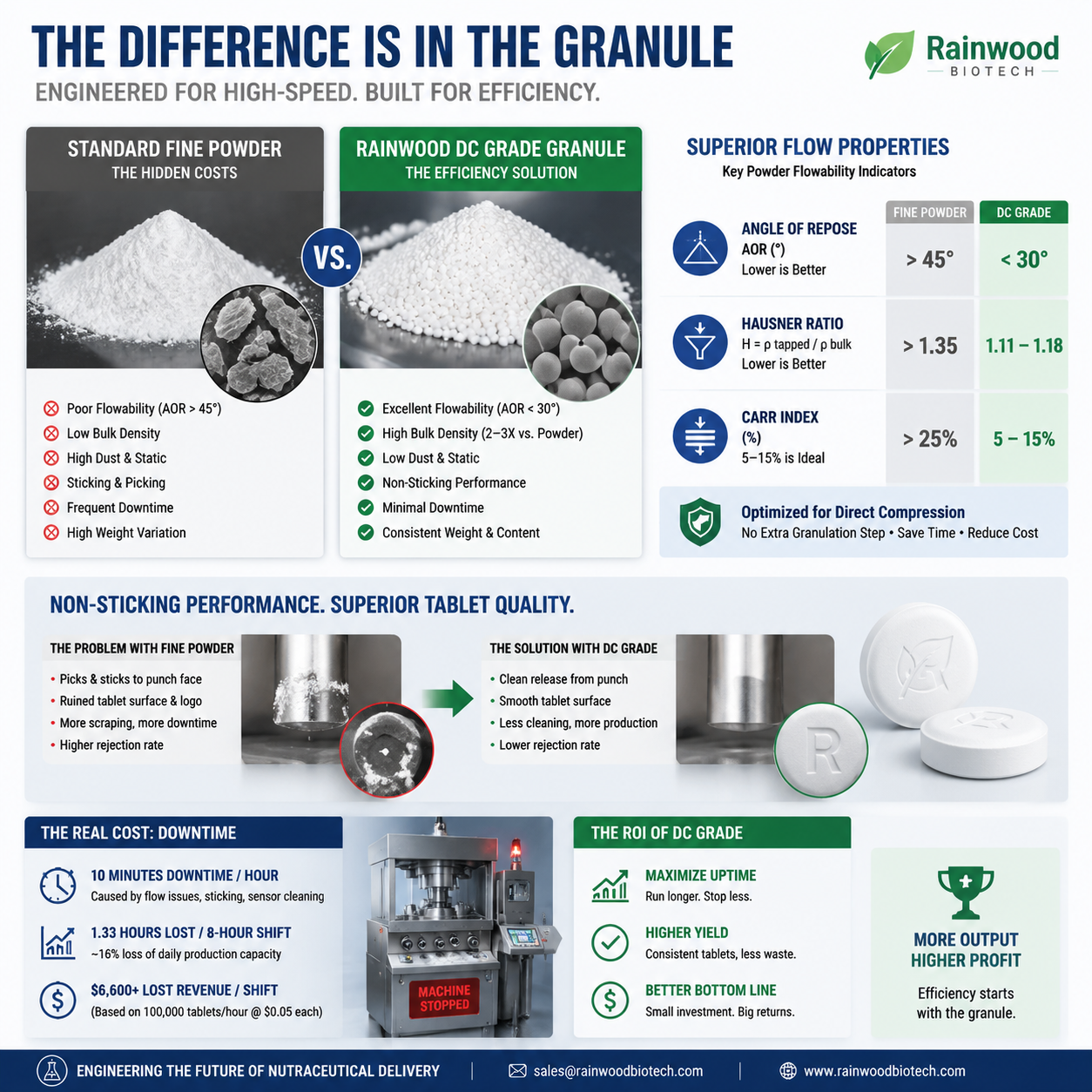
Fine powder (typically 80-200 mesh) presents three primary operational failures:
### A. Weight Variation and "Rat-Hole" Formation
Magnesium Glycinate此处插入内链 is characterized by its high surface area and low bulk density. In a gravity-fed hopper, fine powders often form a "rat-hole"—a narrow column of flow while the rest of the material remains bridged against the walls. This leads to inconsistent die filling, resulting in tablets with massive weight variation that fail IPQC (In-Process Quality Control) checks.
### B. Flying Powder and "White Dust" Contamination
High-speed rotary presses generate significant air movement. Fine powder doesn't stay in the die; it becomes airborne. This "flying powder" infiltrates the machine's mechanical gears, clogs the lubrication systems, and creates a hazardous, dusty environment that requires constant clean-room maintenance.
### C. The Sensor Clog
Modern tablet presses rely on optical sensors to monitor fill levels and ejection. Fine Magnesium Glycinate dust coats these sensors within minutes. When the sensor "goes blind," the machine triggers an emergency stop. Re-calibrating and cleaning the sensors takes only five minutes—but when you do it twelve times a shift, you lose an entire hour of production.
## 3. The Physics of Flow: Understanding AOR, Hausner Ratio, and Carr Index
To solve the "Production Manager’s Headache," we must move beyond chemistry and into rheology. At Rainwood Biotech, we evaluate Magnesium Glycinate此处插入内链 efficiency using three critical metrics:
### The Angle of Repose (AOR)
AOR is the steepest angle of a stable heap of powder.
- **Fine Powder AOR:** Usually > 45°. This indicates "Poor" or "Very Poor" flow.
- **Rainwood DC Granule AOR:** < 30°. This indicates "Excellent" flow, allowing the material to slide through the hopper with liquid-like consistency.
### The Hausner Ratio ($H = \rho_{tapped} / \rho_{bulk}$)
The Hausner Ratio measures the friction between particles. A ratio above 1.35 means the powder is highly cohesive. Our DC grade maintains a Hausner Ratio of **1.11 to 1.18**, minimizing the inter-particle friction that leads to bridging and jamming.
### The Carr Index
This measures the compressibility. A Carr Index between 5-15% is the "Gold Standard" for Direct Compression. Fine powders often exceed 25%, meaning they "settle" too much under vibration, causing density shifts during the run.
## 4. Rainwood Biotech’s Solution: The DC Grade Advantage
Rainwood Biotech doesn't just sell Magnesium Glycinate; we sell **Granular Efficiency**. Our DC (Direct Compression) grade is engineered through a proprietary fluid-bed granulation process.
Instead of jagged, inconsistent particles, we produce **spherical granules**. Each granule acts like a miniature ball bearing.
- **Increased Bulk Density:** Our DC grade is 2-3 times denser than standard powder, allowing for smaller tablet sizes and higher dosage per capsule.
- **Pre-Lubricated Skeletons:** We engineer the granule "skeleton" to accept lubricants (like Magnesium Stearate) more uniformly. This prevents the "over-lubrication" effect where a powder becomes too slick to bind, yet still manages to stick to the punch faces.
## 5. The Economics of Downtime: Calculating the $1,000+ per Hour Loss
Let's look at the math that Procurement often misses.
Assume a high-speed tablet press running at 100,000 tablets per hour.
- **Unit Price:** $0.05 per tablet.
- **Hourly Revenue:** $5,000.
- **Labor & Overhead:** $150/hour.
If your Production Manager has to stop the machine for 10 minutes every hour to wipe down the punch faces or clear a sensor due to fine powder dust, you lose **16% of your daily capacity**.
In an 8-hour shift, that is **1.33 hours of downtime**.
- **Lost Revenue:** ~$6,600 per shift.
- **Extra Labor:** $200 in "dead time" wages.
By switching to Rainwood’s DC grade Magnesium Glycinate此处插入内链, the machine runs continuously for the full 8 hours. Even if the DC grade costs $2.00 more per kilogram, the ROI is achieved within the first two hours of production through increased yield and zero "Static Hell."
## 6. "Non-Sticking" Performance: Beating the Humidity Factor
Magnesium Glycinate is hygroscopic. In humid environments, fine powder absorbs moisture at the surface, creating a "tacky" interface. This leads to **Picking and Sticking**—where a portion of the tablet face remains stuck to the metal punch, ruining the logo and the surface finish.
Rainwood’s DC granules are designed with a **low surface-area-to-volume ratio**. This physical structure naturally resists moisture absorption more effectively than fine powders. Our "Non-Sticking" advantage ensures that even in non-climate-controlled facilities, the tablet "releases" cleanly from the punch every time. No more scraping punch faces with plastic spatulas every thirty minutes.
## 7. Conclusion: Why Efficiency Starts with the Granule
If your Production Manager is complaining about Magnesium Glycinate, they aren't complaining about the quality of the molecule—they are complaining about the quality of the **physics**.
Procuring fine powder is a "false economy." The hidden costs of weight variation, dust contamination, and frequent machine cleaning turn a cheap raw material into an expensive production nightmare. By prioritizing **Granular Efficiency**, CMOs and brands can achieve:
- Faster TTM (Time to Market).
- Lower waste (reject rates < 0.5%).
- A happier, more productive factory floor.
## 8. Call to Action
Stop fighting the physics of fine powder. Upgrade your production line with Rainwood Biotech’s High-Density DC Grade Magnesium Glycinate.
**Request a 1kg Sample for a Pilot Run:**
See the difference in AOR and flowability on your own equipment. Let your Production Manager be the judge.
**Contact our Technical Sales Team:**
[Email: [email protected]]
[Website: www.rainwoodbiotech.com]
---
*Rainwood Biotech: Engineering the Future of Nutracuetical Delivery.*