 EN
EN

**Date:** April 20, 2026
**Series:** Rainwood Biotech NMNH Industry Insights
**Topic:** Analytical Identification and Fraud Detection in Reduced Nicotinamide Mononucleotide (NMNH)
## 1. Executive Summary
The rapid evolution of the longevity science sector has brought Reduced Nicotinamide Mononucleotide (NMNH) to the forefront of metabolic health. Research indicates that NMNH is a more potent NAD+ precursor than its oxidized counterpart, NMN, largely due to its bypassing of certain rate-limiting enzymes in the Salvage Pathway. However, this increased potency comes with significantly higher manufacturing complexity. The chemical synthesis of high-purity NMNH requires stringent anaerobic conditions and specialized reduction catalysts, leading to a production cost that is 3x to 5x higher than standard NMN.
This economic reality has incentivized a disturbing trend in the raw material supply chain: the intentional mislabeling of standard NMN as NMNH, or the distribution of "partially reduced" batches that contain significant levels of unreacted NMN and other impurities. Because NMN and NMNH are structurally similar, they can "hide" behind superficial testing methods.
This Perspective provides an exhaustive technical framework for quality control (QC) departments, third-party auditors, and product formulators to definitively identify NMNH and detect NMN substitution. The core of this identification rests on the fundamental shift in electronic absorption—the 340nm vs. 260nm distinction—and the nuanced chromatographic behavior of the reduced dihydropyridine ring.
## 2. The Structural Paradigm: NMN vs. NMNH
To understand the analytical challenge, one must first appreciate the molecular transformations involved in the reduction of NMN. NMN (C11H15N2O8P) features a pyridinium ring—a positively charged, aromatic system that is inherently stable in its oxidized state. In contrast, NMNH (C11H17N2O8P) is the reduced form, specifically the 1,4-dihydronicotinamide mononucleotide.
This reduction process adds two hydrogen atoms and two electrons to the nicotinamide ring. The impact on the molecule’s physical chemistry is profound:
1. **Loss of Aromaticity:** The pyridinium ring in NMN is aromatic. Upon reduction to NMNH, the ring becomes a 1,4-dihydropyridine system, which is non-aromatic. This change is the primary driver of the shift in UV absorption.
2. **Charge Neutralization:** NMN exists as a zwitterion at physiological pH, with a permanent positive charge on the nitrogen atom of the ring. NMNH is electronically neutral at the ring nitrogen, which significantly alters its interaction with HPLC stationary phases.
3. **Redox Potential:** NMNH is a powerful reducing agent. While NMN is relatively stable under atmospheric oxygen, NMNH is prone to "auto-oxidation" back to NMN if not properly stabilized with antioxidants or stored in an inert environment.
## 3. Spectrophotometric Identification: The 340nm vs. 260nm Rule
The most immediate and robust way to distinguish NMN from NMNH is through UV-Vis spectroscopy. This method is based on the principle of electronic transition within the nicotinamide moiety.
### 3.1 The 260nm Peak (The Signature of NMN)
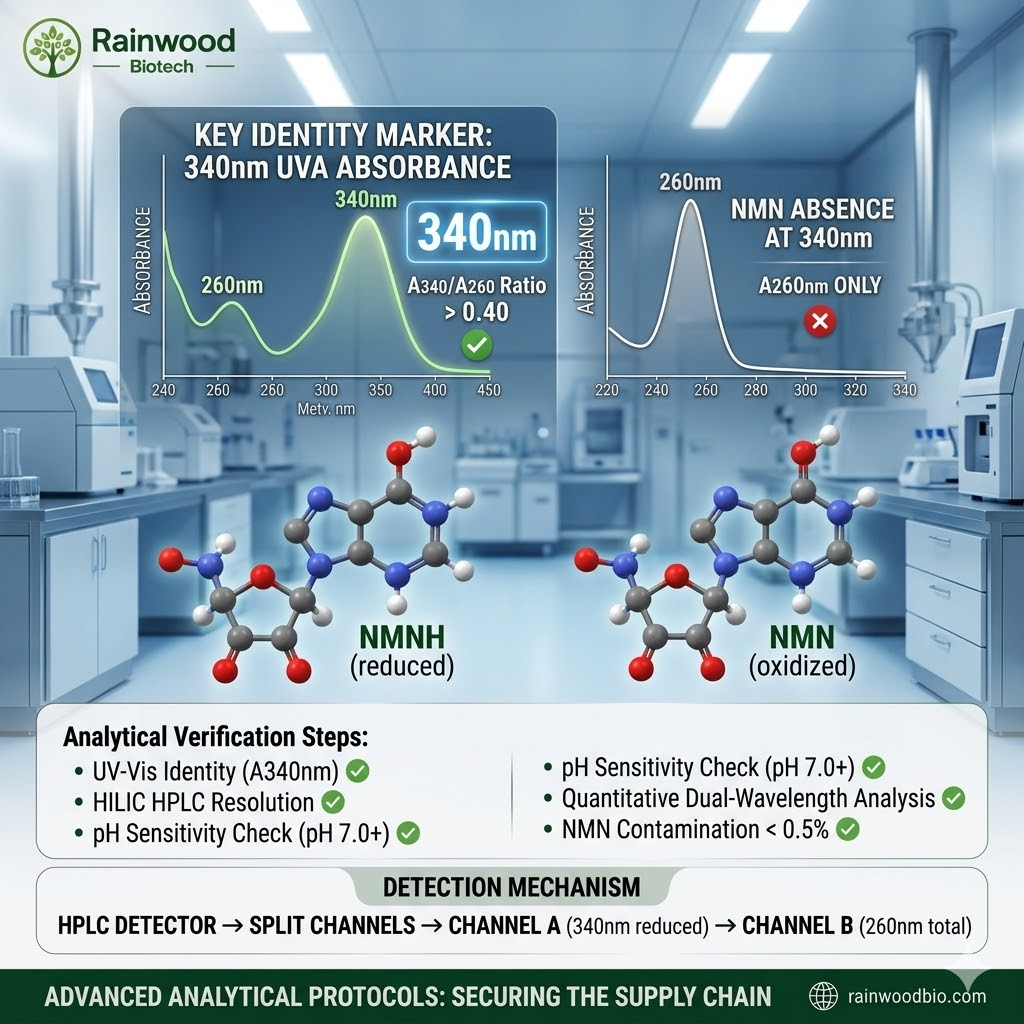
NMN, like NAD+, exhibits a strong absorption maximum (λmax) at approximately **260 nm**. This is a classic pi-to-pi* (π→π*) transition typical of aromatic heterocycles. In the context of HPLC, if an analyst monitors only at 254nm (a standard fixed wavelength), they will see a peak for both NMN and NMNH, as both have some absorbance in this region. However, the 260nm peak is the *dominant* peak for NMN. If a sample labeled "NMNH" shows an absorption profile consisting *only* of a 260nm peak, it is a definitive sign of fraud.
### 3.2 The 340nm Peak (The Signature of NMNH)
The reduction of the ring to the 1,4-dihydropyridine form (NMNH) introduces a new electronic transition: the n-to-pi* (n→π*) transition of the lone pair on the nitrogen into the conjugated system. This results in a characteristic, broad absorption peak at **340 nm** (the UVA range).
- **The Identity Marker:** A genuine NMNH sample MUST show a prominent peak at 340nm.
- **The Purity Indicator:** In high-purity NMNH, the absorbance at 340nm should be roughly 40-50% of the absorbance at 260nm, depending on the pH and solvent. This ratio (A340/A260) is a critical "Identity Fingerprint."
**Expert Insight:** Rainwood Biotech’s internal standard for raw material acceptance requires a UV-Vis scan from 200nm to 450nm. A "Flatline" at 340nm is an automatic rejection, regardless of what the supplier’s HPLC report claims.
## 4. HPLC Peak Shift Analysis: Mastering the Chromatography
While UV-Vis provides a quick identity check, High-Performance Liquid Chromatography (HPLC) is required to quantify purity and detect trace impurities. However, the structural similarity between NMN and NMNH creates a high risk of co-elution if the method parameters are not precisely controlled.
### 4.1 Stationary Phase Selection
Standard C18 Reversed-Phase columns are commonly used for NMN analysis. However, because both molecules are highly polar, they tend to elute very early, often overlapping with the solvent front (the "void volume").
- **HILIC (Hydrophilic Interaction Liquid Chromatography):** For superior resolution, Rainwood Biotech recommends HILIC columns (e.g., Amide or Diol phases). HILIC provides much better retention for these polar nucleotides, allowing for a clear separation of NMN, NMNH, and degradation products like Nicotinamide.
- **C18 Optimization:** If a C18 column is used, it must be a "Polar Embedded" or "AQ" type (e.g., Waters T3 or Phenomenex Luna Omega PS C18) to prevent phase collapse in 100% aqueous mobile phases.
### 4.2 The Retention Time (RT) Shift
The loss of the positive charge in NMNH makes it slightly more lipophilic than NMN. Therefore, in a reversed-phase system:
- **NMN (more polar)** elutes first.
- **NMNH (less polar)** elutes second.
Typically, with a mobile phase of 20mM Ammonium Acetate (pH 7.0) and a slow gradient of Acetonitrile, NMN might elute at 2.8 minutes, while NMNH elutes at 3.5 minutes. A "shift" of less than 0.3 minutes suggests that the method lacks sufficient resolving power to distinguish between the two.
### 4.3 The pH Sensitivity Trap
This is the most common error in NMNH analysis. Many "Standard NMN" methods use acidic buffers (e.g., 0.1% Phosphoric Acid or Formic Acid at pH 2.5).
**NMNH is highly unstable at pH < 6.0.**
If NMNH is injected into an acidic HPLC system, it will rapidly oxidize or undergo acid-catalyzed rearrangement into NMN and other byproducts *while inside the column*. The result is a chromatogram that shows a large NMN peak and a small or non-existent NMNH peak. The analyst might incorrectly conclude the raw material is poor, when in fact the *test method* destroyed the sample.
- **Rainwood Standard:** Mobile phases must be maintained at **pH 7.0 to 7.5**.
## 5. Detecting NMN Contamination in NMNH Raw Materials
Contamination occurs when the reduction of NMN to NMNH is incomplete (process residue) or when the NMNH has partially oxidized during storage.
### 5.1 Dual-Wavelength Quantification
To accurately assess NMNH purity, the HPLC detector must be set to monitor at least two wavelengths simultaneously:
1. **Channel A (340nm):** This channel is specific for the "Reduced" fraction. Only NMNH and other reduced derivatives (like NADH) will show up here.
2. **Channel B (260nm):** This channel detects "Total Nicotinamides," including NMN, NMNH, and Nicotinamide.
By calculating the Peak Area of NMN at 260nm and comparing it to the NMNH Peak Area, we can determine the exact level of NMN contamination. A high-quality NMNH raw material (Rainwood Grade) should have **NMN levels below 0.5%**.
### 5.2 The "99% Purity" Deception
Many suppliers report purity based on "Area Percent" at a single wavelength (usually 210nm or 254nm). This is highly misleading. At 210nm, NMN and NMNH have nearly identical molar absorptivity. A sample that is 20% NMN and 80% NMNH will show a "Total Purity" of 100% if the analyst integrates both peaks as one or fails to distinguish the NMN peak.
**The Audit Rule:** Always ask for the integration table. If there is a peak at the NMN retention time, it must be subtracted from the "Reduced" purity calculation.
## 6. Degradation Pathways: The Analytical "Breadcrumbs"
NMNH does not simply disappear; it degrades into specific molecules that act as markers for the age and quality of the material.
1. **Oxidation (NMNH → NMN):** The most common pathway. High NMN levels in a "pure" NMNH sample indicate poor stabilization or exposure to oxygen.
2. **Hydrolysis (NMNH → NRH):** In the presence of moisture, the phosphate group can be cleaved, yielding Nicotinamide Riboside Reduced (NRH). NRH also absorbs at 340nm, but it has a significantly different retention time.
3. **Ring Opening:** In extreme cases, the dihydropyridine ring can open, leading to non-functional metabolites that no longer absorb at 340nm.
By monitoring for these "breadcrumbs," Rainwood Biotech can determine if a supplier is selling "fresh" NMNH or "recovered" material that has been poorly handled.
## 7. Quality Control and Audit Checklist for Procurement
When auditing a new supplier or a new batch of NMNH, Rainwood Biotech recommends the following "Hard Audit" steps:
* **Step 1: Visual Inspection.** NMNH is naturally a pale, cream-colored to light-yellow powder. If it is "snow white," it is either highly processed with bleaching agents or, more likely, it is actually NMN.
* **Step 2: Solubility and pH.** Dissolve 100mg in 10ml of deionized water. The resulting solution should be slightly yellow. Measure the pH; it should be near neutral.
* **Step 3: UV-Vis Identity Check.** Scan the solution. Confirm the presence of the 340nm peak. Calculate the A340/A260 ratio.
* **Step 4: HPLC Methodology Review.** Ensure the mobile phase is pH 7.0+. If the COA uses "Method 0.1% TFA," the results are invalid.
* **Step 5: NMN Spiking.** Inject the sample, then inject a second time after "spiking" it with 1% known NMN standard. If the NMN peak increases but the NMNH peak remains separate, the method is validated for resolution.
## 8. Matrix Effects and Sample Preparation Challenges
For formulators and brand owners, the challenge of identification extends beyond raw materials into finished dosage forms. Testing NMNH in a capsule or softgel is significantly more complex than testing a pure powder, primarily due to "Matrix Effects"—the interference caused by non-active ingredients (excipients).
### 8.1 Excipient Interference
Many common excipients, such as Microcrystalline Cellulose (MCC), Magnesium Stearate, and certain titanium-based colorants, can scatter UV light or leach small amounts of organic compounds that absorb at 210-260nm. If the sample preparation is not exhaustive, these "noise" peaks can mask the trace NMN levels we are trying to detect.
Rainwood Biotech utilizes a multi-step solvent extraction process (MSEP) to isolate the NMNH from the solid matrix before injection. This ensures that the HPLC column is not fouled and that the UV baseline is stable enough to detect NMN at the < 0.1% level.
### 8.2 The Softgel Dilemma
NMNH is increasingly being delivered in liposomal or oil-based softgel formats to enhance stability. However, oil is the enemy of traditional HPLC. To test these products, we use a "Liquid-Liquid Extraction" (LLE) method, typically involving a mixture of water and a non-polar solvent like Hexane or Chloroform. The NMNH, being highly water-soluble, partitions into the aqueous layer, while the oils and fat-soluble vitamins remain in the organic layer.
**The Risk of "Pre-Oxidation":** During extraction, the sample is often exposed to heat and agitation. Without the addition of a protective antioxidant (such as Ascorbyl Palmitate) during the preparation phase, NMNH can oxidize into NMN *during the test*. This leads to "False Positive" results for NMN contamination. Rainwood's validated extraction protocol (RB-EXT-2026) is performed under a nitrogen blanket to eliminate this variable.
## 9. Regulatory Implications and the Need for a Compendial Monograph
Currently, NMNH is not yet listed in the United States Pharmacopeia (USP) or the European Pharmacopoeia (Ph. Eur.). This lack of a compendial monograph means there is no "official" method that labs must follow. In this regulatory vacuum, unscrupulous labs often use "In-House" methods that are biased toward showing high purity.
Rainwood Biotech is actively collaborating with international standardization bodies to establish a formal monograph for NMNH. Our goal is to make the **340nm UV Identity Test** a mandatory requirement for any material labeled as "Reduced Nicotinamide Mononucleotide." Until such a monograph is codified, the burden of proof remains with the brand owner. Utilizing the technical guidelines in this Perspective is the best defense against regulatory scrutiny and consumer lawsuits.
## 10. Future Outlook: Beyond HPLC
While HPLC remains the workhorse of the industry, new technologies are emerging to complement it:
1. **Liquid Chromatography-Mass Spectrometry (LC-MS):** This provides the exact molecular weight of the peak. NMNH has a mass-to-charge ratio (m/z) of 337.08, while NMN is 335.06. LC-MS is the "Gold Standard" for confirming identity, though its high cost makes it less practical for routine batch testing.
2. **Nuclear Magnetic Resonance (NMR):** 1H-NMR can detect the specific protons on the dihydropyridine ring. This is the only way to distinguish between different isomers of NMNH (e.g., the 1,4-reduced vs. the 1,6-reduced form).
3. **FT-IR Spectroscopy:** While less sensitive than HPLC, Fourier-Transform Infrared Spectroscopy can detect the specific N-H and C=C stretching frequencies of the reduced ring, providing a secondary identity check for raw material intake.
## 11. Conclusion: Establishing the New Standard
The "HPLC Identity" of NMNH is not merely a technical detail; it is the foundation of market trust and the frontline of consumer safety. As the industry moves toward more potent and expensive NAD+ boosters, the technical barriers to entry are rising. Suppliers who cannot—or will not—provide 340nm-validated HPLC reports and UV-Vis scans are essentially asking for "blind trust"—a luxury that the nutraceutical industry can no longer afford in an era of high-stakes litigation and informed consumers.
Rainwood Biotech is committed to analytical transparency. By enforcing the **340nm Identity Protocol**, utilizing HILIC chromatography, and insisting on neutral-pH mobile phases, we protect our partners from the financial and reputational risks of NMN substitution and degradation. In the world of NMNH, if you aren't looking at 340nm, you aren't looking at the truth. We invite all industry stakeholders to adopt these rigorous standards to ensure the long-term viability and integrity of the NMNH category.
---
*Rainwood Biotech provides full analytical support and third-party verification services for our global partners. For access to our validated NMNH HPLC Method (RB-NMNH-2026-V1) or to schedule a technical audit of your supply chain, please contact our Technical Compliance Office.*