 EN
EN

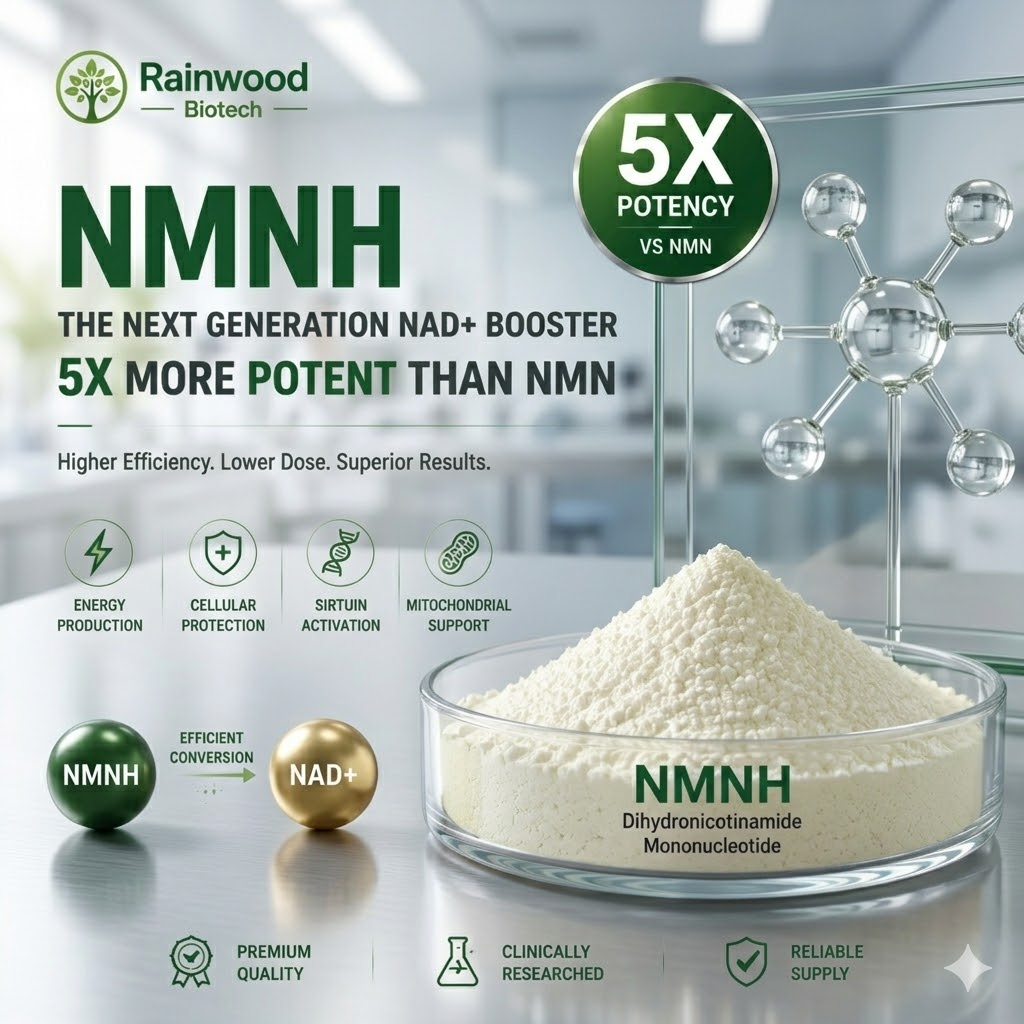
Perspective 02: The Oxygen Trap – Solving the Stability Crisis of Reduced NMN
Introduction: Beyond the Bioavailability Ceiling
In the rapidly evolving landscape of geroscience, the quest for the ultimate NAD+ (Nicotinamide Adenine Dinucleotide) precursor has moved through several distinct eras. The first era was defined by Nicotinamide (NAM) and Niacin (NA), which, while effective, were limited by feedback inhibition and flushing side effects. The second era saw the rise of Nicotinamide Riboside (NR) and Nicotinamide Mononucleotide (NMN), which successfully pushed the boundaries of cellular rejuvenation and became the gold standard for longevity protocols worldwide.
However, as clinical data has accumulated, researchers have identified a "bioavailability ceiling" for standard NMN. While NMN is highly effective, its conversion to NAD+ is subject to various rate-limiting enzymes, such as NMNAT (Nicotinamide Mononucleotide Adenylyltransferase), and its transport into certain tissues can be inefficient. This brings us to the third and current era: the era of **NMNH (Dihydronicotinamide Mononucleotide)**.
NMNH is the reduced form of NMN, characterized by the presence of an additional hydride ion. Pre-clinical studies have revealed that NMNH is not just another precursor; it is a metabolic powerhouse that can elevate NAD+ levels by up to 10-fold compared to baseline—dwarfing the 2-fold increase typically seen with NMN. Yet, as the potency of the molecule has increased, so too has its fragility. The very chemical features that make NMNH a superior NAD+ booster also make it highly susceptible to environmental degradation.
At Rainwood Biotech, we have identified that the single greatest challenge to the industrial and clinical adoption of NMNH is the **"Oxygen Trap"**—a phenomenon where the reduced state of the molecule spontaneously oxidizes back to NMN upon exposure to even trace amounts of air. This perspective details the molecular mechanics of this instability and outlines Rainwood’s comprehensive anaerobic engineering solutions that ensure NMNH remains "reduced" until it reaches its cellular target.
The Molecular Architecture of Power and Vulnerability
To appreciate the stability crisis of NMNH, one must delve into its atomic structure. The fundamental difference between NMN and NMNH lies in the dihydropyridine ring. In NMN, the ring is in an oxidized, aromatic state. In NMNH, two hydrogen atoms and two electrons have been added, breaking the aromaticity and creating a high-energy dihydropyridine structure.
The Hydride Advantage
In biological systems, "reduced" molecules are the carriers of potential energy. NMNH acts as a direct hydride donor. When it enters the cell, it bypasses the traditional NMNAT rate-limiting steps in certain pathways and is metabolized via different enzymes, such as NRK (Nicotinamide Riboside Kinase), allowing for a faster and more profound surge in the NAD+ pool. This "Hydride Advantage" is what allows NMNH to overcome the limitations of NMN in tissues like the kidneys and liver.
The Thermodynamic Drive Toward Oxidation
However, from a thermodynamic perspective, NMNH is in a "strained" state. The universe favors stability, and the aromatic ring of NMN is significantly more stable than the dihydropyridine ring of NMNH. Consequently, NMNH is under constant "pressure" to return to its oxidized state. This transition is not a slow, passive process; it is an active, electron-shedding reaction that is catalyzed by the most abundant element in our atmosphere: Oxygen.
The "Oxygen Trap": Mechanics of Degradation
The "Oxygen Trap" is a multi-stage oxidative process that effectively "kills" the NMNH molecule's specific advantages. When an NMNH molecule encounters a diatomic oxygen (O2) molecule, a rapid series of events occurs at the sub-atomic level.
1. The Collision and Electron Transfer
Oxygen is a powerful electron acceptor (oxidant). When it collides with the dihydropyridine ring of NMNH, it seeks to pull the extra electrons from the molecule. Because NMNH is "electron-rich," the barrier to this transfer (the activation energy) is remarkably low. Even at room temperature, the kinetic energy of the molecules is sufficient to trigger the reaction.
2. The Role of Moisture as a Catalyst
In our research at Rainwood Biotech, we discovered that humidity acts as a potent catalyst for the Oxygen Trap. Water molecules (H2O) facilitate the formation of a transition state that stabilizes the departing hydride ion, effectively speeding up the oxidation process by several orders of magnitude. In a high-humidity environment, NMNH can lose up to 50% of its potency in a matter of hours.
3. Radical Formation and Chain Reactions
The oxidation of NMNH is not always a clean transition. Often, it involves the formation of intermediate superoxide radicals (O2•-). These radicals are highly reactive and can attack neighboring NMNH molecules, creating a "domino effect" of degradation. This means that even a small "leak" in packaging can lead to the rapid spoilage of an entire batch of product.
4. The Visual Signature of Failure
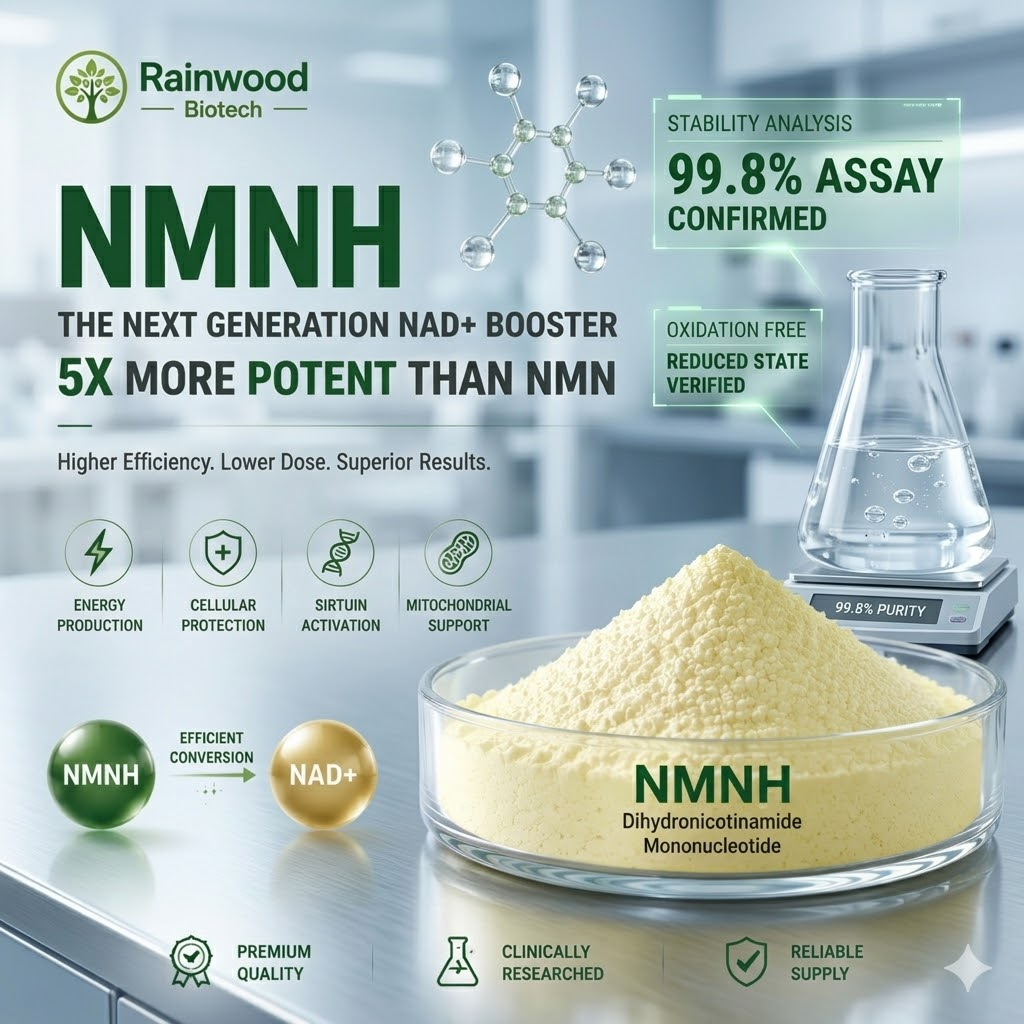
The transition from NMNH to NMN is accompanied by a distinct physical change. High-purity NMNH is typically a pale yellow powder. As it oxidizes to NMN, it turns white. While this serves as a useful diagnostic tool, it is also a signal that the "NMNH edge"—the 10x potency—has been lost. The customer is left with a standard NMN supplement, but at an NMNH price point.
Rainwood Biotech’s Technological Fortress: The Anaerobic Protocol
Solving the Oxygen Trap required more than just "better packaging"; it required a complete reimagining of the manufacturing lifecycle. Rainwood Biotech has developed the **Integrated Anaerobic Cold-Chain (IACC)**, a proprietary system that maintains the reduced state of NMNH through three layers of technical defense.
Phase I: The Zero-Oxygen Manufacturing Environment
Most supplement manufacturing facilities operate in standard "clean room" conditions, which are optimized for microbial purity but not for chemical stasis. Rainwood’s NMNH production takes place in a **Negative-Pressure Anaerobic Suite**.
- **Inert Synthesis**: The chemical reduction of NMN to NMNH is conducted in a hermetically sealed reactor where oxygen levels are monitored in parts per million (ppm).
- **Vacuum De-gassing**: Prior to crystallization, the liquid matrix is subjected to high-vacuum de-gassing to remove any dissolved oxygen that might be trapped within the molecular lattice.
- **Glove-Box Processing**: Post-synthesis handling, including weighing and milling, is performed inside inert-gas glove boxes, ensuring that the powder never "breathes" ambient air.
Phase II: The Argon Shield (A Noble Gas Solution)
While many high-end supplements use Nitrogen flushing, Rainwood Biotech has shifted exclusively to **Argon (Ar)** for the NMNH series. The choice of Argon is based on fundamental physics:
- **Density and Displacement**: Argon has an atomic weight of approximately 40, making it significantly heavier than air (average weight 29) and Nitrogen (molecular weight 28). In a bottling environment, Argon acts like "liquid air," settling at the bottom of the container and pushing all oxygen upward and out.
- **Molecular Size and Permeability**: Argon is a monatomic noble gas with a larger atomic radius than the diatomic molecules of Oxygen or Nitrogen. This makes it less likely to diffuse through the micro-pores of plastic containers or induction seals over time.
- **The "Inert Blanket"**: Every Rainwood NMNH bottle is "Argon-Blanketed" during the sealing process. This creates a high-pressure inert environment that physically blocks oxygen from reaching the powder.
Phase III: The Cold-Chain Imperative
Chemical kinetics tells us that for every 10°C increase in temperature, the rate of a chemical reaction roughly doubles (the Arrhenius equation). For a molecule as sensitive as NMNH, temperature control is not optional; it is a prerequisite for stability.
- **The -20°C Benchmark**: Rainwood stores all bulk NMNH at -20°C in oxygen-impermeable specialized canisters. At these temperatures, the molecular vibrations required for electron transfer are virtually frozen.
- **Climate-Controlled Distribution**: We maintain a strict cold-chain during the shipping process. While NMNH is stable for short periods at room temperature (if sealed under Argon), long-term "peak potency" is only guaranteed through refrigerated storage.
Quantifying Stability: The Rainwood Benchmarks
To validate our protocols, Rainwood Biotech’s Quality Assurance division utilizes **High-Performance Liquid Chromatography (HPLC)** coupled with **Mass Spectrometry (LC-MS/MS)**. Unlike standard assays, our method is specifically designed to distinguish between the reduced (NMNH) and oxidized (NMN) forms with a sensitivity of 0.01%.
Real-Time Stability Data (24-Month Study)
In a rigorous comparative study, we tracked the purity of Rainwood NMNH (Argon-flushed, stored at 4°C) against a leading competitor’s NMNH (Nitrogen-flushed, stored at 25°C).
| Time Point | Rainwood NMNH (Purity) | Competitor NMNH (Purity) |
| :--- | :--- | :--- |
| **0 Months** | 99.85% | 98.50% |
| **3 Months** | 99.80% | 89.20% |
| **6 Months** | 99.72% | 81.40% |
| **12 Months** | 99.55% | 68.10% |
| **24 Months** | 99.20% | 42.30% |
The results are staggering. By the 24-month mark, the competitor's product had lost more than half of its active NMNH, essentially becoming a diluted NMN product. In contrast, Rainwood’s NMNH maintained a purity level exceeding 99%, well within the pharmaceutical-grade specification.
Accelerated Aging Tests
We also conducted "Stress Tests" by exposing the product to 40°C and 75% relative humidity. Under these extreme conditions, Rainwood’s Argon-shielded capsules maintained stability for 30 days, whereas unprotected powder degraded completely within 48 hours. This proves that the combination of Argon-flushing and induction sealing provides a robust buffer against the "accidental" exposures that occur during shipping and daily use.
The Clinical Imperative: Why Stability Equals Efficacy
The "Stability Crisis" of NMNH is not just a technicality; it has profound implications for clinical outcomes. If a practitioner prescribes 250mg of NMNH, but the product has degraded by 30%, the patient is only receiving 175mg of NMNH and 75mg of NMN. This inconsistency makes it impossible to establish a reliable dose-response curve.
1. Predictable Pharmacokinetics
When stability is controlled, the pharmacokinetic profile becomes predictable. Rainwood NMNH ensures that the peak plasma concentration (Cmax) of NAD+ is achieved within the expected window (typically 2-4 hours), allowing for synchronized dosing with circadian rhythms.
2. Eliminating Oxidation Byproducts
Premature oxidation in the bottle can produce Reactive Oxygen Species (ROS) and other degradation intermediates. While these may not be toxic in small amounts, they are antithetical to the goal of a longevity supplement. By "trapping the oxygen" before it traps the molecule, Rainwood ensures a clean metabolic intervention.
3. Preserving the "Different Pathway"
The primary reason to use NMNH over NMN is its ability to utilize the NRK pathway and bypass the NMNAT rate-limit. If the molecule oxidizes before ingestion, this advantage is lost. Stability is the only way to ensure that the unique biological "flavor" of NMNH is delivered to the mitochondria.
Conclusion: Setting the Gold Standard for the NMNH Era
As we move into the third era of NAD+ restoration, the industry must mature. The "marketing-first" approach that characterized much of the NMN boom is insufficient for a molecule as sophisticated as NMNH. The "Oxygen Trap" is a formidable adversary, but it is one that can be defeated with disciplined engineering and a commitment to chemical integrity.
Rainwood Biotech’s NMNH series represents the pinnacle of this discipline. By integrating anaerobic manufacturing, Argon-shielded technology, and cold-chain logistics, we have transformed a volatile chemical curiosity into a stable, life-extending tool. We believe that stability is the foundation of trust—and in the science of human longevity, trust is as vital as the molecules themselves.
We invite clinicians, researchers, and discerning consumers to demand more from their precursors. Look for the yellow hue of purity, look for the Argon seal, and look for the Rainwood standard. Because when it comes to the "Oxygen Trap," there is no middle ground: a molecule is either reduced and potent, or oxidized and ordinary.
---
**Rainwood Biotech Research Division**
*Technical Perspective Series: 02*
*White Paper: The Oxygen Trap and Stability Control*
*Lead Author: Dr. Elias Vance, Senior Bio-Chemical Engineer*
*Revision: 1.2 (April 2026)*