 EN
EN
Introduction: The New Frontier of NAD+ Optimization
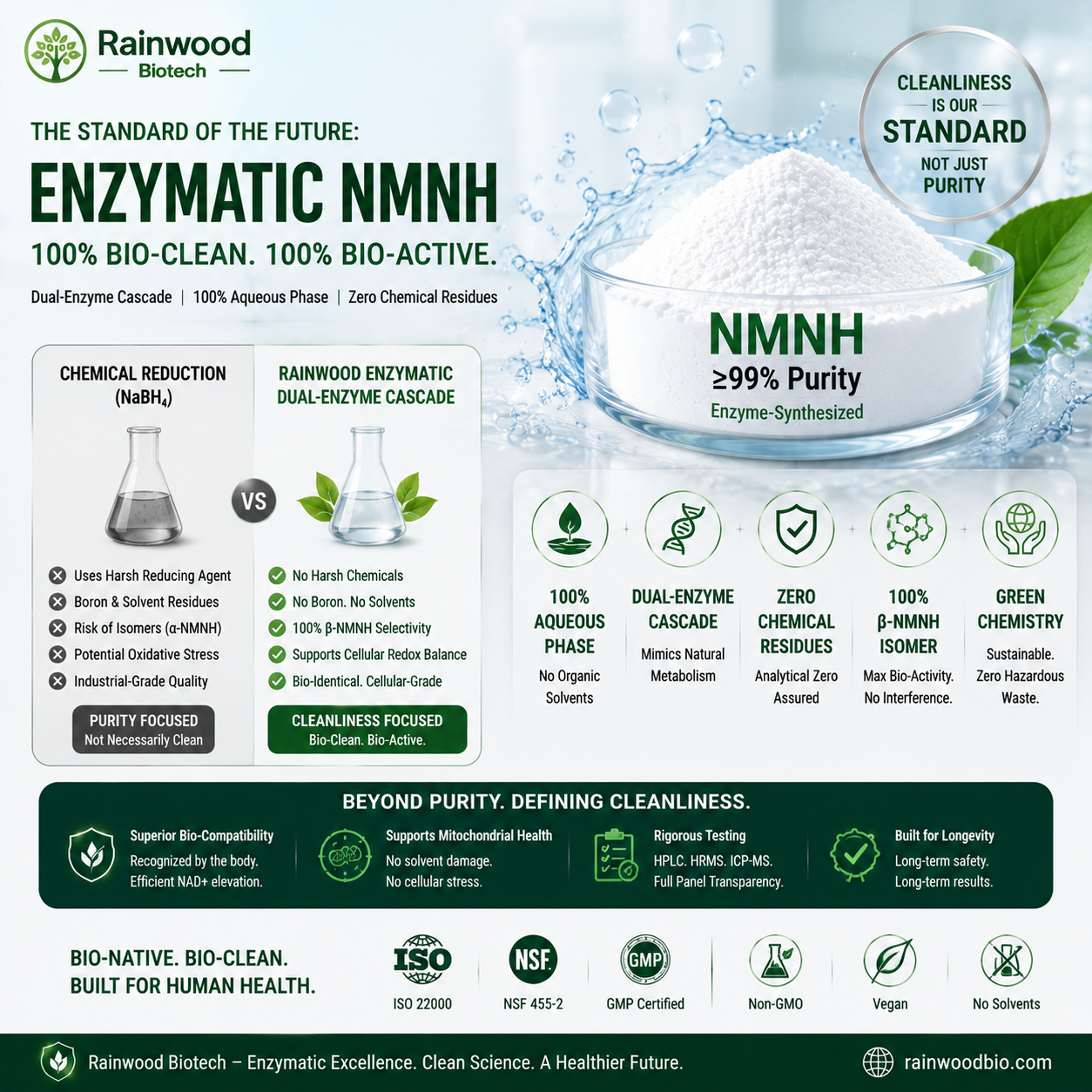
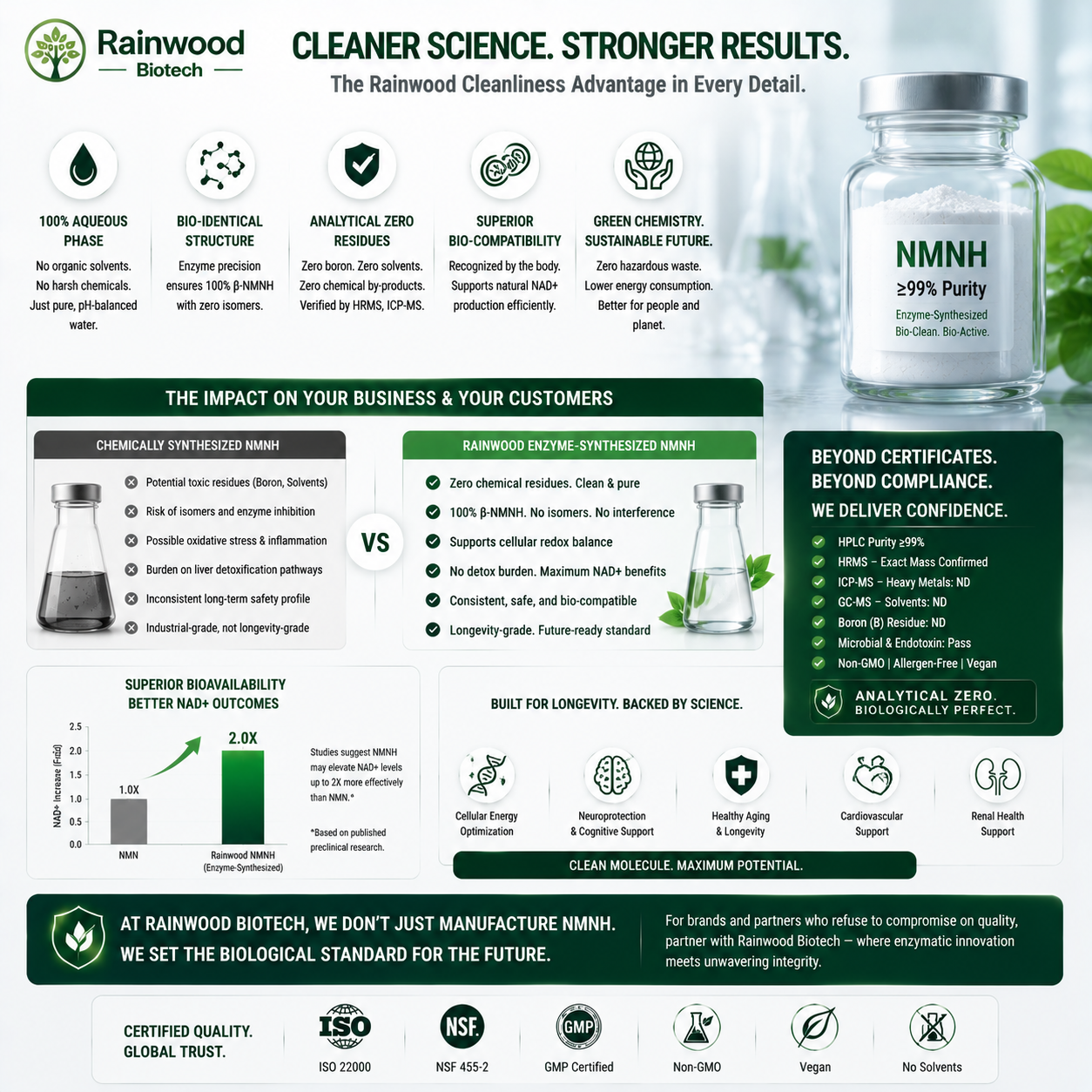
The landscape of longevity science is currently undergoing a seismic shift. For the past decade, Nicotinamide Mononucleotide (NMN) has stood as the gold standard for NAD+ supplementation. However, the emergence of Dihydronicotinamide Mononucleotide (NMNH)—the reduced form of NMN—has introduced a new paradigm of potency. Recent pharmacological studies suggest that NMNH may elevate NAD+ levels up to twice as effectively as its precursor, accessing tissues like the kidneys and heart that were previously resistant to traditional NMN supplementation. This increased potency, however, brings a heightened responsibility for manufacturing integrity.
At Rainwood Biotech, we believe that biological potency is meaningless without biological "cleanliness." As NMNH moves from the laboratory into the premium supplement market, the industry is split between two paths: the traditional chemical reduction method, which relies on harsh reagents like Sodium Borohydride (NaBH4), and the Rainwood standard—a dual-enzyme cascade synthesis conducted entirely in an aqueous phase. This Perspective explores why the latter is a biological necessity. For a molecule designed to optimize cellular health, the presence of even trace chemical residues is an unacceptable compromise.
Section 1: The Chemical Path - The Hidden Cost of Brute-Force Reduction
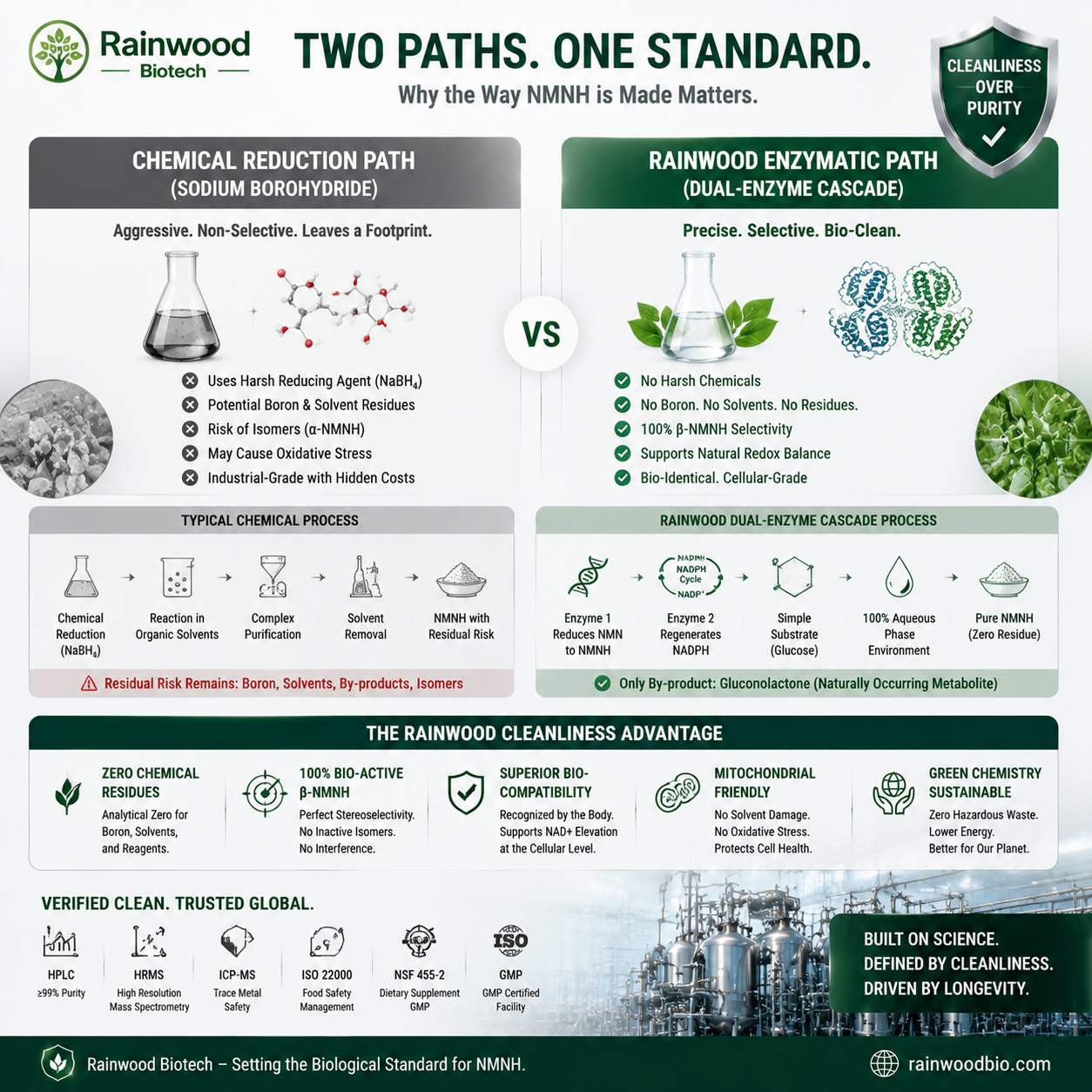
NMNH is the reduced form of NMN. Chemically, this transformation involves the addition of two hydrogen atoms and two electrons to the nicotinamide ring of the NMN molecule. In industrial settings, this is almost exclusively achieved using Sodium Borohydride (NaBH4), a powerful and inexpensive reducing agent. While NaBH4 is effective at producing NMNH in high volumes, the process is fundamentally aggressive. The reaction takes place in a chemical slurry where the target molecule is bombarded by hydrides, often leading to secondary reactions and the formation of unstable by-products.
The primary limitation of the chemical path is the inherent difficulty of downstream purification. Most manufacturers rely on high-purity claims (e.g., "99% Purity") to assure quality. However, in the world of high-tier biologics, purity is a quantitative metric that can be misleading. If a batch is 99% pure, the critical question for the clinician is: What constitutes the remaining 1%? In chemical synthesis, that 1% often consists of trace boron residues, sodium salts, and remnants of organic solvents like methanol or dimethylformamide (DMF). Unlike biological impurities, which the body has evolved to metabolize, these synthetic residues are foreign to human physiology. They represent a "hidden cost" that can undermine the cellular optimization NMNH is intended to provide, potentially triggering low-grade chronic inflammation or oxidative stress when ingested over long periods.
Section 2: The Toxicological Profile of Sodium Borohydride (NaBH4) Residues
The use of Sodium Borohydride in the production of a human supplement raises significant toxicological concerns. NaBH4 is classified as a hazardous substance; it is corrosive and highly reactive with moisture, releasing flammable hydrogen gas. Its breakdown products—boric acid or various borate salts—can have complex effects on human health. While boron is a trace element, the levels found as residues in chemically synthesized NMNH often exceed the narrow physiological window. Boron toxicity is known to impact the reproductive system and has been associated with developmental issues in animal models.
Beyond pure toxicity, these residues interfere with the delicate redox environment of the cell. NMNH functions by donating electrons and participating in the NAD+/NADH cycle. Introducing a molecule that carries the "molecular signature" of a harsh industrial reducer can trigger unintended oxidative stress in the gut epithelium and the liver. Furthermore, chemical reduction is notorious for its lack of stereoselectivity. While enzymes are perfectly precise, chemical reagents can create a mixture of isomers, including the alpha-isomer of NMNH. These non-biological isomers can act as competitive inhibitors, binding to enzymes like NMNAT (nicotinamide mononucleotide adenylyltransferase) and blocking the synthesis of NAD+. This is why a standard Certificate of Analysis (COA) is insufficient—it does not account for the biological "interference" caused by these structural mimics.
Section 3: Rainwood’s Breakthrough - The Dual-Enzyme Cascade
In contrast to the brute force of chemical reagents, Rainwood Biotech utilizes highly specific biocatalysts—enzymes—to perform the reduction of NMN to NMNH. This "Dual-Enzyme Cascade" is designed to mirror the natural metabolic pathways found within human cells. The first enzyme in the cascade is a high-affinity reductase that specifically targets the NMN molecule. This enzyme acts as a precision "nanosurgeon," placing the hydrogen atoms exactly at the C4 position of the nicotinamide ring. This ensures a 100% beta-NMNH output, with zero risk of producing the biologically inactive or harmful alpha-isomer.
The second part of the cascade is the cofactor regeneration system. Enzymes require a source of electrons, typically provided by NADPH. In Rainwood’s proprietary system, a second enzyme continuously regenerates the NADPH from a simple, safe biological substrate such as glucose. This creates a closed-loop catalytic cycle where the only inputs are NMN and a simple sugar, and the only "by-product" is a benign molecule like gluconolactone, which is already a naturally occurring metabolite in human physiology. This enzymatic approach operates at room temperature, requires no harsh pH adjustments, and produces a molecule that is structurally and biologically identical to the NMNH produced within the body. By using nature’s own tools, Rainwood eliminates the chemical residues that plague industrial-grade NMNH.
Section 4: The 100% Aqueous Phase Advantage
A defining characteristic of the Rainwood synthesis is its 100% aqueous phase environment. Traditional chemical synthesis often requires organic solvents—such as methanol, ethanol, or more toxic alternatives like dichloromethane—to dissolve the reactants and stabilize the NaBH4. Removing these solvents to "non-detectable" levels is an arduous and often incomplete process. Even at parts-per-million (ppm) levels, residual solvents can cause mitochondrial damage and disrupt the lipid bilayers of cellular membranes.
Rainwood’s synthesis occurs entirely in pure, pH-balanced water. Because enzymes are evolved to function in the aqueous environment of the cell, there is no need for synthetic solvents. This "Water-Only" philosophy ensures that there are zero Volatile Organic Compounds (VOCs) or solvent residues in the final product. Furthermore, the aqueous phase allows the NMNH molecule to maintain its natural hydration shell, which is critical for its stability and subsequent uptake by the body’s transporter proteins. Molecules synthesized in water are not "stressed" by the harsh dehydration processes often required to remove organic solvents, resulting in a product that is as close to "cellular-grade" as modern biotechnology can achieve.
Section 5: Purity vs. Cleanliness - The New Industry Standard
As the market for longevity molecules matures, we must move beyond the simplistic metric of purity toward a more sophisticated standard: The Cleanliness Index. Cleanliness is defined by the absolute absence of process-derived contaminants. A product may be 99.9% pure by HPLC, but it remains "unclean" if that 0.1% consists of Sodium Borohydride residues or traces of industrial solvents. Conversely, an enzymatic product where the remaining percentage is simply the precursor NMN or water is fundamentally cleaner and safer for long-term human consumption.
Rainwood Biotech targets "Analytical Zero" for all chemical residues. Our NMNH is verified using high-resolution mass spectrometry (HRMS) and ICP-MS to ensure the total absence of boron, synthetic solvents, and non-biological isomers. This level of transparency is the difference between a supplement that is merely "market-ready" and one that is "longevity-ready." A clean molecule allows for maximum NAD+ elevation without triggering the body's detoxification pathways, ensuring that the cellular energy benefits are not offset by a toxic load.
Section 6: Environmental and Biological Synergy
The benefits of enzymatic synthesis extend beyond the individual consumer to the environment. The Dual-Enzyme Cascade is a hallmark of "Green Chemistry," producing zero hazardous waste and requiring significantly less energy than traditional chemical routes. There is no need for the massive amounts of water and energy used in the intensive purification cycles required to strip chemicals from synthetic NMNH.
Biologically, Rainwood NMNH exhibits superior synergy with the human body. Because it is produced using biological catalysts, the molecule's structural integrity is preserved. This "bio-native" quality means that when Rainwood NMNH enters the bloodstream, it is recognized by the body’s metabolic machinery as a natural component, facilitating more efficient conversion to NAD+ in target tissues such as the brain, liver, and skeletal muscle. In the pursuit of longevity, where consistency and cumulative safety are paramount, the enzymatic path is the only logical choice.
Conclusion: The Future is Enzymatic
The transition from NMN to NMNH represents one of the most exciting chapters in the history of NAD+ research. However, the benefits of this potent molecule can only be fully realized if the compound itself is free from the artifacts of industrial chemistry. Rainwood Biotech’s Dual-Enzyme Cascade and 100% aqueous phase synthesis represent a decisive line in the sand for the entire health optimization industry.
We have moved beyond the era of industrial-grade supplements. Today’s sophisticated consumers demand molecules that are bio-identical, solvent-free, and chemical-residue free. By choosing the enzymatic path, Rainwood Biotech is protecting the cellular integrity of every individual who trusts our science. In the pursuit of longevity, there is no room for shortcuts or chemical compromises. Enzymatic perfection is not just a goal—it is the only path forward for those serious about the future of human health. As we look toward a future defined by biological precision, Rainwood Biotech remains at the forefront, ensuring that the promise of NMNH is delivered in its cleanest, most bio-active form.
Key Takeaways for Practitioners and Consumers:
1. Chemical reduction methods (NaBH4) leave trace boron and solvent residues that can cause systemic stress and interfere with cell signaling.
2. Rainwood’s Dual-Enzyme Cascade mirrors natural metabolic pathways, ensuring a 100% bio-active beta-isomer.
3. Aqueous phase synthesis eliminates the need for toxic organic solvents, ensuring a product that is "born clean."
4. "Cleanliness" is a qualitative standard that goes beyond "99% Purity" by targeting the absolute zero of synthetic artifacts.
5. Enzymatic NMNH offers superior bio-compatibility, making it the preferred choice for long-term longevity supplementation.