 EN
EN

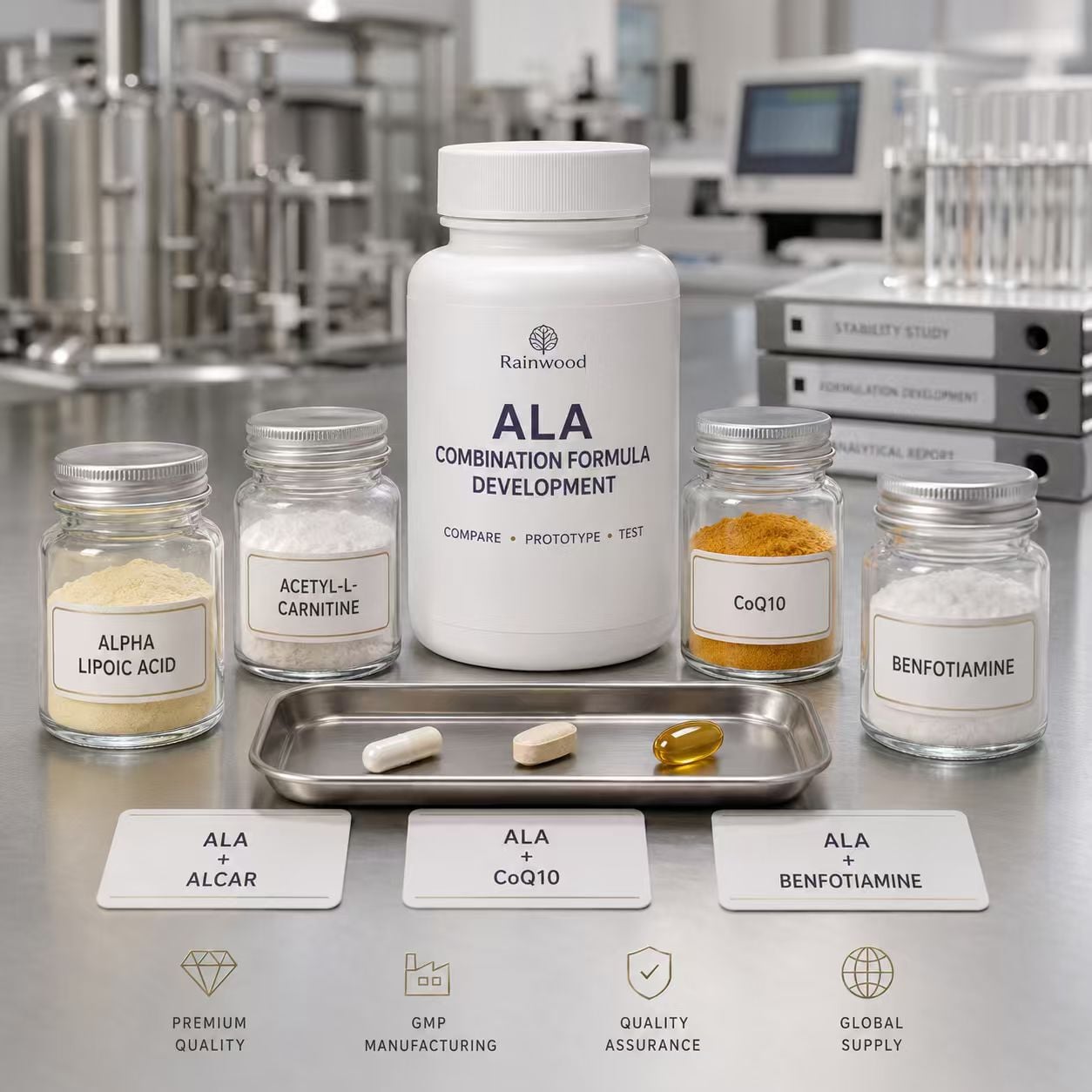
Meta title: ALA Plus ALCAR, CoQ10 or Benfotiamine: Which Formula Wins?
Meta description: Compare ALA combination formulas by buyer, evidence, dose, capsule fit, stability, testability, claims, daily cost, and commercial differentiation.
Adding acetyl-L-carnitine, CoQ10, and benfotiamine to alpha lipoic acid creates a longer label in minutes. Creating a formula that fits, tests, remains stable, and supports one clear claim takes much longer.
The wrong question is, “Which ingredient is best?”
The useful question is, “Which combination solves one defined buyer problem without borrowing evidence or hiding token amounts?”
Give the formula one commercial job
Choose the product job before choosing co-ingredients:
- a simple antioxidant-support product;
- an evidence-led practitioner formula;
- a cellular-energy positioning concept;
- a healthy-glucose-metabolism supplement where lawful;
- a compact premium capsule;
- a higher-dose professional serving.
Each job changes the evidence, amount, format, channel, warnings, and cost. A formula designed for everyone often has no defendable center.
Use the ALA form and declaration guide to lock the hero ingredient before adding supporting actives.
Option 1: ALA plus acetyl-L-carnitine
Acetyl-L-carnitine, often abbreviated ALCAR, can create a coherent energy or nerve-support narrative, but the buyer must define the exact carnitine form, amount, material specification, evidence, and label status.
Ask:
- Is the amount based on acetyl-L-carnitine, its salt, or an equivalent?
- Which ALA and ALCAR forms were used in cited research?
- Does the combined daily mass fit the target capsules?
- Can both ingredients be assayed in the finished matrix?
- Does “nerve support” remain a normal-function statement, or does the copy imply neuropathy treatment?
A disease-population paper does not automatically support an e-commerce supplement claim.
Option 2: ALA plus CoQ10
CoQ10 can support an antioxidant or energy-positioning architecture, but it introduces form, solubility, dispersion, oxidation, dosage-form, and analytical questions. Ubiquinone and ubiquinol should not be treated as one interchangeable input or evidence set.
Ask:
- Which CoQ10 form and carrier system is proposed?
- Is a dry capsule, softgel, tablet, or multi-unit system more realistic?
- Does the material require oil or a delivery system that conflicts with ALA processing?
- Can the finished product meet both ALA and CoQ10 specifications through shelf life?
- Is “synergy” supported by the exact combination, or merely inferred from two ingredient stories?
Do not assume that two antioxidants automatically produce a clinically superior product.
Option 3: ALA plus benfotiamine
Benfotiamine is a thiamine derivative used in some supplement and research contexts. Its ingredient status, naming, permitted amount, and claims require destination-market review.
Ask:
- Is benfotiamine permitted in the target category and market?
- What exact amount and evidence justify its role?
- Is the formula targeting healthy function or implying treatment of diabetic complications?
- Are thiamine-related statements accurate for this derivative and jurisdiction?
- Does the combined formulation require additional warnings or professional oversight?
A popular practitioner combination can still be unsuitable for a mass-market listing.
Do not add all three by default
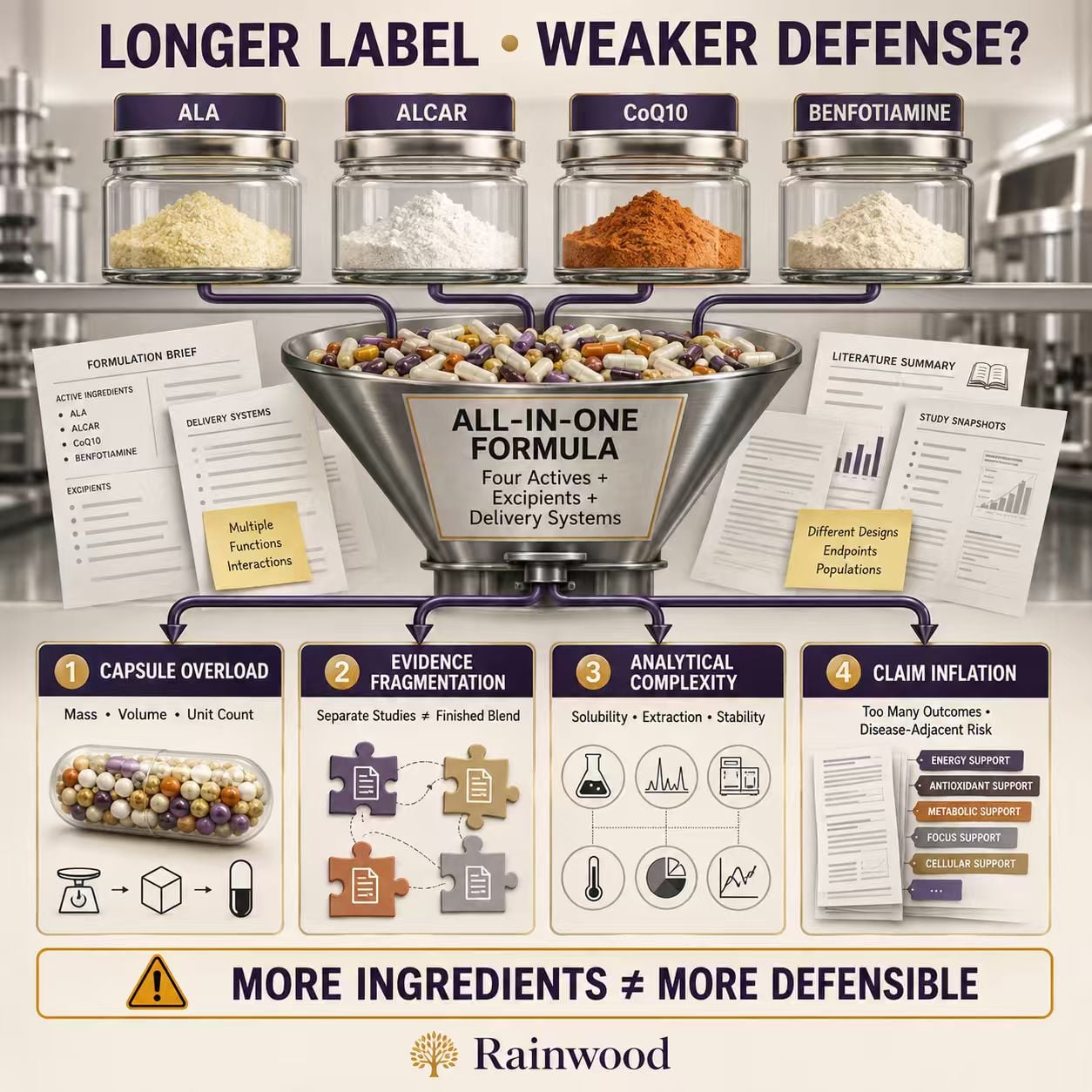
An ALA + ALCAR + CoQ10 + benfotiamine formula creates at least four risks:
Capsule overload
Each active and its excipients consume mass and volume. If the product must fit two capsules, the team may reduce amounts until none matches the intended rationale.
Evidence fragmentation
Separate studies on four ingredients do not prove the finished blend. The more complex the formula, the harder it is to describe exactly what evidence supports.
Analytical complexity
Different solubilities, detection conditions, extraction needs, and degradation profiles can make one finished method unrealistic. Method development and laboratory cost rise.
Claim inflation
Marketing may combine antioxidant, energy, glucose, nerve, cardiovascular, and anti-aging language into a disease-adjacent promise that no study tested.
Run the 600 mg ALA capsule-fit check before approving a multi-active front panel.
The formula decision matrix
| Decision factor | ALA + ALCAR | ALA + CoQ10 | ALA + Benfotiamine |
|---|---|---|---|
| Clearest potential story | energy/nerve-function concept | antioxidant/energy concept | glucose/nerve-function concept |
| Main form question | carnitine salt/equivalent | ubiquinone/ubiquinol/carrier | ingredient status and derivative identity |
| Format pressure | combined mass | oil/dispersion and format | combined mass and market limits |
| Evidence-transfer risk | disease-population borrowing | “synergy” assumption | diabetes-complication implication |
| Finished-test challenge | two active methods | different solubility/matrix | multi-active specificity |
| First regulatory question | wording and dose | form, claim and delivery system | legal status and claim |
These are prompts, not universal rankings. Score the exact commercial materials and market.
Build a study-to-formula bridge
For every central citation, record:
- tested ALA form and manufacturer where known;
- co-ingredient identity and form;
- exact daily amounts;
- dosage form and route;
- population and inclusion criteria;
- duration and schedule;
- endpoints;
- comparator;
- results and limitations;
- proposed claim;
- mismatch and qualification.
FTC guidance says health-related claims require competent and reliable scientific evidence, and relevance to the specific product and claim matters. A reference list is not a bridge.
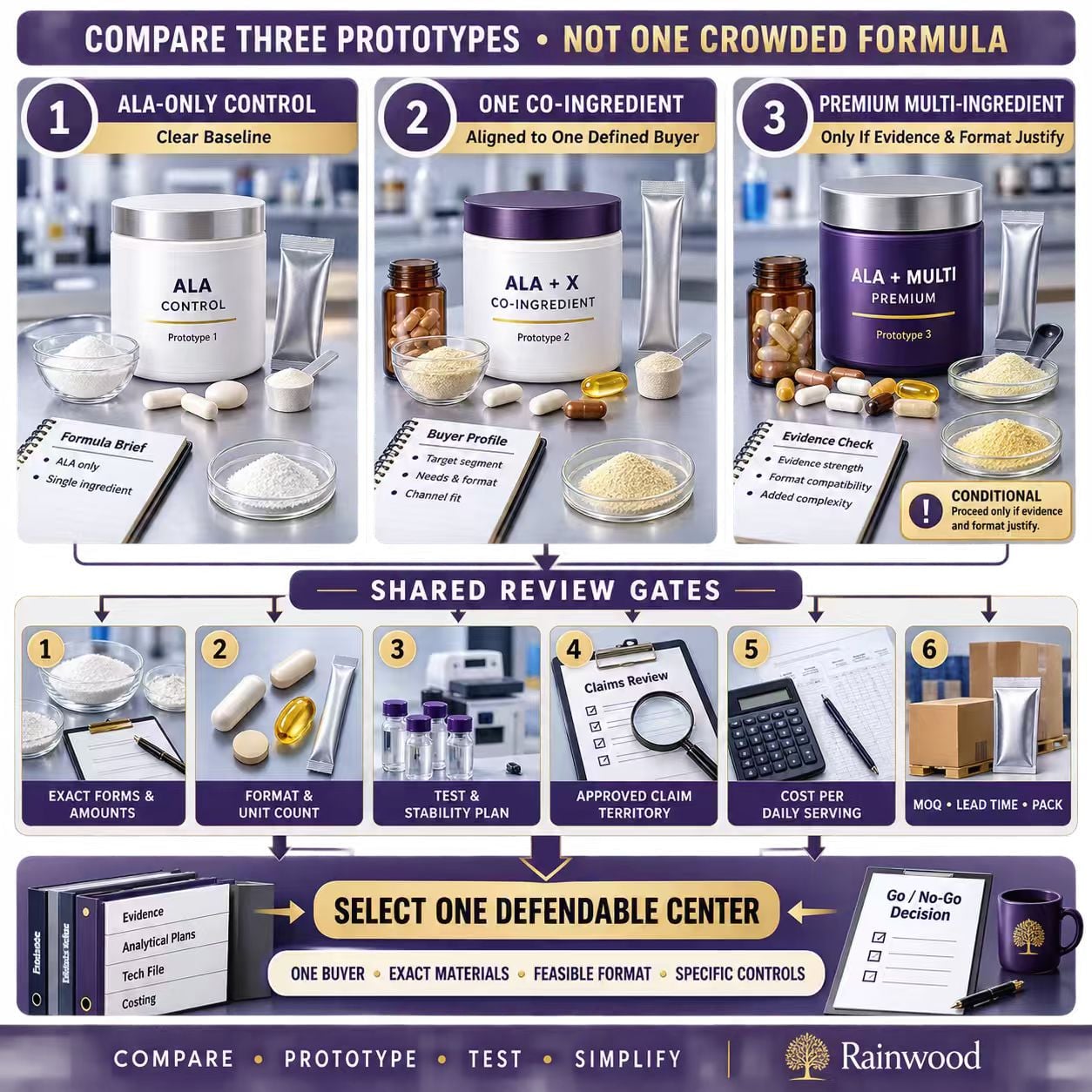
Compare three prototypes, not one crowded formula
Ask the OEM for:
1. ALA-only control concept.
2. One co-ingredient concept aligned to the main buyer.
3. A premium multi-ingredient concept only if evidence and format justify it.
For each, compare:
- exact materials and amounts;
- capsule/tablet/softgel feasibility;
- daily unit count;
- test and stability plan;
- approved claim territory;
- cost per daily serving;
- MOQ and lead time;
- package count and retail price;
- differentiation in one sentence.
RainwoodBio publishes custom formula and multi-format OEM services. Treat this as the stage for a documented comparison, not a reason to add every available ingredient.
How RainwoodBio can support a defendable combination
RainwoodBio's website describes ALA capsules, custom capsules, tablets/softgels, formulation, samples, production, testing, and packaging. Those pages do not prove that a specific ALCAR, CoQ10, or benfotiamine combination is clinically tested, market-authorized, stable, or analytically verified.
Ask RainwoodBio to prepare:
- exact ingredient forms, suppliers, specifications, and inputs;
- per-unit/per-day mass balance;
- two or three format options;
- representative COAs and available evidence files;
- proposed finished methods and stability criteria;
- claim and warning questions for each target market;
- cost per compliant daily serving.
Review the published ALA capsule product context, then require project-specific proof for the selected blend.
The selection rule
Choose the formula that can complete this sentence:
> For [one defined buyer], this product uses [exact materials] at [defensible daily amounts] to support [approved normal-function positioning], in [a feasible format], controlled by [specific tests and stability plan].
If the sentence needs five outcomes and seven disclaimers, simplify the formula.
Request an ALA combination-formula comparison. Send RainwoodBio the target buyer, market, claims, preferred ALA form, candidate co-ingredients, daily serving, maximum unit count, dosage form, evidence papers, pack, target price, volume, and launch date; the team can return three concepts with the evidence and manufacturing tradeoffs visible.
Frequently asked questions
1.Which ALA combination has the strongest evidence?
That depends on the exact materials, amounts, population, outcome, totality of studies, claim, and market. Evaluate the full evidence set rather than the ingredient names.
2.Can separate ingredient studies support a combination product?
They may support carefully limited ingredient context, but they do not automatically prove the finished combination, synergy, safety, stability, or performance.
3.Is CoQ10 better in a softgel with ALA?
The best format depends on CoQ10 form/carrier, ALA stability, compatibility, dose, manufacturing, testing, and consumer brief. Compare prototypes.
4.Can an ALA-benfotiamine product say diabetic neuropathy support?
That wording can imply disease treatment. Obtain qualified market-specific review and use only adequately substantiated, lawful claims.
References
- Cochrane review, Alpha-lipoic acid for diabetic peripheral neuropathy: https://pubmed.ncbi.nlm.nih.gov/38205823/
- Health Canada DL-Alpha-Lipoic Acid/R-Alpha-Lipoic Acid monograph: https://webprod.hc-sc.gc.ca/nhpid-bdipsn/dbImages/mono_alpha-lipoic-acid_english.pdf
- FDA Structure/Function Claims: https://www.fda.gov/food/nutrition-food-labeling-and-critical-foods/structurefunction-claims
- FTC Health Products Compliance Guidance: https://www.ftc.gov/business-guidance/resources/health-products-compliance-guidance
- RainwoodBio alpha lipoic acid capsules: https://www.rainwoodbio.com/oem-odm-alpha-lipoic-acid-capsules-500mg-high-quality-alpha-lipoic-acid-capsules
- RainwoodBio OEM service: https://www.rainwoodbio.com/oem
*This article is for international B2B formulation and educational purposes. Ingredient identity, status, dose, evidence, safety, compatibility, dosage form, finished methods, stability, labels, claims, warnings, and regulatory requirements must be assessed for the exact combination and destination market.*