 EN
EN
Meta title: Alpha Lipoic Acid Gummies: Heat, Taste and Shelf-Life Risks
Meta description: A B2B feasibility guide to ALA gummy heat exposure, chiral profile, sensory masking, uniformity, assay recovery, packaging, and stability.
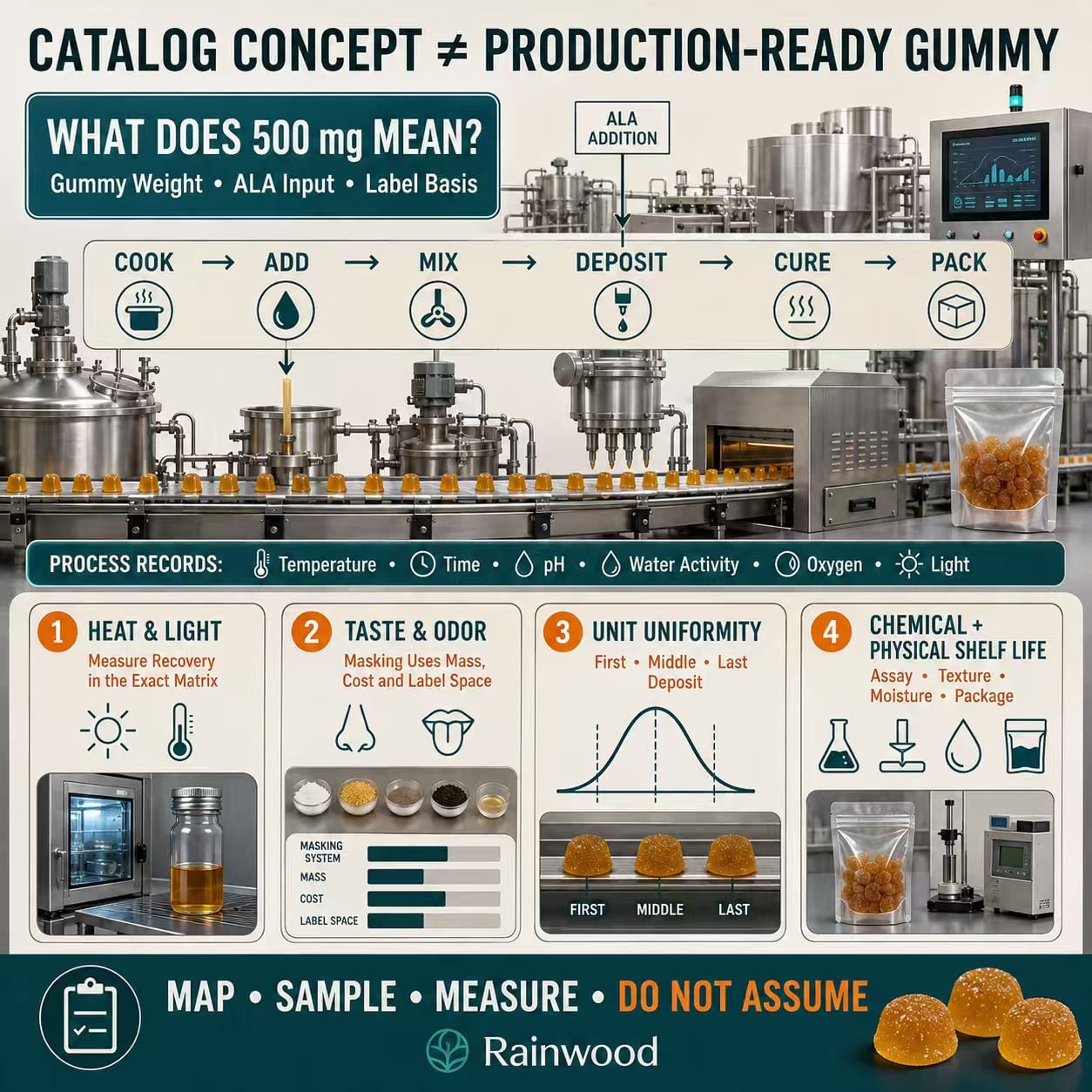
The brief sounds irresistible: put 500 mg of alpha lipoic acid into a great-tasting gummy and turn a technical antioxidant into a consumer-friendly format.
Then formulation asks four questions: Is 500 mg the gummy weight or the ALA amount? Which ALA form? What processing exposure will it see? How will you prove strength and quality at the end of shelf life?
An ALA gummy can be explored. It should not be sold from a catalog title before the chemistry, sensory profile, unit mass, process, and stability are tested.
Start by defining the number
A product listing may use “500 mg gummy” to describe unit weight, active amount, or a customizable concept. These are not interchangeable.
Write the brief as:
> Each gummy weighs ___ mg and contains ___ mg input of [exact ALA form], delivering ___ mg on the approved declaration basis; the daily serving is ___ gummies.
Then calculate:
- ALA form and assay-adjusted input;
- active percentage of total gummy mass;
- sweetener, gelling system, acid, flavor, color, oil, coating, and processing-aid mass;
- number of gummies per serving;
- count and days per bottle;
- target assay at release and shelf life.
Use the 600 mg ALA serving and format guide before turning a capsule benchmark into a gummy.
Heat exposure must be mapped, not guessed
Gummy processes can include heated cooking, holding, mixing, depositing, curing, drying, or coating stages. The ALA does not necessarily experience the peak kettle temperature for the entire process, and different technologies use different conditions.
Record the actual:
- addition point;
- product temperature at addition;
- residence time;
- pH and water activity environment;
- exposure to oxygen and light;
- cooling profile;
- curing conditions;
- rework policy.
Scientific studies report that ALA can be sensitive to light and heat under defined conditions. A separate 2021 study observed chiral conversion under severe heating with glucose in its experimental system. These findings do not prove that every gummy process destroys ALA. They establish why recovery and stability must be measured in the exact matrix.
Review the ALA heat-and-light sample-to-bulk controls before selecting a gummy process.
R-ALA creates an additional analytical question
If the label promises R-ALA, total ALA assay does not automatically establish that the enantiomeric composition remains compliant after processing and storage.
Decide:
- what chiral specification applies to the raw material;
- whether process-development samples require R/S testing;
- whether finished-product verification is needed;
- whether sugar/polyol matrix and sample preparation interfere;
- how heat exposure and shelf life affect the risk assessment.
Do not claim that a stabilized salt automatically solves every gummy problem. It changes the formulation and calculation questions and must be tested as the exact commercial material.
Taste masking can steal formula space
ALA is an organosulfur compound, so an OEM buyer should evaluate its odor and taste in the proposed matrix rather than assume a fruit flavor will cover it. The masking system can require acids, flavors, sweeteners, coatings, or encapsulated material that change gummy mass, processing, label, cost, and stability.
Run blinded sensory comparisons at:
- initial bench stage;
- after pilot processing;
- after early stability exposure;
- at intended serving size;
- with the exact bottle and closure.
Assess aftertaste, odor on opening, flavor fade, color change, texture, stickiness, and consumer willingness to take the full daily serving.
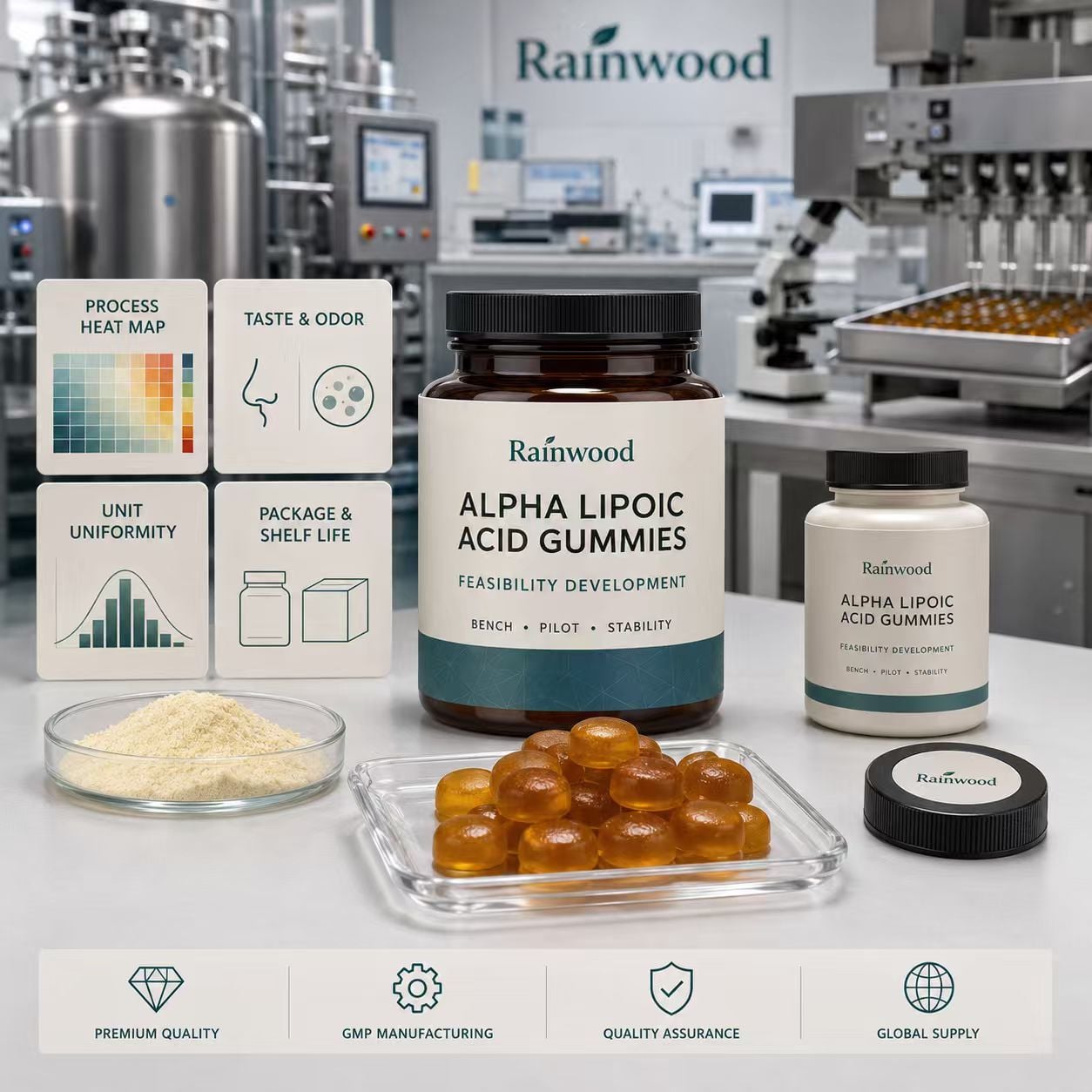
RainwoodBio publishes custom gummy capabilities and an ALA gummy catalog entry. Treat those as a reason to request feasibility data, not proof that every active load is production-ready.
Uniformity is harder than “average assay passes”
ALA must remain uniformly distributed from mixing through depositing and curing. A composite result can hide unit-to-unit variation.
The development plan should evaluate:
- raw-material dispersion or dissolution;
- hold-time uniformity;
- first, middle, and last deposit samples;
- individual-unit or justified composite testing;
- gummy weight variation;
- assay recovery and method precision;
- segregation, precipitation, or surface migration;
- batch reconciliation and yield.
If ALA is added through a premix or carrier, verify the premix composition, uniformity, active basis, and label implications.
Texture and potency share the same shelf life
A gummy can retain acceptable ALA content while becoming too hard, wet, sticky, crystallized, or unattractive. It can also look perfect while assay or degradation results move out of specification.
Stability should therefore include both chemical and physical criteria:
- ALA assay and relevant degradation controls;
- chiral profile where necessary;
- individual or batch uniformity as justified;
- moisture/water activity;
- microbiological quality;
- texture and chew;
- appearance, color, odor, and taste;
- package seal and moisture protection.
Test the marketed container-closure system. A bulk gummy in a laboratory pouch is not the finished product.
The unit-economics test
A fashionable format can destroy margin through:
- high gummy count per daily serving;
- larger bottle and shipping weight;
- expensive taste-masking system;
- active loss and justified process adjustment;
- longer development and stability work;
- slower production or lower yield;
- rejected batches from texture or assay variation.
Compare cost per compliant daily serving with a capsule and tablet—not only cost per gummy.
Use RainwoodBio's published OEM requirement and sample workflow to request a format comparison before committing to molds and labels.
How RainwoodBio can support an ALA gummy feasibility gate
RainwoodBio lists custom gummies and an ALA gummy concept on its website. Those pages do not establish the exact ALA active amount, form, heat recovery, taste acceptance, finished method, or 24-month stability for a new project.
Ask RainwoodBio to provide:
- exact proposed ALA form and input basis;
- target gummy weight and daily serving;
- process-temperature/time map;
- bench and pilot assay recovery;
- sensory options and full excipient system;
- unit-uniformity and finished-method plan;
- packaging and stability protocol;
- capsule or tablet fallback with cost comparison.
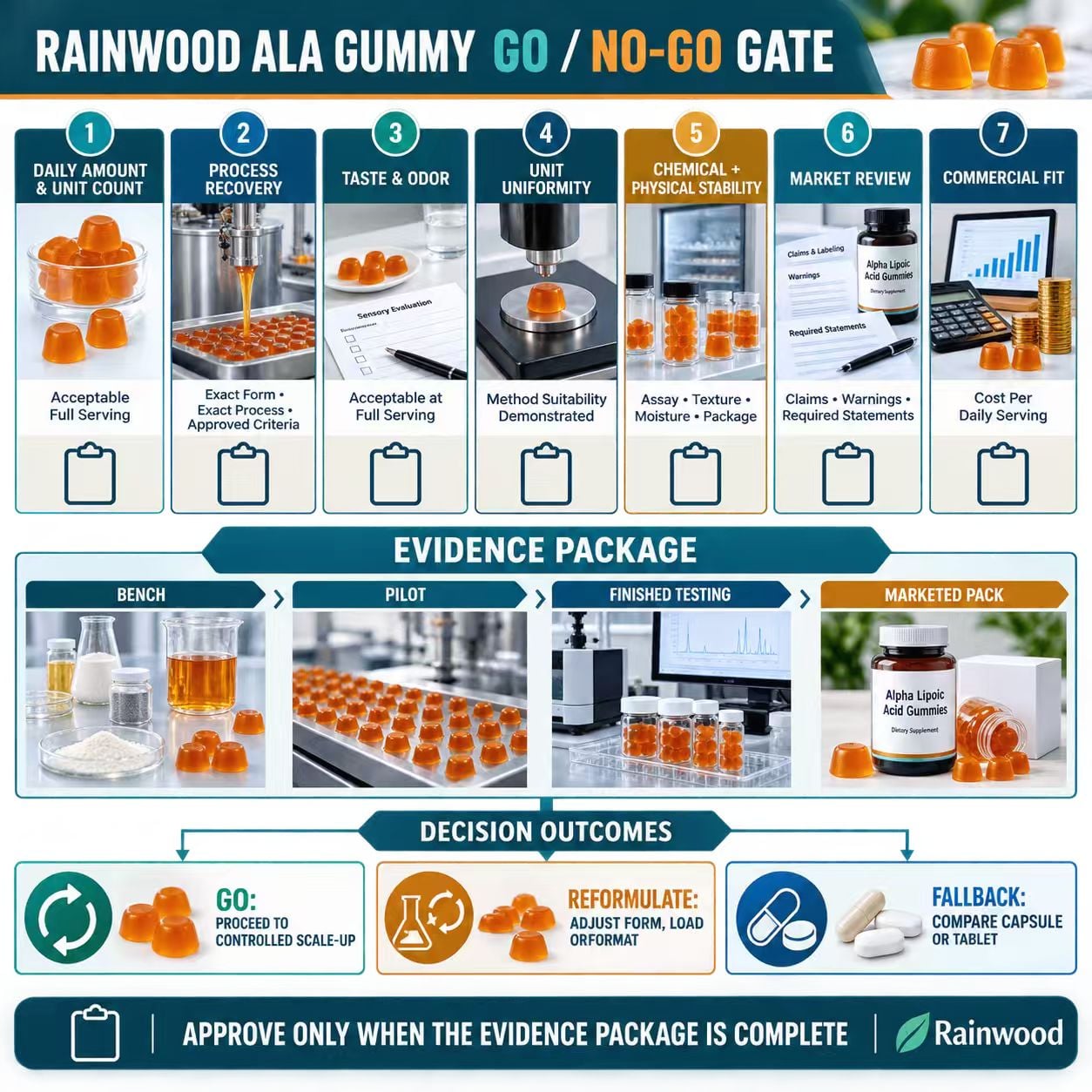
The go/no-go gate
Approve the gummy only when:
1. The intended daily amount fits an acceptable number of units.
2. The exact form survives the proposed process to approved criteria.
3. Taste and odor are acceptable at the full serving.
4. Unit uniformity and method suitability are demonstrated.
5. Chemical and physical stability support the proposed shelf life.
6. Claims and warnings are approved for the destination.
7. Cost per daily serving meets the commercial brief.
Request an ALA gummy feasibility and pilot-sample plan. Send RainwoodBio the exact ALA form, target active amount, gummy count, market, sweetener and gelatin/pectin preference, flavor, claims, packaging, volume, target price, and launch date; the team can return a bench-to-pilot decision plan.
Frequently asked questions
1.Does an ALA gummy require a large overage?
Do not select an overage from assumption. Measure process recovery and stability, investigate losses, and obtain quality and regulatory approval for any justified adjustment.
2.Is R-ALA better for gummies than DL-ALA?
No form wins automatically. Compare form-specific stability, calculation, process recovery, evidence, taste, cost, and market rules.
3.Can the raw-material HPLC method test the gummy?
Not automatically. Sugars, gelling agents, colors, flavors, and other ingredients can affect extraction, separation, detection, and calculation.
4.Can a cool-process gummy eliminate stability work?
No. It may reduce one exposure, but the final matrix, storage, light, moisture, oxygen, packaging, and shelf life still require assessment.
References
- Development of a silica-based ALA formulation and photo/thermal stability evaluation: https://pubmed.ncbi.nlm.nih.gov/32143535/
- Study of alpha lipoic acid chiral conversion under heated conditions: https://www.jstage.jst.go.jp/article/jpchrom/advpub/0/advpub_2021.019/_pdf
- ICH Q1A(R2) Stability Testing: https://database.ich.org/sites/default/files/Q1A%28R2%29%20Step4.pdf
- Health Canada DL-Alpha-Lipoic Acid/R-Alpha-Lipoic Acid monograph: https://webprod.hc-sc.gc.ca/nhpid-bdipsn/dbImages/mono_alpha-lipoic-acid_english.pdf
- RainwoodBio custom gummies: https://www.rainwoodbio.com/gummies
- RainwoodBio OEM service: https://www.rainwoodbio.com/oem
*This article is for international B2B formulation and educational purposes. ALA form, input, process exposure, sensory performance, uniformity, methods, stability, overage, packaging, labels, claims, warnings, and regulatory requirements must be confirmed for the exact gummy and destination market.*