 EN
EN
Meta title: ALA Antioxidant Support vs Neuropathy Treatment Claims
Meta description: Control ALA claims across labels, listings, ads, images, reviews, metadata, and affiliates without turning a supplement into a disease treatment.
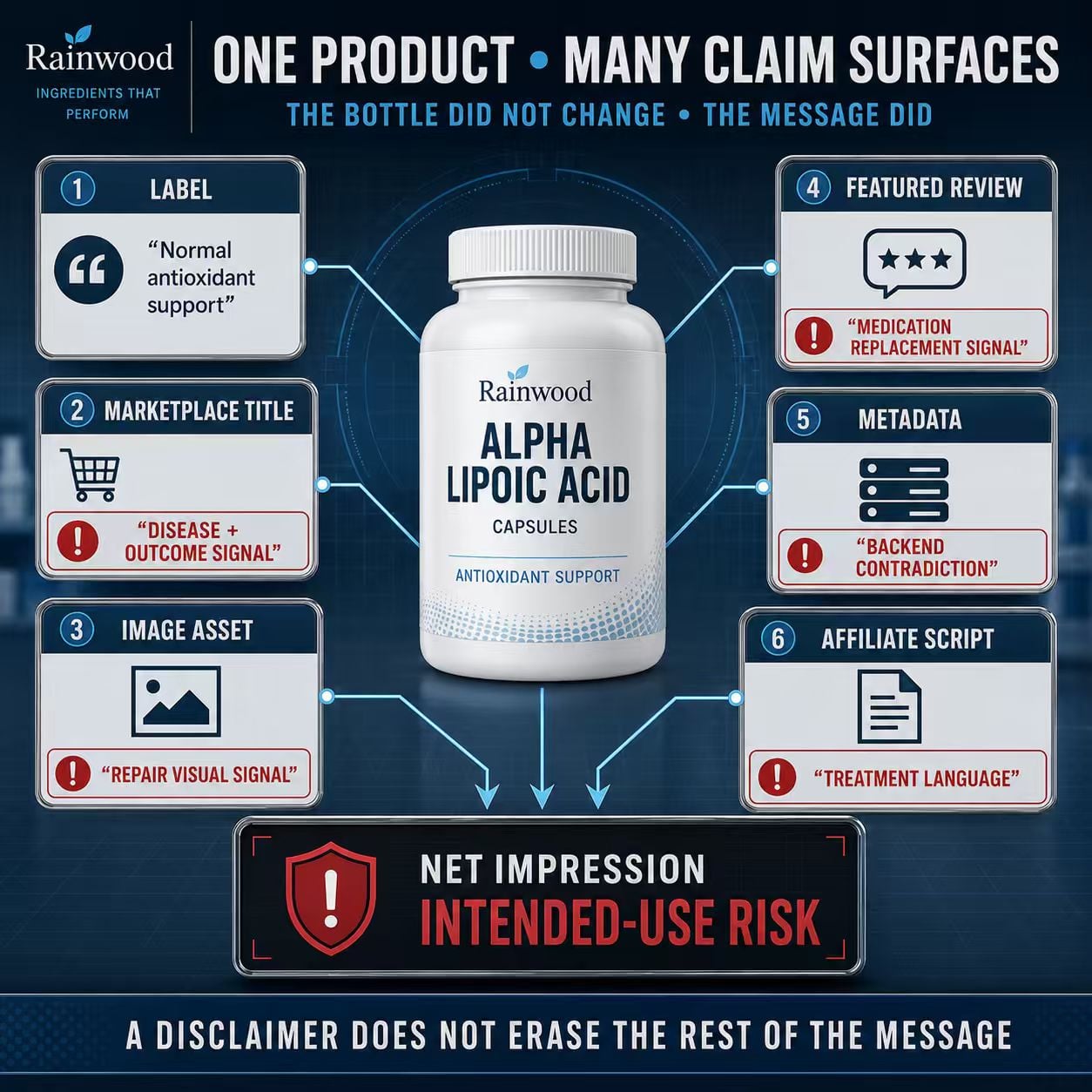
The label says “antioxidant support.” The marketplace title says “diabetic neuropathy relief.” The image shows a damaged nerve becoming healthy. A featured review says the capsules replaced medication.
The bottle did not change. Its intended use may have.
For ALA e-commerce sellers and private-label brands, disease meaning can arise from one phrase, visual, testimonial, keyword, or affiliate script. A supplement disclaimer does not erase the rest of the message.
Review the net impression, not one approved sentence
Audit every consumer touchpoint:
- product and brand name;
- front, side, and back label;
- marketplace title and bullets;
- website H1, URL, meta title, description, and schema;
- paid-search and social ads;
- diagrams, icons, before/after images, and alt text;
- FAQs, chatbots, email, and customer-service scripts;
- reviews selected or reused by the brand;
- influencer and affiliate instructions;
- practitioner handouts and sales decks;
- translated content.
If one asset implies treatment, softer language elsewhere may not neutralize it.
Use the ALA 600 mg evidence-match guide before deciding what any channel may say.
U.S. structure/function wording has conditions
FDA explains that dietary-supplement structure/function claims can describe effects on normal structure or function, but they must be truthful and substantiated, require notification within the specified framework, and carry the statutory disclaimer. Disease claims can cause a product to be regulated as a drug.
The word “supports” is not a shield:
- “supports healthy antioxidant defenses” and “supports normal glucose metabolism” may be considered within a normal-function framework when adequately supported and properly reviewed.
- “supports the treatment of diabetic neuropathy” still names treatment.
- “supports nerve repair after diabetic damage” can imply disease reversal.
- “supports your diabetes medication” can imply augmentation of drug therapy.
Exact wording and context require qualified review.
Seven high-risk ALA patterns
1. Disease name plus outcome
“Diabetic neuropathy relief,” “reverses nerve damage,” and “prevents diabetes complications” are strong disease-treatment or prevention signals.
2. Medication replacement
“Natural alternative to neuropathy drugs” or “reduce your need for insulin” creates serious intended-use and safety concerns.
3. Blood-sugar certainty
“Lowers blood sugar guaranteed” is broader than a carefully substantiated normal-metabolism statement and can create medical risk.
4. Study-image inflation
A paper in patients with diabetes is paired with a general supplement and presented as direct finished-product proof.
5. Nerve-repair graphics
An animation of damaged nerves regenerating can communicate treatment even if the caption avoids a disease name.
6. Testimonial laundering
The brand features a review stating “my neuropathy is gone” or “I stopped my medicine.” Selecting and promoting it can make it part of advertising.
7. Backend contradiction
The visible page is cautious, but metadata, ad groups, tags, or affiliate links target “diabetic neuropathy treatment.”
Review the RainwoodBio ALA capsule product context as a source of product information, not as preapproved claim copy.
Antioxidant language still needs substantiation
“Antioxidant” is not a universal permission slip. Define what the product contains, what the evidence establishes, what consumers will understand, and whether the exact wording is permitted in the destination.
FTC guidance says health claims require competent and reliable scientific evidence and marketers must consider express and implied messages. FDA guidance also states that a disclaimer cannot cure an otherwise misleading or unsubstantiated statement.
For each claim, create a record with:
- exact words and placement;
- intended and implied meaning;
- product version and formula;
- ALA form, manufacturer, and daily amount;
- target population;
- full evidence and totality review;
- study-to-product match;
- limitations and qualifications;
- jurisdiction and channel decision;
- approver, date, and expiration/review date.
Canada, the United States, and Europe are not one claim market
Health Canada's current compendial monograph includes defined antioxidant and healthy-glucose-metabolism uses, form-specific quantities, and warnings within its natural health product pathway. That does not authorize the same exact formula and wording in the United States, European Union, or another market.
In the EU, use the EU Register and target-country requirements to assess health claims and product notification or other obligations. Do not translate a Canadian monograph sentence and assume European authorization.
The label architecture should begin with destination market, not after the bottles are printed.
Build a three-column claim map
| Proposed message | Evidence question | Regulatory question |
|---|---|---|
| Contains 300 mg R-ALA | Is form/amount tested? | Is name/declaration correct? |
| Antioxidant support | Does evidence match product? | Is wording/notification permitted? |
| Healthy glucose metabolism | What population and form? | What market conditions/warnings apply? |
| Nerve support | What normal function is meant? | Does context imply neuropathy treatment? |
| Clinically studied | Was exact material/formula studied? | Is net impression misleading? |
| Safe and natural | What safety evidence and limits? | Is an unqualified safety claim allowed? |
Every row needs both answers. Scientific relevance does not replace legal review, and legal category does not replace evidence.
The safety-copy problem
Health Canada's monograph includes warnings related to pregnancy/breastfeeding, diabetes, and serious low-blood-sugar symptoms under stated conditions. EFSA separately assessed the relationship between ALA intake and insulin autoimmune syndrome.
Therefore avoid absolute phrases such as:
- “completely safe”;
- “no side effects”;
- “safe for diabetics”;
- “safe at any dose”;
- “natural, so there are no interactions.”
Warnings and target users must be selected through market-specific safety review, not copied from a competitor.
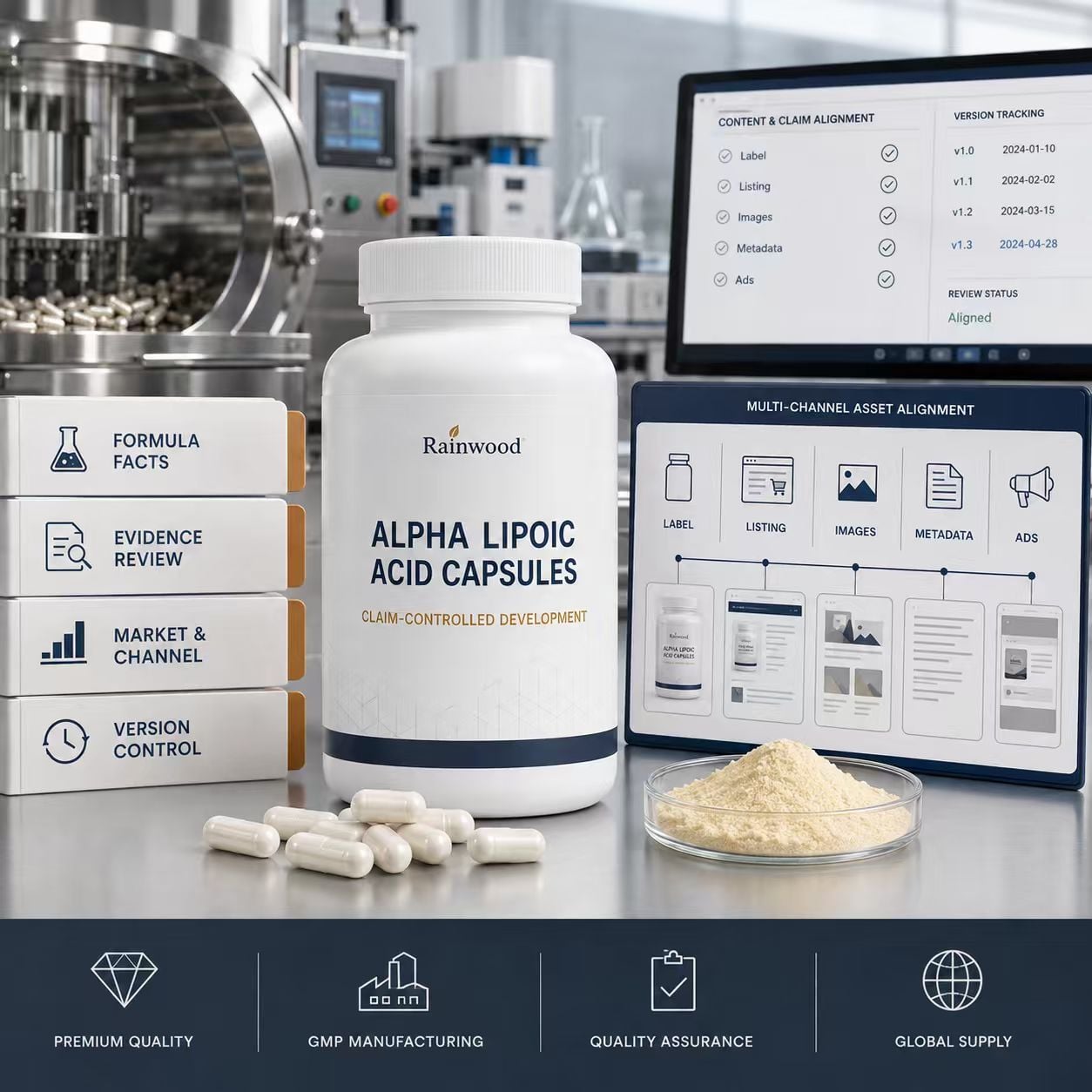
How RainwoodBio can support claim-controlled development
RainwoodBio's current ALA capsule page contains broad marketing statements touching diabetes, neuropathy, disease risk, and other health outcomes. Treat them as company-published website copy, not as regulatory approval or finished-product substantiation. Project copy should be independently re-evaluated.
RainwoodBio can provide the operational facts needed for review:
- exact ALA form, specification, and amount;
- full formula and directions;
- raw and finished test documents available;
- dosage-form and shelf-life information;
- source and manufacturer traceability;
- version changes before artwork.
Use the published OEM requirement-confirmation workflow to collect target market and proposed claims at project start.
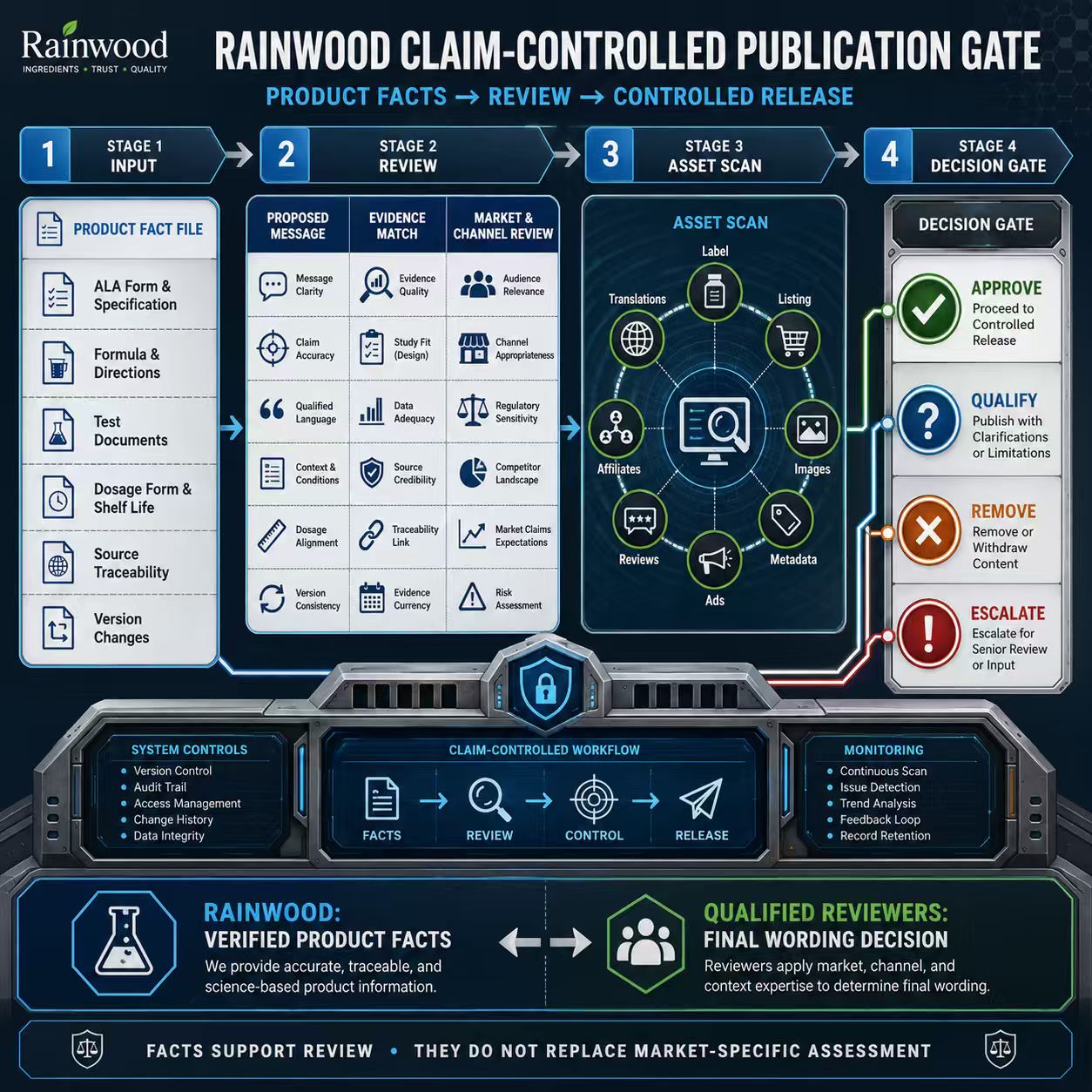
The publication gate
Search all assets for terms such as:
`diabetes`, `diabetic`, `neuropathy`, `nerve damage`, `pain`, `blood sugar`, `insulin`, `treat`, `prevent`, `repair`, `reverse`, `cure`, `medicine`, `clinically proven`, and guaranteed-result language.
Do not automatically delete every scientific mention. Route each occurrence for contextual review. Educational disease discussion can still create a product claim when placed near a sales CTA, product link, testimonial, or image.
Request an **ALA claim and listing-risk review** **[INTERNAL LINK -> Contact Us Page]**. Send RainwoodBio the formula, form, daily amount, market, complete label, listing, metadata, images, ads, affiliate scripts, proposed claims, supporting papers, pack, and volume; RainwoodBio can supply project facts while qualified regulatory reviewers decide the final wording.
Frequently asked questions
1.Does the FDA disclaimer allow a neuropathy claim?
No. The disclaimer does not convert a disease-treatment claim into a permitted structure/function claim.
2.Can we quote a diabetic-neuropathy study on the product page?
Accurate citation does not automatically make the promotional context lawful or non-misleading. Assess proximity, audience, product match, implied message, and market rules.
3.Can we say “supports healthy glucose metabolism” worldwide?
Do not assume so. Wording, evidence, ingredient status, dose, warnings, notification, and permitted claims vary by jurisdiction.
4.Are customer reviews outside the brand's responsibility?
When a brand selects, highlights, edits, rewards, or repurposes a review, it can become part of the advertising message. Establish moderation and escalation controls.
References
- FDA Structure/Function Claims: https://www.fda.gov/food/nutrition-food-labeling-and-critical-foods/structurefunction-claims
- FDA Small Entity Compliance Guide on Structure/Function Claims: https://www.fda.gov/regulatory-information/search-fda-guidance-documents/small-entity-compliance-guide-structurefunction-claims
- FTC Health Products Compliance Guidance: https://www.ftc.gov/business-guidance/resources/health-products-compliance-guidance
- Health Canada DL-Alpha-Lipoic Acid/R-Alpha-Lipoic Acid monograph: https://webprod.hc-sc.gc.ca/nhpid-bdipsn/dbImages/mono_alpha-lipoic-acid_english.pdf
- EFSA opinion on ALA and insulin autoimmune syndrome: https://pubmed.ncbi.nlm.nih.gov/34122657/
- RainwoodBio alpha lipoic acid capsules: https://www.rainwoodbio.com/oem-odm-alpha-lipoic-acid-capsules-500mg-high-quality-alpha-lipoic-acid-capsules
*This article provides international B2B educational information, not legal advice. Product status, safety, substantiation, structure/function wording, disease implications, warnings, labels, advertising, testimonials, platform rules, and regulatory requirements must be reviewed for the exact product, content, channel, and destination market.*