 EN
EN

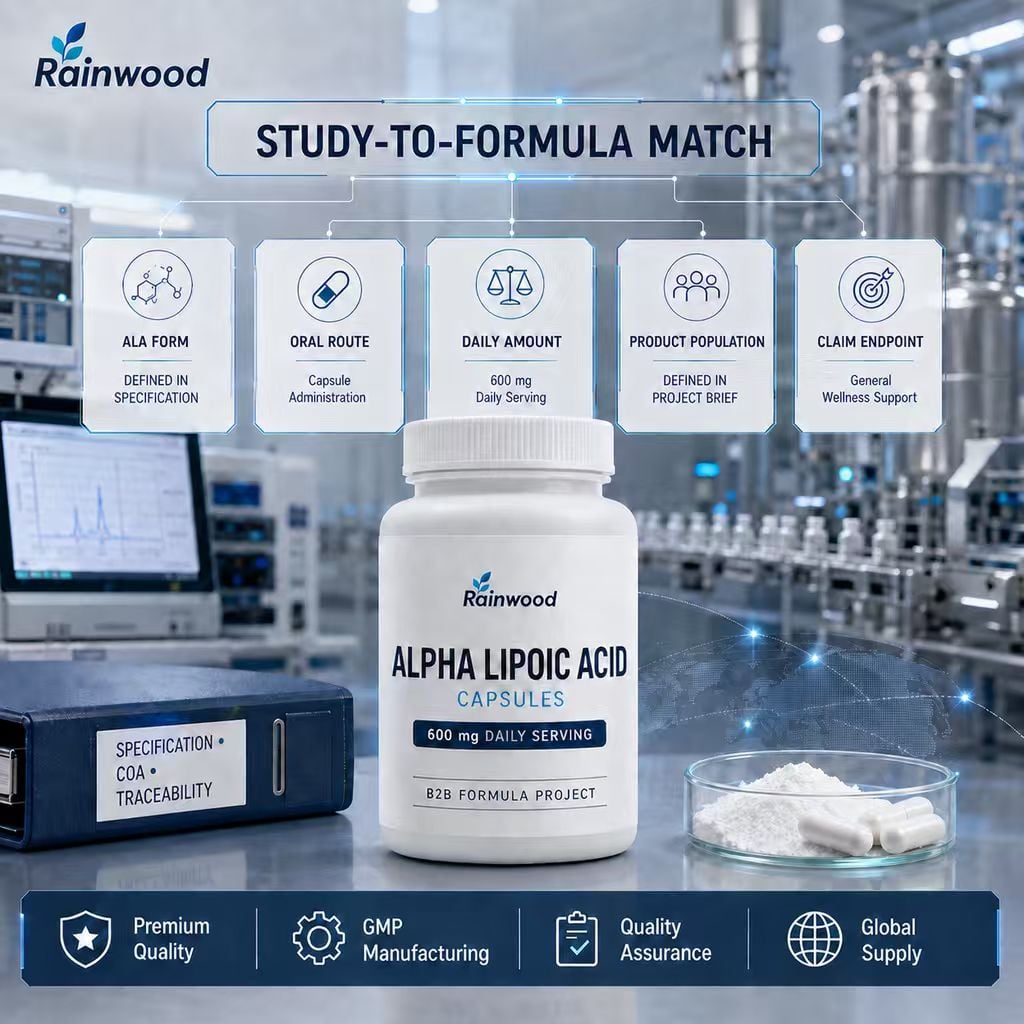
Meta title: Clinically Studied 600 mg ALA—or Borrowed Evidence?
Meta description: Match an ALA product to the studied form, route, population, dose, regimen, duration, endpoint, totality, and exact marketing claim.
Your ALA supplement delivers 600 mg per day. The literature folder contains studies using 600 mg. Marketing concludes: “clinically studied dose.”
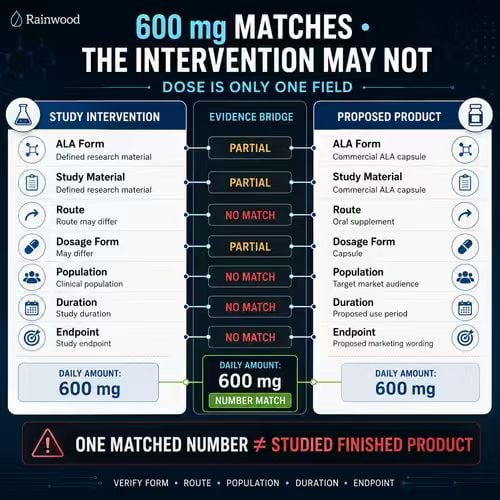
The number matches. The intervention may not.
Some research used oral racemic ALA; some used intravenous administration; some enrolled people with diagnosed diabetic peripheral neuropathy; study durations and outcomes vary. A 600 mg capsule for general wellness cannot inherit every favorable conclusion attached to the same number.
Dose matching is only one field
Build the evidence bridge across:
1. exact ALA form;
2. manufacturer or defined study material;
3. route of administration;
4. dosage form;
5. daily amount and calculation basis;
6. dosing schedule;
7. population;
8. duration;
9. comparator and co-interventions;
10. endpoint and proposed claim.
If nine fields differ and only “600 mg” matches, the product is not the studied intervention.
Use the ALA per-capsule and per-serving calculation to confirm that your finished directions actually deliver the number being discussed.
Oral and intravenous evidence cannot be blended casually
Route changes exposure, formulation, medical context, and intended use. Older reviews have discussed intravenous and oral ALA trials together or in subgroups. An oral dietary supplement should not cite an intravenous medical regimen as if it were direct product evidence.
For every paper, record:
- oral or intravenous route;
- administered material and formulation;
- clinical setting;
- frequency and duration;
- outcome time point;
- adverse-event monitoring;
- whether the result is relevant to a supplement claim.
If the most impressive result comes from a route your product does not use, qualify or remove the inference.
A diabetes study is not a general-wellness study
Many well-known ALA trials recruited people with diabetes and neuropathy symptoms. That population can answer a clinical research question. It does not automatically support a statement for healthy adults, athletes, beauty consumers, or general e-commerce users.
Population mismatch creates two risks:
- scientific relevance is weaker;
- promotional use can imply treatment of a named disease.
Health Canada's current monograph provides an example of jurisdiction-specific antioxidant and healthy-glucose-metabolism wording with defined forms, quantities, and warnings. It does not authorize the same language worldwide.
Review the ALA combination-formula decision guide before using a single-ingredient study for a multi-active product.
The evidence is not one unanimous result
A 2023 meta-analysis of oral ALA in diabetic sensorimotor polyneuropathy reported favorable findings for some symptom scores but not for several other outcomes. A 2024 Cochrane review focused on randomized trials lasting at least six months and concluded that ALA probably has little or no effect on neuropathy symptom scores at six months, with important study limitations.
These reviews ask different questions and use different inclusion criteria. A responsible evidence memo should explain that rather than selecting the most marketable abstract.
Record:
- search date and databases;
- included study durations;
- risk of bias;
- heterogeneity;
- outcomes that did and did not change;
- certainty of evidence;
- shorter- versus longer-term findings;
- relevance to the exact product and claim.
“Research exists” is not the same as “the totality proves our wording.”
R-ALA cannot automatically borrow racemic evidence
R-ALA and DL-ALA are distinguishable forms. Sodium R-lipoate adds another commercial preparation. Form-specific pharmacokinetic research may be useful, but it should not be converted into a universal claim that half the racemic dose produces the same clinical outcome.
Check:
- whether the paper identifies racemic or R material;
- whether the commercial ingredient matches;
- whether the comparison used equal mass, molar amount, or another basis;
- whether the endpoint was blood concentration or a health outcome;
- whether the participant population matches;
- whether the finished formula changes exposure.
Read the R-ALA identity and chiral-proof guide before using R-form language in an evidence claim.
“Clinically studied ingredient” and “clinically studied formula” are different
Use a claim ladder:
Contains alpha lipoic acid
Primarily a truthful composition statement, subject to exact form, amount, label, and test evidence.
Made with an ALA form that has been studied
Requires accurate context and should not imply that every study or result transfers.
Made with clinically studied ALA
Requires a strong identity and evidence match, plus authorization if a defined branded ingredient is involved.
This 600 mg ALA product is clinically studied
Normally requires research on the exact finished product or a robust, appropriately reviewed basis for the statement.
Clinically proven to treat diabetic neuropathy
This is an aggressive disease-treatment statement and can move the product outside lawful supplement positioning.
FTC guidance emphasizes express and implied messages and the relevance of scientific support to the specific product and advertised claim.
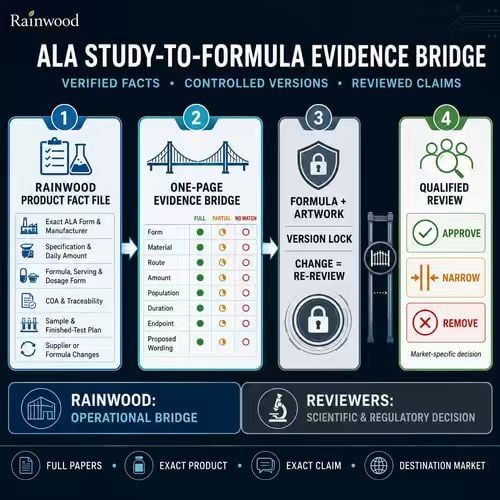
The one-page evidence bridge
| Field | Study | Proposed product | Match |
|---|---|---|---|
| ALA form | | | Full/partial/no |
| Manufacturer/material | | | Full/partial/no |
| Route | | | Full/partial/no |
| Daily amount | | | Full/partial/no |
| Schedule | | | Full/partial/no |
| Population | | | Full/partial/no |
| Duration | | | Full/partial/no |
| Co-ingredients | | | Full/partial/no |
| Endpoint | | | Full/partial/no |
| Proposed wording | | | Approved/narrow/remove |
Attach full papers, not only abstracts or supplier slides. Version-control the bridge with the formula and artwork.
How RainwoodBio can support evidence matching
RainwoodBio publishes an ALA capsule page and describes formula, sample, production, testing, and documentation services. The public page is not a clinical dossier for every custom ALA product, and broad website statements should not be copied as product proof.
Ask RainwoodBio to supply the operational facts:
- exact ALA form, manufacturer, specification, and daily amount;
- complete formula, serving, and dosage form;
- representative COAs and traceability documents;
- sample and finished-test plan;
- formulation or supplier changes that affect the bridge;
- available branded-ingredient rights, if applicable.
Use RainwoodBio's published OEM workflow to trigger evidence re-review after formula confirmation and before artwork.
The claim release gate
Do not release “clinically studied 600 mg” until qualified scientific and regulatory reviewers confirm:
- what a reasonable buyer or consumer will understand;
- which exact studies support that understanding;
- whether the product matches the studies;
- whether contradictory or limiting evidence is addressed;
- whether the wording is lawful in the destination;
- whether formula and supplier changes trigger reapproval.
Request an ALA study-to-formula match review. Send RainwoodBio the full papers, ingredient specification, ALA form, daily amount, formula, serving, target population, market, exact proposed wording, dosage form, pack, and volume; the team can build the operational bridge for your scientific and regulatory reviewers.
Frequently asked questions
1.Is 600 mg automatically a clinically studied ALA dose?
It is a number used in research, but relevance depends on form, route, regimen, population, duration, endpoint, and exact claim.
2.Can a short-term favorable study outweigh a longer-term review?
Do not rank by convenience. Explain different questions, inclusion criteria, outcomes, bias, certainty, and totality with qualified scientific review.
3.Can our R-ALA product cite a DL-ALA study?
Only with an adequately justified and clearly qualified evidence bridge. Do not assume a universal one-half-dose equivalence.
4.Can a disclaimer fix an overstated clinical claim?
No. Disclaimers do not cure a misleading or unsubstantiated net impression.
References
- Cochrane review, Alpha-lipoic acid for diabetic peripheral neuropathy: https://pubmed.ncbi.nlm.nih.gov/38205823/
- 2023 systematic review/meta-analysis of oral ALA: https://pubmed.ncbi.nlm.nih.gov/37630823/
- NATHAN 1 trial: https://pubmed.ncbi.nlm.nih.gov/21775755/
- Health Canada DL-Alpha-Lipoic Acid/R-Alpha-Lipoic Acid monograph: https://webprod.hc-sc.gc.ca/nhpid-bdipsn/dbImages/mono_alpha-lipoic-acid_english.pdf
- FTC Health Products Compliance Guidance: https://www.ftc.gov/business-guidance/resources/health-products-compliance-guidance
- RainwoodBio alpha lipoic acid capsules: https://www.rainwoodbio.com/oem-odm-alpha-lipoic-acid-capsules-500mg-high-quality-alpha-lipoic-acid-capsules
*This article is for international B2B evidence planning and educational purposes. Material identity, route, dose, population, duration, outcomes, totality, substantiation, labels, claims, and regulatory requirements must be assessed for the exact ingredient, finished product, advertising, and destination market.*