 EN
EN

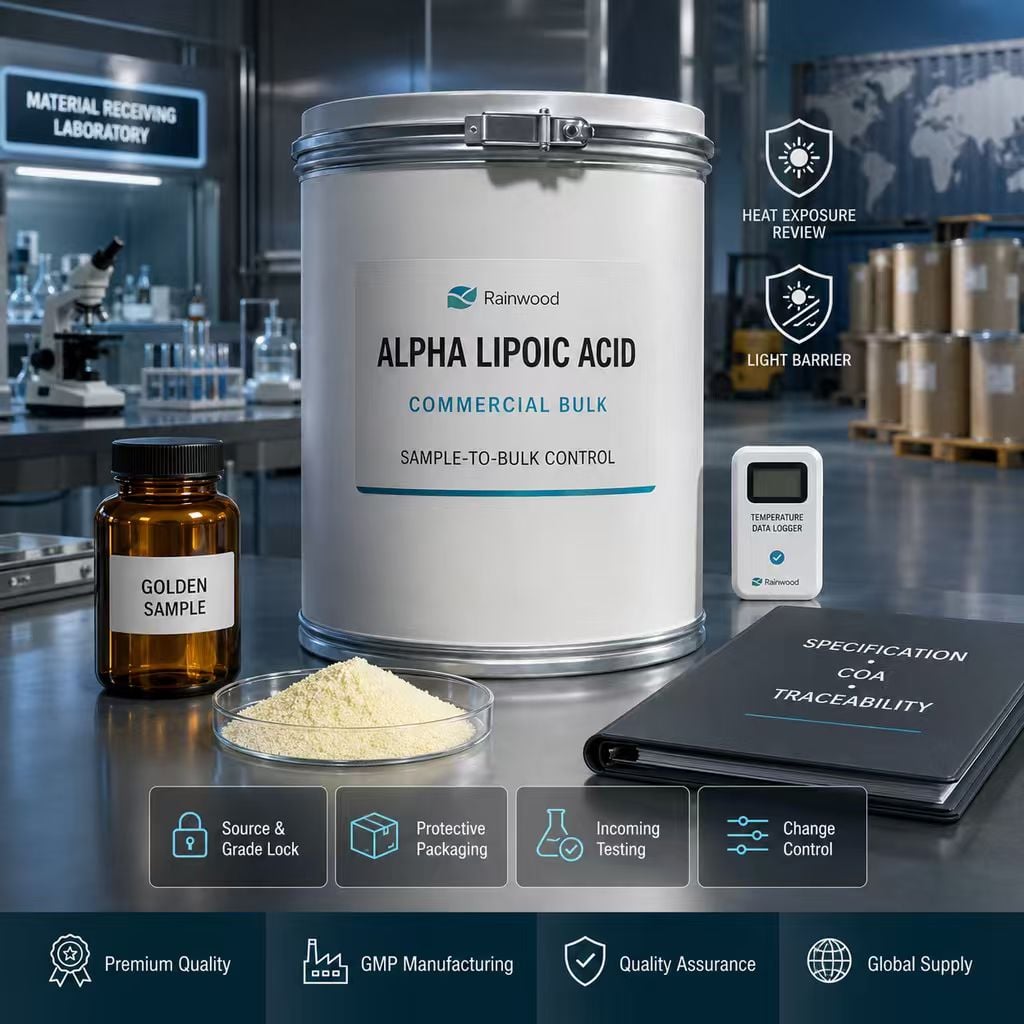
Meta title: Perfect ALA Sample, Sticky Bulk: Lock Heat and Light Stability
Meta description: Prevent alpha lipoic acid sample-to-bulk failures with form control, packaging, transport, incoming tests, retention samples, and change control.
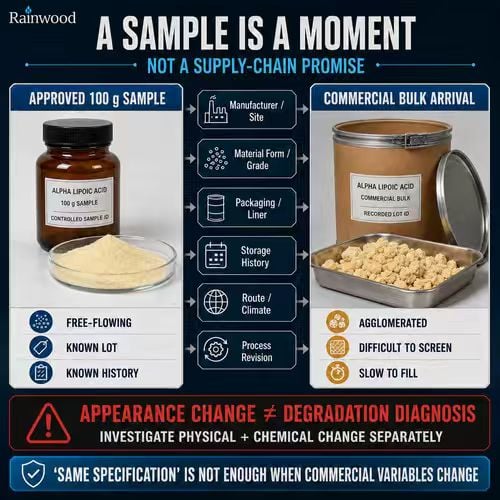
The 100-gram ALA sample arrives as a clean, free-flowing yellow powder. Six months later, the commercial drums reach the factory after a hot transit and the material is agglomerated, difficult to screen, and slow to fill.
That scenario does not prove degradation or supplier misconduct. It proves that sample approval without a commercial stability and logistics gate is incomplete.
Alpha lipoic acid has documented sensitivity to heat and light under defined experimental conditions. The exact consequence depends on form, grade, formulation, packaging, exposure, and test method. Buyers must control those variables before the launch depends on them.
A sample is a moment, not a supply-chain promise
Record what the approved sample actually represents:
- exact manufacturer and site;
- material form and grade;
- batch number and manufacture date;
- assay and chiral profile where relevant;
- packaging and fill quantity;
- storage and shipment history;
- particle and physical profile;
- documents and methods supplied.
If the commercial lot changes any of these attributes, it is not enough to say “same specification.” The change may affect flow, stability, processing, testing, claims, or evidence.
Use the ALA low-price specification comparison before replacing the approved source for margin.
Heat and light can create more than one type of failure
Research has studied ALA photo- and thermal degradation, while other work has explored methods to improve stability through formulation. These studies do not establish the shelf life of your product, but they justify project-specific controls.
Potential observations include:
- softening, sticking, or agglomeration;
- changed color or odor;
- lower assay;
- increased degradation or related-substance results;
- changed chiral composition under severe processing conditions;
- poorer flow and fill-weight control;
- altered dissolution or dispersion;
- difficulty obtaining a representative sample.
Do not diagnose the mechanism by appearance. Investigate chemical and physical changes separately.
The sample and bulk may never have been equivalent
Ask whether the sample was:
- from the same upstream manufacturer;
- from regular commercial production;
- freshly manufactured rather than aged stock;
- packaged in the same liner and drum system;
- shipped through the same route and climate;
- produced with the same process and specification revision;
- representative of the particle-size and density range.
A distributor can provide a technically compliant sample from one source and later quote another source under the same generic name unless the manufacturer/site is locked contractually. This is a control risk, not an accusation of common practice.
Review the RainwoodBio ALA capsule page as product context, then request sample-to-commercial traceability in writing.
Build a “golden sample” correctly
A golden sample is not an unlabeled pouch kept in an office drawer. Create a controlled reference with:
1. material and supplier/manufacturer identity;
2. lot and date;
3. approved specification and COA;
4. sealed retained quantity under defined conditions;
5. reference physical observations or measured attributes;
6. chiral and chemical evidence required for the form;
7. approved packaging;
8. signatures and version control.
Compare commercial lots against defined acceptance criteria, not memory. Visual and organoleptic comparison can support—but not replace—identity, assay, impurity, and other necessary tests.
Transport belongs in the quality plan
“Store in a cool, dry place” does not tell logistics how to manage a summer ocean route, a hot truck, customs delay, or temporary warehouse.
Define:
- allowable shipping and storage conditions;
- protective packaging and liner closure;
- light barrier;
- pallet and container practices;
- temperature-monitoring plan where justified;
- excursion notification and data review;
- quarantine and sampling after an excursion;
- retest and disposition decision;
- responsibility for freight claims or replacement.
Temperature data do not automatically condemn a lot. They allow quality to evaluate actual exposure against stability knowledge instead of guessing.
RainwoodBio publishes documentation, logistics, and traceability context. Confirm the exact records and responsibilities that will apply to the ALA order.
Incoming testing must sample the commercial reality
Commercial drums can vary within a lot. Build a justified sampling plan that addresses lot size, number of containers, material behavior, risk, and applicable quality requirements.
Incoming review can include, as appropriate:
- container and seal condition;
- label and lot reconciliation;
- appearance and agglomeration;
- identity;
- assay and related substances;
- chiral profile for R-form claims;
- water or loss on drying;
- particle and density attributes;
- process-relevant impurities;
- comparison with retained sample or qualification data.
A composite sample can hide a localized problem. Define when individual-container observations or samples are necessary.
Production trials should use commercial-grade material
A bench capsule proves that someone filled a capsule. It does not prove production speed, blend uniformity, fill variation, yield, equipment cleanup, or shelf life.
Before commercial release, run a representative trial with the intended:
- ALA manufacturer and grade;
- lot scale or justified pilot scale;
- excipients and co-ingredients;
- environmental conditions;
- equipment and process settings;
- capsule or tablet format;
- bottle, closure, liner, desiccant, and secondary packaging.
Record deviations and decide whether the formula, process, packaging, or specification needs revision.
Change control prevents the second surprise
Require advance notification for changes to:
- upstream manufacturer or site;
- ALA form or synthetic route;
- purification or relevant solvent;
- specification or test method;
- particle-size process;
- packaging or liner;
- retest period or storage condition;
- shipping origin or regular route.
Quality, formulation, regulatory, and marketing should assess the change. A new R/S profile or material form can affect the label and evidence, not only production.
Use RainwoodBio's published requirement-to-sample OEM sequence to place this gate before the purchase order.
How RainwoodBio can support sample-to-bulk control
RainwoodBio states that it offers requirement confirmation, sample development, manufacturing, testing, packaging, documentation, and logistics. The public website should not be read as an absolute guarantee that samples and commercial lots are identical or that every ALA shipment receives temperature monitoring.
For your project, ask RainwoodBio to provide:
- sample and bulk manufacturer/site/grade confirmation;
- approved specification and representative documents;
- commercial packaging and shipment proposal;
- agreed incoming and finished tests;
- sample-to-bulk comparison criteria;
- excursion and nonconformance workflow;
- retained-sample and traceability arrangements;
- change-notification terms.
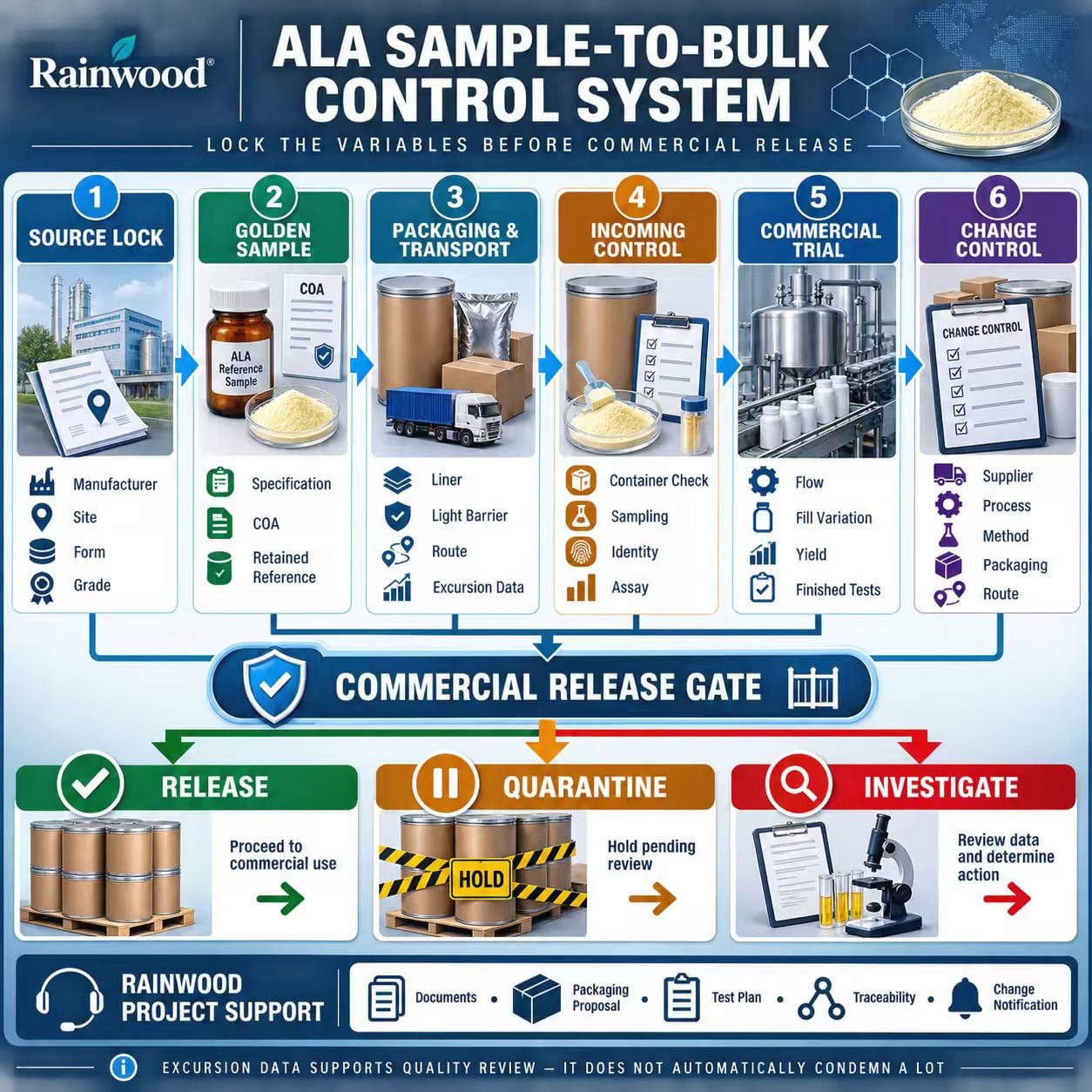
The commercial release gate
Release the first bulk order only when:
1. It matches the approved manufacturer, form, grade, and specification.
2. Shipment and containers meet agreed conditions or excursions are assessed.
3. Incoming results and physical observations are acceptable.
4. Production feasibility is confirmed with representative material.
5. Finished-product tests and stability plan are approved.
6. Deviations have a documented disposition.
Request an ALA sample-to-bulk stability and shipment plan. Send RainwoodBio the approved sample/COA, commercial specification, target form, formula, market, dosage form, shipment destination and season, packaging, quantity, and launch timeline; the team can return proposed comparison and excursion gates.
Frequently asked questions
1.Does agglomerated ALA automatically fail?
Not automatically. Quarantine and assess identity, chemistry, physical properties, process suitability, exposure, specification, and intended use before disposition.
2.Can we mill or screen sticky material and use it?
Only after an approved investigation shows the operation is appropriate and does not hide degradation, contamination, nonuniformity, or another failure.
3.Is a temperature logger required for every shipment?
Set monitoring from the stability risk, route, season, duration, packaging, quality agreement, and market requirements. Do not claim universal monitoring without a project commitment.
4.What should happen when the upstream manufacturer changes?
Treat it as a controlled change requiring documentation, analytical and physical comparison, evidence/label review, trial work, and approval before use.
References
- Development of a silica-based ALA formulation and photo/thermal stability evaluation: https://pubmed.ncbi.nlm.nih.gov/32143535/
- Aqueous solubility and thermal stability of ALA with cyclodextrin: https://pubmed.ncbi.nlm.nih.gov/21512253/
- Study of alpha lipoic acid chiral conversion under heated conditions: https://www.jstage.jst.go.jp/article/jpchrom/advpub/0/advpub_2021.019/_pdf
- ICH Q1A(R2) Stability Testing: https://database.ich.org/sites/default/files/Q1A%28R2%29%20Step4.pdf
- RainwoodBio alpha lipoic acid capsules: https://www.rainwoodbio.com/oem-odm-alpha-lipoic-acid-capsules-500mg-high-quality-alpha-lipoic-acid-capsules
- RainwoodBio OEM service: https://www.rainwoodbio.com/oem
*This article is for international B2B procurement and educational purposes. Material form, identity, stability, transport, packaging, sampling, specifications, methods, processing, finished testing, shelf life, and regulatory requirements must be confirmed for the exact material, lot, product, and destination.*