 EN
EN

Meta title: R-ALA vs DL-ALA vs Sodium R-Lipoate Label Math
Meta description: A B2B guide to comparing ALA forms, raw-material input, lipoic-acid equivalent, sodium contribution, evidence, labels, and cost.
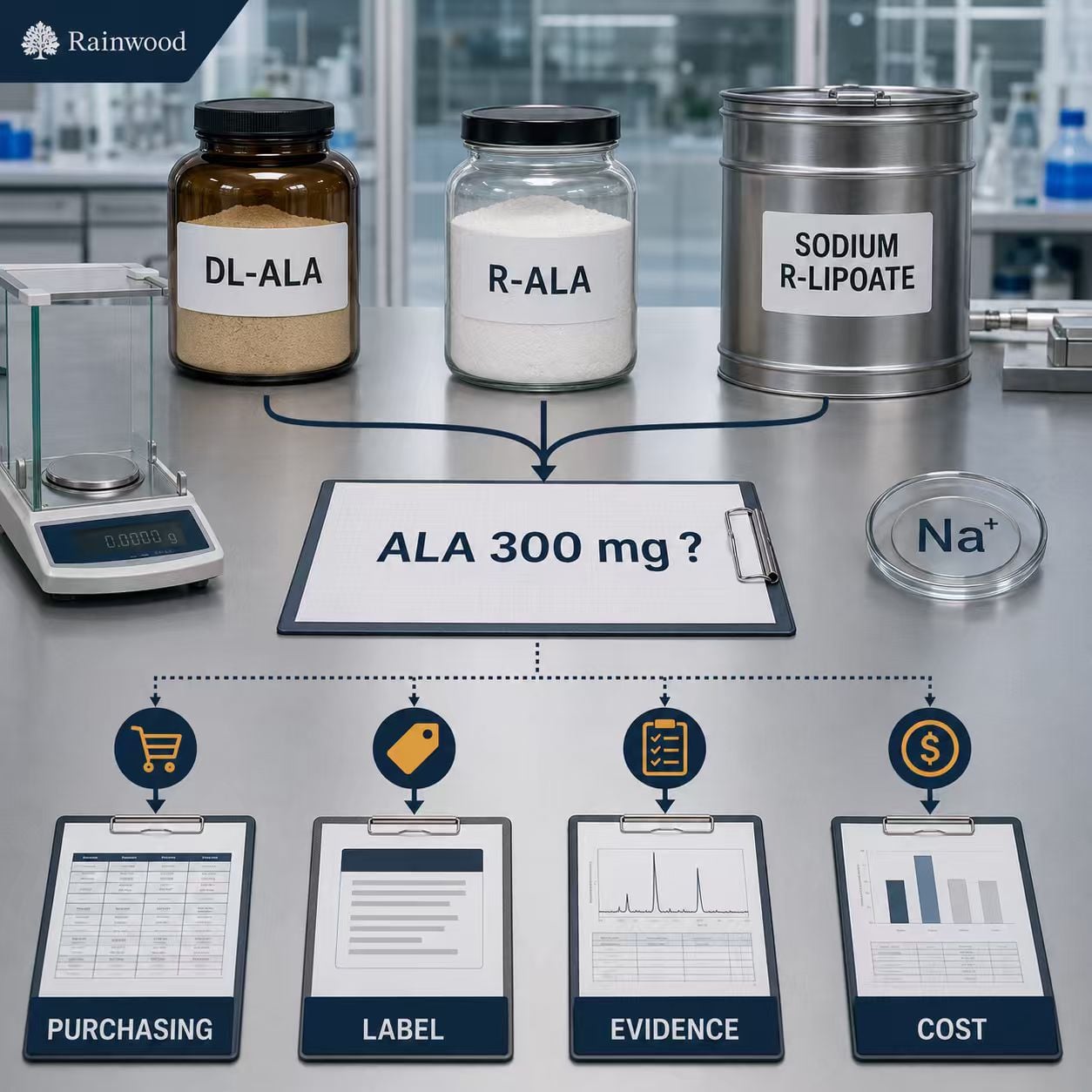
Three suppliers quote “alpha lipoic acid 300 mg.” One offers racemic DL-ALA, one offers R-ALA free acid, and one offers sodium R-lipoate. The sales sheets make them look interchangeable.
They are not one material with three spellings.
If your formula sheet records only “ALA 300 mg,” purchasing can order the wrong form, regulatory can approve the wrong ingredient name, marketing can borrow the wrong study, and finance can compare prices on different active bases.
First lock the exact commercial form
Health Canada's June 2025 monograph is useful because it explicitly distinguishes:
- DL-alpha-lipoic acid;
- R-alpha-lipoic acid;
- sodium R-(+)-lipoate as a source preparation for R-alpha-lipoic acid.
The monograph also uses different compendial dose conditions for DL-ALA and R-ALA in that Canadian pathway. Those values should not be copied worldwide, but they demonstrate why form is not a cosmetic detail.
Your master data should identify:
1. chemical or compositional name;
2. free acid or salt;
3. racemic or R form;
4. manufacturer and site;
5. assay and calculation basis;
6. lipoic-acid equivalent, if used;
7. counterion contribution;
8. market-specific label name.
Read why a 99 percent total assay may not prove R-ALA before comparing the forms.
DL-ALA is not “50 percent impure R-ALA”
Racemic alpha lipoic acid contains R and S enantiomers. It should not be described as a contaminated or automatically inferior R-ALA product. It is a defined material with its own evidence history, specifications, pricing, and market use.
The procurement mistake is different: using a DL-ALA study or dose to market R-ALA without a scientific bridge, or using an R-ALA claim when the supplied material is racemic.
Keep these questions separate:
- What percentage is total alpha lipoic acid?
- What is the R/S composition?
- What commercial form was studied?
- What amount of that form was administered?
- What exact ingredient will the label declare?
Calling DL-ALA “half strength” can also oversimplify study comparability and regulatory dose rules. Use the exact jurisdictional framework and evidence rather than a universal conversion slogan.
Sodium R-lipoate creates a mass-balance step
A sodium salt includes sodium in the commercial material. Therefore:
> Raw-material input is not automatically equal to free R-alpha-lipoic-acid amount.
The formula needs the supplier's exact compositional definition, assay basis, water or hydration information where relevant, molecular or equivalent calculation, and applicable label rules. Do not calculate from a marketing name.
A useful manufacturing worksheet has separate columns for:
- sodium R-lipoate input per unit;
- assay-adjusted input;
- equivalent R-alpha-lipoic acid per unit;
- sodium contributed per serving;
- excipient or carrier already present;
- declared amount and name;
- overage, if scientifically and legally justified.
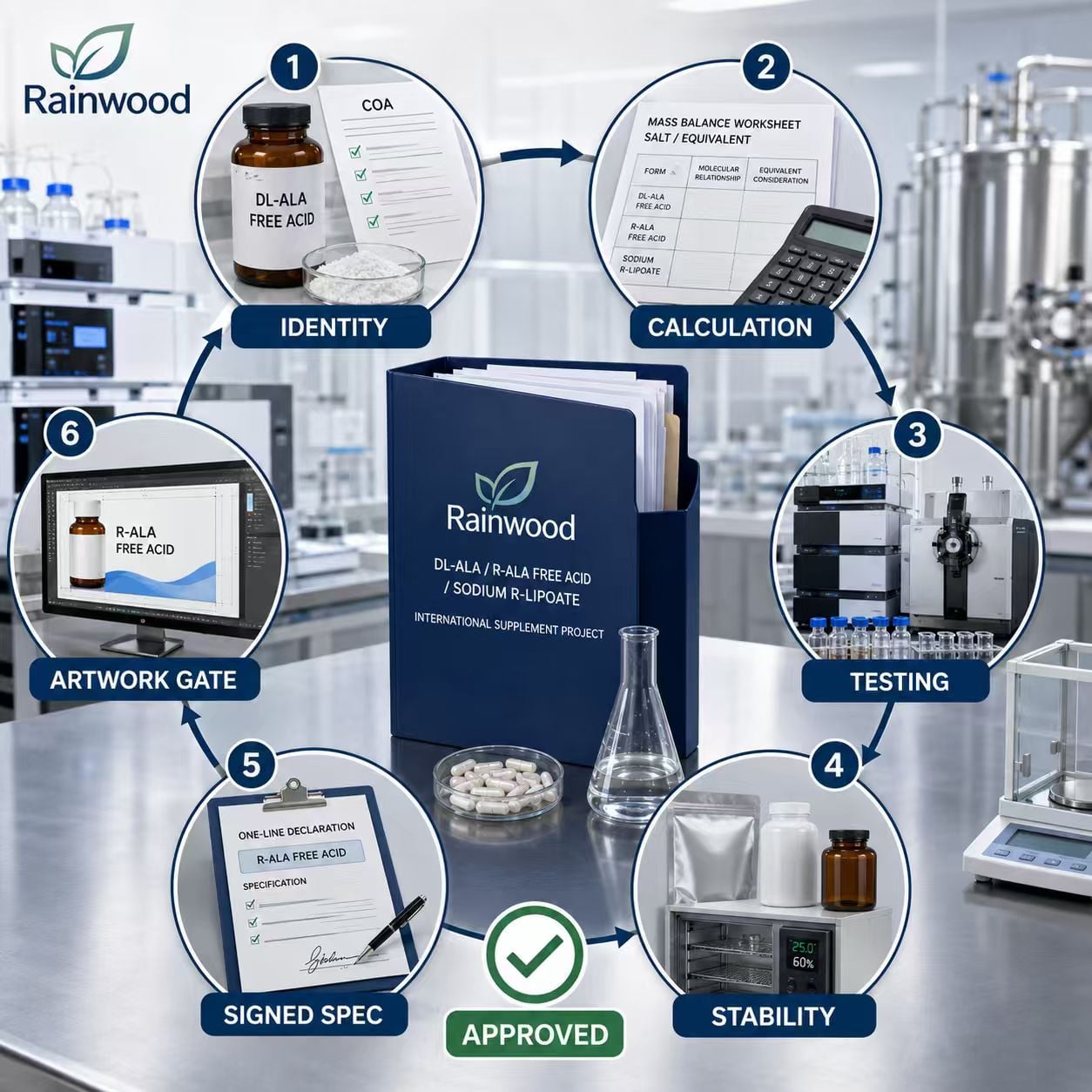
That calculation must be approved before purchasing and artwork.
Use the RainwoodBio ALA capsule project page to start a form-specific inquiry rather than ordering a generic “ALA capsule.”
The price-per-kilogram comparison can be false
Suppose the offers are:
- DL-ALA at Price A per kilogram;
- R-ALA free acid at Price B per kilogram;
- sodium R-lipoate at Price C per kilogram.
The lowest kilogram price does not identify the lowest compliant formula cost. Normalize:
1. commercial material input per daily serving;
2. assay adjustment;
3. target lipoic-acid basis;
4. manufacturing yield and processing behavior;
5. required identity and chiral testing;
6. packaging and stability controls;
7. trademark or evidence costs, if any;
8. capsule count and bottle count;
9. cost of market-specific label and dossier work.
Then compare cost per released daily serving, not cost per kilogram.
Evidence does not transfer merely because the number matches
A study using 600 mg of a racemic oral product does not automatically prove a 300 mg R-ALA capsule. A study using an intravenous preparation does not automatically establish an oral supplement claim. A branded sodium R-lipoate study does not automatically transfer to an unverified generic salt.
Build the evidence bridge with:
- exact form and manufacturer;
- dose basis;
- route and dosage form;
- dosing schedule;
- population;
- duration;
- co-ingredients;
- endpoint;
- study limitations;
- proposed consumer wording.
If the match is partial, narrow the statement. Do not fill the gap with “more bioavailable,” “active form,” or “clinically proven” unless the exact claim is adequately supported.
Physical behavior also changes the formulation decision
R-ALA free acid and a stabilized salt can differ in handling, solubility, thermal behavior, storage, and formulation needs. Those differences must be measured for the specific material; they should not be turned into a universal hierarchy.
Ask the sample to answer:
- Does the powder flow and fill on the intended equipment?
- Does it remain within physical and chemical specifications after relevant storage?
- Is the assay method suitable in the complete formula?
- Does the dosage form protect against light, moisture, and temperature as needed?
- Can the label amount be delivered in the intended unit count?
- Does the selected material create a sodium or excipient declaration issue?
RainwoodBio describes custom formulation, sampling, production, packaging, and documentation. Treat those as project stages; the website does not prove that every ALA form has already passed them.
A three-form approval table
| Approval field | DL-ALA | R-ALA free acid | Sodium R-lipoate |
|---|---|---|---|
| Exact identity/specification | Required | Required | Required |
| Total assay | Required | Required | Required |
| R/S evidence | As specified | Central to R claim | Central to R claim |
| Salt/equivalent calculation | Not applicable as sodium salt | Free-acid basis | Required |
| Sodium contribution | None from ALA itself | None from free acid itself | Calculate/review |
| Study form match | Check | Check | Check |
| Stability/processing | Test exact grade | Test exact grade | Test exact grade |
| Market label name | Review | Review | Review |
| Cost per compliant serving | Calculate | Calculate | Calculate |
No column wins automatically. The right form is the one that fits the product brief, evidence, market, manufacturing process, quality system, and cost.
How RainwoodBio can support form selection
RainwoodBio publicly lists ALA capsules and general OEM services. Its product page does not specify all available ALA forms or prove the form, dose, test method, stability, or label status for a new project.
Ask RainwoodBio to provide or confirm:
- available DL-ALA, R-ALA, or sodium R-lipoate options;
- exact upstream manufacturer and specification;
- representative COA and form/chiral evidence;
- input-to-declaration calculation;
- capsule, tablet, or other format feasibility;
- sample and finished-product testing plan;
- packaging, storage, and stability approach;
- market-specific questions for regulatory review.
Review the published company context and document workflow, then put the selected form and evidence deliverables into the signed specification.
The artwork gate
Do not approve the label until the formula owner can answer in one line:
> We input ___ mg of [exact form] per unit, delivering ___ mg on the approved declaration basis per serving, with ___ mg sodium contribution where applicable.
If the sentence cannot be completed from controlled documents, the product is not ready for artwork.
Request an ALA three-form calculation and quotation comparison. Send RainwoodBio all supplier specifications and COAs, target form, daily amount, proposed label, market, dosage form, maximum unit count, packaging, volume, and target cost; the team can return a normalized formula and evidence checklist.
Frequently asked questions
1.Is R-ALA always twice as potent as DL-ALA?
Do not use a universal potency conversion. Match the exact material, dose, pharmacokinetic or clinical evidence, claim, population, and jurisdiction.
2.Can sodium R-lipoate be labeled simply as alpha lipoic acid?
Ingredient naming and declaration basis depend on the exact material and destination market. Regulatory should review the supplier definition, formula, sodium contribution, and proposed label.
3.Does 300 mg sodium R-lipoate deliver 300 mg R-ALA?
Do not assume so. Use the exact salt composition, assay basis, water status, and approved equivalent calculation from controlled documents.
4.Which form is easiest to manufacture?
That depends on grade, particle properties, excipients, equipment, dosage form, environmental exposure, packaging, and serving. Test the proposed commercial material.
References
- Health Canada DL-Alpha-Lipoic Acid/R-Alpha-Lipoic Acid monograph: https://webprod.hc-sc.gc.ca/nhpid-bdipsn/dbImages/mono_alpha-lipoic-acid_english.pdf
- USP Alpha Lipoic Acid: https://doi.usp.org/USPNF/USPNF_M45550_04_01.html
- Alpha-lipoic acid chemistry review: https://pubs.rsc.org/en/content/articlepdf/2023/ra/d3ra07140e
- R- versus R,S-lipoic acid randomized crossover study: https://pubmed.ncbi.nlm.nih.gov/32212340/
- RainwoodBio alpha lipoic acid capsules: https://www.rainwoodbio.com/oem-odm-alpha-lipoic-acid-capsules-500mg-high-quality-alpha-lipoic-acid-capsules
- RainwoodBio OEM service: https://www.rainwoodbio.com/oem
*This article is for international B2B formulation and educational purposes. Material identity, form, chiral composition, salt and equivalent calculations, sodium, specifications, methods, evidence, labels, claims, and regulatory requirements must be confirmed for the exact ingredient, formula, finished product, and destination market.*