 EN
EN
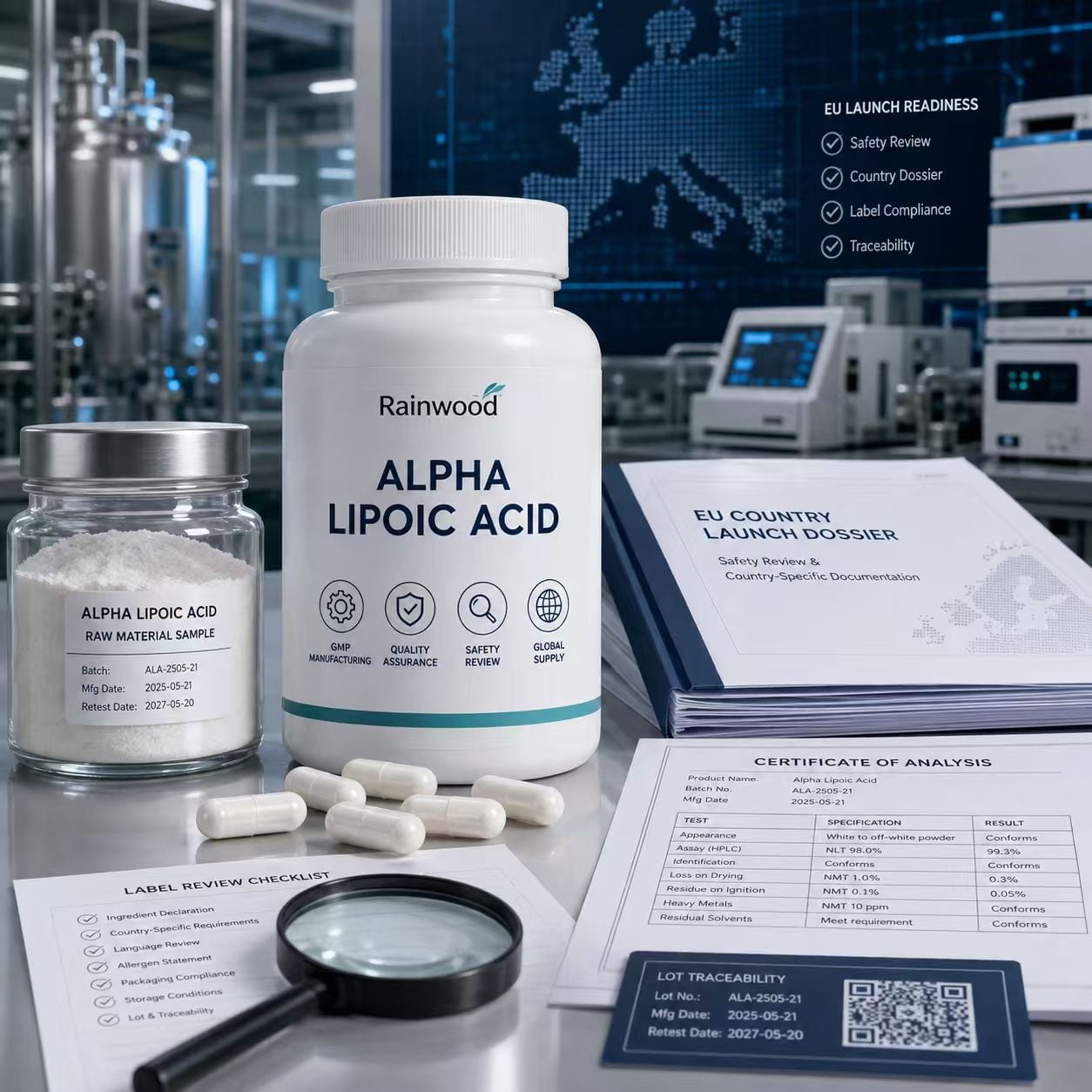
Meta title: Selling Alpha Lipoic Acid in Europe: The IAS Safety Risk
Meta description: An EU-focused B2B checklist for ALA safety, insulin autoimmune syndrome, country rules, dose, warnings, claims, notification, and monitoring.
Your ALA formula sells in North America. The distributor asks for an EU label. The easy answer is to translate the bottle.
That answer ignores the hardest European question: how has the product addressed the EFSA opinion linking supplemental alpha lipoic acid with insulin autoimmune syndrome risk in genetically susceptible people?
For EU importers and international brands, this is not a reason to invent a blanket ban or a universal safe dose. It is a reason to build a country-specific safety and regulatory file before production.
What EFSA concluded—and what it did not
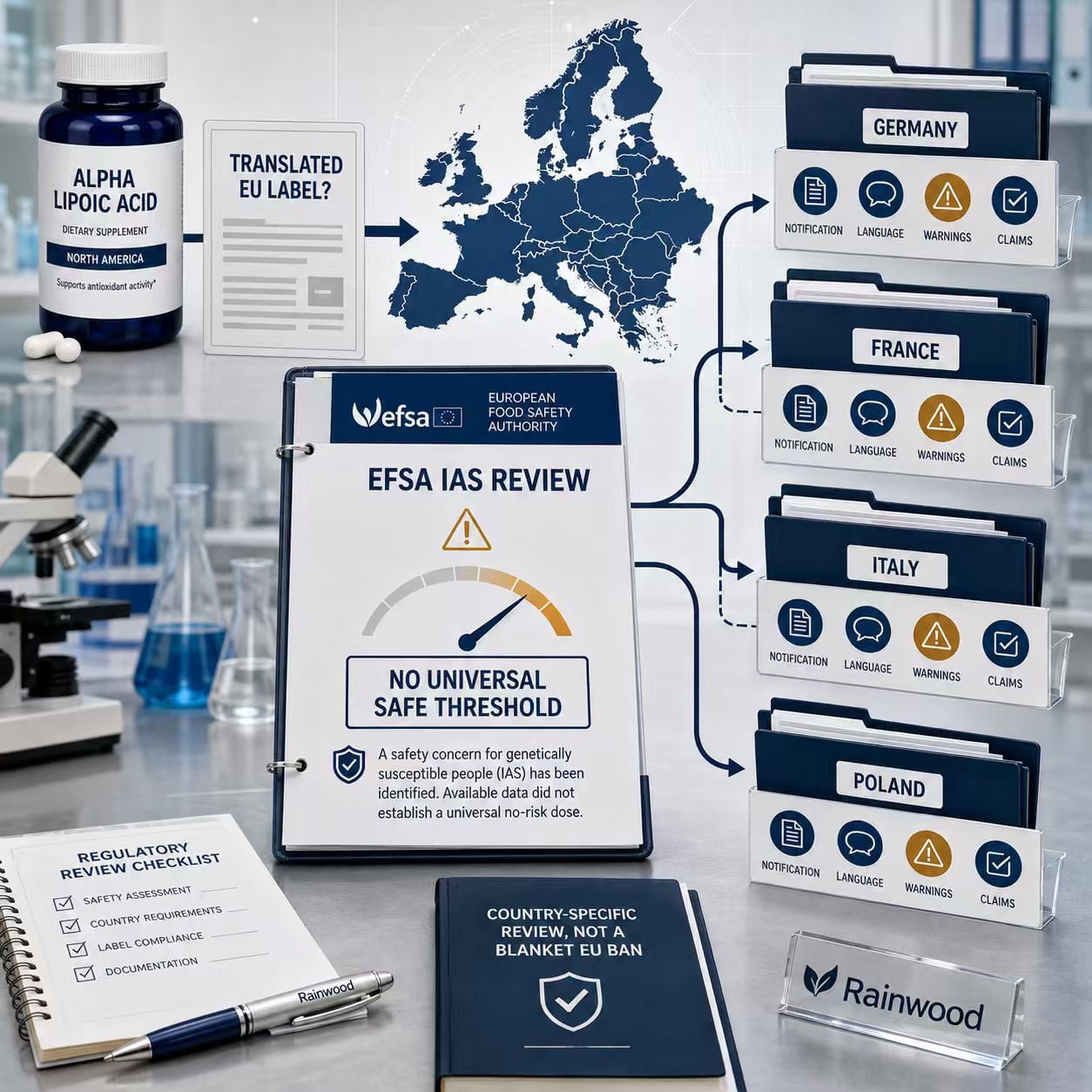
In 2021, the EFSA Panel on Nutrition, Novel Foods and Food Allergens evaluated the relationship between ALA intake and insulin autoimmune syndrome, or IAS. It concluded that consumption of ALA added to foods, including supplements, is likely to increase IAS risk in individuals with certain genetic polymorphisms.
EFSA also stated that those susceptible individuals cannot readily be identified without genetic testing and that available data did not allow a dose below which IAS is not expected to occur to be determined.
The opinion did not quantify one precise risk for every person, every form, or every daily amount. It also did not, by itself, replace the need to check current EU and national law. Scientific risk assessment, Commission action, Member State controls, product classification, and market enforcement are related but distinct.
Use the ALA safety and claim review before finalizing European positioning.
Europe is not one notification desk
The European Commission explains that EU countries may require notification to the national competent authority when a food supplement is placed on their market. Rules for substances other than harmonized vitamins and minerals can also involve national practice, maximum amounts, warnings, positive or negative lists, mutual-recognition questions, and product-classification decisions.
An “EU-compliant” statement is incomplete without naming:
- first destination country;
- product category;
- responsible food business operator/importer;
- ingredient form and daily amount;
- notification or authorization route;
- language and warning requirements;
- health-claim basis;
- countries included in the launch.
A German, Italian, French, Danish, Polish, or other national launch should not be approved from a generic European template.
Do not invent a safe threshold
The most dangerous procurement shortcut is choosing a dose because a competitor sells it or because another jurisdiction permits it under a specific pathway.
Health Canada's June 2025 monograph uses form-specific dose and warning conditions for its natural health product framework. Those Canadian conditions do not answer the EU IAS question and cannot be copied into Europe as a safety determination.
For the target country, qualified reviewers should assess:
- DL-ALA, R-ALA, or sodium R-lipoate form;
- exact daily amount and directions;
- target population;
- co-ingredients affecting glucose or safety messaging;
- IAS evidence and uncertainty;
- national restrictions, guidance, warnings, or precedent;
- pregnancy, diabetes, medication, and other relevant cautions;
- post-market complaint and adverse-event process.
Use the ALA three-form calculation guide to ensure the reviewed daily amount describes the actual commercial material and declaration basis.
The IAS issue belongs on the supplier questionnaire
Ask the manufacturer or OEM:
1. What exact ALA form and upstream manufacturer are proposed?
2. What is the daily input and approved declaration basis?
3. Which safety studies and regulatory opinions were reviewed?
4. Which countries have been assessed by qualified specialists?
5. What warnings and target-user restrictions are proposed?
6. How will serious low-blood-sugar complaints be escalated?
7. Who maintains adverse-event records and reports when required?
8. What formula, source, or dose changes trigger a new review?
“Widely used” is not an adequate answer to a documented safety concern.
Warning language must match the country and product
Avoid creating one homemade warning by combining phrases from U.S., Canadian, and European products. A warning must be accurate, understandable, appropriately prominent, and consistent with applicable national and EU requirements.
The review may need to consider:
- symptoms requiring discontinuation and medical attention;
- use by people with diabetes or taking glucose-related medication;
- pregnancy and breastfeeding;
- age group;
- directions and maximum daily intake;
- keeping the product out of children's reach;
- language requirements;
- whether the product should be marketed to the proposed audience at all.
The final decision belongs to appropriately qualified market reviewers. The OEM should supply exact formula facts, not improvise medical advice.
Claims can make the safety problem worse
An antioxidant-positioned supplement and a product advertised for diabetic neuropathy create different intended-use and consumer-risk contexts. Claims such as:
- “for diabetics”;
- “controls blood sugar”;
- “prevents hypoglycemia”;
- “treats diabetic neuropathy”;
- “safe with diabetes medication”
can be misleading, unsupported, medicinal, or unsafe depending on context and jurisdiction.
The European Commission's EU Register of nutrition and health claims is a starting point for claim status, but national classification and the complete presentation still matter. Do not assume that published ALA research creates an authorized EU health claim.
Review the 600 mg ALA study-to-product bridge before citing diabetic populations in commercial content.
Build a country launch dossier
For each destination, retain:
- responsible entity and importer details;
- formula and specification version;
- ALA form, source, manufacturer, and daily amount;
- raw and finished test evidence;
- safety assessment including EFSA IAS opinion;
- national ingredient-status and dose review;
- notification or registration records where required;
- approved label, language, warnings, and directions;
- health-claim decision and evidence;
- stability and packaging basis;
- complaint, adverse-event, withdrawal, and recall procedures;
- change-control and renewal dates.
Do not let one distributor reuse another country's file without assessment.
Post-market monitoring is part of the launch
Create an escalation path for reports involving sweating, pallor, chills, headache, dizziness, confusion, loss of consciousness, or other serious concerns. Customer service should not diagnose IAS, give medical advice, or assure the consumer that the product is unrelated.
The procedure should define:
- immediate safety escalation;
- product, lot, dose, timing, co-use, and contact data collection;
- medical referral language;
- privacy and record controls;
- importer/brand/OEM responsibilities;
- regulatory reporting assessment;
- trend review and signal escalation;
- batch hold, investigation, and corrective action where justified.
Health Canada's monograph lists serious low-blood-sugar symptom wording under defined dose conditions. Use it as evidence that warnings can be form- and pathway-specific, not as the automatic European text.
How RainwoodBio can support an EU ALA project
RainwoodBio publishes ALA capsule and OEM services, including formulation, samples, production, testing, packaging, and documentation. Its website does not prove EU-wide authorization, a universal safe ALA amount, an approved health claim, or a country-specific IAS warning.
Ask RainwoodBio to provide:
- exact ALA form, manufacturer, specification, and daily input;
- full formula and proposed directions;
- representative raw and finished documents;
- stability and packaging information;
- target-country label data required by the reviewer;
- batch traceability and complaint contact;
- change notification for source, form, dose, and formula.
Use RainwoodBio's published OEM requirement-confirmation process to name the first country before sample approval.

The EU shipment gate
Do not release packaging or inventory until:
1. The exact country and product category are confirmed.
2. ALA form and daily amount reconcile to the label.
3. Current EU and national requirements are reviewed.
4. The IAS opinion is addressed in the safety assessment.
5. Warnings, directions, language, and claims are approved.
6. Notification or other premarket steps are completed where required.
7. The importer accepts the dossier and post-market responsibilities.
Request an EU ALA launch and IAS evidence checklist. Send RainwoodBio the destination country or countries, importer, formula, ALA form and daily amount, label draft, claims, warnings, evidence, dosage form, packaging, volume, and launch date; the team can assemble product facts and missing documents for your EU regulatory reviewer.
Frequently asked questions
1.Did EFSA set a safe maximum ALA dose?
No. EFSA concluded that available data did not allow determination of a dose below which IAS is not expected to occur.
2.Does the EFSA opinion mean ALA is automatically banned across the EU?
Do not convert a scientific opinion into a blanket legal conclusion. Check current EU action, target-country law, product status, and enforcement with qualified counsel.
3.Can one EU label be sold in every Member State?
Do not assume so. Language, notification, ingredient status, amount, warning, claim, and responsible-operator requirements can differ.
4.Is R-ALA exempt from the IAS concern?
Do not make that assumption without authoritative form-specific evidence and regulatory review. The exact product still requires a safety assessment.
References
- EFSA scientific opinion on ALA and insulin autoimmune syndrome: https://pubmed.ncbi.nlm.nih.gov/34122657/
- EFSA food supplements topic page: https://www.efsa.europa.eu/en/topics/topic/food-supplements
- European Commission food supplements overview: https://food.ec.europa.eu/food-safety/labelling-and-nutrition/food-supplements_en
- EU Register of nutrition and health claims: https://food.ec.europa.eu/food-safety/labelling-and-nutrition/nutrition-and-health-claims/eu-register-health-claims_en
- Health Canada DL-Alpha-Lipoic Acid/R-Alpha-Lipoic Acid monograph: https://webprod.hc-sc.gc.ca/nhpid-bdipsn/dbImages/mono_alpha-lipoic-acid_english.pdf
- RainwoodBio alpha lipoic acid capsules: https://www.rainwoodbio.com/oem-odm-alpha-lipoic-acid-capsules-500mg-high-quality-alpha-lipoic-acid-capsules
*This article provides international B2B educational information, not legal or medical advice. ALA safety, IAS risk, ingredient status, dose, warnings, notification, labeling, claims, adverse-event handling, and regulatory requirements must be reviewed for the exact product and each destination country.*