 EN
EN
Meta title: The Cheap Alpha Lipoic Acid Quote That Hides Real Costs
Meta description: Normalize ALA supplier quotes across form, assay, chiral proof, related substances, polymer, solvents, packaging, testing, yield, and freight.
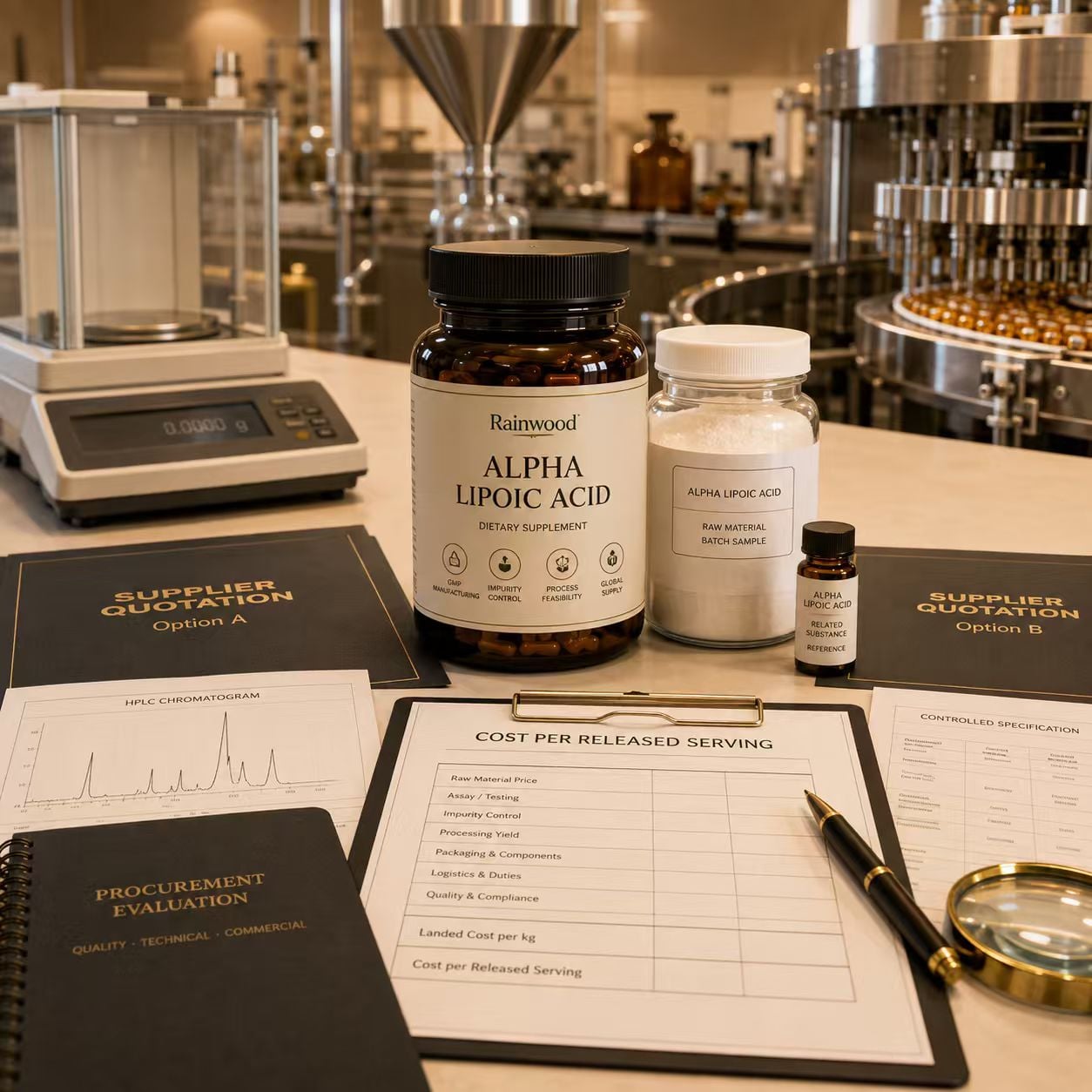
Supplier A quotes alpha lipoic acid 18% below Supplier B. Both show “99% HPLC.” The saving looks obvious—until incoming powder agglomerates, the laboratory asks for a related-substance method, and marketing discovers that the cheaper material cannot support the R-ALA claim.
Low price is not evidence of poor material. It is a signal to normalize what each quote includes.
For importers, OEM procurement teams, and brands switching suppliers, the real comparison is cost per released, manufacturable, claim-compatible daily serving.
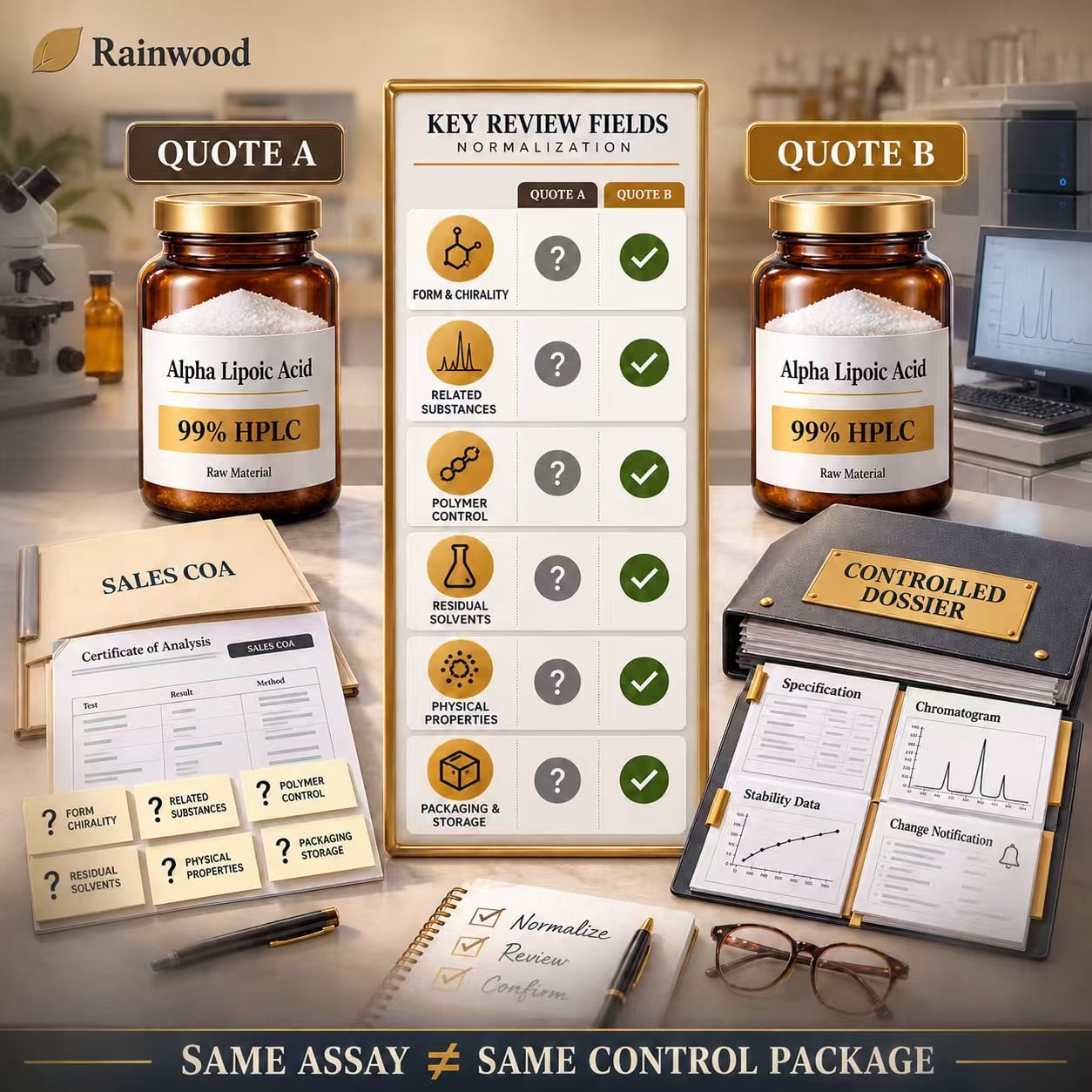
“99%” can hide an unequal test package
The public USP monograph defines alpha lipoic acid at 99.0%–101.0% on the dried basis. Two suppliers can both report a value in that range while offering different:
- chemical forms;
- enantiomeric profiles;
- identity methods;
- related-substance limits;
- polymer controls;
- residual-solvent packages;
- water or loss-on-drying limits;
- physical properties;
- packaging and storage conditions;
- manufacturer and site traceability.
The first quote may include only a sales COA. The second may include a controlled specification, methods, representative chromatograms, stability information, change notification, and order-specific records.
Use the ALA assay-versus-R-form evidence guide before deciding that two 99% offers are equivalent.
Related substances and polymer are not decorative COA lines
Alpha lipoic acid contains a strained cyclic disulfide and has known chemical reactivity. Scientific work has investigated its polymerization and its thermal or photochemical degradation under defined conditions. Commercial specifications may therefore address related substances or polymeric material according to the exact grade and process.
Do not infer that every agglomerate is polymer or that every material will degrade under ordinary storage. Ask the analytical questions:
- What components are included in “related substances”?
- Is polymer measured separately or captured by another test?
- What method, standard, reporting threshold, and acceptance limit apply?
- What process and storage risks drove the limits?
- What does an out-of-trend result trigger?
- Is the test lot-specific or a periodic qualification test?
A supplier who omits these controls may still have acceptable material—but the buyer is now paying to resolve the uncertainty.
Residual-solvent risk depends on the manufacturing route
ALA is commonly produced through synthetic and purification steps. Patents and process literature describe routes involving organic solvents, which demonstrates a technically plausible need for process-relevant solvent control; it does not prove that any named supplier uses a particular solvent or violates a limit.
Request:
- a non-confidential process and solvent declaration;
- the applicable residual-solvent specification;
- method and reporting limits;
- lot or periodic test evidence based on risk;
- change notification for route, solvent, manufacturer, or site.
“Residual solvents: complies” is difficult to interpret without knowing which standard, solvents, method, and testing plan are meant.
The form mismatch can erase the price advantage
If Offer A is DL-ALA and Offer B is R-ALA or sodium R-lipoate, price per kilogram is not a valid comparison. Normalize raw input, assay basis, active/declaration basis, sodium contribution, chiral evidence, dose, and label.
Use the R-ALA, DL-ALA, and sodium R-lipoate cost calculation before sending the quote to finance.
Physical properties create manufacturing cost
A COA can pass chemical tests while the powder creates production loss. For the intended capsule or tablet, compare:
- particle-size distribution;
- bulk and tapped density;
- flow and electrostatic behavior;
- agglomeration or softening after storage;
- blend compatibility;
- fill-weight variation or compression behavior;
- odor and color;
- packaging protection and liner closure.
A slower filling speed, additional screening, higher excipient level, lower yield, or rejected blend can outweigh a raw-material saving.
RainwoodBio publishes custom capsule and sample-development context. Require commercial-grade trials rather than assuming that a small hand-filled sample predicts production.
Normalize the commercial terms too
Put every offer on one sheet:
| Cost field | Supplier A | Supplier B |
|---|---|---|
| Exact form/manufacturer/site | | |
| Price and currency | | |
| Incoterm and named place | | |
| MOQ and price break | | |
| Packaging and net weight | | |
| Freight, insurance, duty and brokerage | | |
| Required retesting | | |
| Expected process yield | | |
| Payment terms and cash cycle | | |
| Lead time and safety stock | | |
| Rejection/replacement terms | | |
| Cost per released daily serving | | |
Do not compare an ex-works offer against delivered pricing. Do not treat free testing as free if the method is not suitable. Do not ignore the cost of a larger MOQ that ages in the warehouse.
The document package that earns approval
Before the first paid commercial lot, obtain as applicable:
1. Manufacturer and site identification.
2. Exact form and grade.
3. Current approved specification.
4. Representative COA and lot COA.
5. Identity, assay, and chiral evidence where relevant.
6. Related-substance and polymer-control information.
7. Process-relevant residual-solvent controls.
8. Elemental, microbiological, and other risk-based requirements.
9. Physical-property data for the dosage form.
10. Packaging, storage, retest/expiry, and stability basis.
11. Change-notification agreement.
12. Deviation, rejection, return, and replacement terms.
The list should be customized; more tests do not automatically mean better control.
How RainwoodBio can support quote normalization
RainwoodBio describes requirement confirmation, supplier management, samples, production, testing, documentation, and logistics as general company workflow. Its public pages do not prove that every ALA quotation includes every control or that every listed laboratory capability applies to a particular lot.
Ask RainwoodBio to state in the quotation:
- exact ALA form, upstream manufacturer, and specification;
- included documents and tests;
- sample and commercial-grade relationship;
- packaging and shipment conditions;
- finished format, unit count, and expected yield assumptions;
- MOQ, lead time, Incoterm, and payment basis;
- nonconformance and replacement process.
Review RainwoodBio's published OEM and supply workflow, then convert every material commercial term into the purchase agreement.
The approval rule
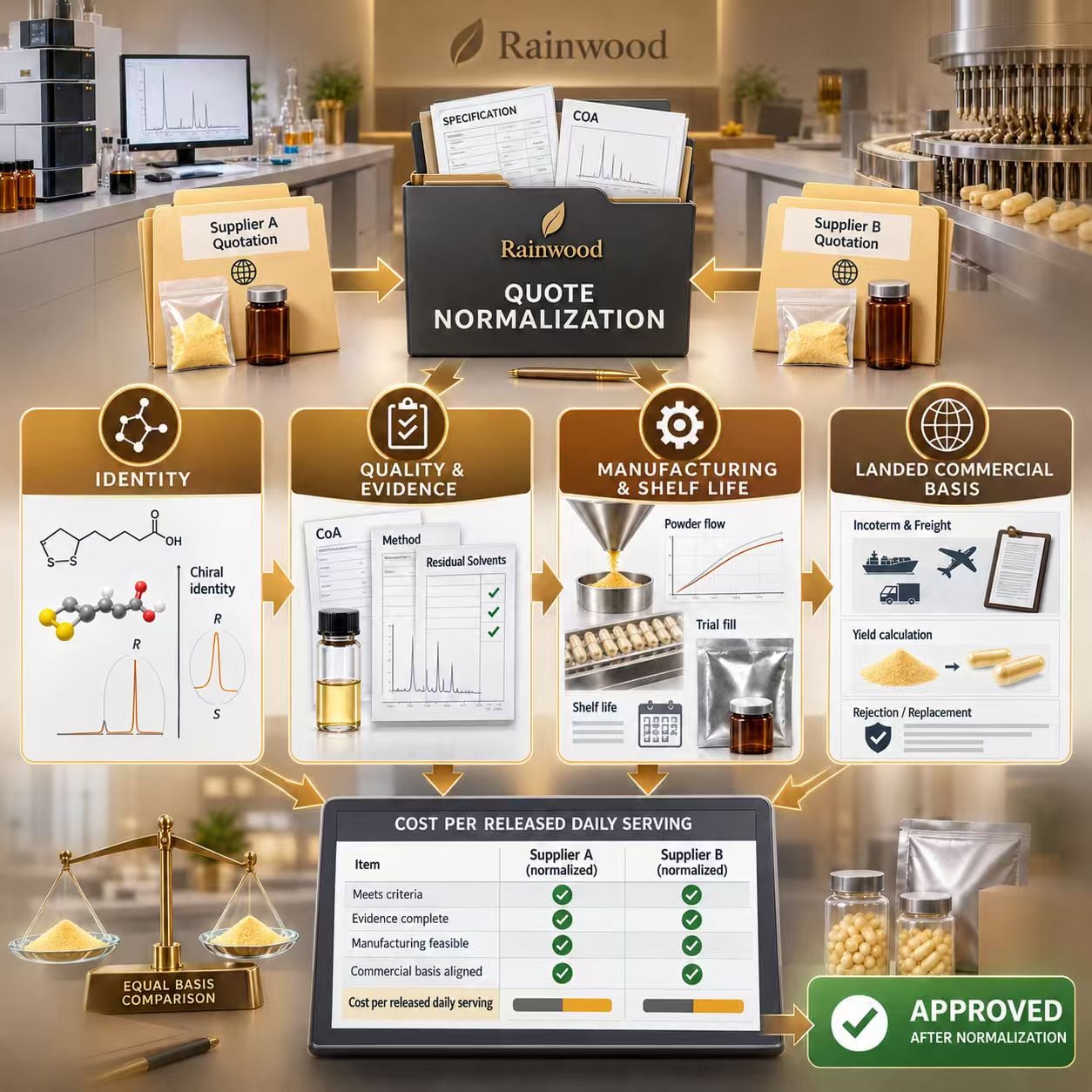
Approve the cheaper quote only when it wins after four normalizations:
1. Same chemical and chiral identity.
2. Same necessary quality and evidence package.
3. Same manufacturing and shelf-life feasibility.
4. Same landed commercial basis.
If the quotes cannot be normalized, the buyer does not yet have two prices for the same purchase.
Request a two-quotation ALA cost and specification comparison. Send RainwoodBio both quotes, specifications, COAs, target form, formula, market, daily amount, dosage form, packaging, forecast, Incoterm, and launch date; the team can return a line-by-line gap and cost sheet.
Frequently asked questions
1.Is the highest ALA assay always the best material?
No. Identity, form, chiral profile, related substances, process-relevant residuals, physical properties, stability, documents, and intended use also matter.
2.Does visible clumping prove polymerization?
No. Moisture, temperature, particle behavior, compression, or other causes may contribute. Investigate with appropriate physical and chemical methods.
3.Should every supplier run every possible contaminant test?
Use a documented risk assessment based on route, inputs, site, use, dose, market, and history. Specify necessary controls and verification frequency.
4.Which Incoterm is cheapest?
There is no universal answer. Compare total landed cost, control, risk allocation, destination, freight, customs, insurance, and your import capability.
References
- USP Alpha Lipoic Acid: https://doi.usp.org/USPNF/USPNF_M45550_04_01.html
- Alpha-lipoic acid chemistry review: https://pubs.rsc.org/en/content/articlepdf/2023/ra/d3ra07140e
- Controlled-radical polymerization of alpha lipoic acid: https://pubmed.ncbi.nlm.nih.gov/37813389/
- Patent example describing solvent control in ALA production: https://patents.google.com/patent/US6462202B1/en
- RainwoodBio OEM service: https://www.rainwoodbio.com/oem
- RainwoodBio About Us: https://www.rainwoodbio.com/about-us
This article is for international B2B procurement and educational purposes. Manufacturing route, material form, identity, chiral profile, assay, impurities, polymer, solvents, physical properties, specifications, methods, packaging, shipping, cost, and regulatory requirements must be verified for the exact material and project.