 EN
EN
Meta title: USP Grade Alpha Lipoic Acid: What It Does Not Approve
Meta description: A B2B guide to the limits of USP-grade ALA claims across raw materials, R-ALA identity, batches, finished products, facilities, and markets.
The quotation says “USP Grade Alpha Lipoic Acid.” By the time the phrase reaches the sales team, it has become “USP certified,” “pharmaceutical quality,” and “approved for the U.S. market.”
Those are not equivalent statements.
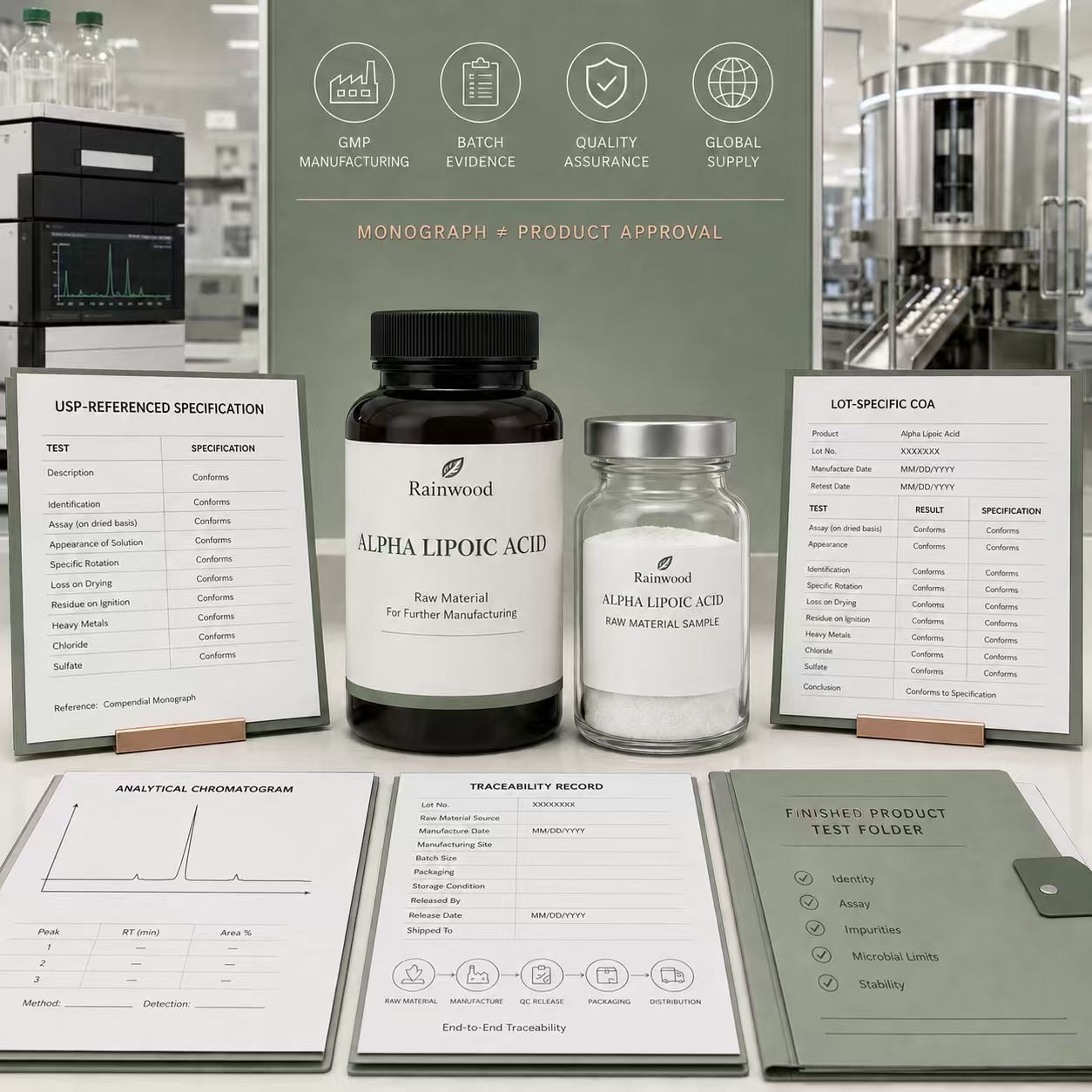
A compendial monograph can be a valuable quality reference. It cannot automatically certify a supplier, approve a finished capsule, prove R-ALA identity, validate a health claim, or authorize market access. Buyers who fail to control the wording can turn a useful specification into a misleading commercial promise.
Start with what the public USP preview actually establishes
USP's public Alpha Lipoic Acid monograph identifies thioctic acid, CAS 1077-28-7, formula C8H14O2S2, and molecular mass 206.33. Its definition states that alpha lipoic acid contains 99.0%–101.0% on the dried basis.
That definition is not a complete supplier dossier. The buyer still needs the current official monograph or licensed access as applicable, an approved specification, suitable methods, reference standards, laboratory controls, sampling, lot traceability, and results for the actual material.
Most importantly, “99.5%” printed beside “USP” does not prove:
- that the material is R-ALA rather than racemic ALA;
- that a named batch was sampled and tested correctly;
- that the finished product meets specifications;
- that the manufacturing site holds a particular certificate;
- that FDA reviewed or approved the supplement;
- that a product claim is substantiated;
- that the product is lawful in every destination.
Read the R-ALA chiral-proof checklist before adding a stereochemical claim to a USP-based specification.
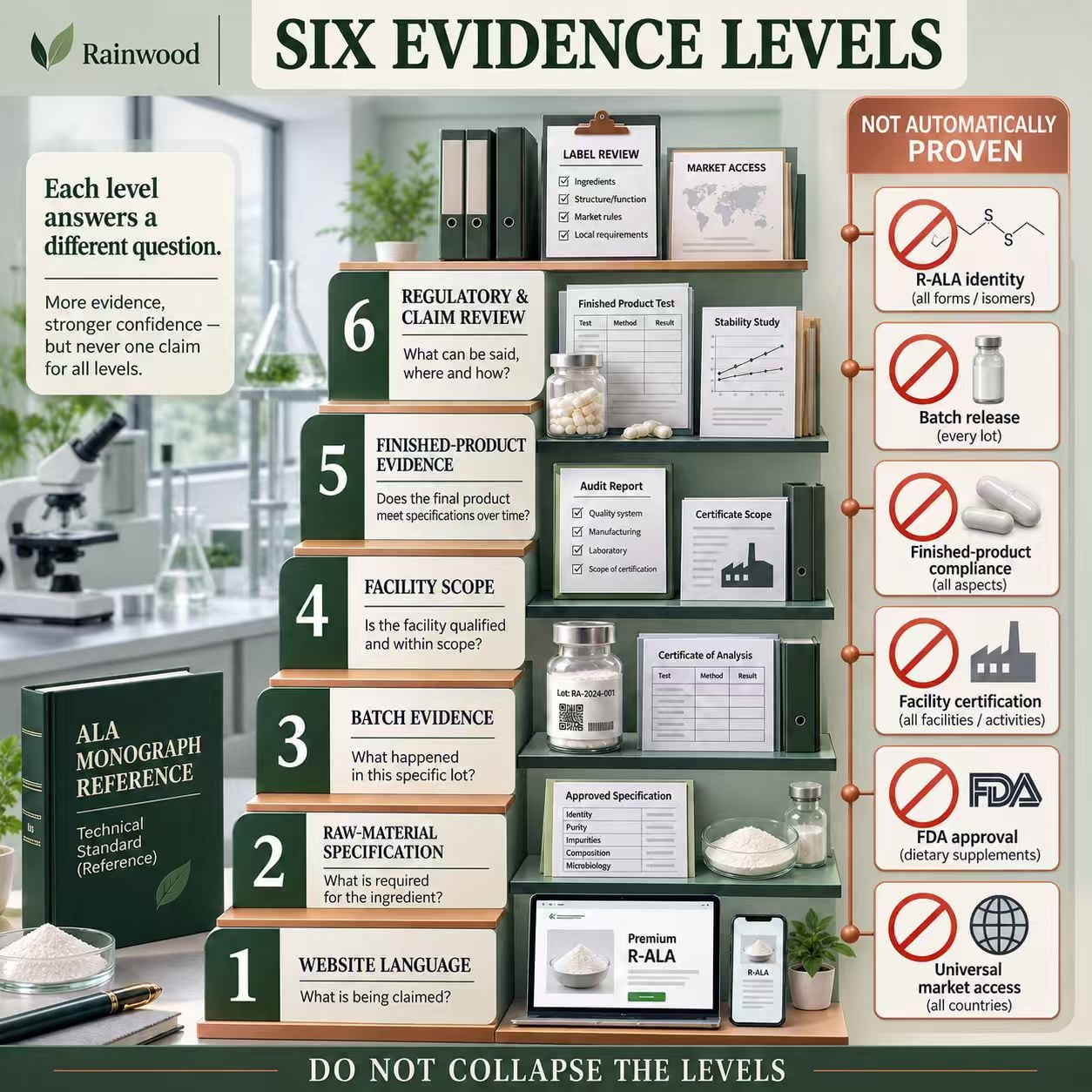
Six evidence levels buyers must not collapse
Level 1: website language
A supplier publishes “USP Grade.” This is a commercial statement, not batch evidence.
Level 2: approved raw-material specification
The specification identifies the exact material and references defined tests and limits. Confirm whether it adopts the full applicable monograph or only selected requirements. “USP-style” is not the same as compendial compliance.
Level 3: batch evidence
A traceable lot-specific COA reports actual results against the approved specification. Sampling, method suitability, laboratory identity, reference standards, calculations, and review still matter.
Level 4: facility or quality-system evidence
Certificates and audits cover named entities, addresses, activities, dates, and scopes. They do not automatically turn every ingredient or finished lot into a compendial product.
Level 5: finished-product evidence
The commercial capsule, tablet, or gummy has its own formula, matrix, manufacturing process, specifications, methods, stability, packaging, and label. Raw-material compliance cannot replace these controls.
Level 6: regulatory and claim evidence
Product status, notification, registration, ingredient naming, warnings, and permitted claims depend on the jurisdiction. USP is not FDA approval, and a monograph is not clinical substantiation.
RainwoodBio's published ALA capsule page should be treated as company context until the exact project evidence is confirmed.
“USP tested” is too vague for a purchase order
Convert the phrase into testable requirements:
1. Exact monograph title and current applicable revision.
2. Exact material form and manufacturer/site.
3. Full specification with acceptance criteria.
4. Test procedures or controlled references.
5. Required compendial reference standards.
6. Sampling and laboratory responsibilities.
7. Lot-specific results and report format.
8. Deviations or alternative-method justification.
9. Change-notification conditions.
10. Incoming verification and supplier-qualification plan.
If an alternative method is used, determine how it has been shown to be suitable and equivalent or better for the intended control under the applicable quality system. Do not accept “HPLC” as the entire method description.
The R-ALA scope trap
The USP preview names alpha lipoic acid. Health Canada's monograph, by contrast, explicitly distinguishes DL-ALA, R-ALA, and sodium R-(+)-lipoate. This illustrates why buyers must not assume that a generic ALA monograph settles form-specific questions.
For an R-ALA purchase, add:
- stereochemical identity;
- R/S composition or enantiomeric-excess requirement;
- suitable chiral method;
- form-specific reference material;
- free-acid or salt calculation;
- form-specific stability and processing review.
Use the three-form ALA label-math guide to keep compendial assay and formulation calculations separate.
The finished-product trap
A finished capsule can fail even when the input material passes. Potential gaps include:
- weighing or reconciliation errors;
- blend segregation;
- content variation;
- analytical interference from co-ingredients;
- degradation during processing or storage;
- capsule or tablet physical failure;
- packaging that provides inadequate protection;
- an unsupported expiration date;
- label amount or serving that does not match the formula.
The finished specification should define the appropriate identity, content, impurities or degradation controls, physical tests, microbiological requirements, and other market-specific attributes. Methods must be suitable for the complete matrix.
RainwoodBio publishes OEM stages covering requirements, samples, production, packaging, and documentation. Ask which project-specific records will demonstrate each finished-product gate.
The marketing words that create avoidable risk
Avoid automatic upgrades such as:
- “USP certified ingredient” when no certification exists;
- “FDA approved supplement”;
- “pharmaceutical grade” without a defined and applicable basis;
- “meets all international standards”;
- “clinically proven because it is USP grade”;
- “every batch USP tested” without verified scope and records.
A safer factual statement describes the exact approved material specification and evidence. The final wording still requires market-specific review.
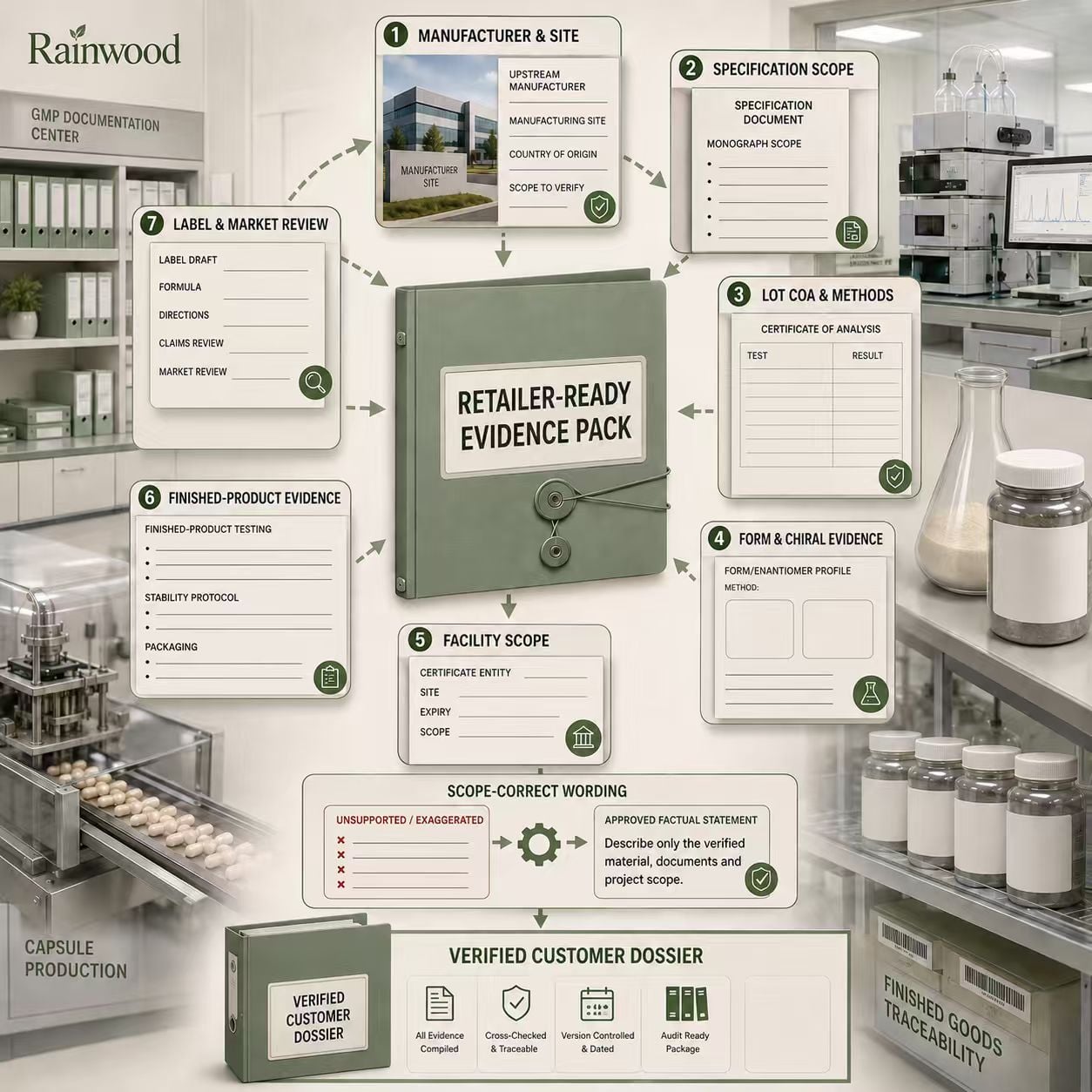
A retailer-ready evidence pack
For a distributor or retailer, assemble:
- manufacturer and site identity;
- current raw-material specification;
- representative and lot COAs;
- methods and reference-standard information available;
- form and chiral evidence where relevant;
- supplier qualification and change control;
- finished-product specification and test report;
- stability and packaging basis;
- facility/certificate documents with scope;
- formula, label, claims, and market review;
- complaint, traceability, and recall contacts.
This file is more persuasive than a large “USP” badge because every document answers a buyer question.
How RainwoodBio can support a scope-correct project
RainwoodBio publishes general quality, OEM, and ALA capsule information. These statements should not be promoted into a specific certificate, method, batch, or finished-product claim without the supporting record.
Ask RainwoodBio to identify:
- the exact ALA form and supplier proposed;
- which monograph or internal specification applies;
- available representative and order-specific documents;
- incoming and finished test responsibilities;
- the certificate entity, site, expiry, and scope;
- packaging and stability deliverables;
- wording that must be referred for regulatory approval.
Review the published RainwoodBio company context, then build the customer dossier from verified project records.
Request a USP-scope and ALA documentation review. Send RainwoodBio the quotation, specification, COA, proposed label claim, target market, formula, dosage form, packaging, quantity, and retailer requirements; the team can return a six-level evidence map showing what is supported and what is still missing.
Frequently asked questions
1Does USP approve dietary supplements?
Do not describe monograph conformity as regulatory approval. USP standards and FDA product regulation are different functions.
2.Can a raw-material COA establish finished capsule compliance?
No. It controls an input. The finished product requires its own manufacturing, sampling, specifications, methods, results, stability, and label reconciliation.
3.Is “USP grade” the same as R-ALA?
No. Alpha lipoic acid form and stereochemical composition require explicit, suitable evidence.
4.Can a supplier test only the assay and claim USP compliance?
The buyer should assess the full applicable monograph and approved specification, not one selected number. Confirm methods, limits, and any alternative-method justification.
References
- USP Alpha Lipoic Acid: https://doi.usp.org/USPNF/USPNF_M45550_04_01.html
- Health Canada DL-Alpha-Lipoic Acid/R-Alpha-Lipoic Acid monograph: https://webprod.hc-sc.gc.ca/nhpid-bdipsn/dbImages/mono_alpha-lipoic-acid_english.pdf
- FDA Dietary Supplements: https://www.fda.gov/food/dietary-supplements
- FDA Structure/Function Claims: https://www.fda.gov/food/nutrition-food-labeling-and-critical-foods/structurefunction-claims
- RainwoodBio alpha lipoic acid capsules: https://www.rainwoodbio.com/oem-odm-alpha-lipoic-acid-capsules-500mg-high-quality-alpha-lipoic-acid-capsules
- RainwoodBio About Us: https://www.rainwoodbio.com/about-us
This article is for international B2B procurement and educational purposes. Compendial status, material identity, specifications, methods, batch evidence, certificates, finished-product testing, stability, labels, claims, and market authorization must be confirmed for the exact product and jurisdiction.