 EN
EN

Meta title: Your 24-Month ALA Shelf Life Needs More Than a COA
Meta description: Build a defensible ALA shelf life with representative batches, stability-indicating methods, degradation limits, packaging, storage, and commitments.
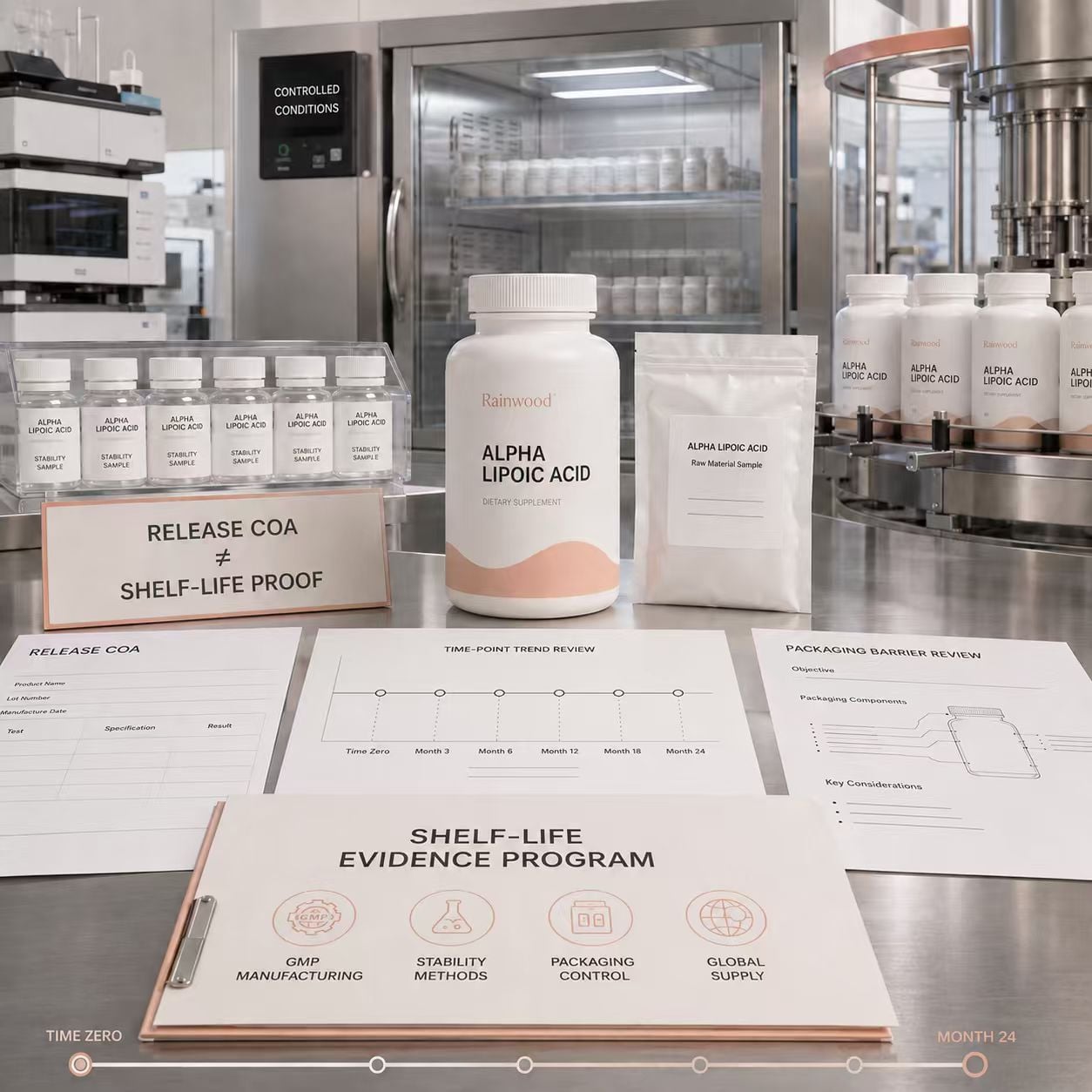
The finished ALA capsules test at 102% of label claim on release. The brand prints a 24-month expiration date.
Those two numbers are not a stability study.
A release COA tells you whether the tested lot met defined criteria at one point in time. Shelf life asks whether the finished product remains within approved chemical, physical, microbiological, and performance specifications throughout the labeled period in its marketed packaging and storage conditions.
For quality managers and private-label brands, ALA deserves this distinction because published research has documented heat- and light-related stability challenges under defined conditions.
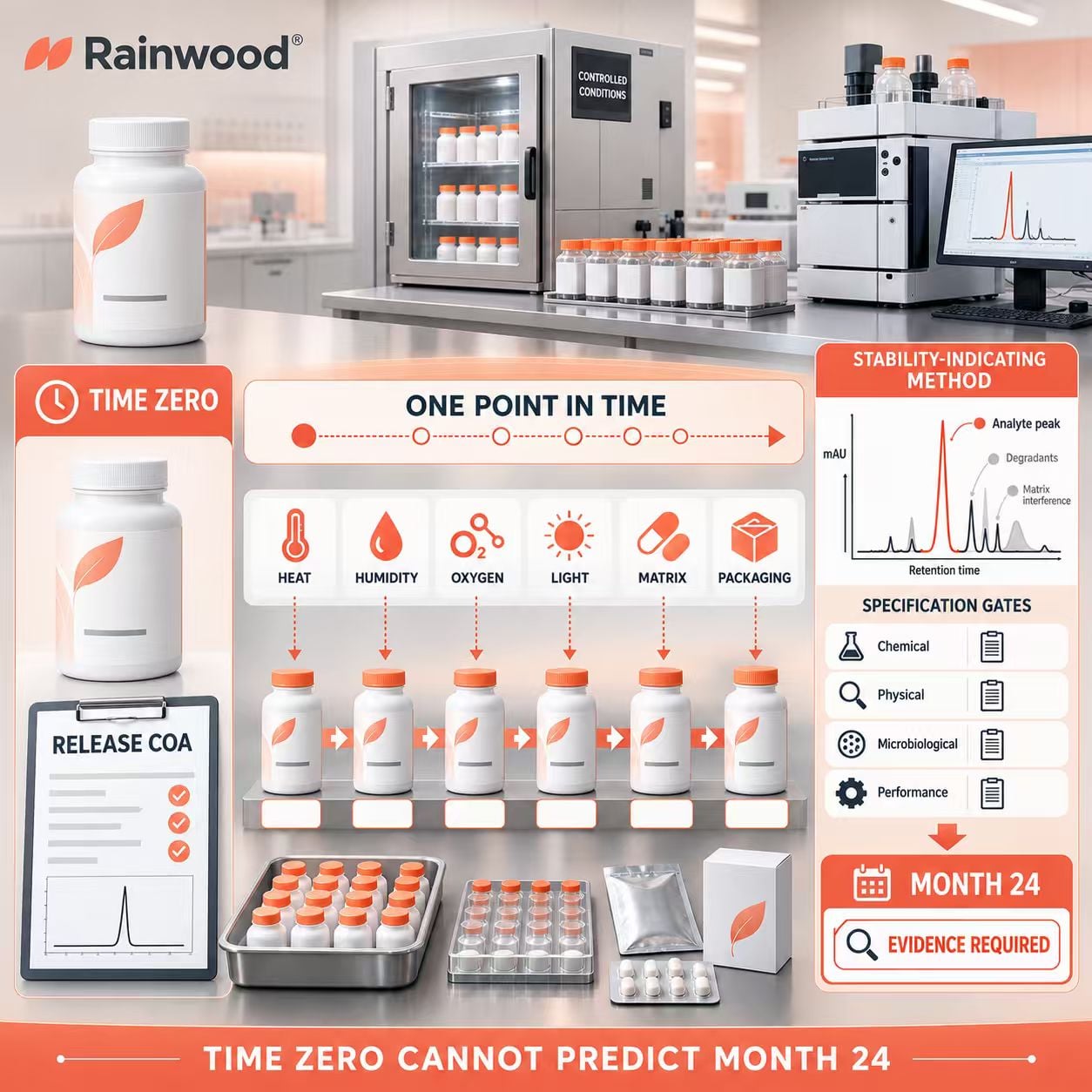
Time zero cannot predict month 24 by itself
A lot may release with acceptable:
- identity;
- ALA content;
- related substances;
- capsule weight and disintegration;
- microbiological quality;
- appearance.
During storage, the product can experience temperature, humidity, oxygen, light, packaging interactions, excipient contact, and physical change. ALA form, co-ingredients, dosage form, process, and container closure can all affect the trajectory.
The shelf-life claim therefore belongs to the exact finished product—not to the raw-material COA or a different ALA formula.
Review the ALA heat-and-light commercial control guide before selecting conditions and packaging.
Use a stability-indicating method
An assay method can measure an ALA peak without adequately separating relevant degradation products or matrix interference. A stability-indicating method should demonstrate that the active can be measured accurately and specifically in the presence of expected degradants, excipients, and other actives.
Method work can include, as appropriate:
- specificity and peak purity assessment;
- forced-degradation studies under justified stress conditions;
- separation of relevant degradants;
- recovery from the complete matrix;
- linearity, accuracy, precision, range, and robustness;
- system suitability;
- mass-balance investigation where meaningful;
- chiral assessment if an R-ALA claim and process risk justify it.
Do not report “HPLC assay” as proof that the method is stability-indicating.
Release limits and shelf-life limits answer different questions
ICH Q1A(R2), while written for drug substances and products rather than automatically governing every supplement, provides useful stability concepts. It distinguishes release specifications from shelf-life specifications and defines formal studies, container-closure systems, long-term testing, and accelerated testing.
For a supplement project, translate those concepts through applicable market rules and your quality system:
- What must the product meet at release?
- What must it meet through expiration?
- Is an initial target or scientifically justified overage needed?
- Which degradation products or physical changes are critical?
- What trend triggers investigation before failure?
- What result supports the proposed storage statement?
The answer cannot be “raw material is 99%.”
Use the USP-scope checklist for ALA to avoid turning raw-material conformance into a finished expiry promise.
The stability protocol must lock the real product
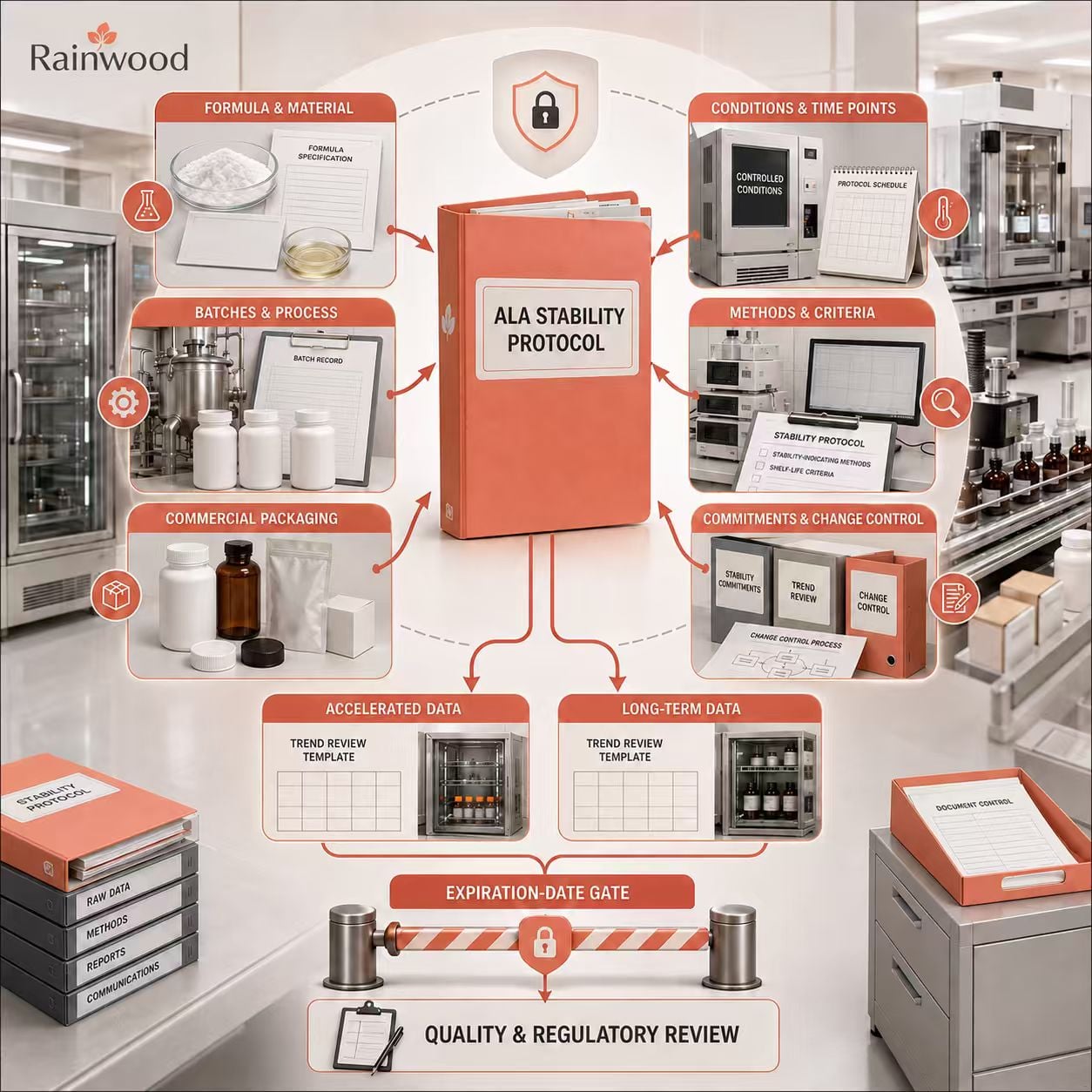
Define before samples enter the chamber:
1. Formula version and exact ALA form/manufacturer.
2. Batch size and manufacturing process.
3. Number and representativeness of batches.
4. Strength and dosage form.
5. Marketed bottle, blister, liner, closure, desiccant, induction seal, and secondary pack.
6. Storage conditions and tolerances.
7. Time points.
8. Tests, methods, and acceptance criteria.
9. Statistical or trend-review approach.
10. Excursion, out-of-trend, and out-of-specification handling.
11. Commitment to continue long-term monitoring.
12. Change-control triggers.
A laboratory bottle with extra headspace or a different closure does not necessarily represent the commercial package.
Packaging is part of the formula's protection system
Compare packaging using evidence, not color preference:
- light transmission;
- moisture and oxygen barrier as relevant;
- closure integrity;
- desiccant need and capacity;
- headspace;
- tablet/capsule count and repeated opening;
- liner and product compatibility;
- shipping case and storage exposure;
- consumer instructions after opening.
A dark bottle may reduce light exposure but does not automatically control heat, moisture, oxygen, or closure failure. A desiccant does not compensate for an unsuitable seal.
RainwoodBio publishes packaging and OEM customization context. Ask which exact container-closure configuration will enter the ALA stability protocol.
One formula cannot borrow another formula's shelf life
Reopen stability assessment when you change:
- DL-ALA to R-ALA or sodium R-lipoate;
- ALA manufacturer or grade;
- active amount or serving;
- capsule to tablet or gummy;
- excipient, coating, or flavor system;
- bottle, blister, closure, liner, or desiccant;
- manufacturing process or site;
- storage statement or target market.
Bridging may be scientifically possible in some cases, but it requires documented justification. “Same hero ingredient” is not a bridge.
Accelerated data do not create certainty
Accelerated conditions can reveal risk, support comparisons, and help predict trends. They may not reproduce every long-term mechanism or physical change. ICH guidance itself notes limits to what accelerated testing can predict.
Use accelerated and long-term data together according to the applicable framework. Avoid:
- extrapolating far beyond available data;
- ignoring an early negative trend because results remain in specification;
- using only one unrepresentative bench batch;
- testing bulk capsules but marketing bottled product;
- changing formula while keeping the old expiry date;
- treating assay alone as the complete stability specification.
How RainwoodBio can support an ALA stability program
RainwoodBio publishes general sampling, production, testing, documentation, and packaging services. These pages do not establish a 24-month shelf life for every ALA capsule, gummy, form, formula, or package.
For a project, ask RainwoodBio to define:
- exact formula version and ALA material;
- representative pilot or production batches;
- release and shelf-life specifications;
- method status and matrix suitability;
- packaging configurations;
- accelerated and long-term protocol;
- available initial and ongoing data;
- stability commitments after launch;
- change-control and customer-notification conditions.
Review RainwoodBio's published company documentation context, then verify the laboratory, methods, batches, sites, and reports behind the project.
The expiration-date gate
Approve a 24-month shelf life only when the responsible quality and regulatory owners can explain:
- which exact product and pack the data cover;
- why the batches are representative;
- why the methods reveal meaningful change;
- what every shelf-life criterion is;
- how current data and commitments support the date;
- how deviations and changes will be managed;
- whether destination-market rules are satisfied.
Request an ALA shelf-life protocol and evidence-gap review. Send RainwoodBio the formula, ALA form and supplier, release results, proposed expiry, market, dosage form, package components, storage statement, stability data, annual volume, and launch date; the team can return a protocol and missing-evidence map.
Frequently asked questions
1.Does a 24-month raw-material retest period prove a 24-month capsule shelf life?
No. Raw material and finished product have different matrices, manufacturing histories, specifications, packaging, and use conditions.
2.Can we use an overage to guarantee shelf life?
An overage does not excuse uncontrolled degradation. It must be justified, safe, lawful, accurately manufactured, and supported by stability data and market review.
3.Must every strength and bottle count be tested separately?
Use a justified design considering formula, strength, fill, headspace, packaging, and applicable rules. Bracketing or matrixing requires a sound rationale.
4.What if accelerated results fail but long-term results pass?
Investigate the mechanism and follow the applicable stability framework. Do not ignore either result or assume accelerated conditions always predict long-term behavior.
References
- ICH Q1A(R2) Stability Testing: https://database.ich.org/sites/default/files/Q1A%28R2%29%20Step4.pdf
- Development of a silica-based ALA formulation and photo/thermal stability evaluation: https://pubmed.ncbi.nlm.nih.gov/32143535/
- Aqueous solubility and thermal stability of ALA with cyclodextrin: https://pubmed.ncbi.nlm.nih.gov/21512253/
- Health Canada DL-Alpha-Lipoic Acid/R-Alpha-Lipoic Acid monograph: https://webprod.hc-sc.gc.ca/nhpid-bdipsn/dbImages/mono_alpha-lipoic-acid_english.pdf
- RainwoodBio OEM service: https://www.rainwoodbio.com/oem
- RainwoodBio About Us: https://www.rainwoodbio.com/about-us
This article is for international B2B quality and educational purposes. Stability protocols, methods, specifications, packaging, storage, overages, shelf life, expiry dating, labels, and regulatory requirements must be approved for the exact formula, batches, container-closure system, and destination market.