 EN
EN
Meta title: Why a 99% Alpha Lipoic Acid COA May Not Prove R-ALA
Meta description: Learn how B2B buyers separate total ALA assay from R-ALA identity, chiral purity, lot traceability, and finished-product verification.
You requested R-alpha-lipoic acid. The supplier sent a COA showing “Assay: 99.4% by HPLC.” Purchasing approved the premium.
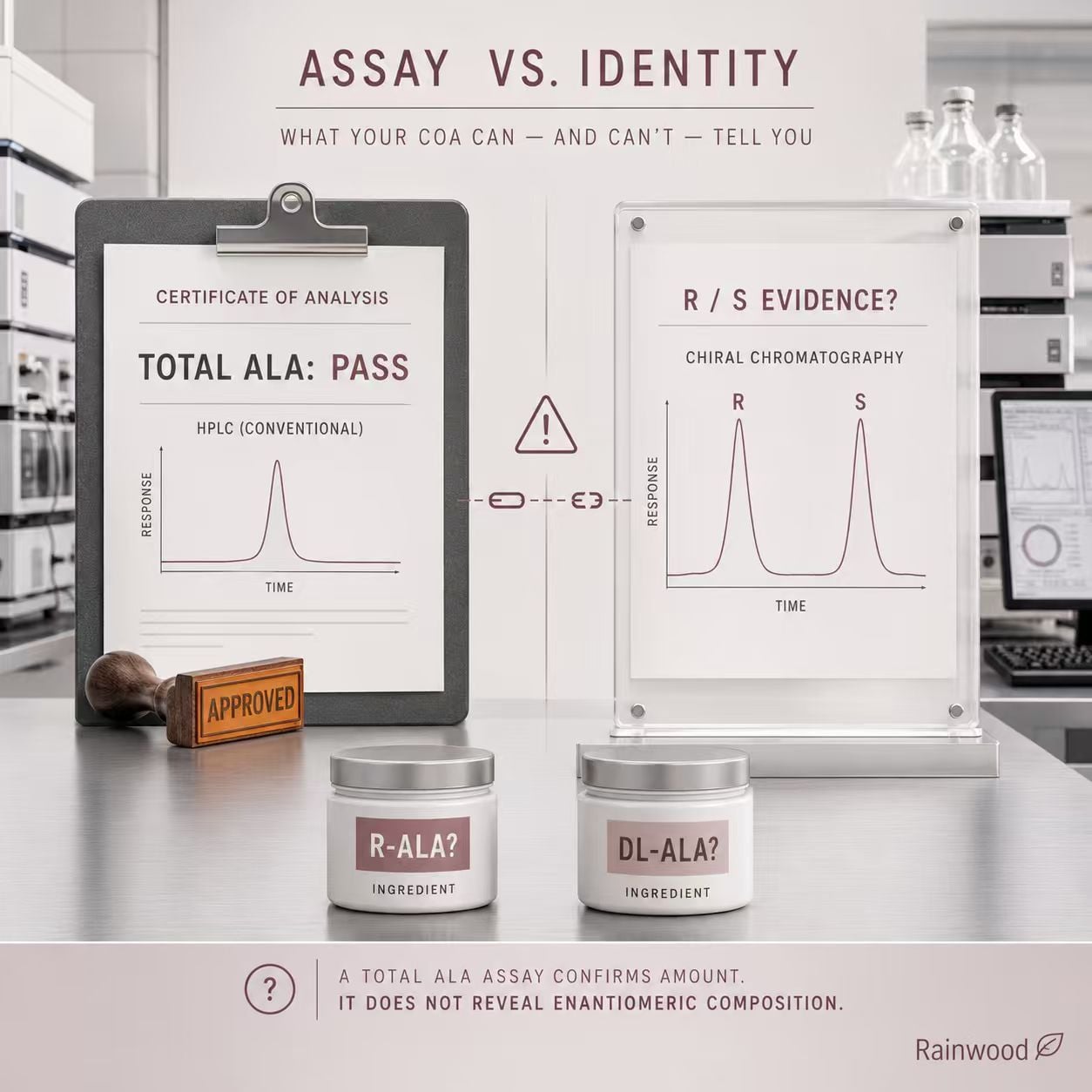
There is still one unanswered question: **did that HPLC method separate R-ALA from S-ALA?
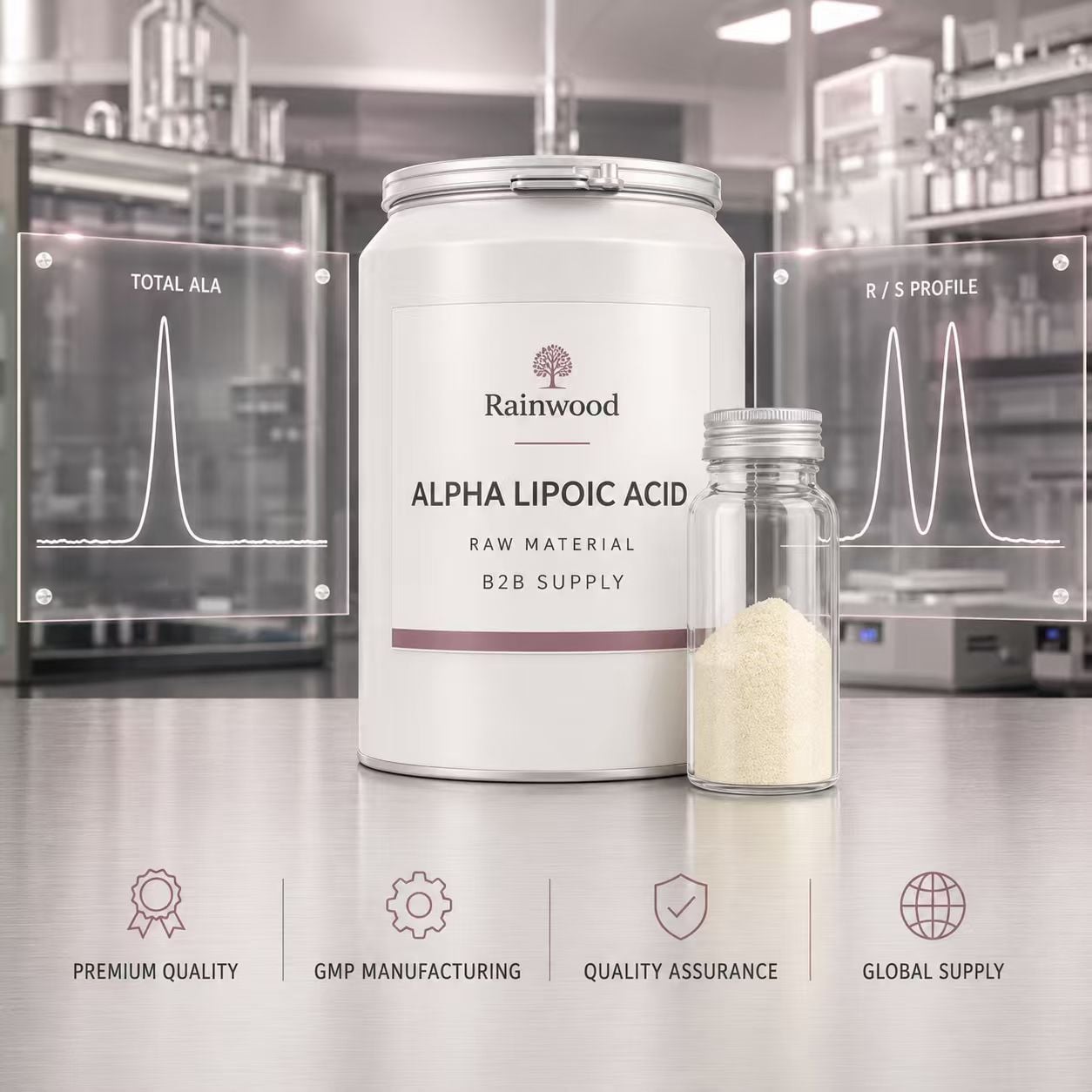
Alpha lipoic acid has a chiral center and can exist as R and S enantiomers. A method that measures total ALA can produce an excellent assay while saying nothing about the R/S composition. For raw-material importers, evidence-led brands, and contract manufacturers, this is the gap between buying high-assay ALA and proving that the material is R-ALA.
Total content and chiral identity answer different questions
The public USP monograph defines alpha lipoic acid at 99.0%–101.0% on the dried basis. That is a useful compendial reference for the material it covers. It does not mean that every result near 100% establishes an enantiopure R material.
Health Canada's current natural health product monograph separately identifies DL-alpha-lipoic acid, R-alpha-lipoic acid, and sodium R-(+)-lipoate. That distinction is commercially important: a buyer cannot turn a generic alpha lipoic acid assay into an R-ALA claim by changing the name on the purchase order.
A conventional achiral assay can answer:
> How much total alpha lipoic acid responds under this method?
A suitable chiral method can answer:
> What proportions of R and S forms are present?
Both may be needed when the commercial promise is R-ALA.
Review the RainwoodBio alpha lipoic acid capsule option as company-published product context, then request the exact raw-material form and method package for your project.
The COA wording that should stop approval
Watch for these combinations:
- Product name says “R-ALA,” but the test line says only “ALA assay.”
- Identification is “retention time conforms” with no statement that the column resolves enantiomers.
- Specific rotation is reported without method conditions, concentration, solvent, temperature, reference range, or justification.
- “Chiral purity” appears as a specification but not as a lot result.
- A supplier brochure claims “natural R form,” while the manufacturer specification names generic alpha lipoic acid.
- The chromatogram has one peak because the method was never designed to separate R and S.
“HPLC” is an instrument category, not a complete answer. Buyers need to know the stationary phase, sample preparation, reference standards, system suitability, resolution, calculation, reporting basis, and whether the method is suitable for the exact material and matrix.
A real supplement finding shows why the distinction matters
A 2021 chromatographic study developed an approach to examine alpha lipoic acid enantiomers and reported that relatively large amounts of S-form had been detected in some dietary supplements labeled as R-ALA. The study also investigated chiral conversion under high-heat conditions in the presence of coexisting components such as glucose.
That does not prove that every R-ALA product is mislabeled or that ordinary supplement processing will reproduce the study conditions. It proves a narrower and useful point: **enantiomer composition can be an analytical and formulation question that total assay alone cannot settle.
Read the linked R-ALA, DL-ALA, and sodium R-lipoate calculation guide before translating a raw-material result into a serving declaration.
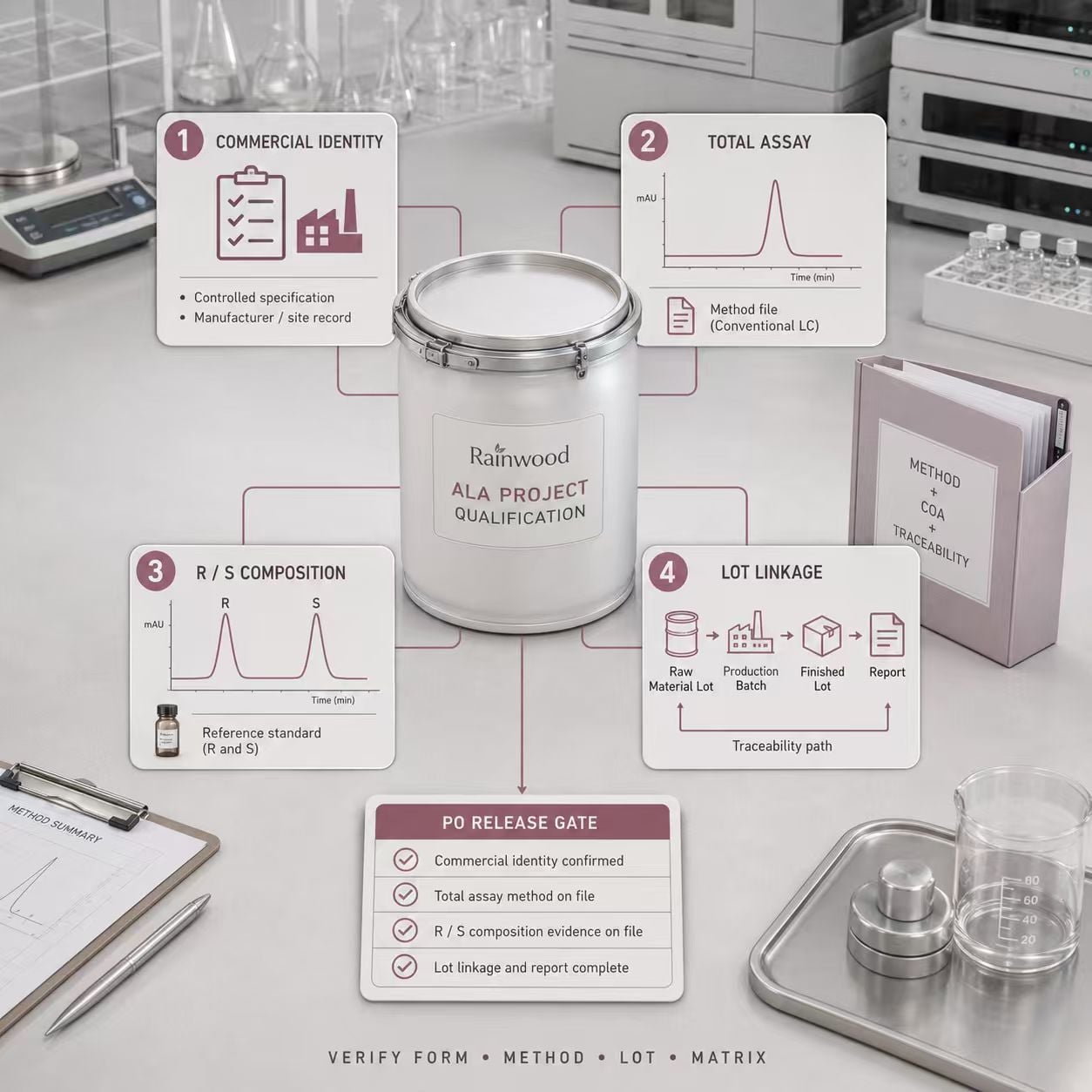
Build a four-layer R-ALA evidence file
1. Commercial identity
Lock the exact material name, form, manufacturer, manufacturing site, country of origin, specification code, and revision. Do not allow “ALA,” “R-ALA,” and “sodium R-lipoate” to share one uncontrolled stock code.
2. Chemical identity and total assay
Use fit-for-purpose identity and assay procedures for the specified material. Record the basis—such as dried or as-is—and make the method and acceptance criteria visible.
3. Enantiomeric composition
For an R-ALA claim, define the R/S reporting requirement, chiral method, reference standards, system suitability, calculation, and acceptance criterion. Decide whether every commercial lot, periodic verification, or another justified plan is required for the project; do not claim a testing frequency without evidence.
4. Lot and finished-product connection
Connect the manufacturer lot to the received drums, production batch, finished lot, retained sample, and test report. Then determine whether the finished matrix requires verification of total content, chiral composition, or both.
Use RainwoodBio's published OEM requirement and sampling process to place these decisions before mass production.
Specific rotation helps—but does not excuse method design
Optical rotation can contribute to identification or chiral assessment when the method, material, concentration, solvent, temperature, path length, and acceptance criterion are appropriate. It should not be treated as a magical one-line substitute for a complete chiral control strategy.
Ask:
- Can the proposed rotation range distinguish the intended material from a relevant mixture?
- Does salt form or formulation matrix change the interpretation?
- Is the sample sufficiently pure for the measurement to be meaningful?
- Is the instrument qualified and the procedure controlled?
- Does the result agree with the chiral chromatographic profile?
Where two methods answer complementary questions, use both rather than forcing one number to prove everything.
The premium-price trap
R-ALA commonly carries a different commercial story from racemic DL-ALA. A buyer who pays that premium should normalize offers using evidence, not names:
| Decision field | Supplier A | Supplier B |
|---|---|---|
| Exact form and manufacturer | Confirmed? | Confirmed? |
| Total assay and basis | Defined? | Defined? |
| Chiral method | Shared/referenced? | Shared/referenced? |
| R/S result | Lot-specific? | Lot-specific? |
| Reference standards | Identified? | Identified? |
| Representative chromatogram | Available? | Available? |
| Change notification | Contracted? | Contracted? |
| Finished verification | Planned? | Planned? |
| Cost per verified daily serving | Calculated? | Calculated? |
The cheaper R-ALA can be the more expensive purchase if the buyer must develop a method, reject inventory, revise the label, or remove the evidence story.
How RainwoodBio can support an R-ALA qualification project
RainwoodBio publishes an ALA capsule page and describes requirement confirmation, formulation, samples, production, testing, and documentation in its OEM materials. Those pages do not prove that every ALA option is R-ALA, that chiral testing is performed on every lot, or that a specific finished product preserves its enantiomeric profile.
For a real project, ask RainwoodBio to confirm:
- which exact ALA forms and upstream manufacturers are available;
- the form-specific specification and representative COA;
- total assay and chiral-composition evidence available;
- sample, commercial-lot, and change-control conditions;
- proposed finished-product test and stability plan;
- documents delivered with the commercial order.
Review RainwoodBio's published company and quality context, then verify the exact entity, site, scope, method, lot, and report before using them in sales copy.
The purchase-order gate
Do not write “R-ALA powder” as the entire material description. Reference the approved form, manufacturer/site, specification revision, chiral acceptance criterion, required documents, sampling/retest plan, packaging, storage, shipment conditions, and change-notification obligations.
Request an R-ALA COA and chiral-proof gap review. Send RainwoodBio the specification, COA, supplier quote, proposed label, target market, daily amount, dosage form, packaging, order quantity, and any R-ALA marketing statement; the team can return a document-gap checklist before you pay for an unverified premium.
Frequently asked questions
1.Does 99% HPLC purity mean 99% R-ALA?
Not unless the method and calculation specifically establish the enantiomeric composition. A total-content result and an R/S result answer different questions.
2.Is R-ALA the same as sodium R-lipoate?
No. One is the free acid and the other is a sodium salt. Identity, input mass, declaration basis, physical properties, evidence, and sodium contribution require separate review.
3.Can a supplier's chromatogram prove my received lot?
Only if it is traceable to that lot and the sampling, method, system suitability, integration, standards, and report are appropriate. A representative chromatogram is not lot proof.
4.Should the finished capsule be tested for R/S composition?
Set the plan from the claim, processing risk, market, matrix, and method suitability. Raw-material evidence may not answer every finished-product question.
References
- USP Alpha Lipoic Acid: https://doi.usp.org/USPNF/USPNF_M45550_04_01.html
- Health Canada DL-Alpha-Lipoic Acid/R-Alpha-Lipoic Acid monograph: https://webprod.hc-sc.gc.ca/nhpid-bdipsn/dbImages/mono_alpha-lipoic-acid_english.pdf
- Study of alpha lipoic acid chiral conversion and LC/UV analysis: https://www.jstage.jst.go.jp/article/jpchrom/advpub/0/advpub_2021.019/_pdf
- Alpha-lipoic acid chemistry review: https://pubs.rsc.org/en/content/articlepdf/2023/ra/d3ra07140e
- RainwoodBio alpha lipoic acid capsules: https://www.rainwoodbio.com/oem-odm-alpha-lipoic-acid-capsules-500mg-high-quality-alpha-lipoic-acid-capsules
- RainwoodBio OEM service: https://www.rainwoodbio.com/oem
*This article is for international B2B procurement and educational purposes. Material form, identity, chiral composition, assay, specifications, methods, batch evidence, finished testing, labels, claims, and regulatory requirements must be confirmed for the exact raw material, finished product, and destination market.*