 EN
EN

Meta title: Astaxanthin Powder in Gummies: Test Heat and Moisture
Meta description: Astaxanthin powder can pass a raw-material COA and still fail a gummy or drink mix. Validate heat, moisture, pH, oxygen, color, and potency.
The supplier says the astaxanthin powder is stable. The gummy kettle runs hotter than the pilot, the drink mix sits in a humid warehouse, and the finished color shifts before the launch campaign ends.
“Stable” is incomplete without temperature, time, oxygen, moisture, pH, matrix, package, and endpoint. Astaxanthin is a light- and oxidation-sensitive carotenoid, so a raw powder result cannot automatically predict a gummy or beverage outcome.
Review the astaxanthin powder product information and build a format-specific process gate.
Gummy and drink-powder processes expose different stresses
A gummy may expose the ingredient to syrup concentration, heat, acids, gelling agents, vacuum, depositing, drying, and moisture migration. A drink mix may expose it to spray drying, blending, sachet filling, water reconstitution, oxygen, and light.
Record:
- peak and average temperature;
- residence time at each temperature;
- pH and water content;
- oxygen exposure and mixing energy;
- addition point in the process;
- drying or cooling profile;
- package and storage humidity.
Do not carry a powder supplier’s application list into your master formula without matching the actual process conditions.
Read the astaxanthin water-dispersible powder guide if the final product must perform in water.
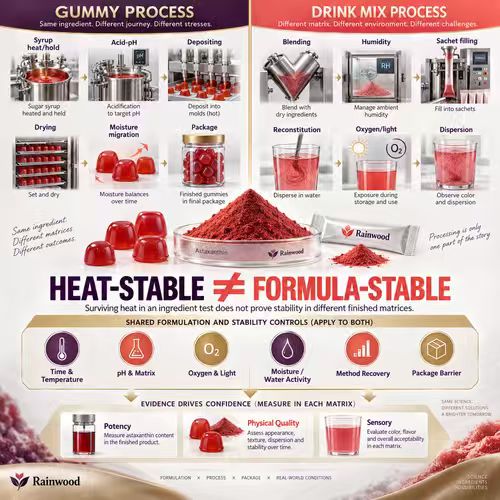
Heat stability does not protect against oxidation
A process can be within a temperature range and still create a loss through oxygen, metal ions, light, or a long hold time. Wall materials and antioxidants may reduce exposure, but their performance depends on the exact grade and formula.
Ask for a pilot comparison that measures:
- astaxanthin retention before and after processing;
- color change;
- free and ester form where relevant;
- moisture and water activity;
- relevant oxidation indicators;
- sensory performance;
- package integrity after storage.
The study should use the same powder, formula, equipment profile, and package concept planned for production.
A raw-powder COA cannot release the finished matrix
The raw powder may meet its assay and moisture limits. The gummy or drink mix can still have extraction recovery, distribution, color, or stability problems. The laboratory method must be suitable for the finished matrix, not only the incoming ingredient.
Ask whether the method can recover astaxanthin from:
- gelatin, pectin, or starch;
- sugars and polyols;
- acids and flavors;
- proteins and emulsifiers;
- oils and other carotenoids;
- low-dose finished servings.
Use the astaxanthin finished-product testing plan to connect raw-material evidence with the product customers actually receive.
Gummy texture and powder dispersion can fail after storage
In a gummy, moisture migration can change texture and create a different microenvironment for the carotenoid. In a drink powder, moisture pickup can cause caking, poor flow, and slower dispersion. Color loss may be a visible sign, but a stable color does not prove potency.
Set separate acceptance criteria for:
- potency;
- color and appearance;
- texture or dissolution;
- moisture and water activity;
- microbial quality where relevant;
- package seal and barrier;
- sensory profile.
Do not collapse all criteria into “looks acceptable.”
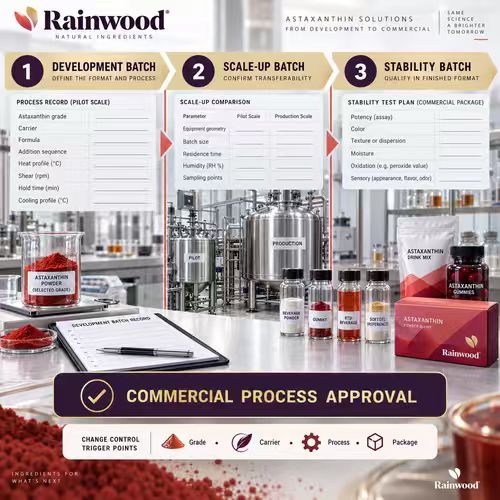
Pilot design for powder-based formats
Development batch
Use the intended astaxanthin powder grade, carrier, formula, and addition sequence. Record heat, shear, hold, and cooling.
Scale-up batch
Compare equipment geometry, batch size, residence time, humidity, and operator exposure. Sample from defined process locations.
Stability batch
Store the finished product in its commercial package under intended and justified stress conditions. Recheck potency, color, texture or dispersion, moisture, oxidation indicators, and sensory behavior.
Explore the astaxanthin gummy and drink-powder OEM service before choosing a grade based only on a laboratory sample.
How RainwoodBio can support the process trial
RainwoodBio’s public site lists gummies, powders and sachets, tablets, capsules, testing and release, packaging, and traceability. These are company-published capabilities. Ask for a process report that states the exact grade, carrier, heating profile, sampling points, and finished-product acceptance criteria.
Approval gate before commercial processing
Require:
- the exact powder grade and assay basis;
- process-specific retention data;
- finished-matrix method suitability;
- moisture, oxygen, light, and package controls;
- sensory and physical acceptance criteria;
- stability results in the commercial format;
- written change control for carrier or encapsulation process.
Request an astaxanthin powder process-feasibility review. Send RainwoodBio your formula, heat profile, target dose, format, package, storage route, and current pilot results so the team can identify the true scale-up risk.
Record the change points that can invalidate the pilot
The approved pilot should identify the astaxanthin powder lot, carrier, addition point, kettle or dryer profile, hold time, cooling, package, and storage condition. A later change to any of these points should be classified as a potential requalification trigger rather than an ordinary production adjustment.
For gummies, compare pieces from the start and end of the deposit run and after drying. For drink powders, compare the blend before filling, after transport simulation, and after consumer reconstitution. These samples help separate an active-loss problem from a distribution or packaging problem and give the supplier a practical action list instead of a vague request to “improve stability.”
Ask for a process-specific sample, not a catalog sample
The development sample should use the same astaxanthin form, carrier, flavor, acid, and package planned for the pilot. Record the lot and retain enough material for a repeat test. If the supplier offers a different encapsulation or concentration for production, treat that as a new grade and reopen the heat, moisture, and stability review.
This discipline helps the buyer distinguish a formula problem from a raw-material change and gives the OEM a clear list of variables to control during scale-up.
Keep raw-material and finished-product release separate
The powder COA can release the incoming ingredient; it cannot replace potency, color, texture, dispersion, or stability checks for the gummy or drink mix. Write both specifications before the pilot.
Ask for end-of-shelf-life sensory checks
A finished gummy or drink can remain within potency while its color, taste, sediment, or texture becomes commercially unacceptable. Include sensory and physical observations at stability pulls so the launch decision reflects what customers will actually notice.
Frequently asked questions
1.Is astaxanthin powder suitable for gummies?
It can be, but the answer depends on the powder form, carrier, dose, process heat, moisture, matrix, and stability evidence.
2.Does a color change prove astaxanthin degradation?
Not by itself. Color is a useful observation, but potency and suitable analytical tests are needed to confirm the change.
3.Can beverage data support a gummy shelf life?
No. The matrices, water activity, package, and processing history are different and need separate evidence.
References
- Food-grade astaxanthin encapsulation study: https://pubmed.ncbi.nlm.nih.gov/32517928/
- Review of astaxanthin delivery and stability: https://pmc.ncbi.nlm.nih.gov/articles/PMC13210799/
- RainwoodBio homepage: https://www.rainwoodbio.com/
- RainwoodBio OEM service: https://www.rainwoodbio.com/oem
This article is for B2B procurement and educational purposes. Product, analytical, safety, labeling, and regulatory requirements should be confirmed for the exact ingredient, finished product, and destination market.