 EN
EN

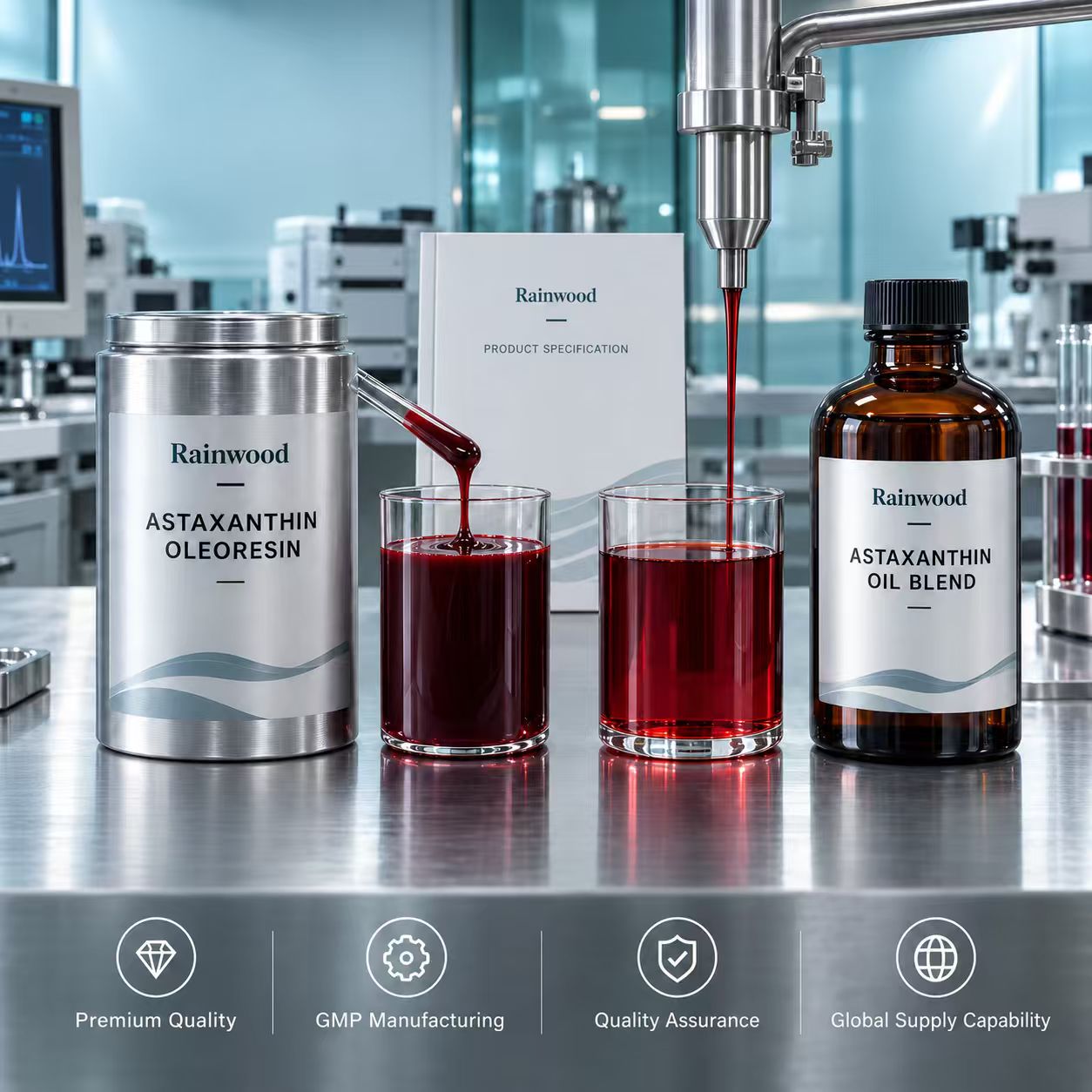
Meta title: Astaxanthin Oil vs Oleoresin: Compare the Actual Material
Meta description: Astaxanthin oil and oleoresin are not interchangeable quote terms. Verify concentration, ester form, carrier oil, stability, and intended format.
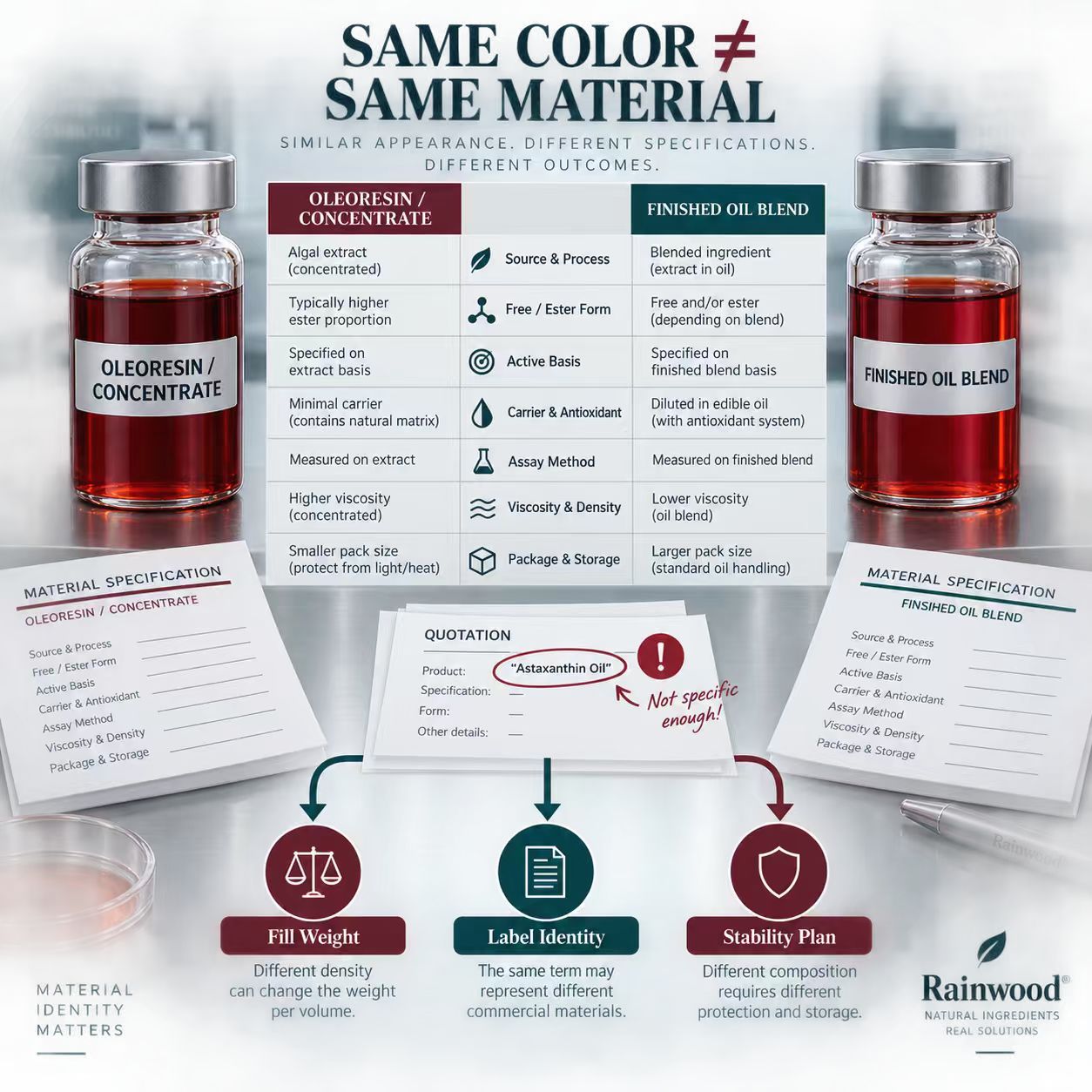
One supplier quotes “astaxanthin oil.” Another quotes “astaxanthin oleoresin.” Both show a red liquid and a similar percentage. The buyer assumes they are equivalent until the softgel fill weight, viscosity, label, and stability program no longer match.
The word “oil” describes a delivery medium. “Oleoresin” describes a concentrated extract preparation. Neither term alone tells you the astaxanthin form, carrier, concentration basis, or process history.
Review the astaxanthin oil and oleoresin specification before normalizing the quotations.
The commercial identity sits inside the red liquid
USP describes astaxanthin esters from *Haematococcus pluvialis* as a dark red, viscous oil containing mainly 3S,3′S stereoisomers in monoester, diester, and free forms. It defines total astaxanthin as free astaxanthin on an anhydrous basis. [USP Astaxanthin Esters](https://doi.org/10.31003/USPNF_M7359_03_01)
Your oil specification should state:
- oleoresin or finished oil blend;
- source organism or synthesis route;
- free and esterified form;
- total astaxanthin basis;
- carrier oil and antioxidant system;
- viscosity and density expectations;
- moisture, insoluble matter, and oxidation limits;
- package and storage conditions.
Without this information, a “10% oil” comparison is incomplete.
Carrier oil changes the product and the price
MCT oil, sunflower oil, olive oil, algae oil, and other carriers can create different viscosity, flavor, oxidation behavior, label declarations, and softgel compatibility. A supplier may also add antioxidants or emulsifiers that change the formula and market file.
Ask for the full carrier composition and percentage. Then calculate the actual astaxanthin amount per gram and per softgel. A higher concentration may reduce fill weight, while a lower concentration may be easier to pump or dose. The right choice depends on the final format and process.
Read the astaxanthin oil dose-conversion guide before selecting a concentration.
Oil and oleoresin can use different test language
One supplier may report total astaxanthin after saponification or hydrolysis. Another may report intact esters by a different chromatographic method. One may list only a total color value. These results are not automatically interchangeable.
Request:
1. analyte definition;
2. sample preparation;
3. reference standard;
4. free-equivalent calculation;
5. ester and free-form profile where relevant;
6. recovery and specificity information;
7. lot number and laboratory identity.
Use the astaxanthin oil COA and method review to prevent a method difference from becoming a false price or potency comparison.
Viscosity is a production attribute
A thick oleoresin may remain stable in a drum and behave poorly in a small-volume pump, inline mixer, or softgel encapsulation machine. Temperature changes during transport can alter flow. A carrier substitution can change fill-weight accuracy and air entrainment.
Measure or specify:
- viscosity at a stated temperature;
- density;
- pump and hose conditions;
- fill-weight variation;
- mixing and recirculation requirements;
- settling or phase separation;
- filtration or foreign-matter controls.
Do not select an oil based on color and assay alone when the line depends on precise liquid filling.
Format fit determines the right material
An oil for softgels may prioritize fill weight, shell compatibility, oxygen control, and release. An oil for a beverage may require emulsification and a different carrier. An oil for a cosmetic may need a different odor and color profile.
Define the end use before the RFQ. Ask the supplier to provide the material, not a generic “oil form,” against that use.
Explore the astaxanthin oil and softgel OEM service if the same raw material must be evaluated in more than one dosage form.
How RainwoodBio can support the comparison
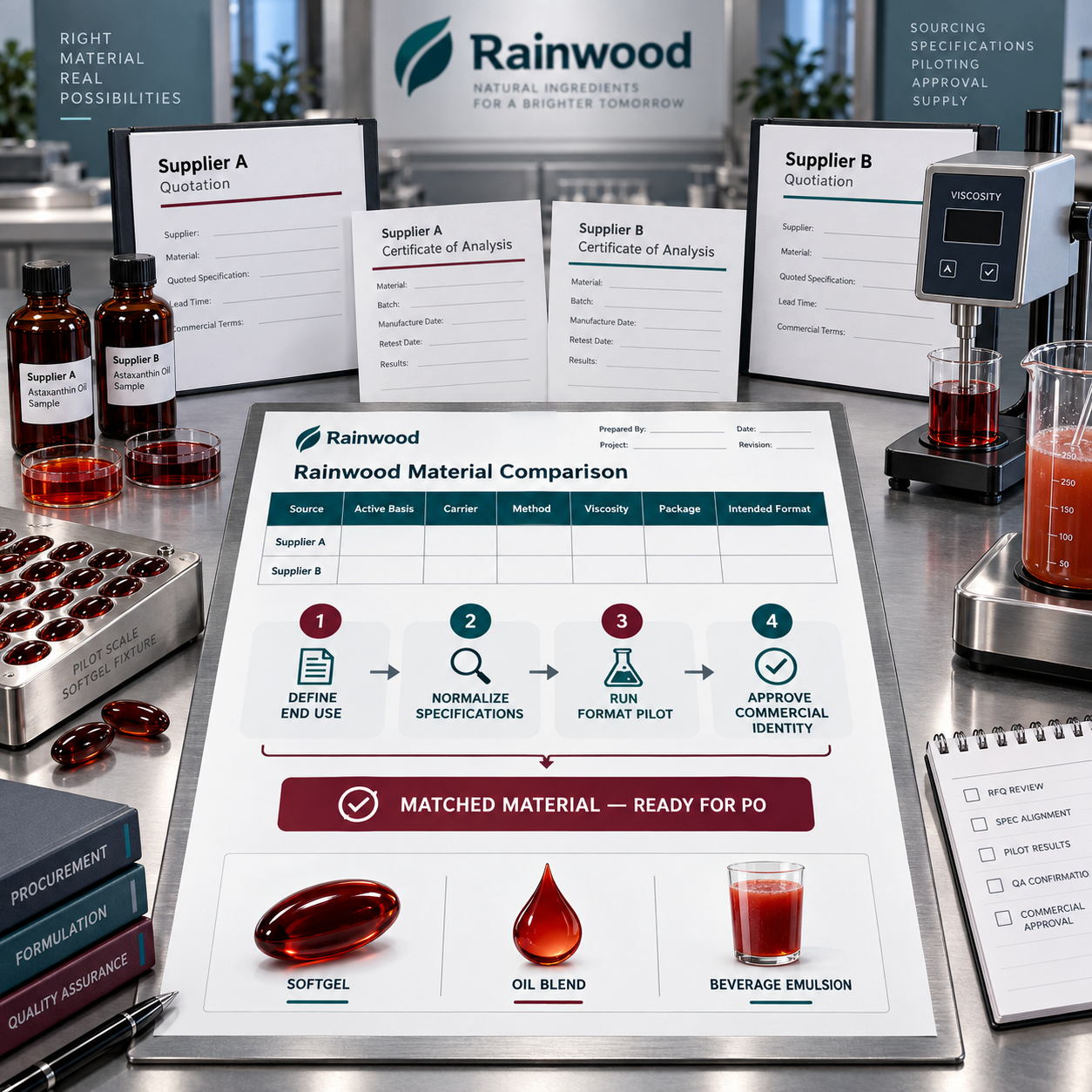
RainwoodBio’s public workflow describes requirement confirmation, raw-material management, formulation, testing and release, multiple dosage forms, packaging, and traceability. These are company-published capabilities. Ask for a side-by-side table showing concentration basis, carrier, viscosity, package, test panel, MOQ, and intended format.
Approval gate before selecting the oil
Require:
- a defined commercial identity;
- concentration and free-equivalent basis;
- carrier and antioxidant disclosure;
- method and lot traceability;
- viscosity and density evidence;
- oxidation and package controls;
- a format-specific pilot.
Request an astaxanthin oil versus oleoresin comparison. Send RainwoodBio the two quotations, COAs, target format, dose, carrier restrictions, market, and annual quantity so the team can compare equivalent materials.
The RFQ should force the difference into the open
Ask every supplier to complete the same fields: source, extraction route, total astaxanthin basis, ester profile, carrier, antioxidant, density, viscosity, package, storage, MOQ, and retest period. Request a retained sample from the lot represented by the quote and identify whether it is the same material planned for commercial production.
If the supplier uses “oleoresin” for a concentrate and “oil” for a diluted blend, make that distinction visible in the purchase order. Specify whether the buyer is paying for active, carrier, or a finished fill-ready liquid. This single clarification often prevents the wrong unit economics from reaching the softgel formula.
What a buyer should request with the first sample
Request a sample large enough for identity, assay, viscosity, oxidation, and a small format pilot. Ask for the package type, fill date, storage condition, and lot represented. If the supplier cannot provide a lot-specific sample, label it as a development sample rather than an approved commercial reference.
Compare the sample with the quotation line by line. If the commercial offer changes concentration, carrier, antioxidant, package, or assay basis, do not issue a blanket approval. Request a revised sample and a new calculation. This prevents a small vocabulary difference from becoming a wrong softgel fill or a failed stability study.
Treat the carrier as a declared ingredient
The carrier affects label, nutrition, allergens, oxidation, viscosity, and price. Require its name, grade, percentage, and change-control status before the oil or oleoresin enters the formula.
Record the material’s intended use
State whether the oil or oleoresin will be filled into softgels, blended into an oil formula, emulsified for a beverage, or sold as an ingredient. The same commercial name can cover different process needs, and the supplier should not be asked to guarantee every application from one generic sample.
Add a commercial release sample
Keep a sealed sample from the approved lot for later comparison. Label it with the lot, package, fill date, and storage condition so a future shipment can be compared against a real commercial reference rather than an old sales photo.
Frequently asked questions
1.Is astaxanthin oil the same as astaxanthin oleoresin?
Not automatically. Confirm source, concentration, carrier, ester form, method, and intended use.
2.Does a darker oil contain more astaxanthin?
Color alone does not prove potency. Use a suitable assay and identity method.
3.Can one oil serve softgels and beverages?
Possibly, but softgel filling and beverage dispersion have different requirements. Validate the exact format.
References
- USP Astaxanthin Esters: https://doi.org/10.31003/USPNF_M7359_03_01
- USP FCC Astaxanthin Esters from *Haematococcus pluvialis*: https://doi.org/10.31003/USPFCC_F102276_03_01
- RainwoodBio OEM service: https://www.rainwoodbio.com/oem
- RainwoodBio homepage: https://www.rainwoodbio.com/
This article is for B2B procurement and educational purposes. Product, analytical, safety, labeling, and regulatory requirements should be confirmed for the exact ingredient, finished product, and destination market.