 EN
EN

Meta title: Astaxanthin Oil Sample vs Bulk: Qualify the First Drum
Meta description: A passing astaxanthin oil sample does not guarantee bulk equivalence. Control concentration, viscosity, carrier, oxidation, color, and lot traceability.
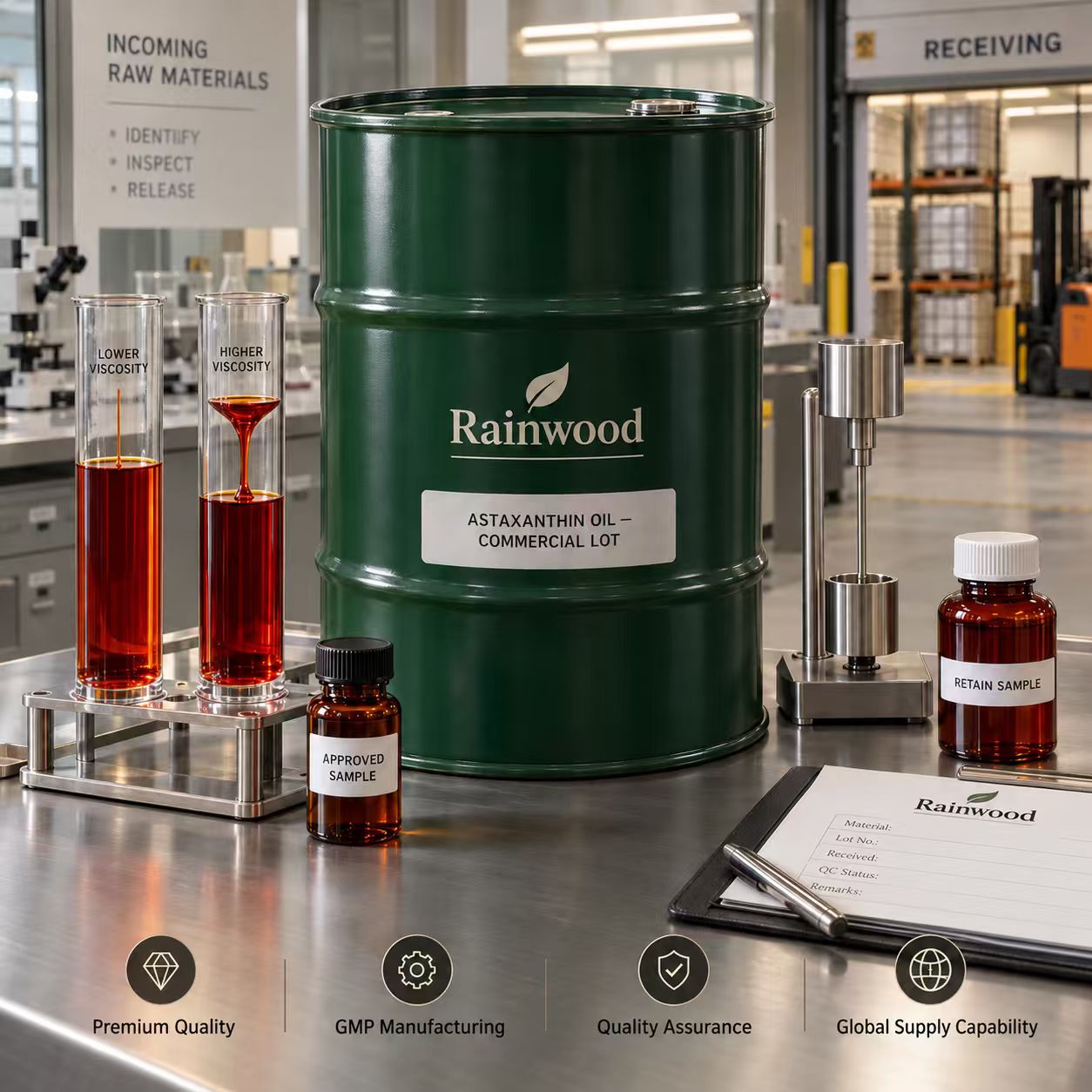
The sample flows easily through the pilot pump. The bulk drum arrives thicker, darker, and harder to mix. The COA still says “10% astaxanthin,” so the supplier calls the difference normal.
Normal lot variation can exist. But if viscosity, color, concentration basis, or oxidation changes the fill or stability of your product, it must be controlled before the shipment becomes inventory.
Use the astaxanthin oil raw-material specification to define what the approved sample actually represents.
Know the sample’s commercial identity
Ask whether the sample came from:
- the same manufacturer and site;
- the same production lot;
- the same concentration and carrier;
- the same antioxidant system;
- the same package and storage period;
- the lot reserved for commercial production.
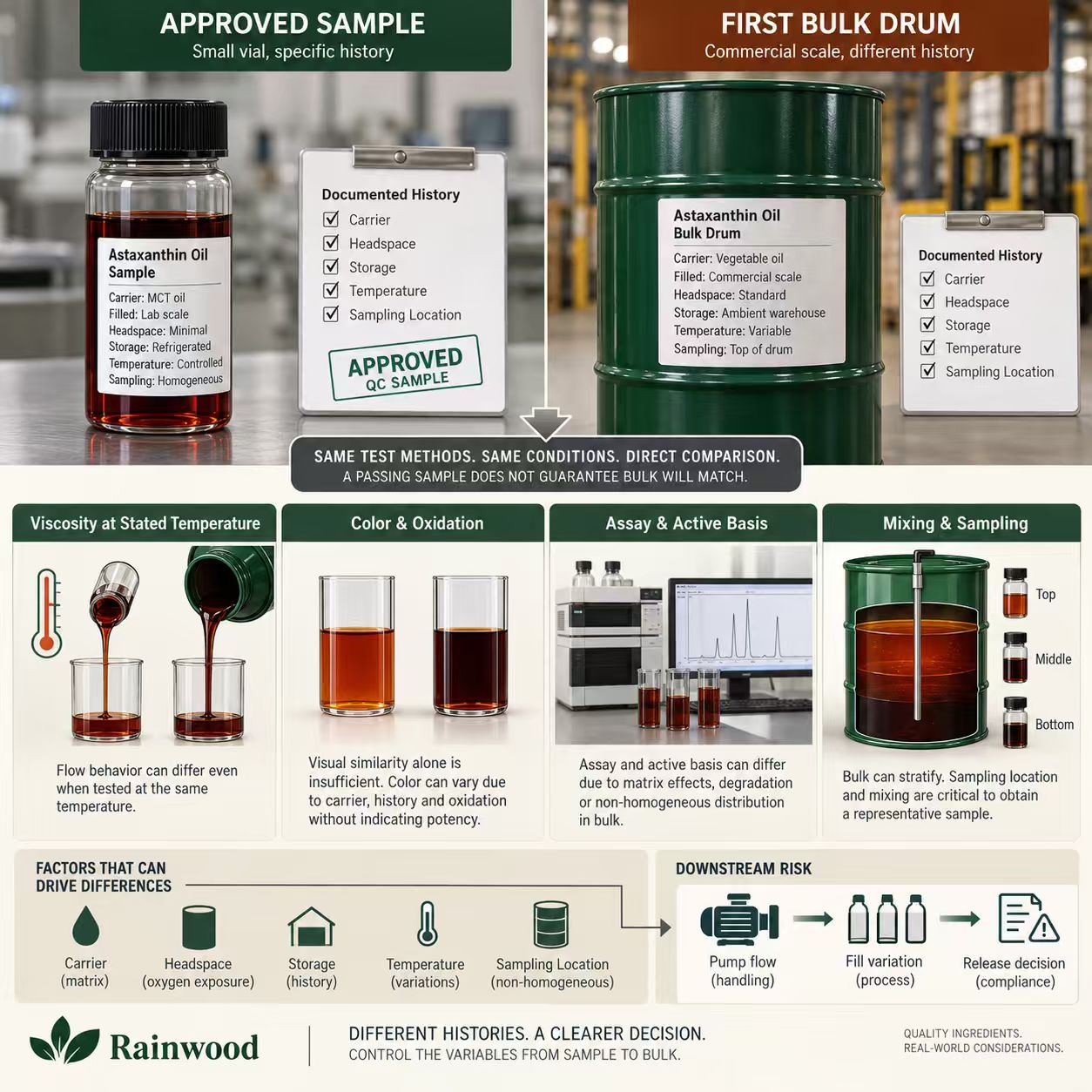
Record the sample lot, fill date, storage, temperature, and test results. A small laboratory vial can have a different headspace and exposure history from a commercial drum.
Read the astaxanthin oil versus oleoresin comparison before approving a sample by appearance alone.
Viscosity must be measured at a stated temperature
Oil flow changes with temperature and carrier composition. A sample tested at a warm laboratory bench may not represent a drum in a cool warehouse or a filling line with a controlled temperature.
Specify:
- test temperature;
- method and spindle or instrument;
- equilibration time;
- density;
- pump and hose condition;
- acceptable range;
- fill-weight effect.
If a supplier changes the carrier, concentration, or antioxidant, repeat the viscosity and filling assessment even if the assay remains within range.
Color can expose concentration and oxidation differences
Color depends on astaxanthin concentration, ester form, carrier, particle or droplet distribution, light history, and oxidation. Compare sample and bulk under the same lighting and with a documented visual or instrumental method.
When color shifts, check:
- total astaxanthin and free-equivalent basis;
- ester and free-form profile where relevant;
- peroxide or oxidation indicators;
- package opacity and headspace;
- storage temperature and light;
- carrier oil identity.
Do not release a bulk lot solely because a red oil “looks close.”
Assay can shift through method or sampling differences
The sample may be tested after mixing while the bulk drum is sampled from one location. A viscous oil can stratify, settle, or retain concentrated material on the container wall. A different method can also report a different basis.
Define:
1. drum inversion or mixing before sampling;
2. number of sampling locations;
3. sample temperature;
4. sample preparation;
5. method and reference standard;
6. free-equivalent calculation;
7. retest and disposition rules.
Use the astaxanthin oil COA and sampling plan to connect the result to the shipment.
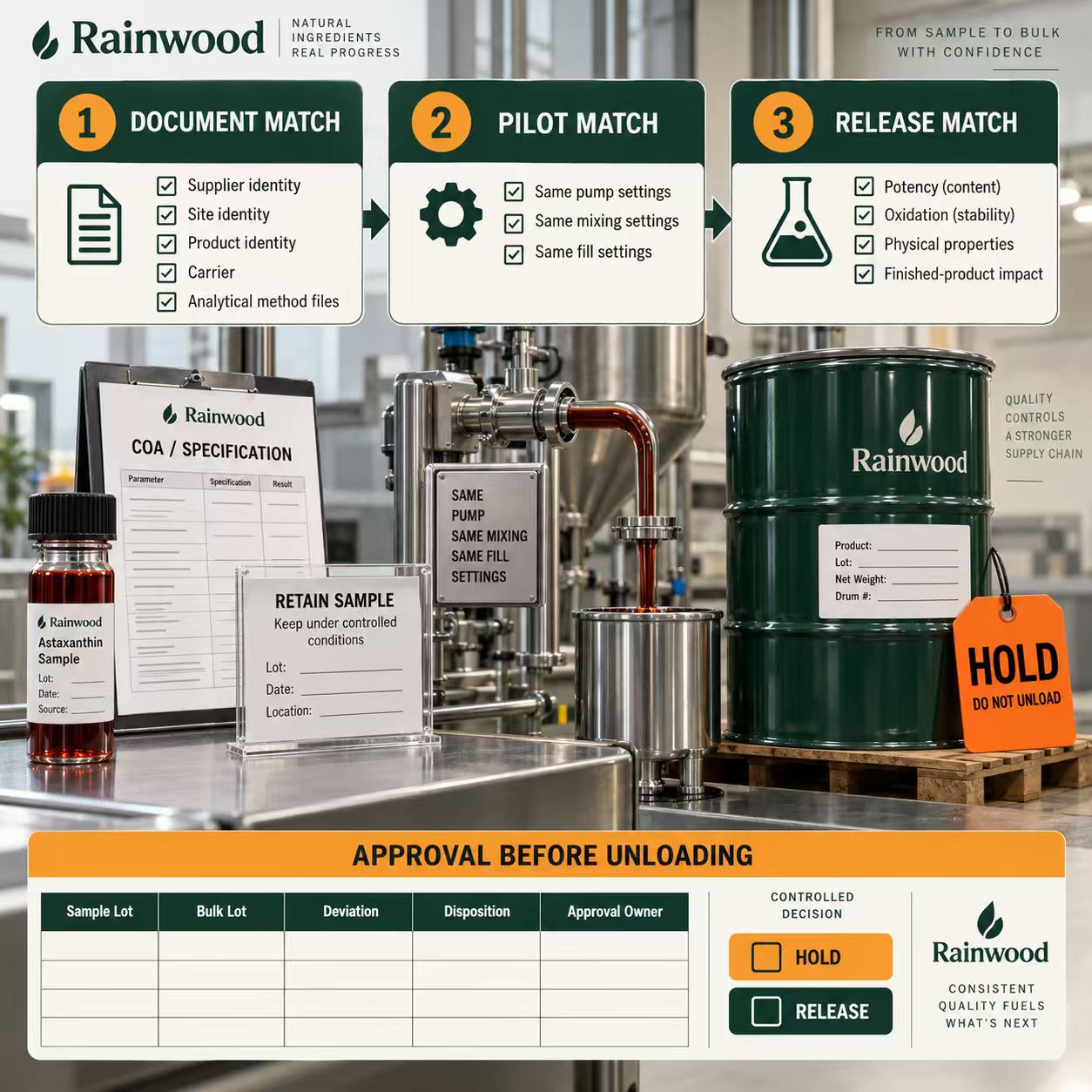
Three-stage sample-to-bulk gate
Document match
Compare supplier, site, product identity, concentration, carrier, package, and method.
Pilot match
Run the sample and first bulk lot through the same pump, mixing, and fill settings. Record viscosity, yield, color, fill variation, and cleanup.
Release match
Test potency, oxidation, identity, physical properties, and finished-product impact before releasing the bulk lot.
Explore the astaxanthin oil sample-to-bulk OEM review before ordering a full production quantity.
How RainwoodBio can support the first-lot qualification
RainwoodBio’s public workflow describes sample development, supplier management, testing and release, packaging, logistics, and traceability. These are company-published capabilities. Request a comparison table showing sample lot, commercial lot, test result, deviation, disposition, and approval owner.
Approval gate before unloading the bulk drum
Require:
- matching manufacturer, site, and commercial identity;
- concentration and basis confirmation;
- viscosity and density at the fill condition;
- color and oxidation review;
- representative lot sampling;
- package and storage history;
- written change-control terms.
Request an astaxanthin oil sample-to-bulk review. Send RainwoodBio the approved sample COA, bulk COA, photos, viscosity data, target format, and pilot notes so the team can identify whether the difference is acceptable or requires investigation.
Put the first-lot comparison in the release record
Save the approved sample, commercial sample, package photographs, temperature records, and test reports under the same project number. Record who reviewed the difference and whether the decision applies only to that lot or to future orders. If the supplier proposes a new carrier or concentration, treat it as a change requiring new sample approval.
This record helps the production team avoid two common errors: rejecting a usable lot because it looks different, or using a risky lot because the assay number looks familiar. The decision should be based on the critical attributes that protect the final softgel or oil-based formula.
Put physical differences into the release record
If the bulk lot is outside the approved physical range, do not solve the disagreement by warming the drum until it pumps. Temperature conditioning may be part of the process, but it must be stated in the specification and repeated consistently. Otherwise, the fill result may depend on warehouse conditions rather than on a controlled formula.
Ask the supplier to explain whether the drum was mixed before sampling, whether the material settled during transport, and whether the package was opened or resealed. Compare a representative sample after controlled homogenization with an as-received sample. This distinction helps determine whether the issue is stratification, handling, or a genuine change in the commercial grade.
Set the commercial lot release rule before the shipment
The purchase order should state whether the buyer may unload and store the drum before verification, which documents are required, and who can approve a deviation. If the material needs homogenization before sampling, define the equipment and temperature. If a lot fails, define hold, retest, replacement, credit, and investigation steps.
This makes the sample-to-bulk process practical under time pressure. It also protects the supplier from a late complaint based on an attribute that was never agreed in the first place.
Make the first-lot decision time-bound
Define how long QA has to review the drum, where it is held, and who can authorize use. A clear hold period prevents production pressure from turning an unresolved sample-to-bulk difference into an undocumented release.
Frequently asked questions
1.Can a thicker bulk oil still be acceptable?
Possibly, if it remains within the agreed specification and the filling process still meets yield, dose, and finished-product requirements.
2.Does a darker oil mean higher potency?
No. Color is influenced by several variables and should be assessed with suitable potency and oxidation data.
3.Should sample and bulk always be identical?
They should be equivalent against the agreed critical attributes. Define acceptable variation and the reapproval trigger before ordering.
References
- USP Astaxanthin Esters: https://doi.org/10.31003/USPNF_M7359_03_01
- USP FCC Astaxanthin Esters: https://doi.org/10.31003/USPFCC_F102276_03_01
- RainwoodBio About Us: https://www.rainwoodbio.com/about-us
- RainwoodBio homepage: https://www.rainwoodbio.com/
This article is for B2B procurement and educational purposes. Product, analytical, safety, labeling, and regulatory requirements should be confirmed for the exact ingredient, finished product, and destination market.