 EN
EN

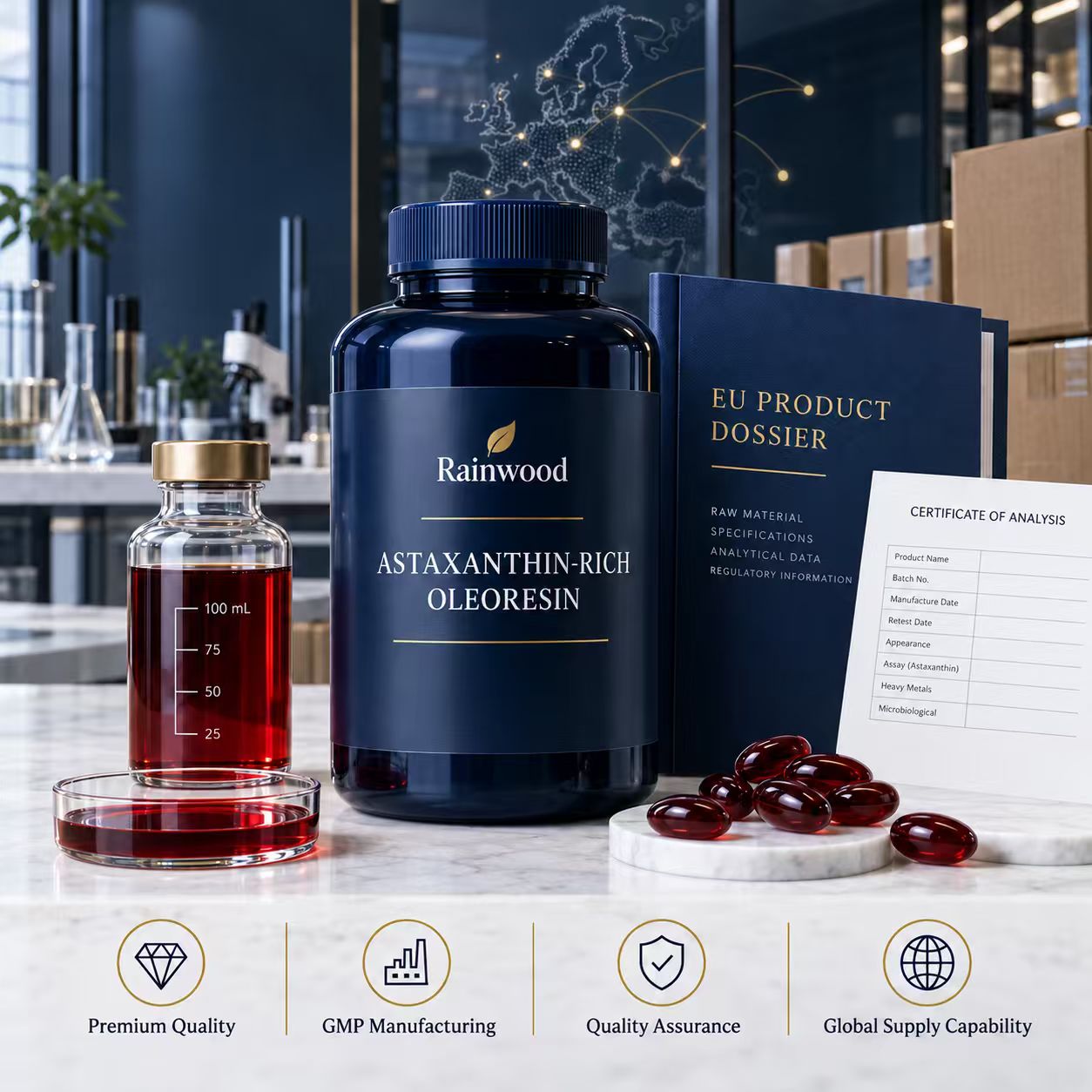
Meta title: Astaxanthin EU Compliance: 8 mg, Label, and Dossier
Meta description: EU astaxanthin buyers must connect oleoresin identity, 8 mg daily limit, age statement, label wording, and import documents to the exact product.
The supplier says its astaxanthin is “EU compliant.” The importer asks for the exact oleoresin identity, daily astaxanthin amount, age statement, label wording, and evidence connected to the commercial lot. The supplier sends a generic COA and a website link.
For the EU, the raw material, finished supplement, label, and dossier must tell the same story. A general export claim is not a substitute for a market-specific review.
Review the astaxanthin oil and oleoresin information before approving the shipment.
The EU rule is about the authorized novel-food form
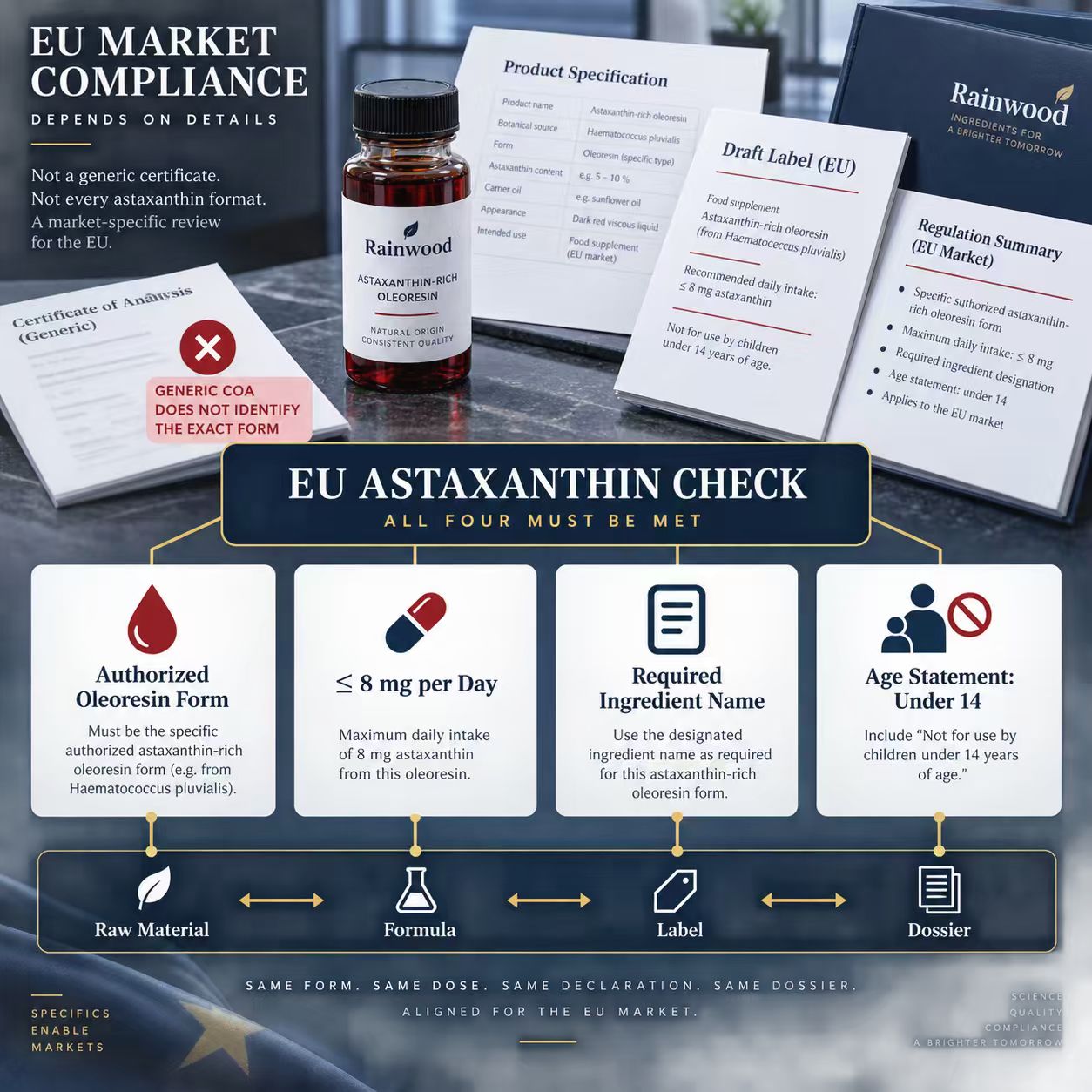
Commission Implementing Regulation (EU) 2021/1377 amended the Union list entry for astaxanthin-rich oleoresin from *Haematococcus pluvialis*. For food supplements for the general population, the stated conditions result in no more than 8 mg astaxanthin per day, and the label must state that products should not be consumed by infants, children, and adolescents younger than 14 years. [EU Regulation 2021/1377](https://eur-lex.europa.eu/legal-content/EN/TXT/?uri=celex%3A32021R1377)
This is not a universal global dose rule, and it does not mean every powder, synthetic preparation, or softgel automatically falls under the same conditions. Confirm the exact source, form, category, and current market position.
The label name must match the material
The EU entry specifies the designation “Astaxanthin-rich oleoresin from *Haematococcus pluvialis* algae” for foods containing that novel food. Your finished label, technical dossier, and supplier documents should identify the same commercial form.
Check:
- source organism;
- oleoresin or powder form;
- concentration and free-equivalent basis;
- carrier oil or wall material;
- daily dose and serving instructions;
- age statement;
- importer and responsible operator;
- language and packaging requirements.
Read the astaxanthin natural-source and label review before translating a supplier’s generic “natural astaxanthin” phrase.
A powder may need a different regulatory analysis
Water-dispersible or microencapsulated astaxanthin powder can contain an oleoresin core plus wall materials. It may not be enough to describe the powder as “10% natural astaxanthin.” Identify the source ingredient, carrier, process, and finished-product use.
Ask the supplier for:
1. source and manufacturing statement;
2. composition and carrier ratio;
3. identity and assay method;
4. lot-specific COA;
5. stability and package data;
6. change-control commitment;
7. documents needed by the EU importer.
Do not assume that an ingredient used in one EU category is automatically cleared for another format or population.
The dossier must connect dose to the exact label
Calculate the daily astaxanthin amount from the actual oil, powder, or softgel formula. Keep the active basis consistent with the COA, master formula, and label. Include overage and end-of-shelf-life assumptions in the review.
Use the astaxanthin dose and softgel calculation guide if the product uses an oil fill.
Import documents are part of the product decision
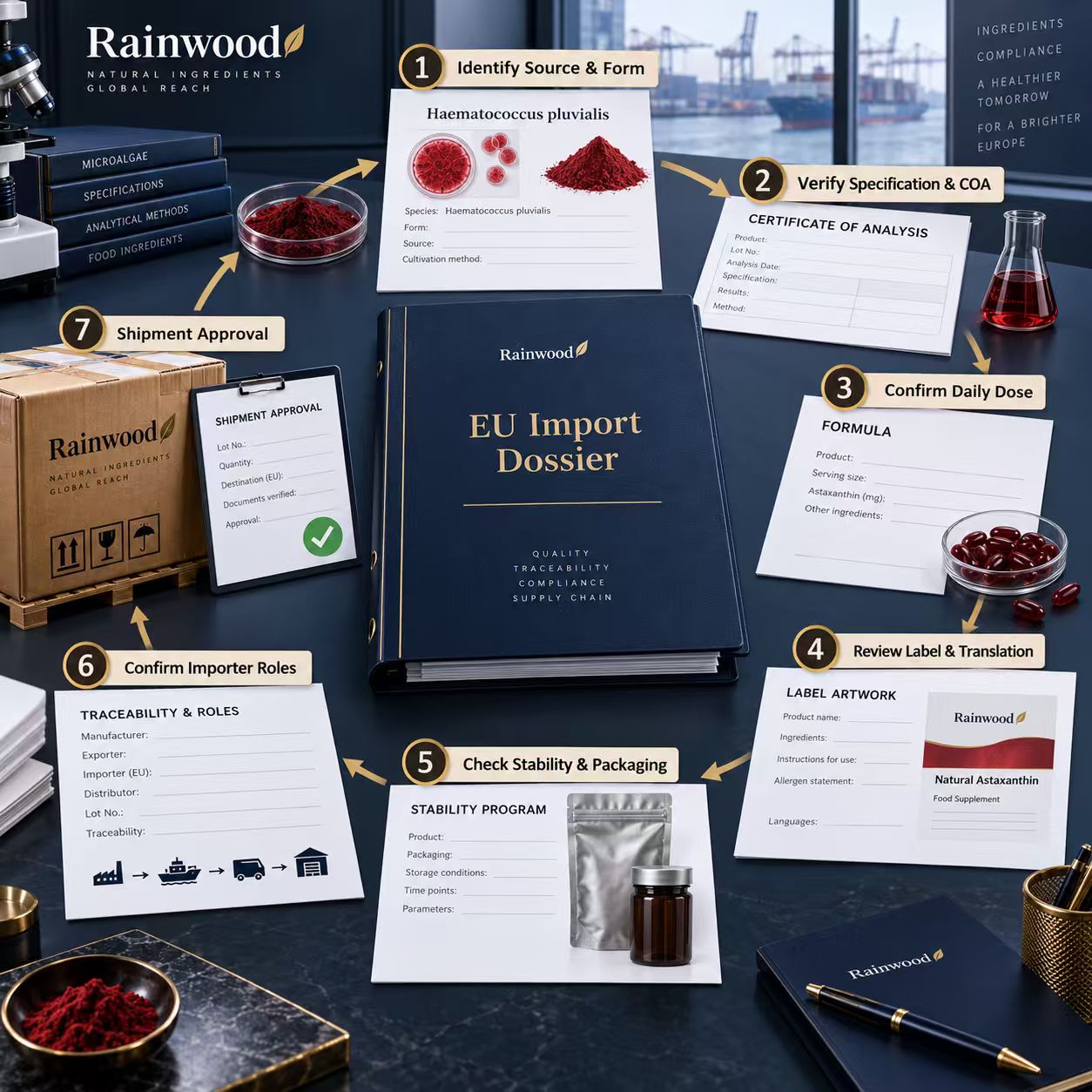
The importer may need:
- supplier and manufacturer details;
- source and form statement;
- current specification and COA;
- certificate scope and validity;
- batch and packaging records;
- finished-product formula;
- label and translation review;
- stability and shelf-life evidence;
- complaint and traceability procedure.
Keep company-published context separate from product and batch evidence. A broad certificate page does not prove that the actual astaxanthin lot or softgel is covered.
Explore the astaxanthin EU dossier and private-label service before the container is booked.
How RainwoodBio can support the EU project
RainwoodBio’s public workflow describes compliance assessment, raw-material management, testing and release, product registration and documentation, packaging, logistics, and traceability. These are company-published capabilities. Ask for a destination-specific document list and a formula-to-label review for the exact astaxanthin form.
Shipment approval gate
Do not ship until:
- the exact astaxanthin form is identified;
- the daily amount is checked against current EU conditions;
- the required label designation and age statement are included;
- source, carrier, and lot documents match;
- package and shelf-life evidence are available;
- importer and responsible-operator roles are clear;
- claims are reviewed separately from safety authorization.
Request an astaxanthin EU import dossier review. Send RainwoodBio your target member state, source and form, formula, serving, draft label, COA, package, and shipping date so the team can identify missing documents before dispatch.
Do not treat the EU rule as a substitute for importer review
The regulation sets conditions for a specified novel-food entry; it does not complete the importer’s technical file. The buyer still needs to confirm that the commercial ingredient matches the authorized form, that the daily amount is calculated correctly, and that the finished label and package use the required designation. National enforcement, language, notification, and retailer requirements may add practical steps.
Keep a version-controlled dossier with the regulation reference, supplier documents, lot evidence, formula, label, and reviewer decision. If the source, carrier, concentration, or finished format changes, reopen the comparison instead of carrying the old approval forward.
Keep the importer’s question list practical
Ask the supplier to identify which documents are available before purchase and which must be generated for the finished product. Confirm whether the COA identifies the authorized form, whether the label designation matches the ingredient, and whether the daily amount is calculated from the same assay basis. Escalate questions about national notification, claims, and language to the responsible importer or regulatory adviser.
Keep legal review separate from supplier marketing
Use the supplier’s technical documents as inputs, not as a substitute for the importer’s current legal review. Record the regulation version, market, reviewer, and approved label wording.
Ask the importer to archive the final label, lot COA, formula calculation, and legal review together. This creates one evidence trail for customs questions, retailer onboarding, and future reorders.
Keep the lot document pack ready for reorders
For every shipment, preserve the current regulation reference, ingredient specification, lot COA, label version, packaging record, and importer review. A new source, carrier, concentration, or format should create a new dossier comparison rather than silently using the previous approval.
Review the file again when the supplier, source, concentration, package, or target population changes.
Frequently asked questions
1.Does the EU 8 mg limit apply to every astaxanthin product?
The cited condition applies to the authorized astaxanthin-rich oleoresin from Haematococcus pluvialis in the specified food-supplement context. Confirm the exact product and current rules.
2.Does an EU certificate prove market access?
No. Review entity, scope, product, lot, label, formula, and current legal conditions.
3.Can an imported powder use the same label wording as an oil?
Not automatically. The source, form, carrier, designation, and finished formula must be reviewed together.
References
- Commission Implementing Regulation (EU) 2021/1377: https://eur-lex.europa.eu/legal-content/EN/TXT/?uri=celex%3A32021R1377
- EFSA safety opinion on astaxanthin: https://efsa.onlinelibrary.wiley.com/doi/10.2903/j.efsa.2020.5993
- EFSA novel food overview: https://www.efsa.europa.eu/en/topics/topic/novel-food
- RainwoodBio OEM service: https://www.rainwoodbio.com/oem
This article is for B2B procurement and educational purposes. Product, analytical, safety, labeling, and regulatory requirements should be confirmed for the exact ingredient, finished product, and destination market.