 EN
EN

Meta title: Astaxanthin Softgel Fill Formula: Check Compatibility Early
Meta description: A qualified astaxanthin oil can still fail in a softgel. Validate carrier, antioxidant system, shell compatibility, leakage, fill weight, and release.
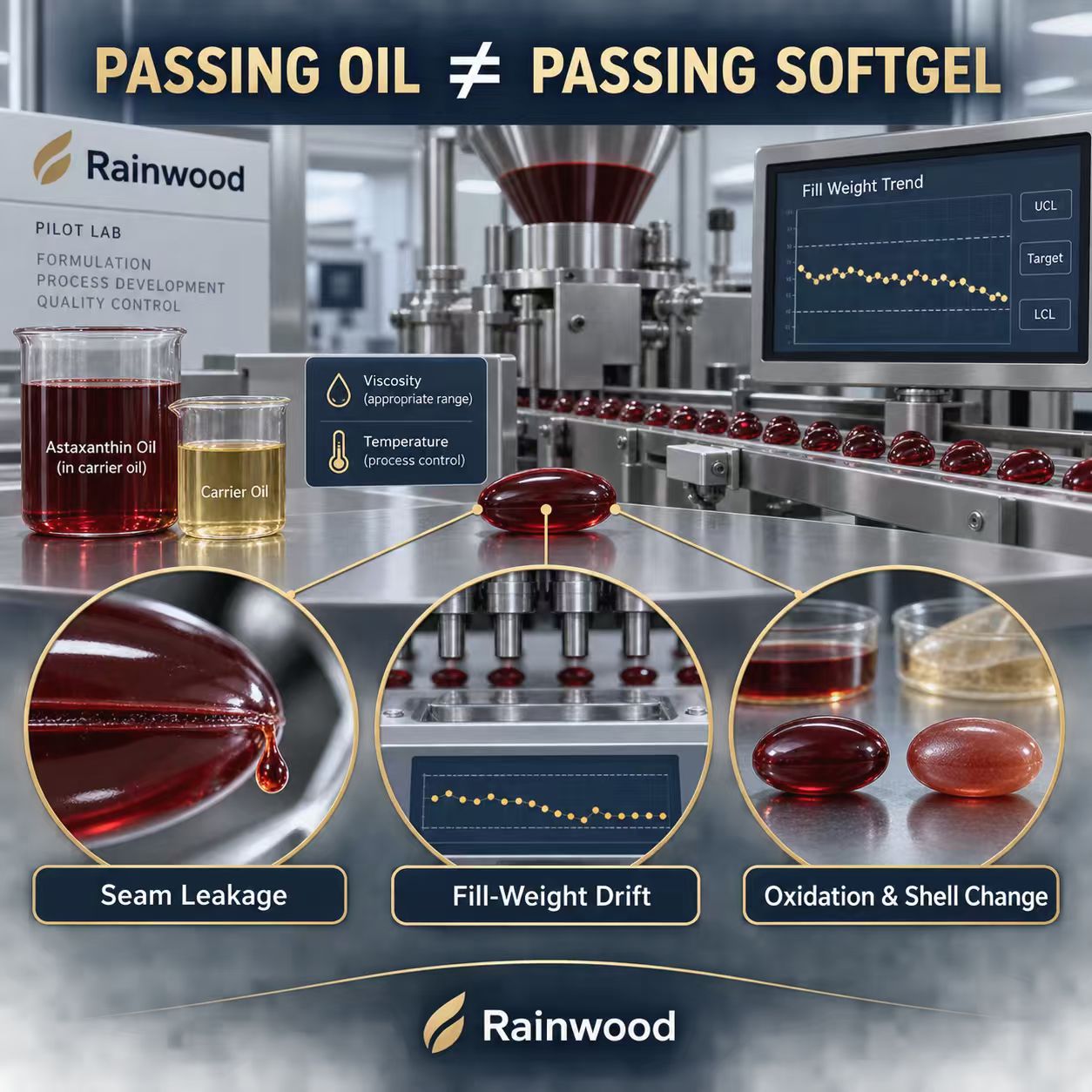
The astaxanthin oil passes incoming testing. The finished softgel develops a seam leak, a strong odor, or a fill-weight drift during the run. The raw-material supplier says the oil is within specification. The OEM says the shell is within specification.
The problem may be the interface between them. A softgel is a system: fill composition, temperature, viscosity, oxygen, shell water, sealing, drying, package, and shelf life must work together.
Review the astaxanthin oil and softgel raw-material information before treating a passing oil COA as finished-product proof.
Fill composition determines shell behavior
Astaxanthin oil may contain a carrier, antioxidant, emulsifier, or other lipid component. The fill can interact with gelatin or a vegetarian shell, plasticizer, seam, or drying process. A change in oil polarity, moisture, viscosity, or surfactant level can alter leakage and shell appearance.
Request a fill-compatibility review covering:
- carrier oil identity and percentage;
- antioxidant and emulsifier system;
- water and volatile content;
- density and viscosity at encapsulation temperature;
- shell type and plasticizer;
- drying profile;
- seam integrity and leakage criteria.
Do not reuse a softgel shell setting from another carotenoid oil without a pilot.
Read the astaxanthin oil dose and concentration guide before changing the fill percentage.
A high-concentration oil can create a low-volume fill problem
A 10% oil and a 2% oil may deliver the same astaxanthin dose at very different fill weights. The smaller fill may improve capsule size but increase dosing sensitivity, headspace, mixing, and line loss.
Calculate:
`target astaxanthin dose ÷ active fraction = oil fill mass`
Then validate actual fill-weight variation, not only the theoretical result. Include density, temperature, pump behavior, and overage in the master formula.
Antioxidants are part of the commercial identity
An antioxidant can help protect the oil but may affect label declarations, sensory profile, shell compatibility, and regulatory review. Ask which antioxidant is used, at what concentration, and whether the stability data were generated with the same system.
Review:
- peroxide and other oxidation indicators;
- oxygen exposure during blending and filling;
- headspace and nitrogen strategy;
- light protection;
- carrier and antioxidant change control;
- end-of-shelf-life acceptance limits.
Use the astaxanthin softgel stability checklist to connect fill chemistry with package and expiry.
Release testing must cover the finished softgel
The oil COA does not answer:
- whether the dose is uniform across softgels;
- whether the shell leaks;
- whether potency survives encapsulation and drying;
- whether the product releases as expected;
- whether the fill oxidizes during storage;
- whether the capsule remains visually acceptable.
Set a finished-product panel with suitable potency, fill-weight, shell-integrity, disintegration or release, oxidation, microbial, and stability endpoints as required by the product and market.
Tooling and process variables can change the outcome
Record the die size, fill temperature, pump speed, gelatin or shell temperature, seam pressure, drying time, residual moisture, and package. A small change in any of these variables can create a different product even with the same oil.
Keep the approved sample and commercial batch under the same specification code. If the oil, shell, flavor, antioxidant, or equipment changes, repeat the relevant compatibility check.
Explore the astaxanthin softgel OEM feasibility service before approving a large tooling order.
How RainwoodBio can support the fill development
RainwoodBio’s current website lists custom softgels and describes requirement confirmation, sample development, production control, testing and release, packaging, and traceability. These are company-published capabilities. Ask for a softgel pilot record that identifies the oil lot, fill formula, shell, process settings, test results, and unresolved risks.
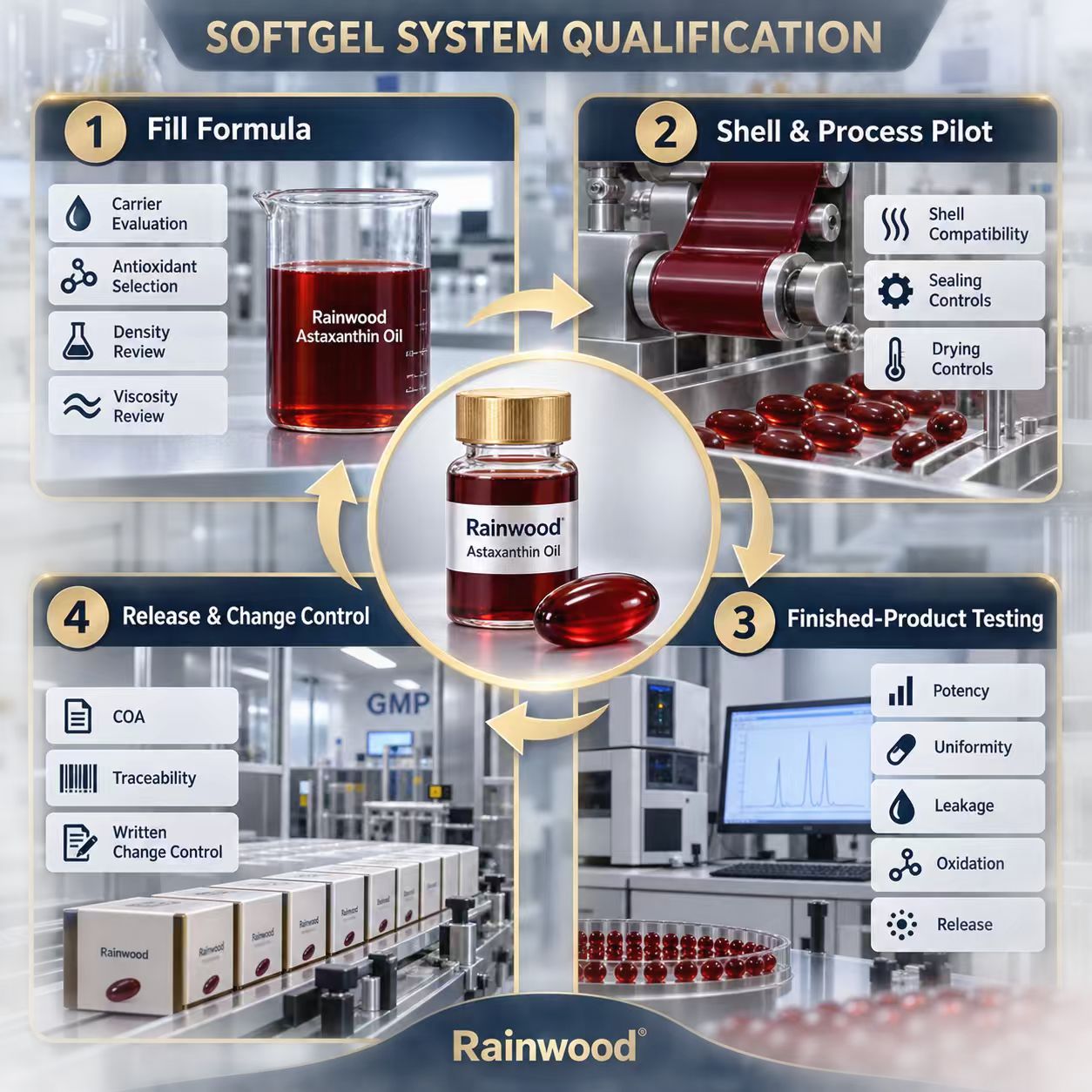
Approval gate before mass encapsulation
Require:
- oil identity, active basis, and carrier disclosure;
- fill-weight and density calculation;
- shell compatibility and leakage results;
- oxidation and package controls;
- finished potency and uniformity testing;
- stability data for the exact softgel;
- written change control for fill or shell components.
Request an astaxanthin softgel fill-feasibility review. Send RainwoodBio your oil COA, target mg per softgel, shell preference, format, package, market, and current pilot failure so the team can design the right development gate.
The pilot record should be reproducible
Record the oil lot, carrier and antioxidant percentages, shell material, fill temperature, pump settings, seam conditions, drying time, and package. Keep samples from the first, middle, and last part of the run. If leakage or color migration appears later, these records let the team compare process variation with material variation.
Ask the OEM to define the acceptance criteria for a pilot before production begins. “No visible leakage” should be linked to an inspection method, sample size, and storage condition. “Uniform dose” should be linked to a finished-product assay and sampling plan. Clear criteria make the sample approval useful rather than merely cosmetic.
Make the pilot reproducible
The pilot should include a short hold-time study for the prepared fill. Check whether the oil changes viscosity, settles, entrains air, or develops a different color while waiting for encapsulation. A fill that passes immediately after mixing may behave differently after a shift change or an overnight hold.
Also compare the first and last softgels from the run. If the active, fill weight, color, or shell appearance drifts, investigate mixing and recirculation before blaming the raw material. These records are valuable when the brand later changes capsule size, antioxidant, package, or production site.
Ask for a shell-and-fill risk table
Request a short table showing each critical fill component, its purpose, acceptance limit, possible shell interaction, and verification method. Include the oil concentration, carrier, antioxidant, water, viscosity, fill temperature, shell moisture, seam, and drying conditions. The table makes it easier to assess a supplier change or a new softgel size without relying on memory.
Do not approve the shell before the fill is frozen
A shell selected for one oil can behave differently with another carrier or antioxidant system. Freeze the fill composition and run a compatibility pilot before locking the shell and tooling.
Keep the raw material and finished unit specifications separate
The oil specification controls the incoming material. The softgel specification controls dose, shell, leakage, appearance, release, and stability. Combining the two into one broad “astaxanthin softgel” COA makes it harder to identify where a failure occurred.
Frequently asked questions
1.Can any astaxanthin oil be put into a softgel?
No. Carrier, viscosity, antioxidant system, fill weight, shell, sealing, drying, and stability must be evaluated together.
2.Does a passing oil COA prove the softgel will not leak?
No. Leakage is a finished-product and process outcome involving fill and shell compatibility.
3.Is a smaller softgel always better?
Not necessarily. A smaller fill can increase dose and process sensitivity. Compare consumer convenience with manufacturing control.
References
- USP Astaxanthin Esters: https://doi.org/10.31003/USPNF_M7359_03_01
- Astaxanthin delivery and stability review: https://pmc.ncbi.nlm.nih.gov/articles/PMC13210799/
- RainwoodBio homepage: https://www.rainwoodbio.com/
- RainwoodBio OEM service: https://www.rainwoodbio.com/oem
This article is for B2B procurement and educational purposes. Product, analytical, safety, labeling, and regulatory requirements should be confirmed for the exact ingredient, finished product, and destination market.