 EN
EN

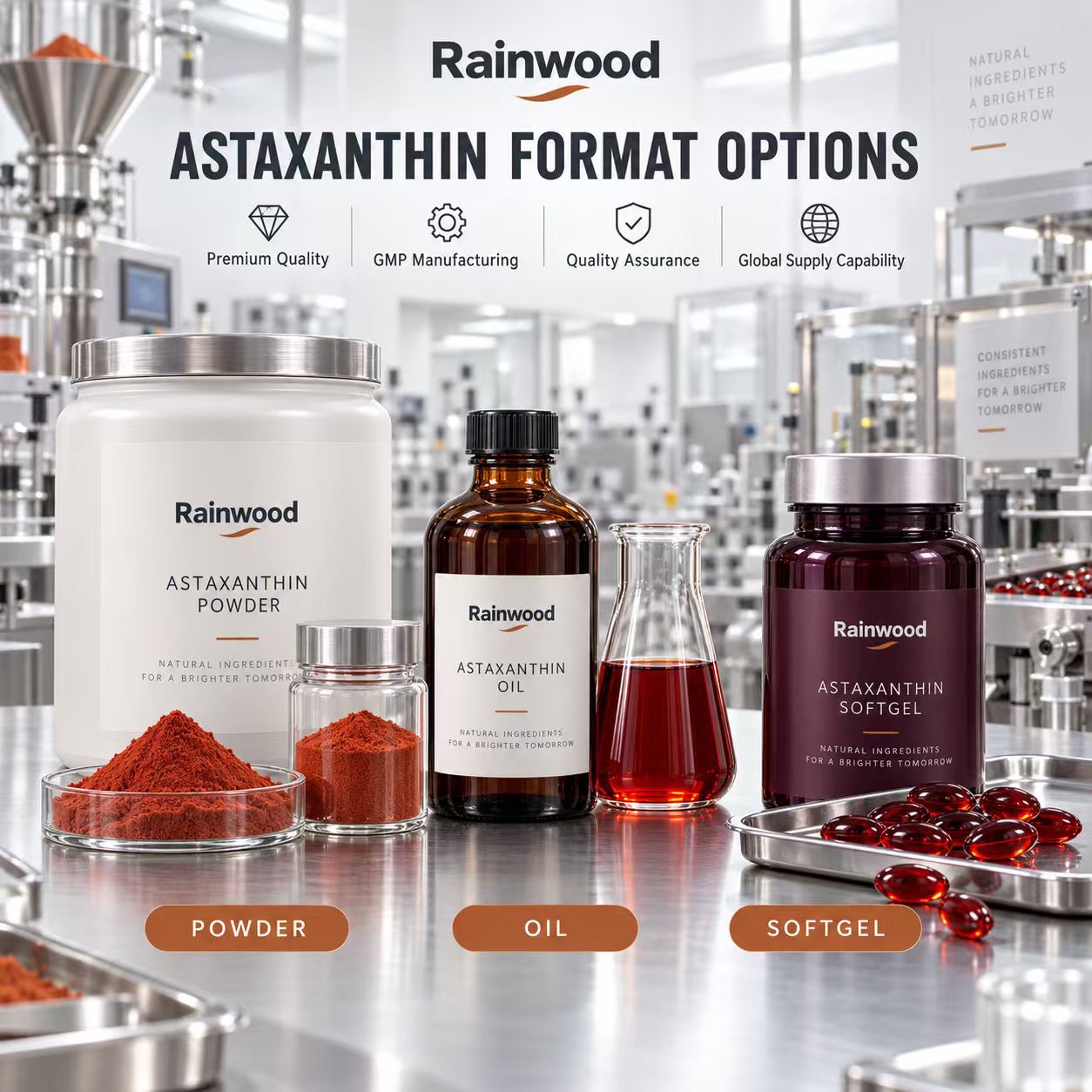
Meta title: Astaxanthin Powder, Oil, or Softgel: Choose by Use Case
Meta description: Astaxanthin format choice changes dose, stability, taste, packaging, testing, and cost. Compare powder, oil, and softgel against the buyer’s use case.
The product team starts with a trend: powder for a clean label, oil for premium positioning, or softgels because competitors use them. The better starting point is the buyer’s actual use case, target dose, process, package, and market.
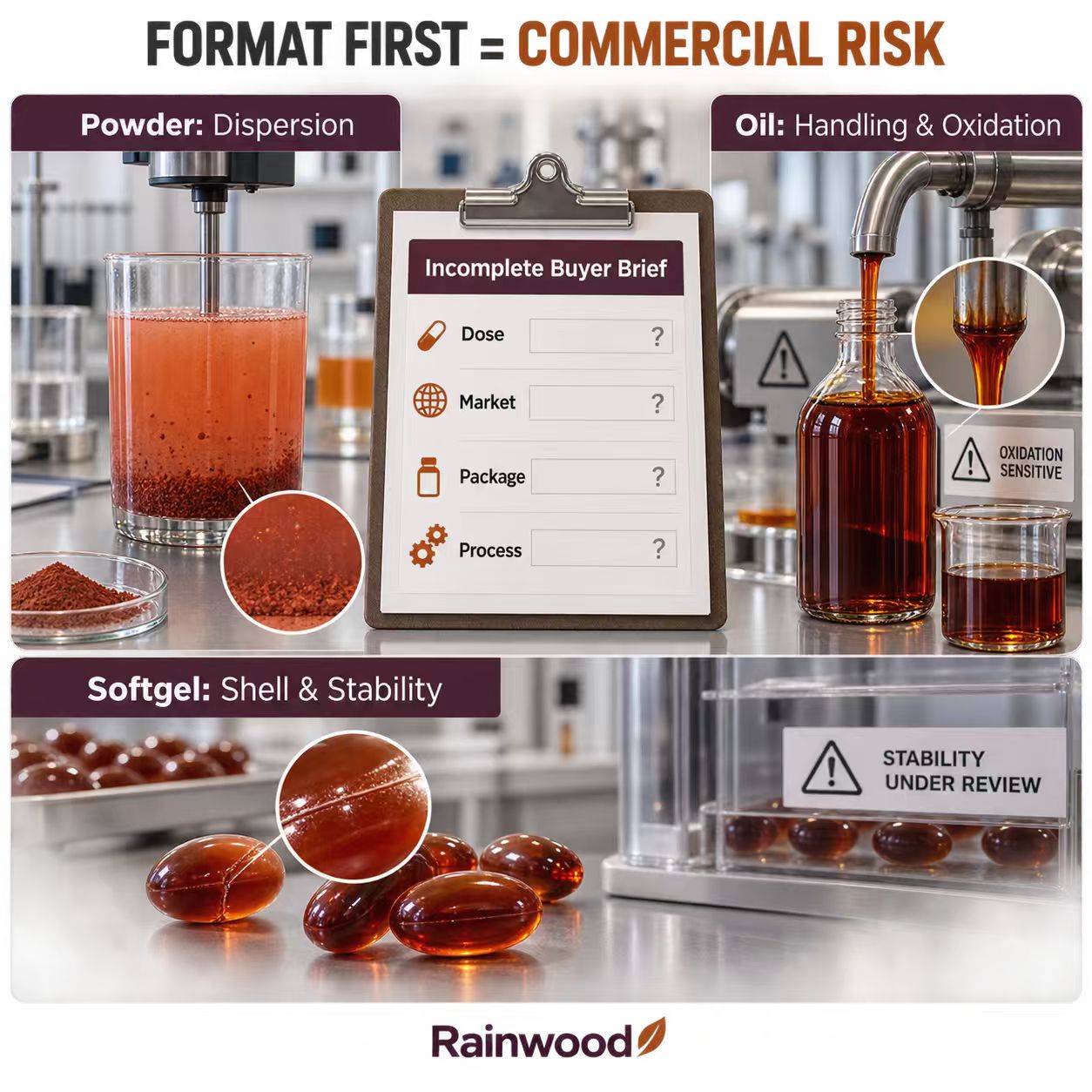
Powder, oil, and softgel are not three names for the same product. They are three different control systems built around a light- and oxidation-sensitive carotenoid.
Review the astaxanthin product format options before selecting the format from a catalog image.
Powder fits dry formats when dispersion and carrier are controlled
Powder can suit sachets, drink mixes, tablets, gummies, and dry capsules. The buyer must define whether it is oil-dispersible, water-dispersible, or microencapsulated, and how the carrier affects the label and dose.
Key questions:
- Will the powder flow and sample consistently?
- Does the finished formula disperse or dissolve acceptably?
- What happens under heat and humidity?
- Is the carrier declared and stable?
- Can the method recover astaxanthin from the finished matrix?
Read the water-dispersible astaxanthin powder review when the end product is a beverage or sachet.
Oil fits lipid systems but creates liquid-handling risk
Astaxanthin oil or oleoresin can fit softgels and oil-based formulas. The buyer must control concentration basis, carrier oil, viscosity, oxidation, light, headspace, pumpability, and fill weight.
The oil may be chemically suitable but operationally wrong for a clear beverage or a small softgel. A lower concentration may improve handling while increasing fill volume and cost per unit.
Use the astaxanthin oil and oleoresin comparison before accepting the word “oil” as a complete specification.
Softgels are a finished format, not just a package
A softgel adds shell, filling, sealing, drying, package, and release requirements. It can make an oil easier for consumers to use, but it also creates a finished-product stability file that the raw oil cannot replace.
Ask:
- What is the dose and fill mass?
- Is the carrier compatible with the shell?
- How are potency and uniformity tested?
- What happens at expiry?
- Is the package suited to the route?
Explore the astaxanthin softgel OEM feasibility review before assuming that the softgel is the easiest answer.
Compare the formats with one buyer scorecard
| Decision point | Powder | Oil | Softgel |
|---|---|---|---|
| Best starting matrix | Dry mix or powder | Lipid or liquid fill | Consumer-ready unit |
| Main process risk | Dispersion, flow, moisture | Viscosity, oxidation, fill | Shell, seam, stability |
| Label complexity | Carrier and encapsulant | Carrier oil and antioxidants | All fill and shell components |
| Dose control | Blend and fill uniformity | Active basis and fill mass | Finished potency per unit |
| Package priority | Moisture and light barrier | Oxygen and light barrier | Shell plus package barrier |
| Evidence gap | Raw powder versus matrix | Oil versus finished fill | Release versus expiry |
Use the table to select the evidence, not to declare one format universally superior.
The buyer determines the correct trade-off
For a beverage brand, dispersion and color may be more important than small capsule size. For a softgel brand, fill weight and shell compatibility may dominate. For an importer, source, assay basis, package, and traceability may be the first gate.
Set the product brief with:
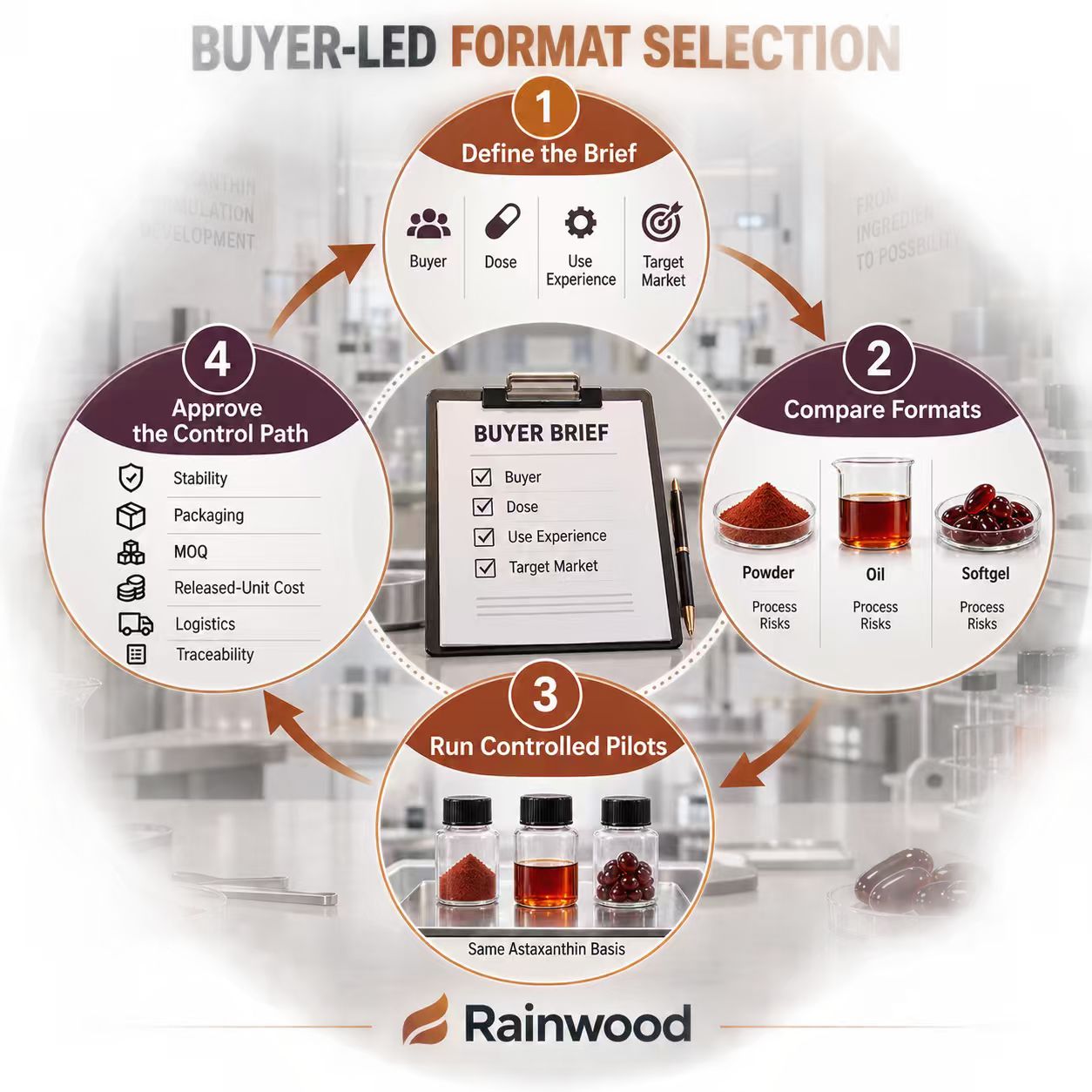
1. target buyer and use occasion;
2. daily astaxanthin amount;
3. format and serving experience;
4. target market;
5. package and storage route;
6. testing and claim needs;
7. MOQ and landed-cost target.
How RainwoodBio can support a format comparison
RainwoodBio’s current website lists powders, sachets, capsules, gummies, tablets, softgels, and raw ingredients, and describes requirement confirmation, sample development, testing and release, packaging, logistics, and traceability. These are company-published capabilities. Ask for two or three format pilots using a controlled astaxanthin specification rather than a generic catalog proposal.
Approval gate before selecting the format
Require:
- a defined source, form, and assay basis;
- a dose calculation for the selected format;
- format-specific process and stability tests;
- package and transport assumptions;
- label and market review;
- first-lot and change-control plan;
- a cost comparison based on released units, not raw kilograms.
Request an astaxanthin powder, oil, and softgel format comparison. Send RainwoodBio your target buyer, dose, formula, market, package, annual quantity, and preferred use experience so the team can recommend the format with the clearest control path.
Make the first sample answer a commercial question
Do not ask for three attractive samples without defining the decision. For powder, ask whether the target consumer can prepare it and whether the package protects the active. For oil, ask whether the process can pump and dose it while controlling oxidation. For softgel, ask whether the fill, shell, package, and expiry can be released consistently.
Use the same target dose, buyer, market, and cost assumptions in the comparison. Record what changes between forms: carrier, serving size, unit count, package, test method, MOQ, lead time, and claims. The winning format should be the one with the clearest evidence and the lowest uncontrolled commercial risk, not simply the one with the most attractive sample.
Use a staged format decision
First eliminate formats that cannot meet the dose, market, or use experience. Then run a focused pilot for the remaining options. Finally compare released cost, stability evidence, package, MOQ, and reorder risk. This staged method prevents the team from spending the same development budget on three formats that were never commercially feasible.
The format brief should also state the expected reorder volume and delivery route, because the best laboratory format may not be the most reliable commercial format after transport and storage.
Ask what the buyer will notice first
The format decision should include the customer’s preparation time, swallowability, taste, color expectations, capsule count, package opening, and reorder behavior. These practical details often reveal a better format than a technical comparison based only on potency and price.
Frequently asked questions
1.Is softgel always the best format for astaxanthin?
No. It may fit an oil-based consumer product, but powder or another delivery system may be better for beverages, sachets, or dry formulations.
2.Can one astaxanthin grade serve all formats?
Sometimes, but the carrier, concentration, particle properties, process, and stability requirements may differ. Validate the exact use.
3.Should format be chosen before the raw material?
Choose them together. The raw material must be specified for the final matrix, dose, process, and market.
References
- USP Astaxanthin Esters: https://doi.org/10.31003/USPNF_M7359_03_01
- Astaxanthin delivery and stability review: https://pmc.ncbi.nlm.nih.gov/articles/PMC13210799/
- RainwoodBio homepage: https://www.rainwoodbio.com/
- RainwoodBio OEM service: https://www.rainwoodbio.com/oem
This article is for B2B procurement and educational purposes. Product, analytical, safety, labeling, and regulatory requirements should be confirmed for the exact ingredient, finished product, and destination market.