 EN
EN

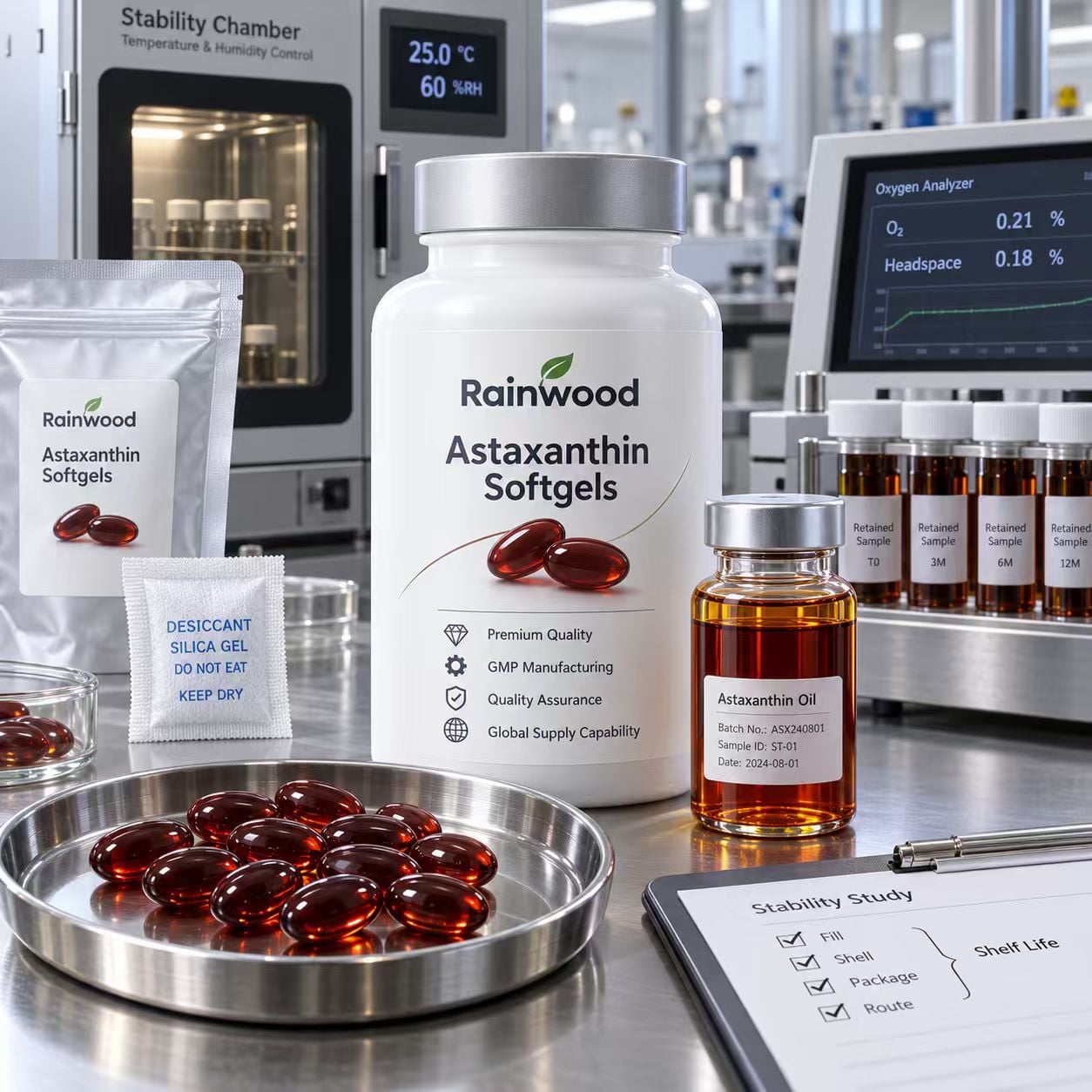
Meta title: Astaxanthin Softgel Stability: Shell, Fill, and Package
Meta description: An oxygen barrier alone cannot prove astaxanthin softgel shelf life. Control fill oxidation, shell moisture, seams, light, package, and release.
The softgel bottle uses an opaque package and the supplier says the shell protects the oil. At month nine, the capsules are sticky, the seam is weak, and the astaxanthin result is below the target.
An oxygen barrier can help. It cannot replace a finished-product stability program that examines the fill, shell, manufacturing process, package, and storage route together.
Review the astaxanthin softgel stability information before accepting a generic “shelf stable” statement.
The fill and shell create a shared environment
Astaxanthin oil can interact with shell moisture, plasticizer, pigments, or the seam. A change in fill oil, antioxidant, or water content can alter drying time, shell flexibility, leakage, and oxidation.
Define:
- fill composition and water content;
- carrier and antioxidant system;
- shell type and plasticizer;
- residual shell moisture;
- drying and conditioning profile;
- seam integrity;
- package barrier and desiccant;
- storage temperature and humidity.
Do not judge the shell and fill as independent materials.
Read the astaxanthin softgel fill-compatibility guide before changing the carrier or shell.
Oxidation testing needs a baseline and an endpoint
Record initial astaxanthin potency, free and ester form where relevant, oxidation indicators, color, odor, and shell condition. Then repeat those endpoints through the intended shelf life and under justified stress conditions.
The method should specify:
- sample preparation and homogenization;
- reference standards;
- extraction recovery;
- reporting basis;
- acceptance criteria;
- relationship to the label claim.
The same method should be used for trend comparison unless a validated change is documented.
Light, oxygen, heat, and moisture interact
A dark bottle may reduce light exposure but cannot prevent oxygen in the headspace or moisture movement through the shell. A hot warehouse can accelerate the fill and shell changes even when the product leaves the factory in good condition.
Map the route:
1. filling and drying;
2. bulk storage;
3. carton and pallet transport;
4. distributor warehouse;
5. retail or FBA environment;
6. consumer opening and use.
Use the astaxanthin package and transport stability checklist to select realistic storage conditions.
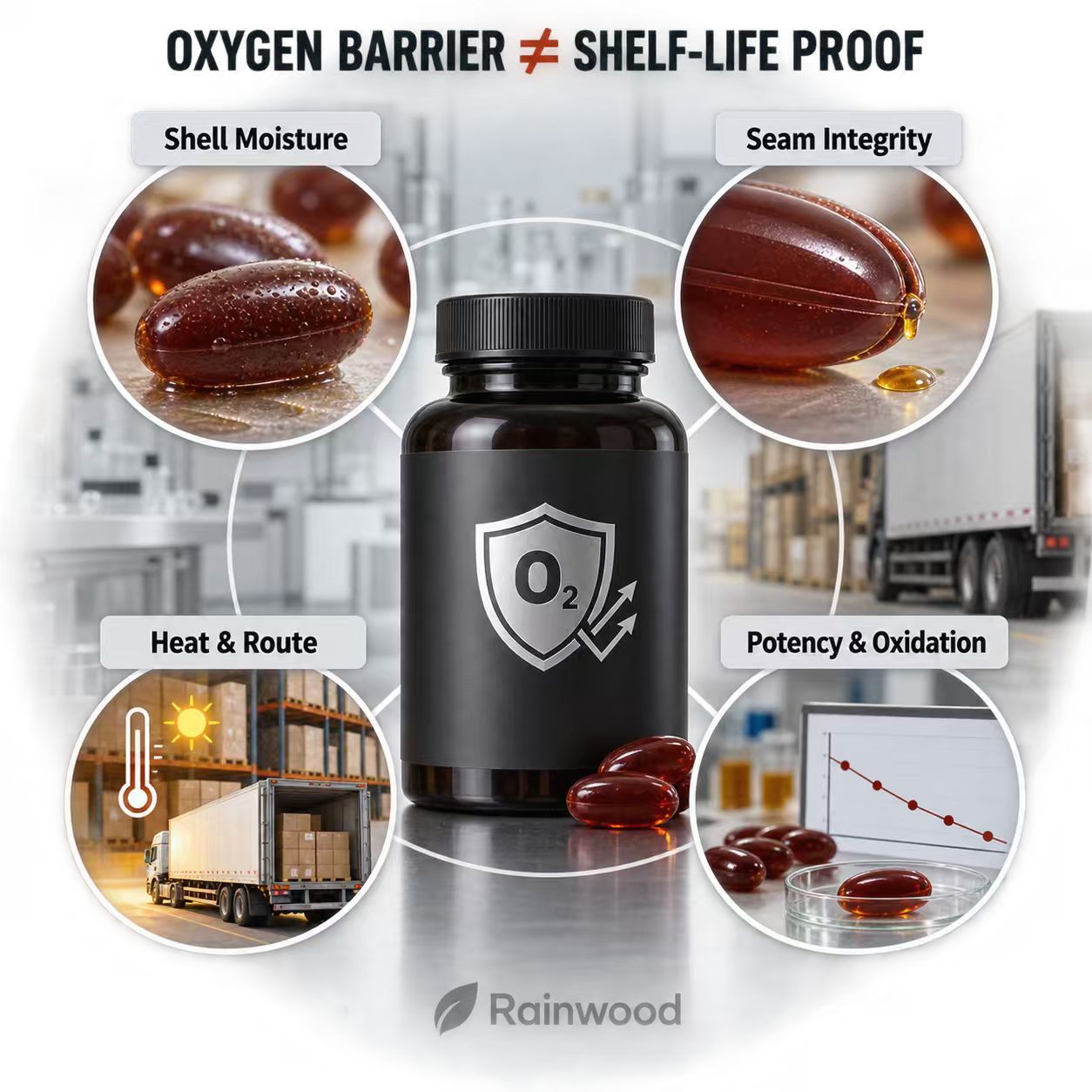
Release appearance is not expiry evidence
Softgels can look acceptable while potency or oxidation changes, or they can show a surface change without a meaningful chemical failure. Inspect:
- color and transparency;
- stickiness and shell bloom;
- seam and leakage;
- odor;
- fill migration;
- disintegration or release;
- potency and oxidation.
Retain samples in the commercial package and record the lot, pull date, storage, and test result. A photo without conditions is difficult to use in a complaint investigation.
The package must be qualified with the softgel
Compare bottle, pouch, blister, closure, liner, desiccant, oxygen absorber, and headspace. The best package depends on the fill, shell, label, transport, and storage route.
Do not transfer an expiry from another astaxanthin softgel simply because the dose or color looks similar. The oil concentration, shell, package, and manufacturing history may be different.
Explore the astaxanthin softgel packaging and OEM service before printing the expiry date.
How RainwoodBio can support stability qualification
RainwoodBio’s public workflow describes sample development, production control, testing and release, packaging, warehousing, logistics, and traceability. These are company-published capabilities. Request a stability protocol that names the exact oil lot, shell, package, storage conditions, time points, endpoints, and acceptance limits.
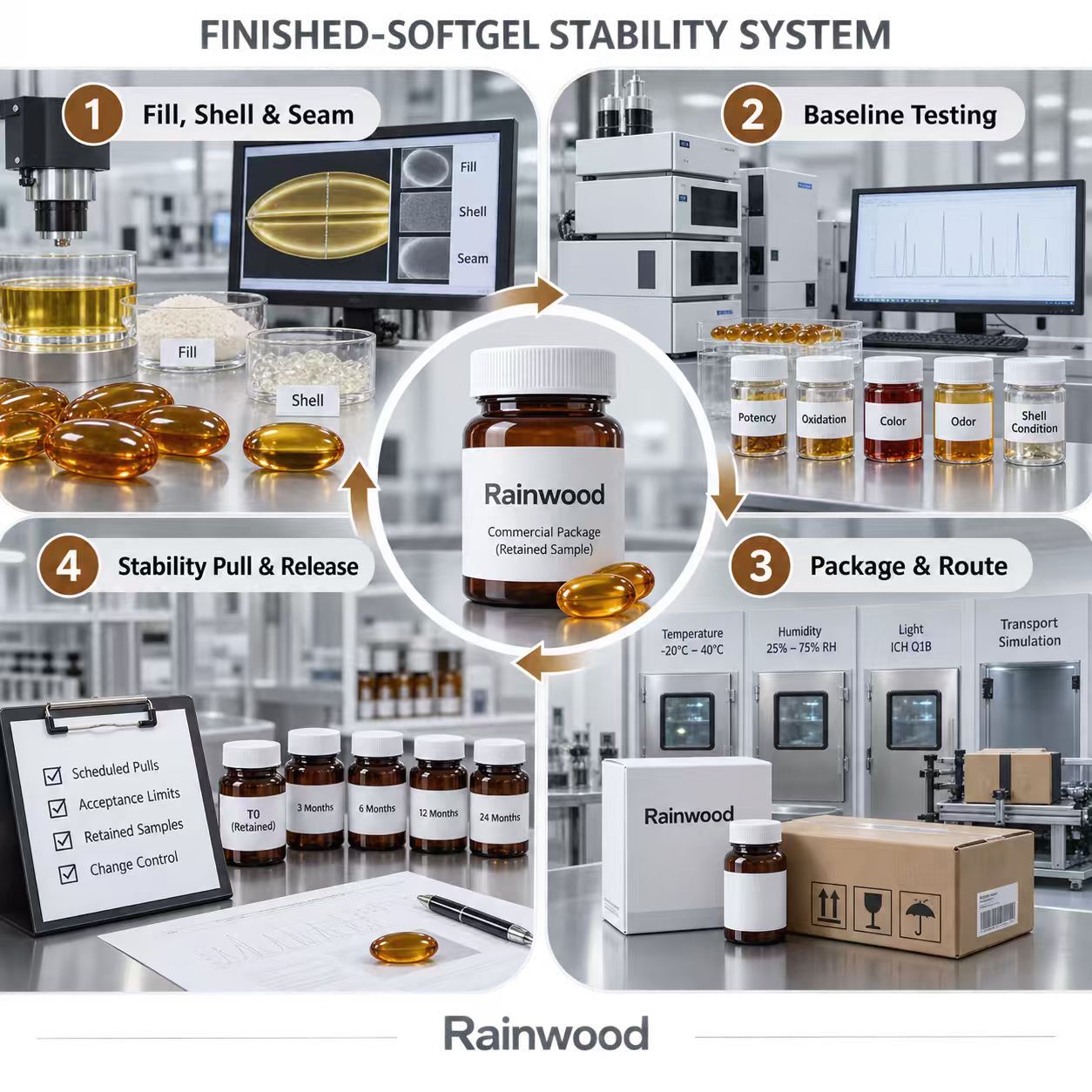
Approval gate before approving the expiry
Require:
- fill-shell compatibility evidence;
- baseline and end-of-life potency;
- oxidation, color, odor, and shell checks;
- package and route assessment;
- representative retained samples;
- market-specific storage and expiry language;
- change control for oil, shell, package, or process.
Request an astaxanthin softgel stability and packaging review. Send RainwoodBio your oil COA, shell specification, package, target shelf life, storage route, and any stability result so the team can identify the real expiry risk.
Make every stability pull answer a release question
At each time point, decide in advance what result would trigger a hold, investigation, or package review. For example, a potency trend can require a method check or retest, while leakage can require a shell or drying investigation. A color shift should be compared with potency and oxidation rather than treated as an automatic failure.
Retain enough units for repeat testing and complaint comparison. Label the retained package with lot, condition, pull date, and analyst. This discipline turns a stability study into a business tool that supports expiry, complaint response, and supplier-change decisions.
Include a failure-response plan in the study. State who places inventory on hold, which results require confirmation, how many units are retained for repeat testing, and when the package or formula must be investigated. If the trend is moving toward a limit, do not wait for the final pull to start a corrective action. Review the storage route, package, and supplier changes while there is still time to protect the next production campaign.
Also confirm that the stability method can recover the active from the softgel fill and shell. A low result caused by incomplete extraction is an analytical problem, while a real potency loss is a product problem. The two require different actions and should not be mixed in the conclusion.
Add a complaint-ready retention plan
Keep enough units from each stability pull for repeat potency, oxidation, shell, and release testing. Store the retained units in the commercial package and record the storage condition, opening history, and analyst. When a customer complaint arrives, compare the returned product with the retained lot before guessing whether the issue began in the fill, shell, package, warehouse, or transport route.
Review the package after every route change
New freight lanes, warehouse climates, pallet configurations, or retail channels can change the exposure even when the softgel formula is unchanged. Reassess the package and storage instructions when the commercial route changes.
Confirm the method before interpreting a trend
Use the same sample preparation, extraction, reference standard, and reporting basis at each stability pull. Otherwise, a method change can look like a product change and lead to the wrong package or formula decision.
Keep the stability conclusion tied to the exact shell, fill, package, and lot.
Frequently asked questions
1.Does an opaque bottle guarantee softgel stability?
No. It addresses light exposure only in part. Fill oxidation, shell moisture, seam, headspace, temperature, and package performance also matter.
2.Can an oil stability study support a softgel expiry?
Not by itself. The finished softgel and package need their own evidence.
3.Is stickiness always a chemical failure?
Not necessarily. Investigate shell moisture, drying, packaging, temperature, fill migration, and potency before deciding.
References
- Astaxanthin delivery and stability review: https://pmc.ncbi.nlm.nih.gov/articles/PMC13210799/
- USP Astaxanthin Esters: https://doi.org/10.31003/USPNF_M7359_03_01
- RainwoodBio homepage: https://www.rainwoodbio.com/
- RainwoodBio OEM service: https://www.rainwoodbio.com/oem
This article is for B2B procurement and educational purposes. Product, analytical, safety, labeling, and regulatory requirements should be confirmed for the exact ingredient, finished product, and destination market.