 EN
EN

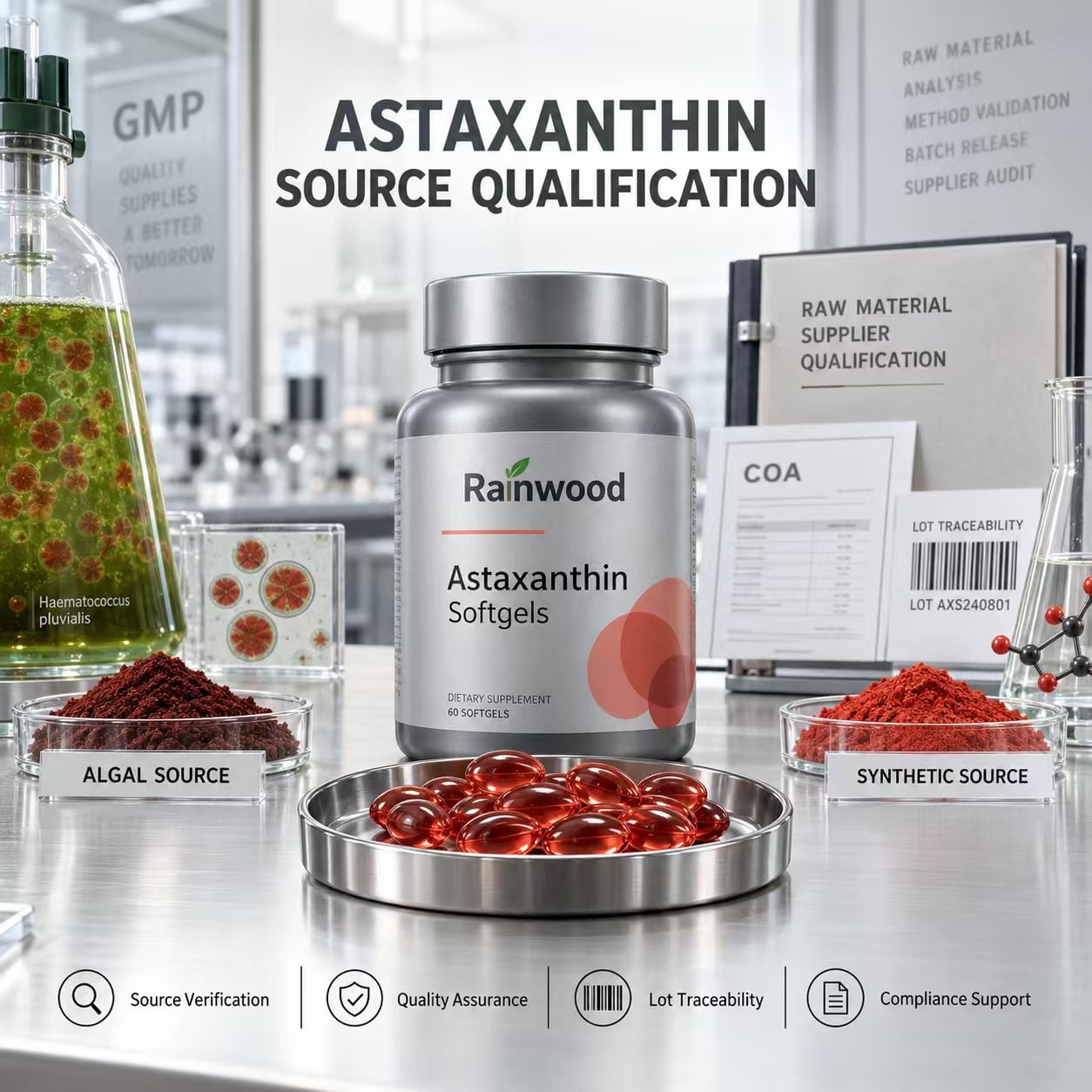
Meta title: Natural Astaxanthin Softgels: Verify Source Before Labeling
Meta description: Algal and synthetic astaxanthin are different sourcing and claim decisions. Verify source, isomer profile, ester form, certificates, and market wording.
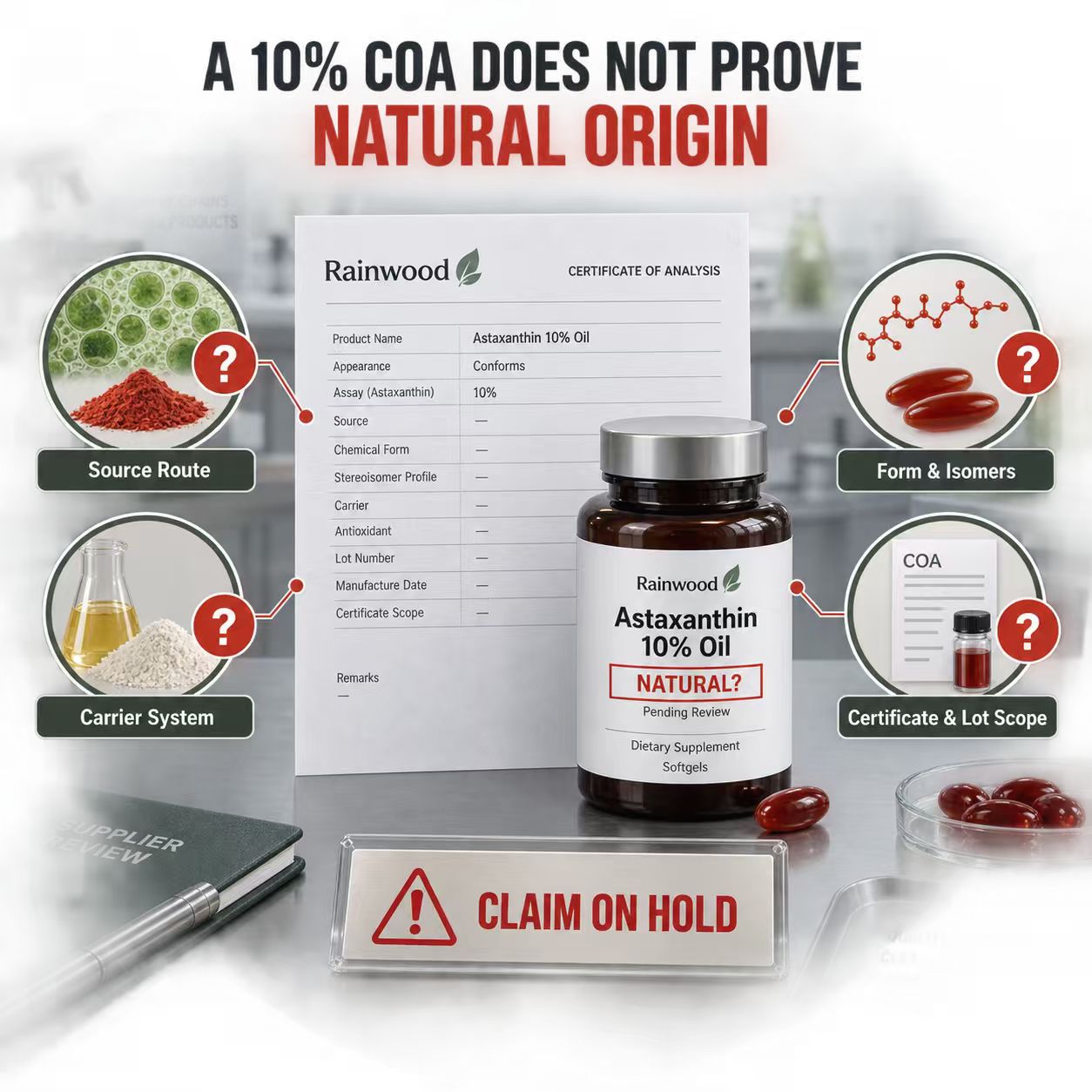
The softgel formula is ready, but the marketing team wants “natural astaxanthin” on the front panel. The supplier’s quote says “astaxanthin 10% oil” and the COA does not identify the source, isomer profile, or carrier.
That is not enough evidence for a natural-origin claim. Source, chemical form, concentration, certification, and finished-product wording must be connected before the softgel is printed.
Review the astaxanthin softgel raw-material options before approving the source language.
Algal and synthetic materials are different commercial identities
Astaxanthin can be produced from different sources and processes. Algal astaxanthin-rich oleoresin from *Haematococcus pluvialis* has a defined commercial and regulatory history, while synthetic astaxanthin may have a different stereoisomer and use profile. Neither source should be described by a vague color-based statement.
USP’s astaxanthin esters monograph describes the *Haematococcus pluvialis* material as mainly 3S,3′S stereoisomers in monoester, diester, and free forms. [USP Astaxanthin Esters](https://doi.org/10.31003/USPNF_M7359_03_01)
Ask the supplier to state:
- source organism or synthesis route;
- manufacturer and site;
- free and esterified form;
- stereoisomer information where relevant;
- carrier oil and antioxidant;
- assay and calculation basis;
- lot traceability and change control.
“Natural” is not the same as “organic” or “certified”
An algae-derived ingredient may be natural without being organic-certified. A certificate can cover a site or category without covering the exact product, lot, or finished softgel. Review:
1. certificate issuer and validity;
2. entity and facility;
3. product or category scope;
4. processing and chain of custody;
5. lot connection;
6. destination-market label rules.
Use the astaxanthin natural-claim documentation checklist before copying a supplier adjective into consumer packaging.
Source can affect the softgel fill and stability
Changing from an algal oleoresin to a synthetic preparation can alter concentration, ester profile, color, odor, carrier, viscosity, antioxidant system, and fill volume. The softgel may need a new process pilot and stability study even if the label still says the same milligrams.
Do not qualify a source only through a raw assay. Compare:
- fill weight and uniformity;
- color and odor;
- viscosity and density;
- potency method and basis;
- oxidation indicators;
- shell compatibility;
- finished-product stability.
Claims need an evidence chain, not a supplier brochure
“Algae-derived” is an origin claim. “Natural astaxanthin clinically proven for skin, eye, or sports performance” adds evidence and regulatory questions. Do not borrow a branded ingredient’s study or trademark unless the purchased material is the authorized ingredient and the claim is permitted in the target market.
Review the astaxanthin softgel label and evidence file before approving the product page, marketplace bullets, or influencer brief.
How RainwoodBio can support source qualification
RainwoodBio’s public workflow describes raw-material supplier management, requirement confirmation, testing and release, documentation, packaging, and traceability. These are company-published capabilities. Ask for a source map that connects the exact astaxanthin oil, manufacturer, lot, assay basis, softgel fill, and label language.
Explore the astaxanthin softgel OEM and compliance review when “natural,” algae-derived, organic, or origin-sensitive positioning is part of the brief.
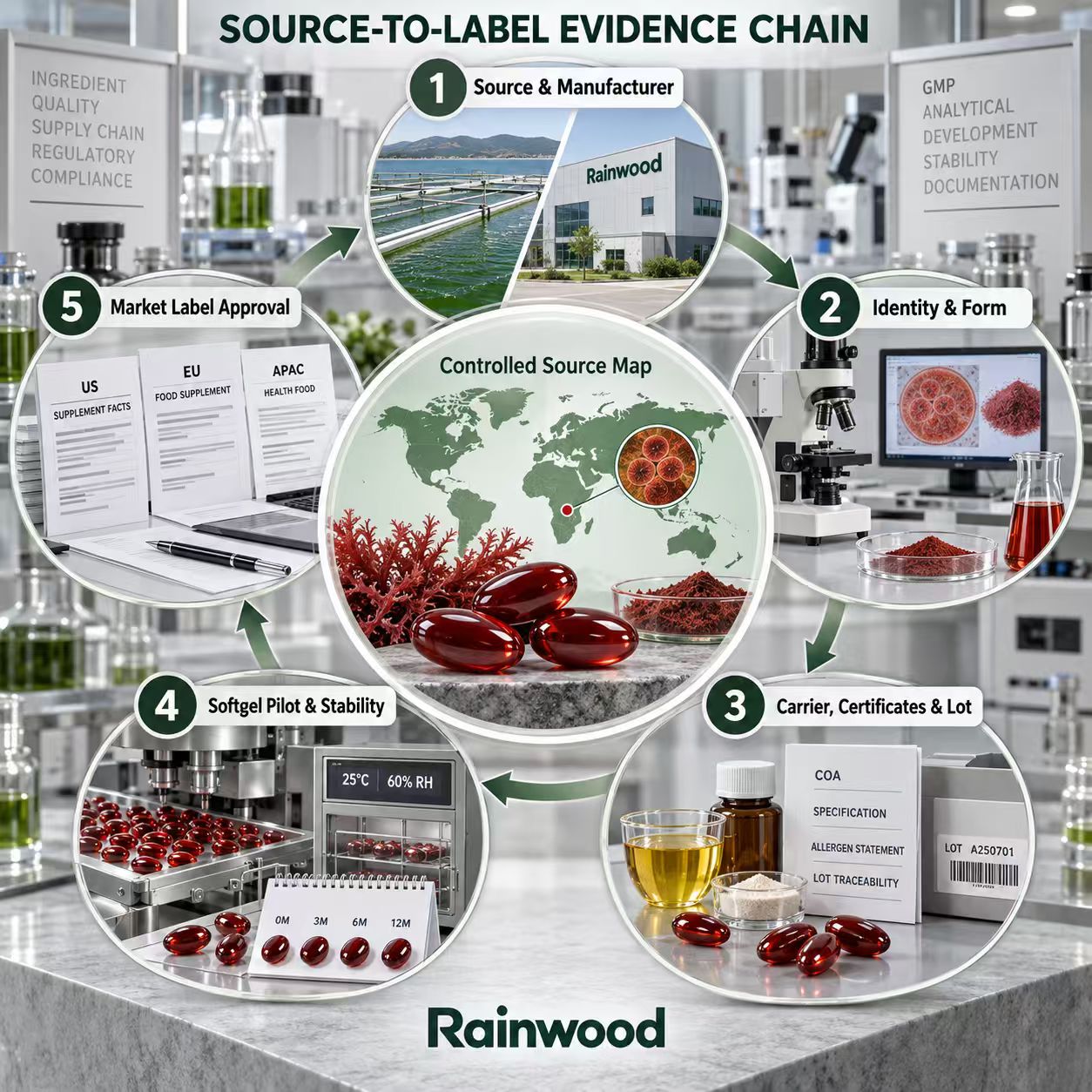
Approval gate before printing “natural”
Require:
- source and process statement;
- identity and form evidence;
- certificate scope review;
- lot traceability;
- carrier and antioxidant disclosure;
- softgel process and stability pilot;
- market-specific label approval.
Request an astaxanthin softgel source and natural-claim review. Send RainwoodBio the supplier COA, source statement, certificates, draft label, target market, softgel dose, and package so the team can identify unsupported jumps.
Do not let a source change bypass the finished-product file
When the source changes, compare more than the label wording. Review concentration, ester distribution, color, odor, viscosity, carrier, antioxidant, fill weight, potency method, shell compatibility, and stability. A replacement that is chemically acceptable may still change the softgel appearance or the way the finished product is released.
Ask the supplier to provide a comparison sample and a written change statement before the next campaign. Keep the approved natural-origin wording frozen until QA and regulatory owners confirm that the replacement material supports it.
The source comparison belongs in the technical file
The source review should also identify what the buyer is actually paying for. An algal oleoresin may contain a defined concentration of astaxanthin plus carrier and natural matrix components. A synthetic preparation may be quoted on a different concentration or form basis. If the softgel uses the same nominal milligram number but a different active basis, the formula and label math must be rebuilt.
Ask for a side-by-side comparison sample under identical lighting and storage, then test both through the intended filling and stability process. Document the decision in the raw-material specification and the marketing claim file. This prevents “natural” from becoming a last-minute design request that the technical team cannot support.
Put the source decision in the purchase order
State the accepted source, form, concentration basis, carrier, and certificate requirements in the commercial specification. Add a written notice trigger for any change to organism, synthesis route, extraction, ester profile, carrier, antioxidant, or manufacturer. If the supplier cannot commit to those controls, the brand should not print a source-sensitive claim that depends on them.
Use the same source wording on every document
Quotation, specification, COA, package, label, website, and distributor listing should not describe the source differently. A controlled source vocabulary reduces the chance that “algal,” “natural,” and “organic” are treated as interchangeable claims.
Keep the source decision commercial as well as technical
Ask how source availability, MOQ, lead time, and replacement policy change when the brand specifies algal material. A source claim that cannot be supplied consistently can create a launch gap even when the technical file is complete.
Build a source-change approval form
The form should identify the old and new source, manufacturer, site, process, concentration, carrier, antioxidant, assay method, and certificate scope. Add fields for softgel fill weight, color, odor, shell compatibility, stability, label wording, and target market. This makes a source switch a controlled project rather than a sales update.
Ask for a written statement that the replacement lot is the same defined commercial identity or identify exactly what has changed. If the answer is uncertain, keep the product on hold until a new sample and finished-product comparison are complete.
Frequently asked questions
1.Is algal astaxanthin automatically natural-certified?
No. Source and certification are separate questions. Verify the exact product, entity, scope, and lot.
2.Can synthetic and algal astaxanthin use the same softgel formula?
Possibly, but compare concentration, form, carrier, viscosity, color, stability, and market requirements through a pilot.
3.Does “natural” prove a better finished-product outcome?
No. It is an origin or positioning statement, not proof of potency, stability, bioavailability, or efficacy.
References
- USP Astaxanthin Esters: https://doi.org/10.31003/USPNF_M7359_03_01
- EFSA safety opinion: https://efsa.onlinelibrary.wiley.com/doi/10.2903/j.efsa.2020.5993
- RainwoodBio About Us: https://www.rainwoodbio.com/about-us
- RainwoodBio OEM service: https://www.rainwoodbio.com/oem
This article is for B2B procurement and educational purposes. Product, analytical, safety, labeling, and regulatory requirements should be confirmed for the exact ingredient, finished product, and destination market.