 EN
EN

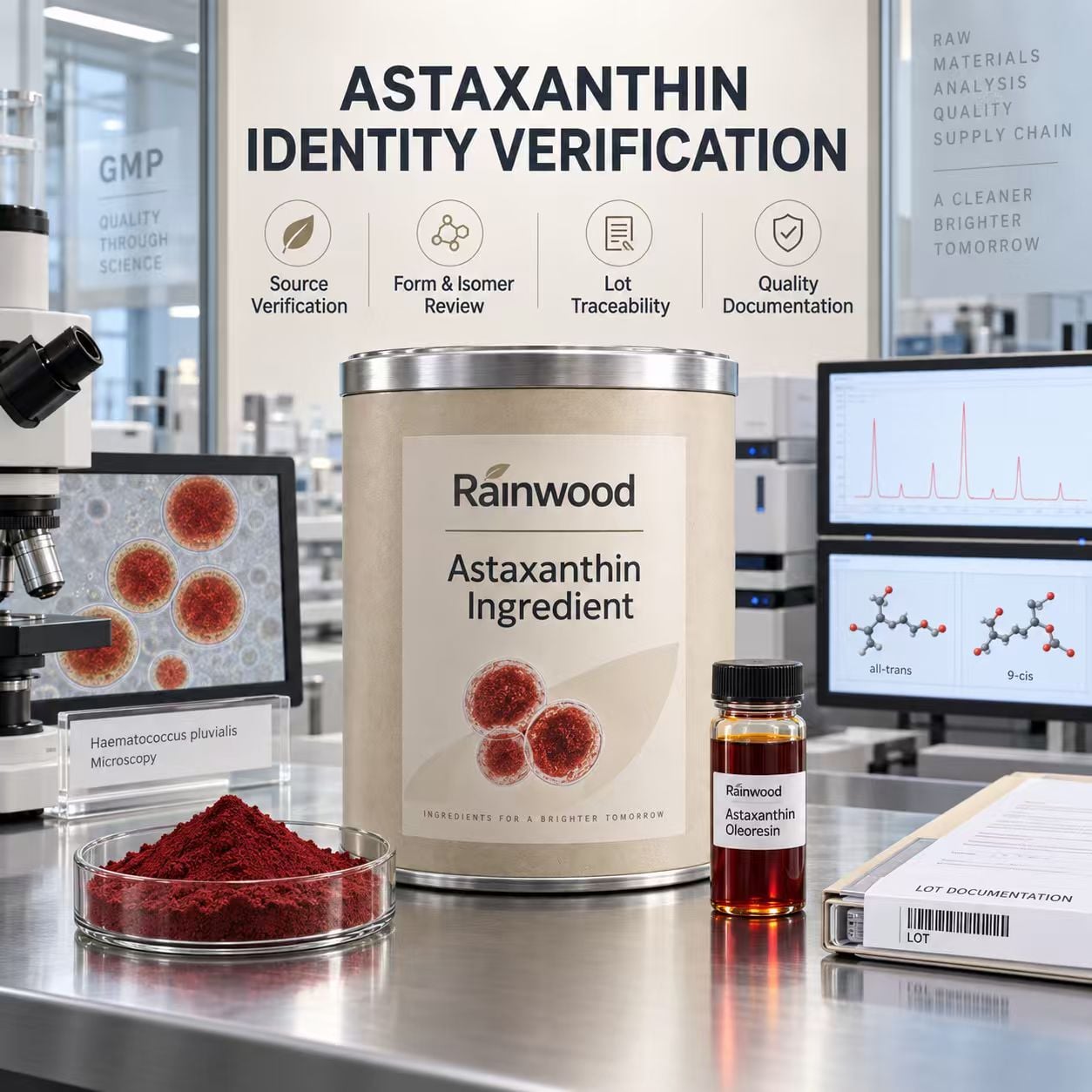
Meta title: Natural Astaxanthin: Verify Source, Form, and Isomers
Meta description: “Natural astaxanthin” is not a complete specification. Verify source organism, stereoisomer profile, ester form, manufacturer, and label evidence.
The sales sheet says “natural astaxanthin.” The brand team puts a green leaf on the front panel. The purchasing file contains no source statement, no stereoisomer profile, and no proof that the commercial lot matches the material used in the supplier’s presentation.
“Natural” can be an important positioning decision. It can also become an expensive claim when the buyer has not defined what the word means for the ingredient, finished product, certification, and destination market.
Review the natural astaxanthin powder specification before approving the claim or the lot.
Source is not the same as color
Astaxanthin’s red color does not prove that it came from algae, that it contains the desired stereoisomer profile, or that it is free of undeclared carrier and other carotenoids. A source claim should connect to the manufacturer, process, lot, and evidence.
Ask whether the material is derived from:
- *Haematococcus pluvialis* microalgae;
- another biological source;
- chemical synthesis;
- a blended or standardized preparation;
- an upstream oleoresin diluted into an oil or powder.
Do not treat “natural” as a substitute for identity testing. The material still needs a defined assay, form, and specification.
USP’s astaxanthin esters monograph describes a material from *Haematococcus pluvialis* that consists mainly of 3S,3′S stereoisomers in ester and free forms, with total astaxanthin calculated as free astaxanthin on an anhydrous basis. [USP Astaxanthin Esters](https://doi.org/10.31003/USPNF_M7359_03_01)
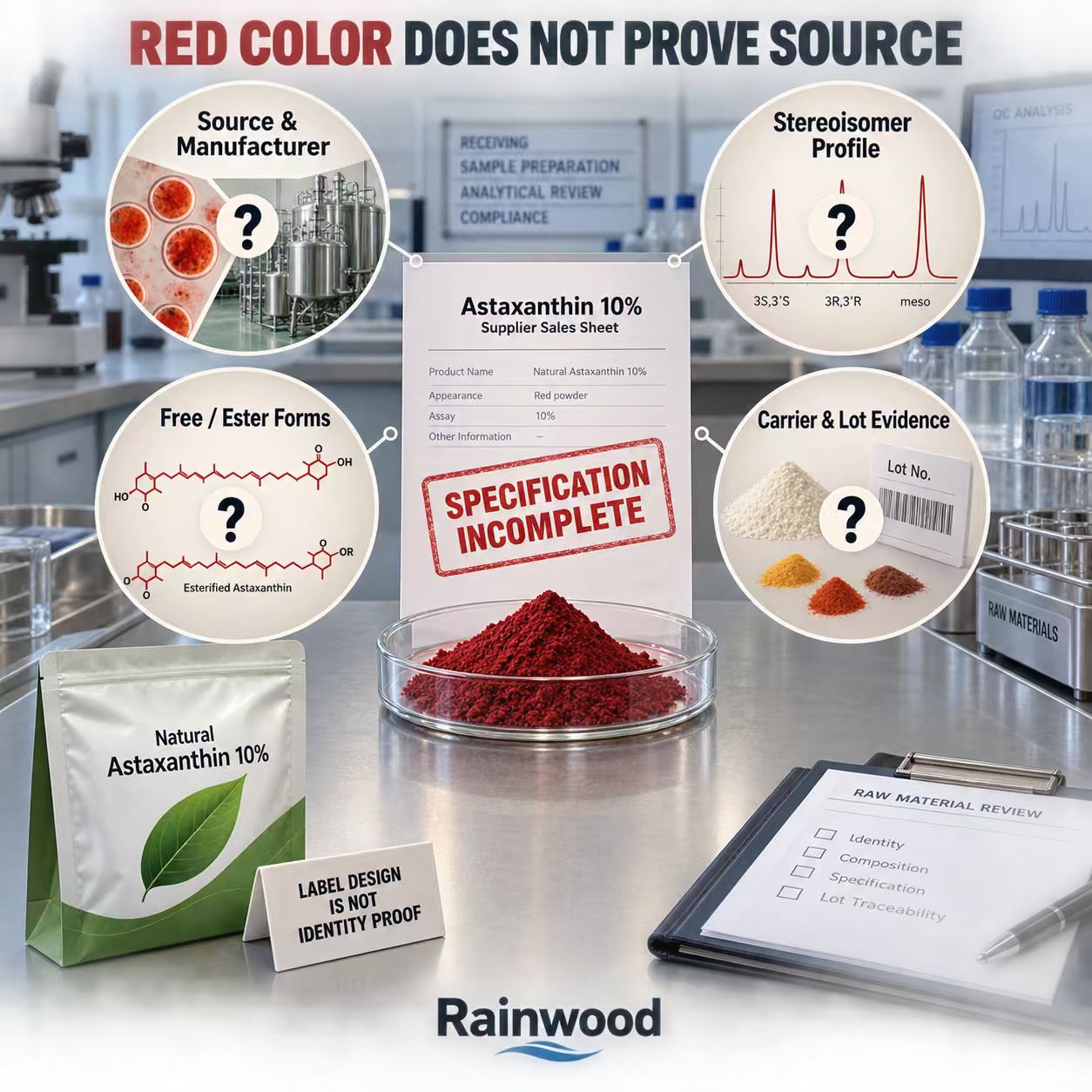
Isomer language must match the actual material
Astaxanthin is not one undifferentiated peak for every commercial purpose. Source and process can affect stereoisomer composition and the ratio of free and esterified forms. A supplier should explain which profile is specified and how it is tested.
Request:
- source and cultivation or synthesis statement;
- identity method and reference standard;
- total astaxanthin calculation;
- ester and free-form information where relevant;
- stereoisomer data if the claim or specification depends on it;
- lot-specific evidence and change controls.
If the supplier cannot define the material beyond “natural 10%,” the claim is ahead of the evidence.
Read the astaxanthin assay-basis and COA review before comparing source claims.
“Algal” does not automatically mean certified organic
Source, cultivation, processing, and certification are separate questions. A material can be algae-derived without meeting an organic standard. It can be natural without being certified. It can be certified at the raw-material stage while the finished product uses other non-certified ingredients.
For every certification or origin statement, check:
1. certificate holder and site;
2. product or category scope;
3. valid dates;
4. production and processing coverage;
5. lot or chain-of-custody connection;
6. destination-market labeling rules.
Keep the technical dossier and marketing claim file linked but not merged. The dossier proves what the ingredient is; the claim file decides what the brand can say.
A label can overreach the ingredient evidence
“Natural astaxanthin from algae” is a source statement. “Clinically proven natural astaxanthin for eye, skin, or athletic performance” is a broader marketing proposition that needs separate evidence and market review. Do not borrow a branded ingredient’s studies, trademark, or claim language unless the purchased material is authorized and equivalent.
Use the astaxanthin label and evidence review to match every customer-facing phrase to the exact ingredient and finished product.
Source changes can affect more than origin wording
A supplier change from one algal source to another may alter ester distribution, color, odor, concentration, carrier oil, particle behavior, and stability. The new source may still look compliant on a basic assay while requiring a new softgel or powder pilot.
Add source-change triggers for:
- organism or cultivation site;
- extraction method;
- solvent or purification step;
- esterification or hydrolysis condition;
- carrier or antioxidant;
- drying or encapsulation process;
- analytical reference standard.
Use the astaxanthin supplier-change checklist before accepting a new “natural” source.
How RainwoodBio can support the source file
RainwoodBio’s public workflow describes supplier management, requirement confirmation, testing and release, documentation, and traceability. These are company-published capabilities. Ask for a source and form map that identifies the exact astaxanthin preparation, manufacturer, lot, assay basis, and finished application.
Explore the astaxanthin private-label and documentation service when the project includes natural, algae-derived, organic, or origin-sensitive positioning.
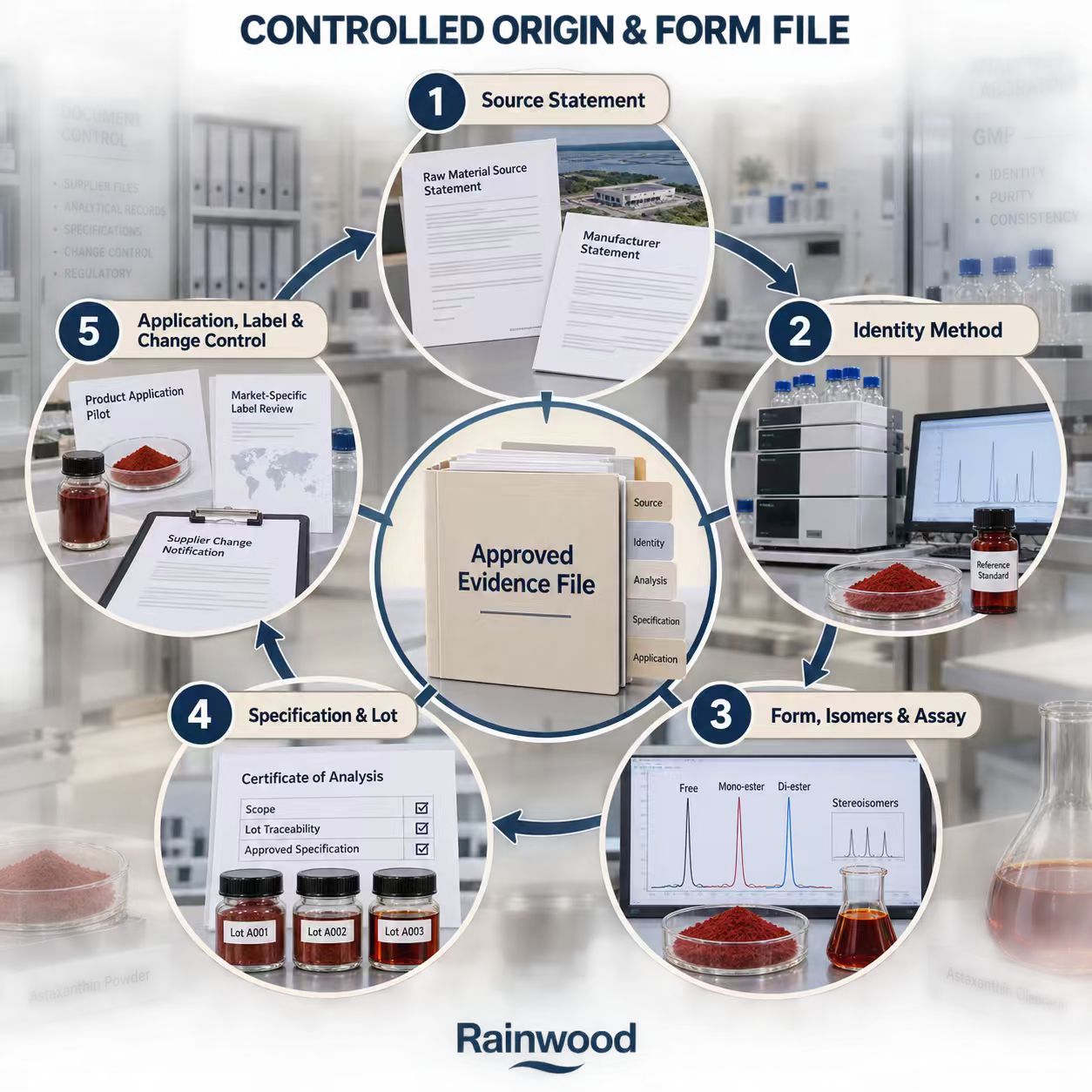
Approval gate before printing “natural”
Require:
- a written source statement;
- identity and stereochemical evidence appropriate to the claim;
- clear free and esterified form information;
- certificate scope and validity review;
- lot traceability;
- market-specific label approval;
- supplier change notification.
Request an astaxanthin source and natural-claim review. Send RainwoodBio the supplier COA, source statement, certificate, draft label, target market, and intended dosage form so the team can separate supportable origin language from unsupported marketing claims.
Keep the origin file independent from the sales story
Create a controlled origin file with the source statement, manufacturing flow, certificate, lot records, and approved label wording. Create a separate evidence file for benefit claims, study references, testimonials, or comparison language. The two files can be linked, but they should not be allowed to substitute for each other.
This separation helps when a distributor asks to change the wording. The team can check whether the requested change affects origin, certification, formulation, or health-claim evidence. It also makes a supplier switch easier to evaluate because the replacement material can be compared against the technical origin requirements before any marketing copy is updated.
Use the same source wording in the quotation, COA, specification, label, website, and distributor listing. This prevents “algal,” “natural,” and “organic” from being treated as interchangeable claims.
Recheck the claim after a formula change
Adding a carrier, changing the softgel oil, replacing another ingredient, or moving production can affect whether the original source or certification language remains accurate. Trigger a new claim review whenever the finished product no longer matches the approved evidence file.
Keep the approved wording with the source documents and review it again whenever the supplier, carrier, source, finished format, market, or certificate scope changes.
This protects the label during reorders, distributor updates, and future audits.
Frequently asked questions
1.Does “natural” prove the astaxanthin came from algae?
No. Ask for a source statement and evidence connected to the exact manufacturer and lot.
2.Does algae-derived astaxanthin always have the same stereoisomer profile?
Do not assume that. Source, strain, cultivation, extraction, and processing can matter; define what your specification requires.
3.Can I use a supplier’s “clinically studied” wording?
Only after confirming study material, dose, product equivalence, authorization, market rules, and permitted wording.
References
- USP Astaxanthin Esters: https://doi.org/10.31003/USPNF_M7359_03_01
- EFSA safety opinion on astaxanthin-rich ingredients: https://efsa.onlinelibrary.wiley.com/doi/10.2903/j.efsa.2020.5993
- RainwoodBio About Us: https://www.rainwoodbio.com/about-us
- RainwoodBio OEM service: https://www.rainwoodbio.com/oem
This article is for B2B procurement and educational purposes. Product, analytical, safety, labeling, and regulatory requirements should be confirmed for the exact ingredient, finished product, and destination market.