 EN
EN

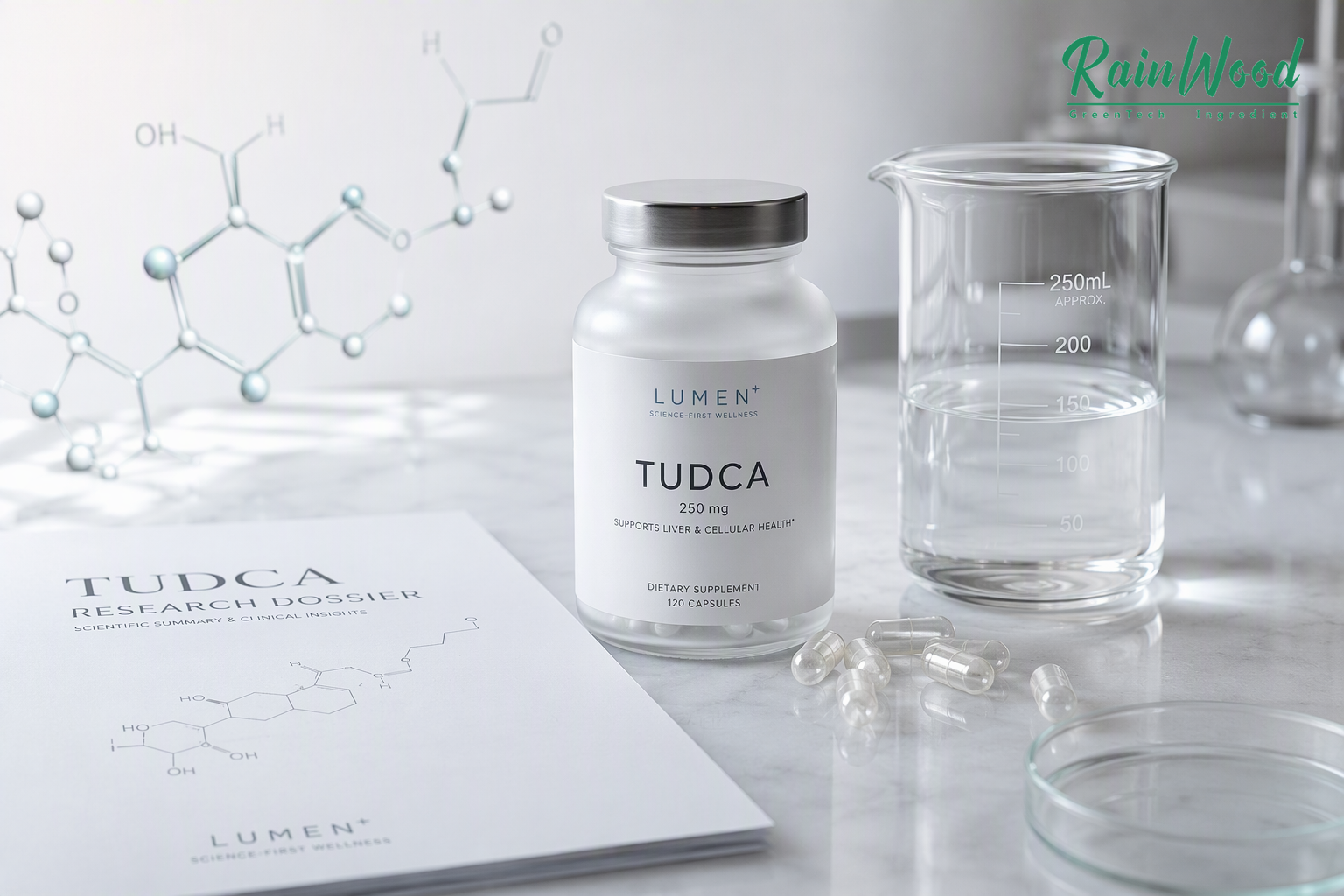
Executive Summary: While peer-reviewed biomedical research establishes TUDCA's role in endoplasmic reticulum (ER) stress mitigation and hydrophilic bile acid circulation, commercial supplement marketing must strictly distinguish between structure/function wellness claims and prohibited therapeutic disease claims. Building a defensible market position requires aligning raw material assay, dosage form, clinical evidence, and regulatory frameworks across US, EU, and global e-commerce channels.
The consumer marketing brief often promises sweeping outcomes: "TUDCA detoxifies the liver, repairs damaged liver cells, cures fatty liver, and optimizes metabolic health." The scientific dossier cited in support frequently contains an exploratory cellular mechanism review or a murine metabolic study. Meanwhile, the actual finished commercial product is a 250mg or 500mg TUDCA capsule with a completely distinct delivery matrix and no matched human clinical trial.
This critical gap is where supplement brand marketing routinely runs ahead of regulatory evidence. While Tauroursodeoxycholic Acid (TUDCA) is one of the most scientifically compelling hydrophilic bile salts studied today, academic research does not grant private-label brands a license to make unapproved medical or disease-treatment promises. A defensible commercial market position must precisely match the certified TUDCA raw material grade, serving dose, finished format, target jurisdiction, and verified evidence tier.
1. Separate Three Categories of Regulatory Language
To insulate your brand against FDA warning letters, FTC enforcement, and Amazon listing suspensions, utilize our TUDCA claim-to-evidence checklist to classify every piece of promotional text into three discrete categories:
- Category 1: Ingredient Identity & Chemical Composition: Factual statements regarding chemical name (Tauroursodeoxycholic Acid, CAS 14605-22-2), HPLC active assay (≥98%), absence of heavy metals, and cGMP synthesis origin.
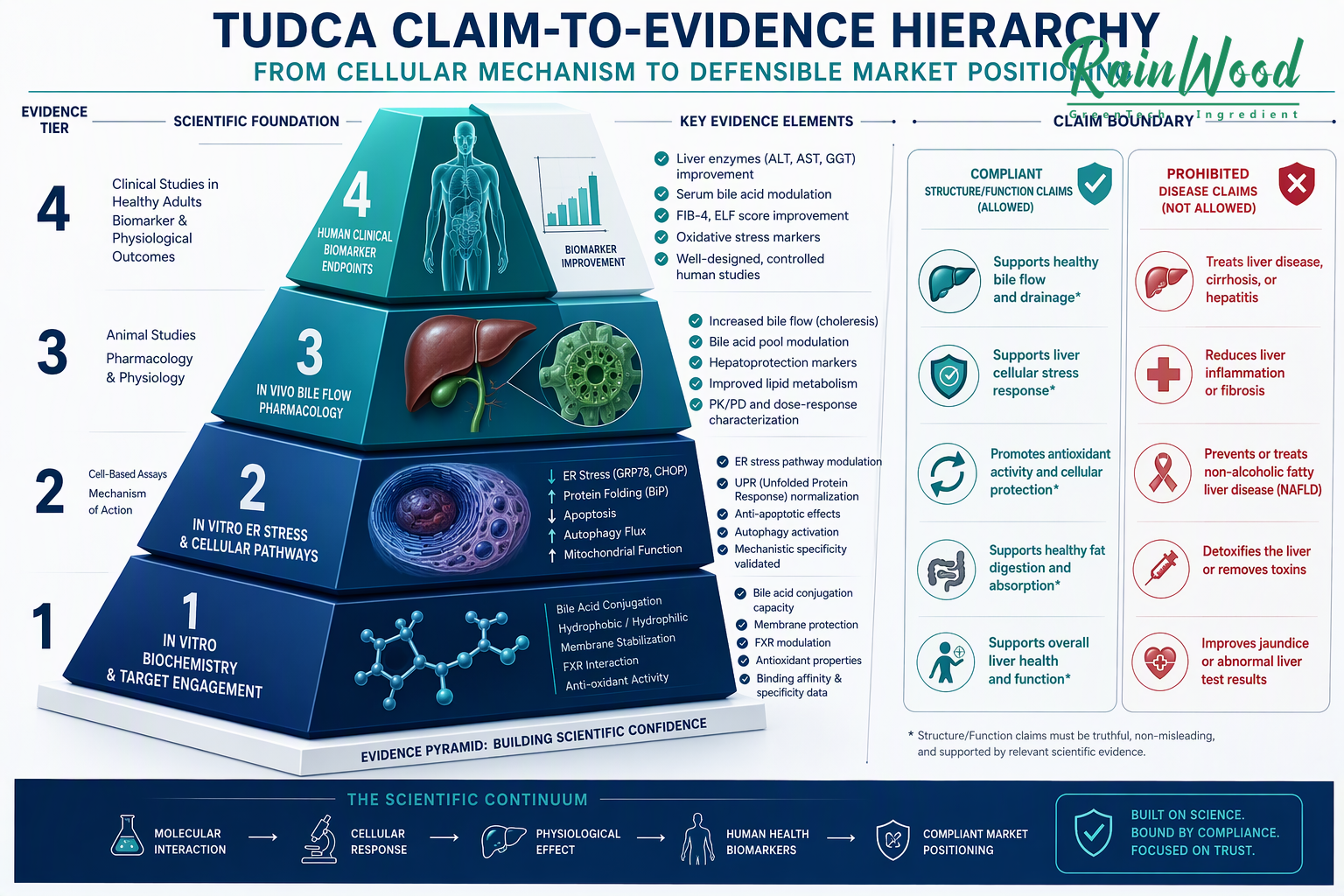
- Category 2: Structure/Function & Wellness Language (Permitted): Lawful statements describing how TUDCA supports normal hepatic bile flow, aids cellular membrane integrity, and supports endogenous glutathione synthesis (e.g., "Supports healthy liver function and bile acid metabolism*").
- Category 3: Disease, Treatment & Therapeutic Claims (Prohibited for Supplements): Unlawful statements claiming to cure, mitigate, treat, or prevent pathological conditions (e.g., cirrhosis, hepatitis, cholestasis, fatty liver disease, or toxic drug-induced liver injury).

2. Cellular Mechanism Is Not a Finished-Product Clinical Outcome
Peer-reviewed literature published on PubMed and PMC highlights TUDCA's ability to act as a chemical chaperone, alleviating Endoplasmic Reticulum (ER) stress and preventing mitochondrial apoptosis in cultured hepatocytes. While these cellular pathways provide foundational biochemical context, a five-link validation chain is required before translating benchtop science into commercial consumer packaging:
3. Practical Rules for Defensible Amazon & DTC Positioning
To maximize commercial conversion while maintaining bulletproof compliance across Amazon, Shopify, and retail channels, implement the following positioning rules:
- Eliminate "Detox" & "Cure": Replace aggressive medical buzzwords with precise physiological descriptors such as "Promotes healthy bile acid conjugation" and "Supports hepatic antioxidant defense systems."
- Mandate the FDA Disclaimer: Ensure every consumer-facing label and digital landing page prominently features: "*These statements have not been evaluated by the Food and Drug Administration. This product is not intended to diagnose, treat, cure, or prevent any disease."
- Audit Customer Support Scripts: Train sales representatives and AI chatbots never to recommend TUDCA as an alternative to prescribed liver therapeutics or post-cycle therapy (PCT) medical treatments.
Build a Science-Backed, Fully Defensible TUDCA Product Line
Partner with Shaanxi Rainwood Biotech for cGMP-certified bulk TUDCA powder and turnkey custom capsule manufacturing backed by comprehensive technical dossiers and third-party testing.
Frequently Asked Questions (FAQ)
Q1: Can supplement brands legally claim that TUDCA supports liver health?
Yes, provided the claim is framed as a structure/function statement (e.g., "Supports healthy liver bile acid flow*") and supported by documented substantiation files, without referencing disease prevention or treatment.
Q2: Can in vitro cellular studies alone substantiate consumer marketing claims?
No. Mechanistic in vitro data demonstrates biological plausibility, but regulatory bodies (such as the US FTC and FDA) require competent and reliable scientific evidence connecting the finished dosage form and dose to physiological outcomes.
Q3: What is the recommended commercial capsule dosage for TUDCA?
Commercial dietary supplements typically offer 250mg or 500mg per capsule, with recommended daily servings between 250mg and 1000mg depending on formula complexity and companion ingredients (such as NAC or Milk Thistle).
References & Regulatory Frameworks
- PubMed: Unexpected Uses of Urso- and Tauroursodeoxycholic Acid (PMID: 24891994)
- PubMed Central (PMC): Tauroursodeoxycholate Pharmacological Review (PMC6952947)
- US FDA: Dietary Supplement Labeling Guide (21 CFR Part 101.93).
- European Commission: EU Nutrition and Health Claims Regulation (EC) No 1924/2006.
- Shaanxi Rainwood Biotech: TUDCA Powder Specifications and Turnkey Capsule OEM Solutions.