 EN
EN

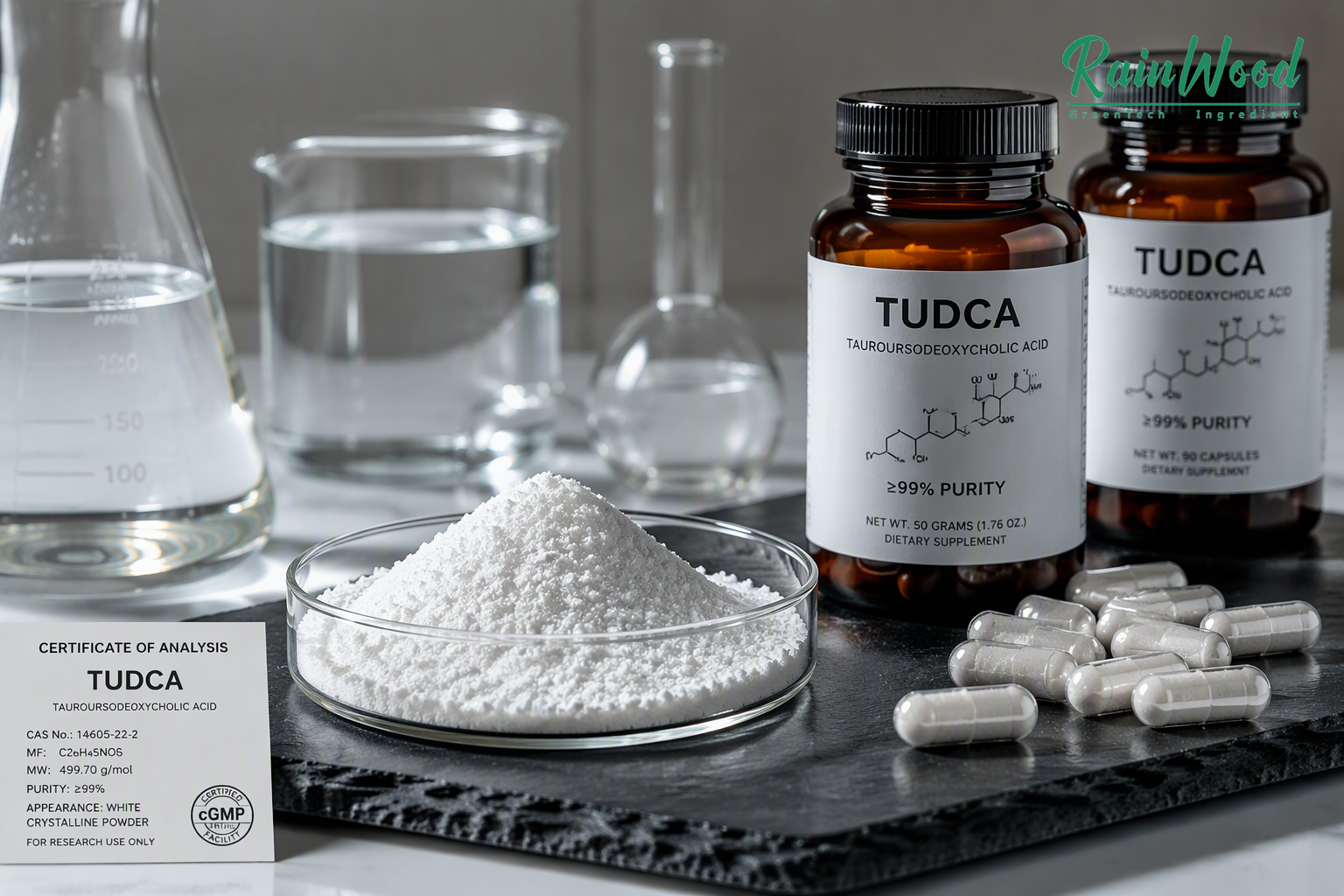
Executive Summary: A simple "98% TUDCA" quotation headline leaves vital commercial and regulatory questions unanswered. For B2B dietary supplement brand owners, raw material specification must rigorously account for related bile acid impurity profiles, specific optical rotation, residual solvents, moisture, and format-specific physical tap density before lot release.
The quotation headline is deceptively simple: TUDCA, 98% purity. The specification fits on one line. The procurement buyer assumes the remaining 2% is harmless process moisture. However, the quality and formulation teams later discover there is no agreed threshold for related bile acids (such as UDCA, CDCA, or lithocholic acid derivatives), residual synthetic solvents, specific optical rotation, heavy metals, or microbiology.
For pure bulk TUDCA raw material powder, chemical assay purity is merely a baseline, not a comprehensive product definition. A mature specification architecture explains exactly what the analytical percentage measures, what remains outside the primary chromatographic peak, how the powder behaves in two-piece hard capsules or tablets, and which batch evidence is legally required before factory release.
1. Start by Defining What “98%” Measures
Before issuing a purchase order, utilize our TUDCA raw material purity and specification checklist to record and lock:
- Assay Analytical Method & Reference Standard: HPLC-UV / HPLC-ELSD vs titration; secondary vs primary USP/EP reference standards.
- As-Is vs. Dry-Basis Reporting: A 98.0% assay reported "on dry basis" with 3.0% loss on drying yields an actual active delivery of only ~95.0% as-is.
- Chromatographic Peak Identity & Resolution: Baseline separation between Tauroursodeoxycholic acid and closely related conjugated bile salts.
- Related-Substance Quantitative Limits: Specified individual limits (e.g., free UDCA ≤ 0.5%, Taurodeoxycholic acid ≤ 0.5%) and total impurities ≤ 1.5%.
- Residual Solvents & Process Reagents: Route-specific screening for organic coupling agents, methanol, ethanol, or acetone under ICH Q3C.
- Water Content & Loss on Drying (LOD): Karl Fischer titration threshold (≤ 1.0%) to prevent powder caking and capsule embrittlement.
- Heavy Metals & Microbiology: ICP-MS testing (Pb ≤ 0.5 ppm, As ≤ 0.5 ppm, Cd ≤ 0.2 ppm, Hg ≤ 0.1 ppm) and full microbiological release panels.
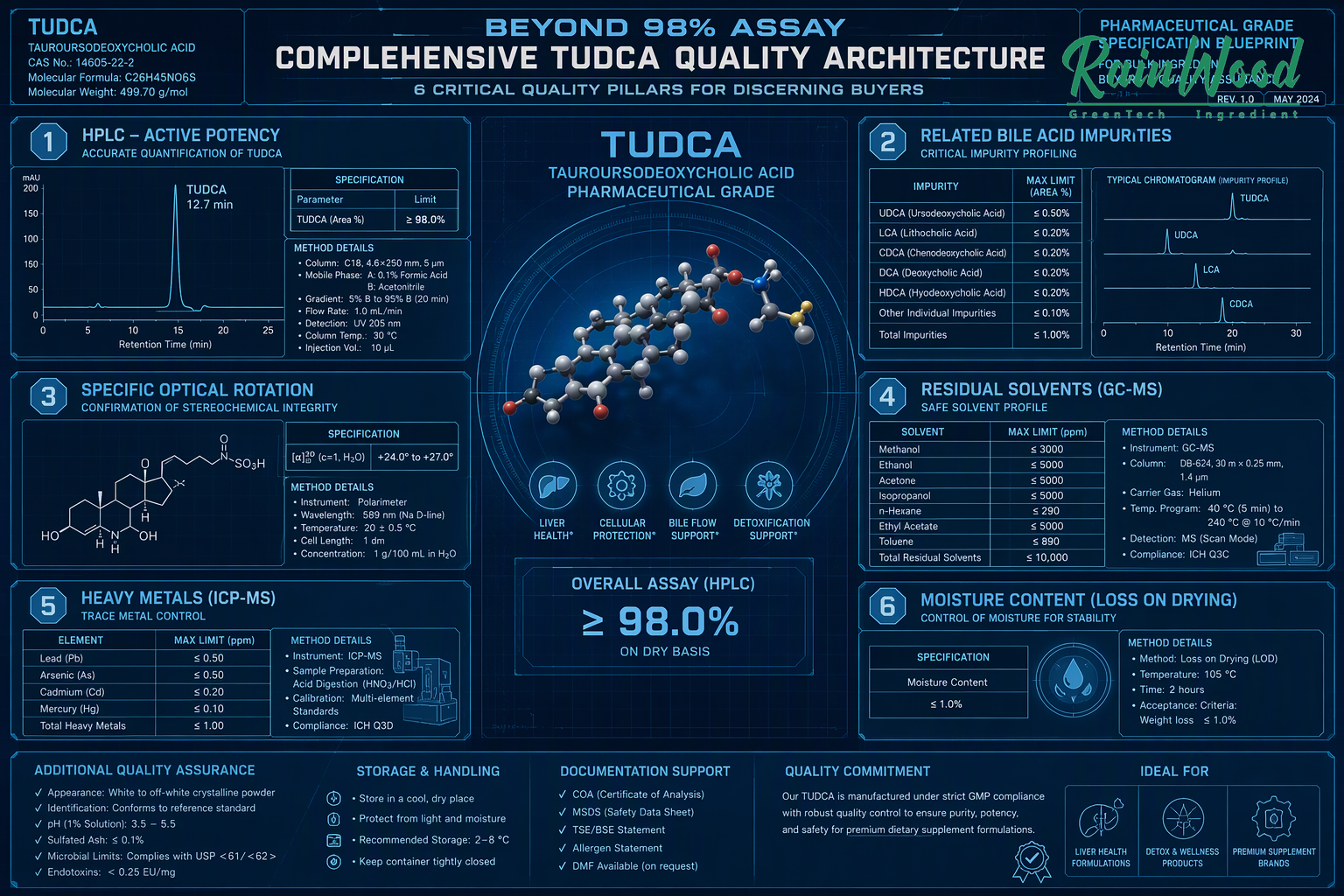
Two distinct chemical synthesizers can both quote 98% purity and still deliver dramatically different commercial grades if their assay baseline, impurity limits, or test panels differ.
2. Related Substances Define the Commercial Quality Difference
The non-TUDCA 1% to 2% portion typically contains unreacted Ursodeoxycholic Acid (UDCA), closely related bile acid conjugates (Taurodeoxycholic Acid, Taurochenodeoxycholic Acid), residual taurine, inorganic coupling salts, or thermal degradation products. The exact impurity fingerprint depends directly on the synthetic or semi-synthetic route.
For custom formulation brands, review our full technical dossier on TUDCA COA verification and impurity profiling before approving a raw material batch based purely on a high headline assay.
3. Specific Optical Rotation Confirms Stereochemical Integrity
TUDCA is a chiral steroid conjugate. High-grade specifications incorporate specific optical rotation (typically $+43.0^\circ$ to $+48.0^\circ$, determined at 20°C in anhydrous ethanol) as a supporting identity and stereochemical control parameter. When properly executed with documented concentration and solvent parameters, optical rotation detects epimerization and structural degradation that standard non-chiral methods might overlook.
Always verify whether optical rotation is tested on every shipped production lot or merely carried forward as a historical "typical value" on generic distributor specification sheets.
4. Moisture and Physical Flow Properties Govern Capsule Encapsulation
TUDCA raw powder exhibits fine, electrostatic, and hygroscopic crystal characteristics. In high-speed automated capsule filling machines or rotary tablet presses, powder bulk density, Hausner ratio, and moisture content dictate fill-weight consistency and defect rates.
Explore our turnkey contract manufacturing capabilities for OEM/ODM 250mg & 500mg TUDCA hard capsules to ensure zero fill-weight variation in commercial runs.
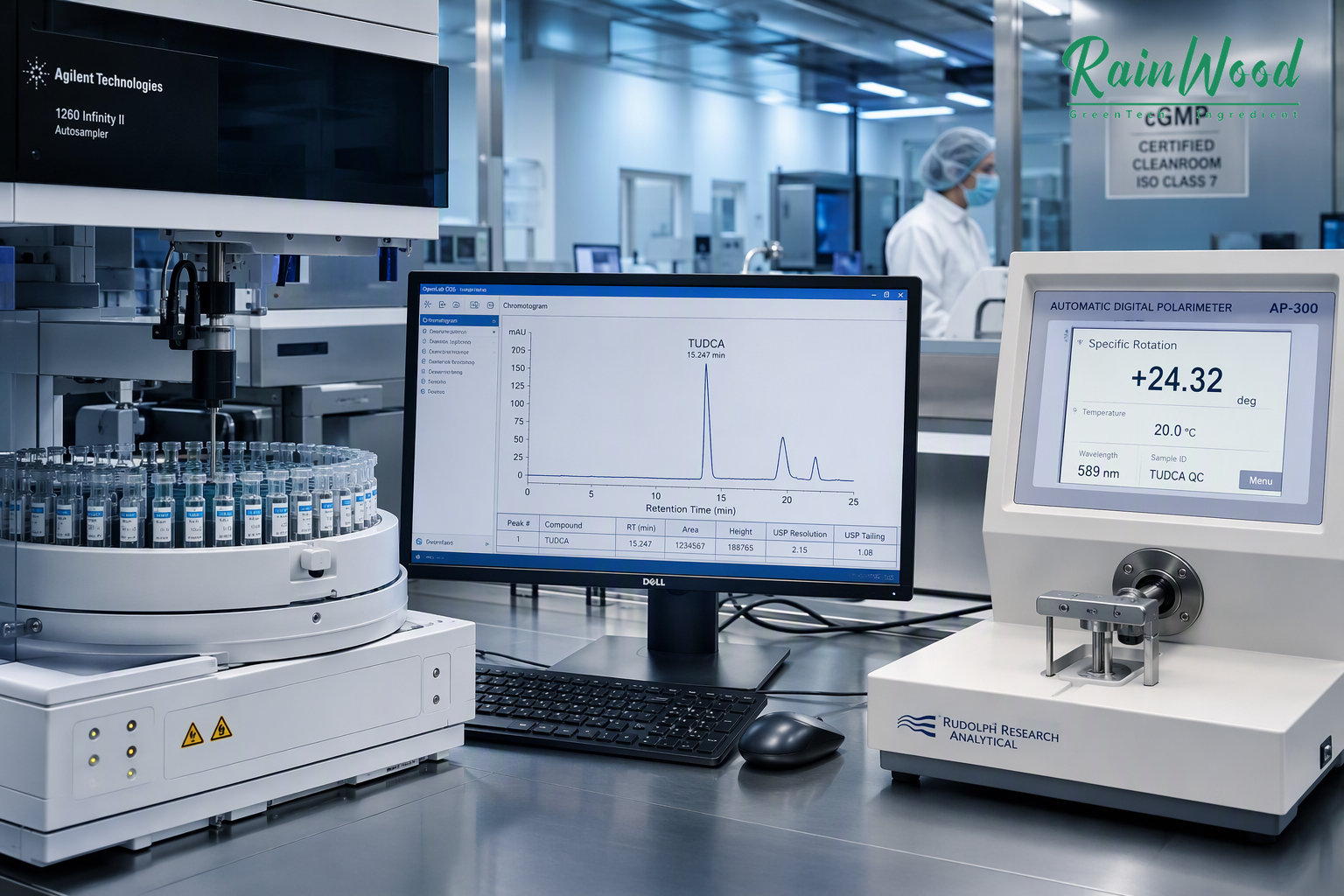
5. The Comprehensive TUDCA Master Specification Standard
Lock Your Full-Specification TUDCA Raw Material & Finished Formulations
Shaanxi Rainwood Biotech provides certified cGMP bulk TUDCA raw material powder (≥98% dry basis) and turnkey OEM/ODM capsule manufacturing with complete third-party ISO 17025 Certificate of Analysis (COA) batch release dossiers.
Frequently Asked Questions (FAQ)
Q1: Is a 98% TUDCA assay sufficient for private-label dietary supplement release?
No, not by itself. Under US FDA 21 CFR Part 111 cGMP regulations, brands must confirm identity, quantify related bile acid impurities, verify heavy metals and microbiological limits, and ensure residual solvents comply with ICH Q3C standards.
Q2: What is the primary difference between as-is and dry-basis purity reporting?
Dry-basis purity calculates potency after subtracting residual moisture content. If a batch contains 2.5% moisture, a 98.0% dry-basis assay delivers only 95.55% active substance per kilogram of as-shipped powder, which directly alters capsule dosing calculations.
Q3: Should specific optical rotation be tested on every commercial batch?
Yes. For chiral molecules like TUDCA, batch-specific optical rotation verifies stereochemical consistency and ensures no epimerization or structural degradation occurred during synthetic coupling and crystallization.
References & Standards
- PubMed Central: Bile Acids as Therapeutic Agents and Cytoprotective Chaperones (PMID: 41601986)
- ICH Harmonised Guideline: Impurities: Guideline for Residual Solvents Q3C(R8).
- United States Pharmacopeia (USP): <781S> Optical Rotation and <621> Chromatography.
- Shaanxi Rainwood Biotech: TUDCA Powder Technical Specification and Contract Manufacturing Services.
Table of Contents
- 1. Start by Defining What “98%” Measures
- 2. Related Substances Define the Commercial Quality Difference
- 3. Specific Optical Rotation Confirms Stereochemical Integrity
- 4. Moisture and Physical Flow Properties Govern Capsule Encapsulation
- 5. The Comprehensive TUDCA Master Specification Standard
- Frequently Asked Questions (FAQ)
- References & Standards