 EN
EN

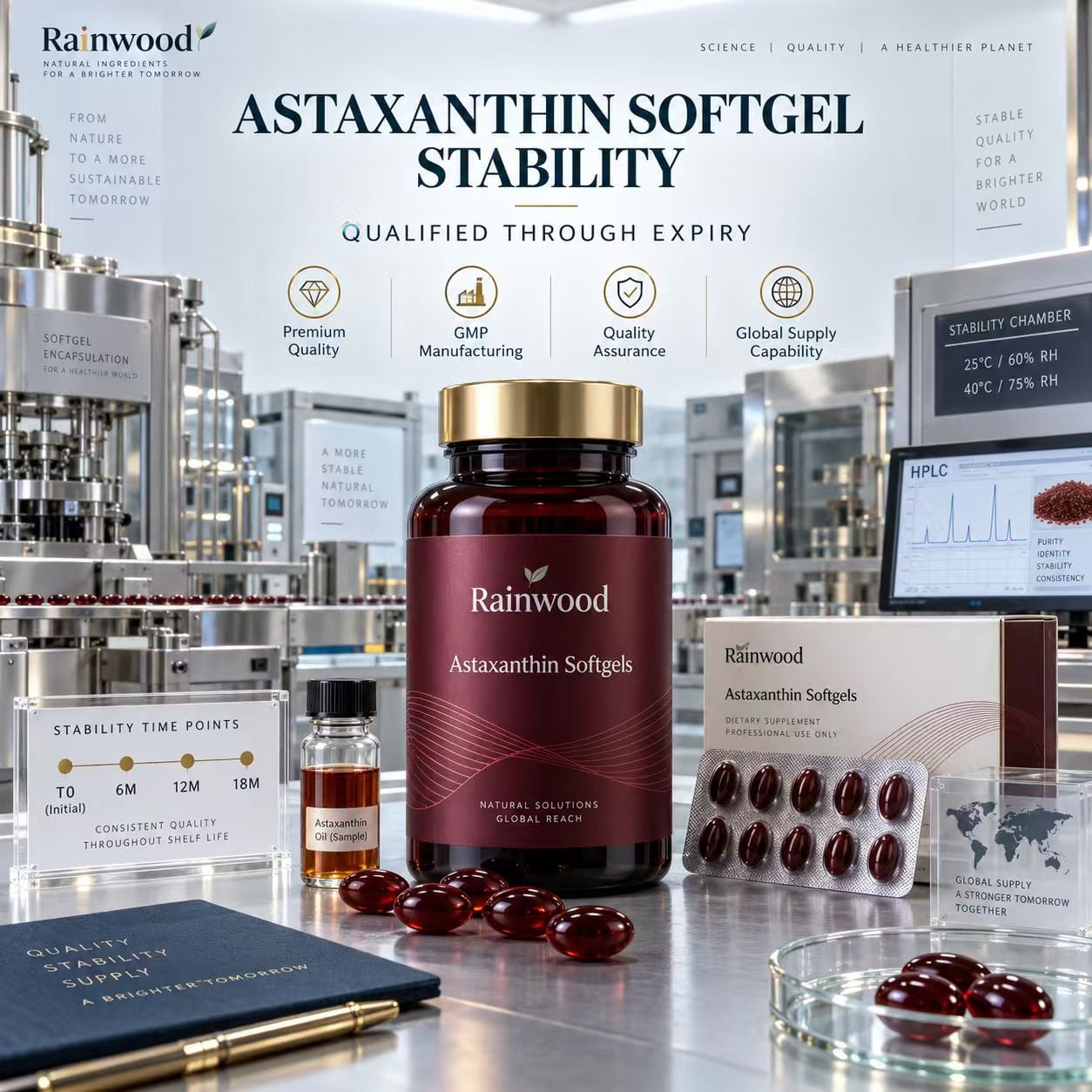
Meta title: Astaxanthin Softgel Expiry: Release Data Is Not Enough
Meta description: A passing release COA does not prove astaxanthin softgel shelf life. Track potency, oxidation, shell integrity, color, package, and storage through expiry.
The first softgel batch passes potency and appearance. The brand prints an 18-month expiry. Near the end of the period, the capsules are darker, the fill smells different, and the potency trend is moving toward the limit.
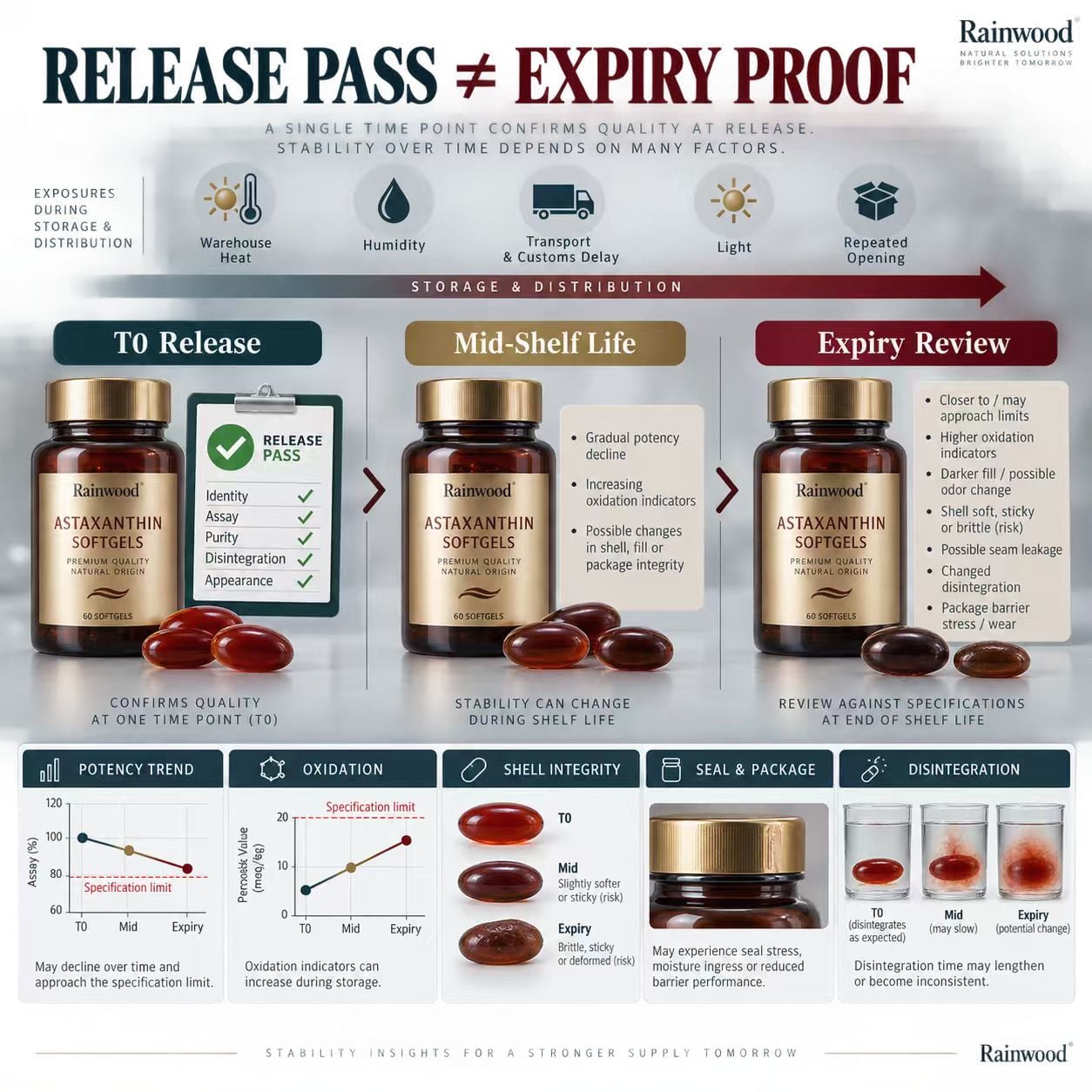
Release testing proves the condition at one time point. Expiry claims require evidence that the finished softgel and package remain within specification through the intended storage route.
Review the astaxanthin softgel stability specification before treating a passing release result as a shelf-life guarantee.
The product changes after the line stops
Astaxanthin oil remains exposed to the fill environment, shell, headspace, package, warehouse, and temperature route. Softgel stability may involve both chemical and physical changes:
- potency loss;
- ester or free-form changes;
- oxidation indicators;
- color and odor shift;
- shell stickiness or brittleness;
- seam leakage;
- fill migration;
- disintegration or release change.
The relevant endpoints depend on the formula, shell, package, market, and claims. Define them before the study starts.
Read the astaxanthin softgel packaging and stability guide to keep the expiry file connected to the actual package.
Use the commercial package, not a laboratory vial
A vial can have a different headspace, closure, light exposure, and opening frequency from the bottle or blister sold to customers. Retain samples in the commercial package and record lot, fill date, storage, pull date, and test results.
Test the route:
1. manufacturing and drying;
2. bulk warehouse;
3. transport and customs delay;
4. distributor or FBA warehouse;
5. retail conditions;
6. consumer opening.
If the product is sold in a hot or humid destination, the stability design should reflect a justified exposure rather than an ideal laboratory room.
Potency alone cannot explain a complaint
A softgel can remain within potency while becoming sticky, leaking, or developing an unacceptable odor. It can also look normal while oxidation or potency changes require action.
At each pull point, consider:
- astaxanthin assay using the defined basis;
- free and ester form where relevant;
- oxidation indicators;
- color and odor;
- shell moisture and appearance;
- seam integrity and leakage;
- disintegration or release;
- package barrier and seal.
Use the astaxanthin finished-softgel release checklist to define the end-of-shelf-life decision.
A stability change can start with the carrier
If the carrier oil, antioxidant, shell, plasticizer, or package changes, historical stability data may no longer represent the new product. The same applies to a change in astaxanthin source, concentration, or ester profile.
Record change triggers for:
- oil or oleoresin source;
- carrier and antioxidant;
- softgel shell;
- filling and drying process;
- package and closure;
- assay method;
- storage or distribution route.
Explore the astaxanthin softgel change-control service if the product is already in distribution and a supplier or package change is proposed.
How RainwoodBio can support expiry qualification
RainwoodBio’s public workflow describes testing and release, packaging, warehousing, logistics, traceability, and multiple dosage forms. These are company-published capabilities. Request a stability plan that names the exact oil lot, shell, package, conditions, time points, methods, and acceptance limits.
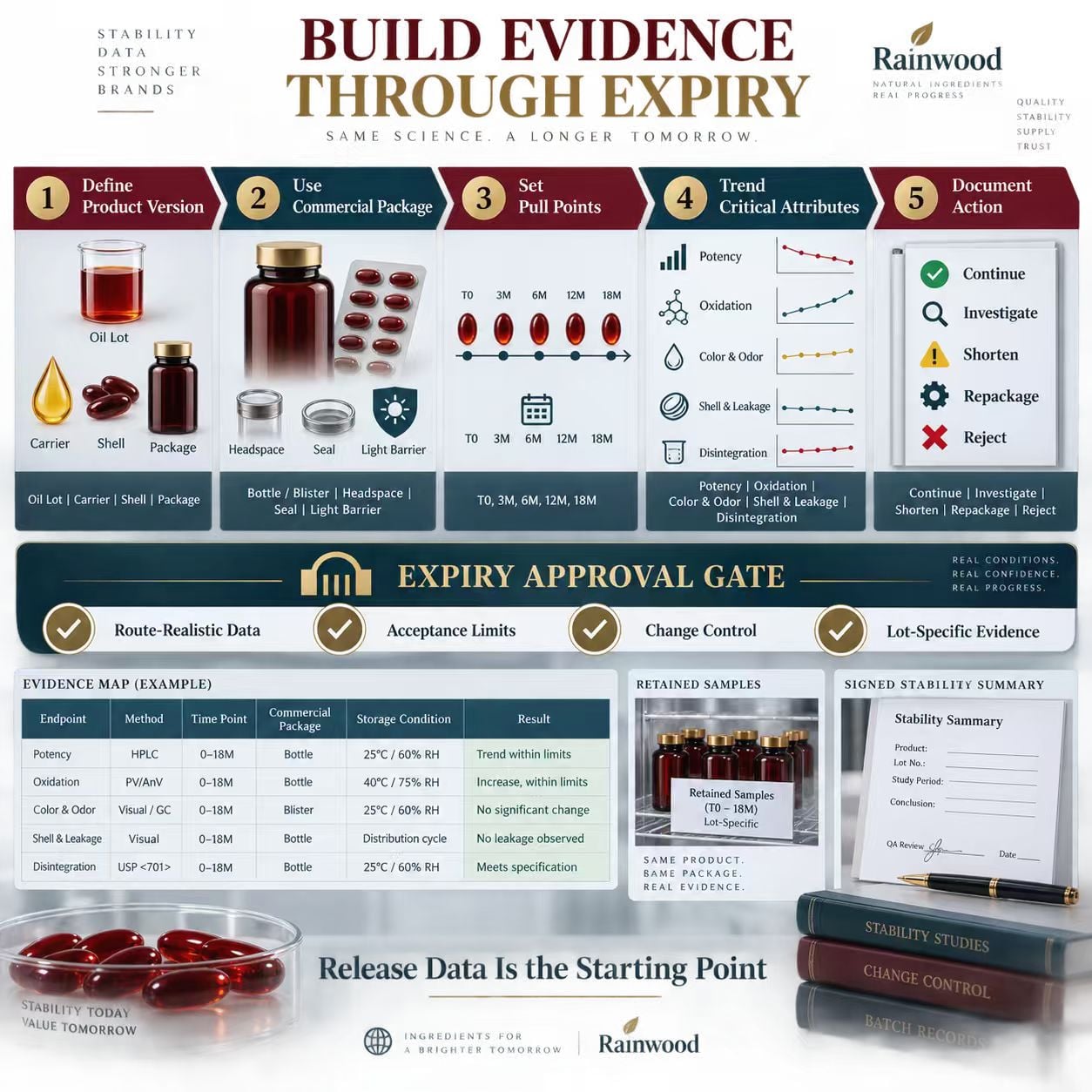
Approval gate before publishing the expiry date
Require:
- commercial-package stability data;
- potency and oxidation trend;
- shell and seal observations;
- color and odor review;
- release or disintegration evidence where relevant;
- realistic route and storage assessment;
- change-control triggers and retained samples.
Request an astaxanthin softgel expiry and stability review. Send RainwoodBio your release COA, stability pulls, package specification, target shelf life, storage route, and complaint history so the team can assess whether the expiry claim is defensible.
Trend the result instead of waiting for a failure
Plot potency, oxidation indicators, shell moisture, leakage, color, and odor at every pull point. A gradual trend toward a limit can justify a packaging review or a shorter retest interval before a batch fails. Keep the same method, sample preparation, and reporting basis so the trend reflects product change rather than analytical drift.
If the commercial route includes long customs holds or hot warehouses, add a documented transport challenge or justified stress condition. The purpose is not to invent a worst-case story; it is to test an exposure the product may actually encounter.
Use the stability trend to protect the next campaign
If potency or oxidation is moving toward a limit, review the package, storage route, and next oil lot before the current batch reaches expiry. A trend is an early business signal: it can justify a package change, shorter retest interval, or supplier investigation before inventory is stranded.
Do not extend expiry without evidence
An attractive release result or a supplier’s raw-oil retest date does not justify extending the finished softgel expiry. Any extension should use the approved package, method, storage records, and trend data for the actual product.
Link expiry to the exact commercial lot
Do not combine data from different oil lots, shell systems, packages, or manufacturing sites without documenting comparability. The final expiry decision should identify the product version and evidence set it covers.
Ask for an expiry evidence map
List each claimed endpoint, method, time point, package, storage condition, and acceptance range. Include a note showing whether the endpoint is raw-material, finished-product, or customer-facing. This prevents the final shelf-life statement from being supported by an unrelated oil study or a release result from a different shell.
If the stability program is still running, qualify the interim expiry carefully and record which evidence remains outstanding. Do not let a marketing deadline turn an incomplete trend into a permanent claim.
Decide what happens when a pull fails
Define whether the lot is held, retested, investigated, or rejected when potency, oxidation, shell, or package results fall outside the limit. Record who owns the decision and how affected inventory is identified. A stability program becomes commercially useful when every result leads to a documented action rather than a discussion after expiry.
Keep the approved stability summary with the batch-release and label-approval records.
Frequently asked questions
1.Does a passing release test prove the expiry date?
No. It proves the batch at release. Expiry requires data through the proposed shelf life in the commercial package.
2.Should softgel color be a release and stability attribute?
If color affects consumer acceptance or signals a process or oxidation change, define an appearance method and acceptance range.
3.Can a new package use the old stability data?
Not automatically. Package barrier, headspace, closure, and storage exposure can change the stability outcome.
References
- Astaxanthin delivery and stability review: https://pmc.ncbi.nlm.nih.gov/articles/PMC13210799/
- USP Astaxanthin Esters: https://doi.org/10.31003/USPNF_M7359_03_01
- RainwoodBio homepage: https://www.rainwoodbio.com/
- RainwoodBio OEM service: https://www.rainwoodbio.com/oem
This article is for B2B procurement and educational purposes. Product, analytical, safety, labeling, and regulatory requirements should be confirmed for the exact ingredient, finished product, and destination market.