 EN
EN
Meta title: Best Zinc Glycinate Format for Dose and Margin
Meta description: Compare capsules, tablets, gummies and lozenges by elemental dose, taste, stability, packaging, customer routine and landed monthly cost.
The wrong format can quietly destroy a good zinc formula.
A gummy wins the first click but cannot hide the mineral taste. A tablet hits the cost target but is too large. A lozenge encourages disease-like cold messaging. A capsule looks simple until customers discover they need several per day.
Format is not packaging chosen after formulation. It decides what dose can be delivered, what claims feel natural, what the customer experiences and whether the product can make money.
Compare equal elemental zinc—not equal unit weight
Every prototype must target the same intended elemental amount. Comparing a 15 mg zinc capsule with a gummy containing 15 mg of total zinc glycinate powder is meaningless.
Normalize:
- elemental zinc per day;
- raw-material input;
- units per day;
- days per pack;
- finished-product test target; and
- landed cost per 30 days.
Use our zinc format comparison worksheet.
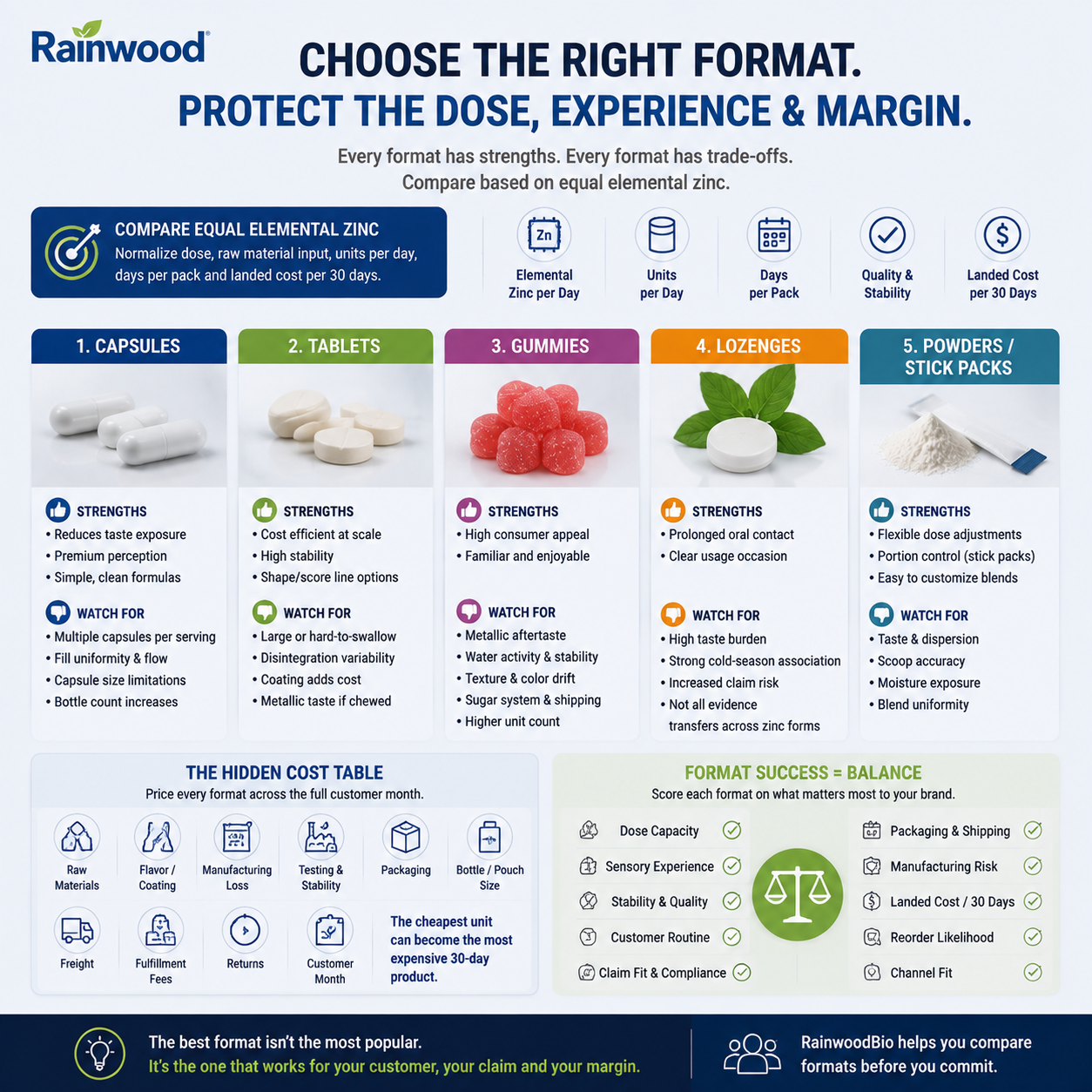
Option 1: hard capsules
Capsules reduce direct taste exposure and support a clean premium presentation. They are often well suited to simple zinc formulas.
Watch for:
- bulk density and flow;
- capsule size;
- fill uniformity;
- number of capsules per serving;
- excipient load;
- shell choice;
- disintegration; and
- bottle count.
Capsules become commercially weak when a crowded formula forces multiple large units. Customers may accept one or two; beyond that, the label must work much harder to explain the routine.
Explore RainwoodBio’s custom hard-capsule service.
Option 2: tablets
Tablets can deliver efficient production, strong shelf stability and lower unit cost at scale. They also allow shape and score-line options.
The risks include:
- compression behavior;
- hardness and friability;
- slow disintegration;
- large or difficult-to-swallow units;
- metallic exposure if chewed; and
- coating requirements.
A premium coating can improve swallowability and appearance but adds process, cost and stability variables. Test the actual formula, not a placebo tablet.
Option 3: gummies
Gummies are visually powerful and familiar to consumers who dislike pills. They also expose zinc directly to the mouth and to a technically demanding water-containing matrix.
Evaluate metallic aftertaste, acid interaction, texture, water activity, color drift, serving count, sugar system and warm-weather shipping.
The gummy can win customer acquisition while losing retention if the first week is fun and the fourth week tastes exhausting.
Read why zinc glycinate gummies fail.
Option 4: lozenges
Lozenges create prolonged oral contact and are strongly associated with cold-season products. This can support a clear customer ritual, but it also increases taste burden and claim risk.
Do not assume evidence from zinc acetate or zinc gluconate lozenges transfers to zinc glycinate. Form, ionic availability, dose, timing and study design matter.
Avoid turning format association into disease claims such as preventing or curing colds. Review all product-page, affiliate and seasonal advertising language.
Option 5: powders and stick packs
Zinc usually requires a smaller mass than macronutrients, so a stand-alone powder may feel commercially awkward. Powders can work in broader daily blends, but taste, dispersion and ingredient interactions become central.
Stick packs provide portion control and portability while increasing packaging cost. Bottled powder offers flexibility but introduces scoop accuracy and moisture exposure.
If zinc is only a small part of a multi-ingredient powder, ensure the blend and sampling plan can demonstrate serving uniformity.
The hidden cost table
Price each format with:
- raw materials;
- flavor or coating system;
- manufacturing loss;
- tooling;
- testing;
- stability work;
- primary packaging;
- bottle or pouch size;
- freight;
- fulfilment fees;
- expected returns; and
- customer month.
The cheapest unit can create the most expensive 30-day product when customers need several units or the bottle becomes oversized.
Claims should fit the format without becoming reckless
A lozenge naturally suggests cold relief. A beauty gummy invites skin and hair messaging. A sports capsule may drift into testosterone claims. Those associations can push copy beyond what the evidence and market rules allow.
Design the claim framework at the same time as the format. Do not wait until launch to discover that every high-converting headline turns the product into an unapproved drug claim.
Review our zinc marketing claim checklist.
Run a format stress test
For each prototype, document:
- dose capacity;
- customer actions per day;
- sensory burden;
- disintegration or dissolution behavior;
- process risk;
- assay and uniformity strategy;
- stability risk;
- pack size;
- shipping risk;
- target retail price; and
- expected reorder barrier.
Weight the criteria for the channel. Practitioner brands may prioritize technical clarity and simple capsules. Mass retail may value sensory appeal and shelf impact. Amazon subscriptions need shipping efficiency and obvious days of supply.
Prototype the complete customer month
Do not review one loose unit. Produce the intended bottle, count, label and directions. Put it through fulfilment simulation and representative daily use.
Ask users:
- Did you understand the dose?
- Did you miss servings?
- Did taste or swallowing become worse over time?
- Did the package travel well?
- Did the product feel worth the monthly price?
- Would you reorder?
The best-looking unit in a sample box may create the weakest routine at home.
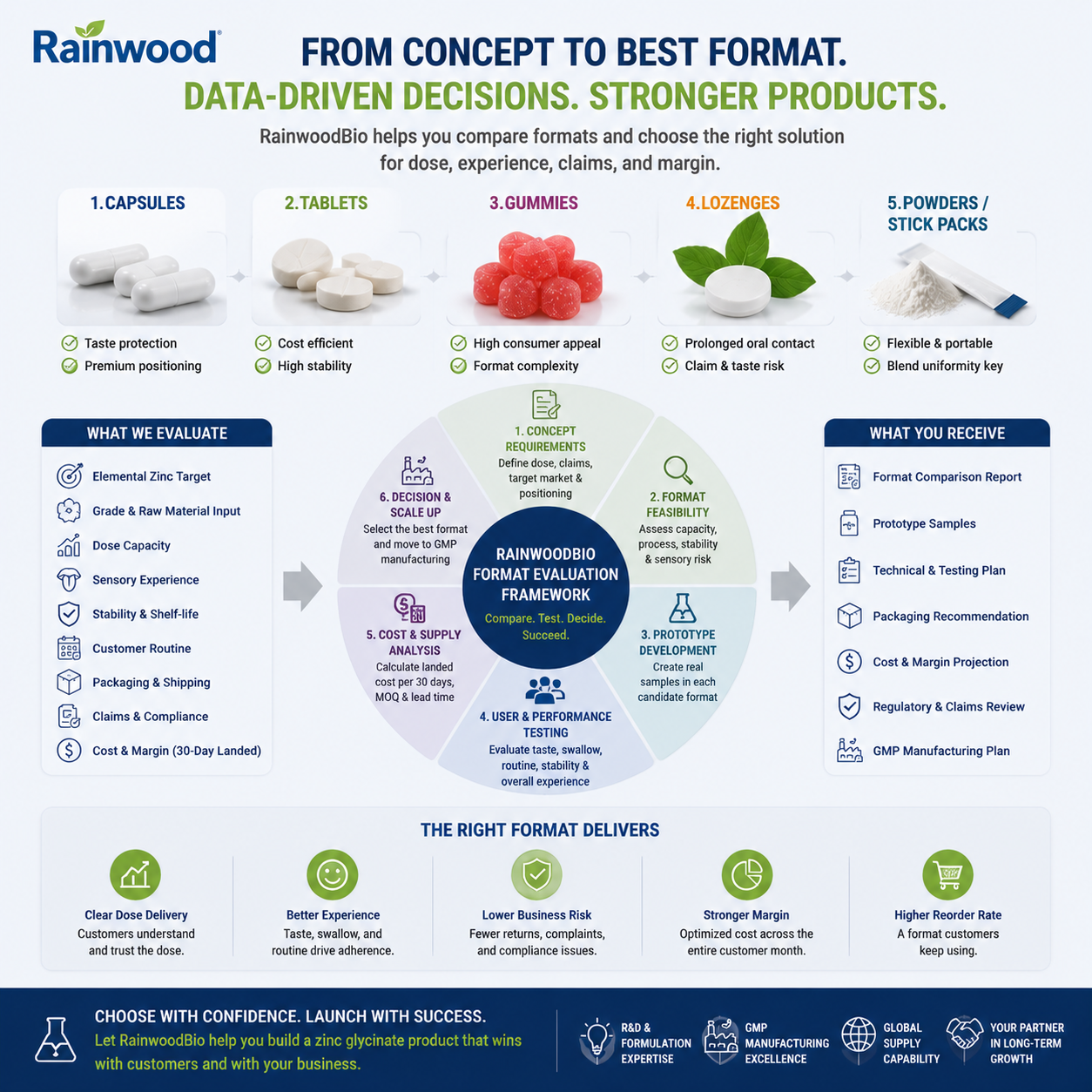
How RainwoodBio can compare formats before commitment
RainwoodBio publishes OEM/private-label capabilities across capsules, tablets, gummies and powder sachets. Its website also describes sample development and laboratory validation before mass production.
For zinc glycinate, RainwoodBio can prepare a decision around:
- elemental target;
- grade and raw-material input;
- physical capacity;
- prototype format;
- sensory or swallowing assessment;
- packaging;
- testing plan;
- MOQ;
- lead time; and
- landed commercial estimate.
The purpose is not to force every concept into every available format. It is to identify which format protects the dose, claim and margin with the fewest hidden compromises.
The decision rule
Choose the format that:
1. delivers the intended elemental zinc clearly;
2. remains stable and testable;
3. creates a realistic daily routine;
4. supports defensible claims;
5. survives shipping and household use; and
6. reaches the target monthly price.
If the format requires you to hide the serving size, reduce the dose without explanation or overpromise the benefit, it has already failed.
Request a multi-format zinc glycinate feasibility comparison. RainwoodBio can compare capsules, tablets and gummies around your exact target before you pay for full artwork or inventory.
Frequently asked questions
1.Which format is best for zinc glycinate?
There is no universal winner. Capsules often simplify taste; tablets may improve efficiency; gummies improve appeal but increase sensory and stability risk; lozenges create specific use and claim challenges.
2.Can a gummy deliver the same dose as a capsule?
Potentially, but equal elemental dose may require different unit counts, taste systems and cost. Prototype both.
3.Are lozenge studies interchangeable across zinc forms?
No. Review the exact zinc form, dose, formulation and endpoint before using study conclusions.
4.Should cost be compared per unit?
Compare per compliant customer month and include packaging, testing, freight and returns.
References
- NIH ODS, Zinc Fact Sheet for Health Professionals: https://ods.od.nih.gov/factsheets/Zinc-HealthProfessional/
- FDA warning letter involving online zinc disease claims: https://www.fda.gov/inspections-compliance-enforcement-and-criminal-investigations/warning-letters/benjaminmcevoycom-607149-05142020
- FDA, Dietary Supplements Guidance and Regulatory Information: https://www.fda.gov/food/guidance-documents-regulatory-information-topic-food-and-dietary-supplements/dietary-supplements-guidance-documents-regulatory-information
- RainwoodBio Private Label Supplements: https://www.rainwoodbio.com/private-label-supplements
*This article is for product-development education. Format, stability, claims and compliance must be reviewed for the exact formula and destination market.*