 EN
EN
Meta title: Can Your High-Absorption Zinc Claim Survive a Challenge?
Meta description: Zinc bisglycinate has promising absorption evidence, but one small study does not prove every formula. Build sharper marketing without turning science into fiction.
“High absorption” is the sentence almost every zinc glycinate brand wants.
It is also where many brands stop reading the research.
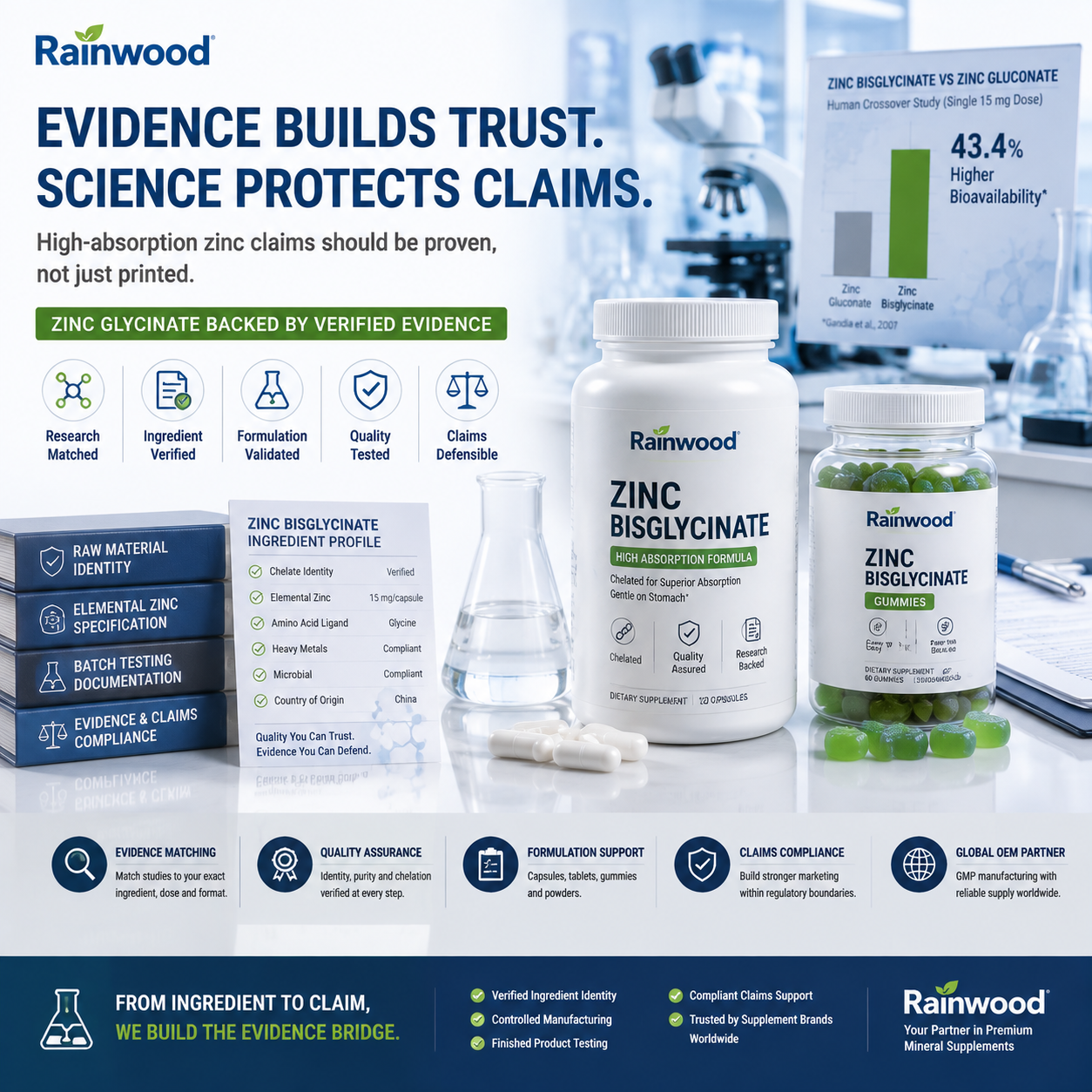
A human crossover study reported greater oral bioavailability for zinc bisglycinate than zinc gluconate after a single 15 mg dose in 12 healthy women. That is commercially interesting evidence. It is not a universal certificate for every zinc glycinate raw material, dose, gummy, capsule, multi-mineral blend or health outcome.
The fastest way to weaken a premium product is to stretch one useful study until it says something it never tested.
Evidence belongs to an exact material and design
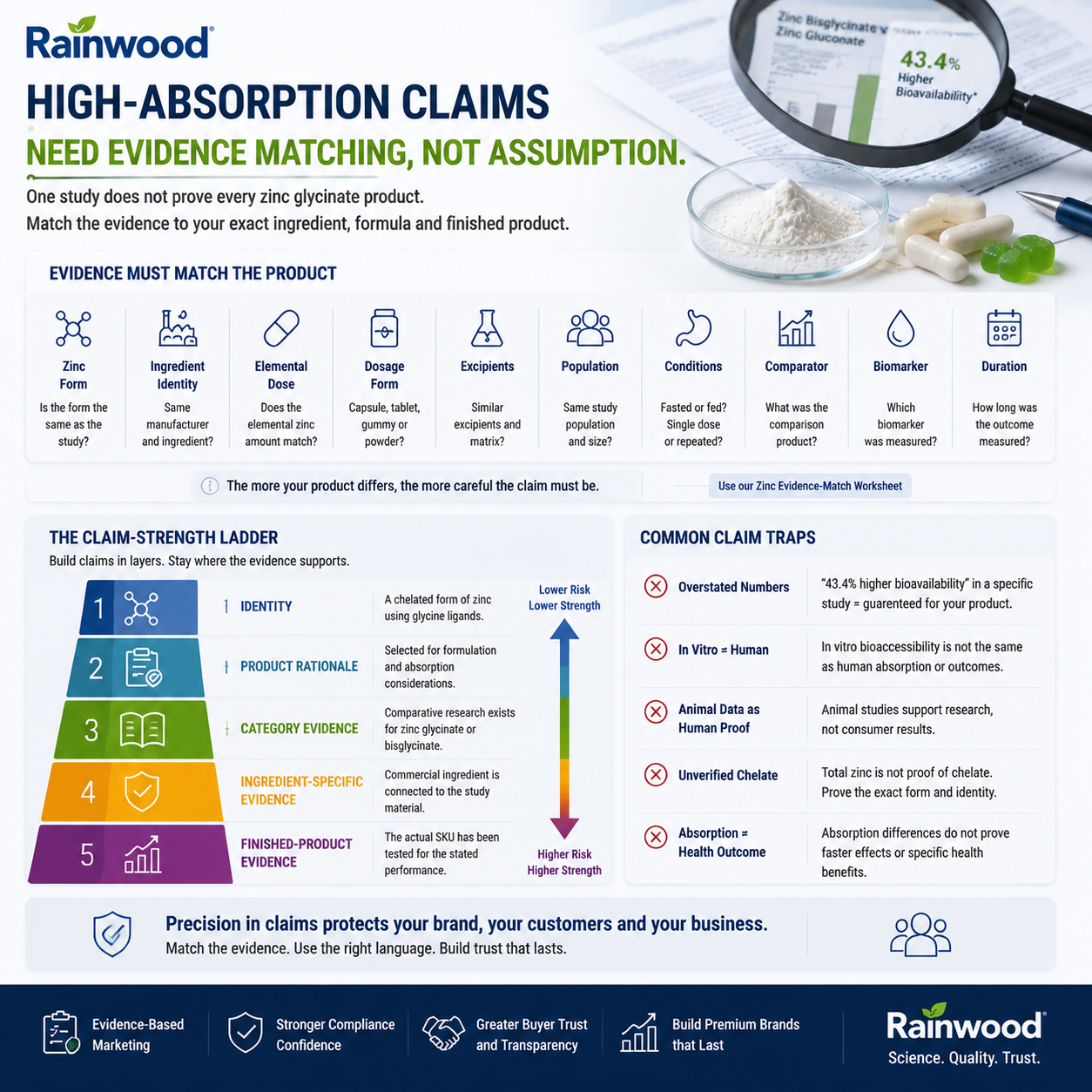
Before borrowing a study headline, compare:
- zinc form;
- manufacturer or ingredient identity;
- elemental dose;
- dosage form;
- excipients;
- single-dose or repeated use;
- fed or fasted conditions;
- study population;
- comparator;
- measured biomarker; and
- outcome duration.
The more your commercial product differs, the more careful the claim must become.
Use our zinc evidence-match worksheet to score the gap.
Trap 1: “43.4% higher bioavailability” becomes a product guarantee
The 2007 study reported a 43.4% increase relative to zinc gluconate in its specific single-dose design. Brands sometimes place the number on packaging without identifying the comparator or context.
That creates a stronger impression: 43.4% better than all zinc, for all users, in the finished product.
If you use a comparative number, state what was compared and ensure the tested material is relevant. Also review whether the intended market permits the exact presentation.
A safer, still-commercial approach may explain that zinc glycinate is selected for its chelated form and cite comparative absorption research in educational content—without pretending the finished SKU itself completed a head-to-head clinical trial.
Trap 2: in vitro bioaccessibility becomes proven human absorption
A 2023 in vitro study found zinc diglycinate had the highest bioaccessibility among the tested supplements. In vitro digestion can help compare behavior under modeled conditions. It is not the same as demonstrating clinical outcomes in customers.
Distinguish:
- disintegration;
- dissolution;
- bioaccessibility;
- absorption;
- bioavailability;
- zinc-status improvement; and
- a health outcome.
These are connected concepts, not interchangeable marketing words.
Read our guide to zinc glycinate test claims.
Trap 3: animal evidence is hidden behind a human headline
Animal studies can support mechanism and research development. They should not be presented as though they prove consumer results.
Always record species, diet, comparator and endpoint in the evidence summary. If the website says “clinical research shows” while the cited paper studied rats or lambs, the trust damage can be worse than using no number at all.
Professional buyers will check.
Trap 4: the exact chelate is never verified
Even a relevant study cannot support a product if the brand cannot establish that its raw material is the form described.
A total-zinc result does not prove the chelate. A supplier brochure does not connect the research ingredient to your batch. A generic “amino acid chelate” description may cover multiple compositions.
Build a chain:
**research material → approved commercial ingredient → purchased batch → finished product → consumer claim**
Break any link and the headline becomes vulnerable.
Trap 5: “better absorbed” becomes “works faster”
Absorption data do not automatically prove customers feel an effect sooner, avoid every stomach complaint or achieve a specific immune, skin, hormone or fertility outcome.
Avoid turning pharmacokinetic differences into untested promises such as:
- immediate immune protection;
- guaranteed deficiency correction;
- faster recovery from illness;
- testosterone enhancement;
- acne treatment; or
- prevention of colds.
High-intent buyers can still be attracted with precise language. Precision makes the premium believable.
The claim-strength ladder
Build marketing in layers:
1. **Identity:** a chelated form of zinc using glycine ligands.
2. **Product rationale:** selected for formulation and absorption considerations.
3. **Category evidence:** comparative research exists for zinc glycinate or bisglycinate.
4. **Ingredient-specific evidence:** the commercial ingredient is connected to the study material.
5. **Finished-product evidence:** the actual SKU has been tested for the stated performance.
Do not write at level five when your file supports only level two.
Explore our finished-product testing approach.
Aggressive marketing that remains defensible
Weak copy says: “Zinc is an essential mineral.”
Reckless copy says: “Absorbs 43% better and prevents illness.”
Stronger copy challenges the buyer with a verifiable problem:
“Your customer is paying for a premium chelate. Can your supplier prove the form, elemental dose and evidence match—or is ‘high absorption’ only printed on the front label?”
That message creates urgency while directing attention to facts your brand can document.
Control affiliates and marketplace content
FDA warning letters have cited online zinc content tied to disease-treatment or prevention claims, including COVID-19 messaging. A compliant bottle does not protect a brand if its website, affiliate, influencer or marketplace images create an unapproved drug claim.
Create an approved language pack with:
- permitted structure/function language;
- prohibited disease language;
- evidence-linked educational statements;
- required context for comparative numbers;
- testimonial rules;
- escalation triggers; and
- monitoring responsibilities.
Review zinc immune-claim red flags before launch.
How RainwoodBio can support the evidence bridge
RainwoodBio publishes capabilities in mineral ingredients and private-label capsules, tablets, gummies and powder formats. Its website also describes laboratory equipment and pre-production sample development.
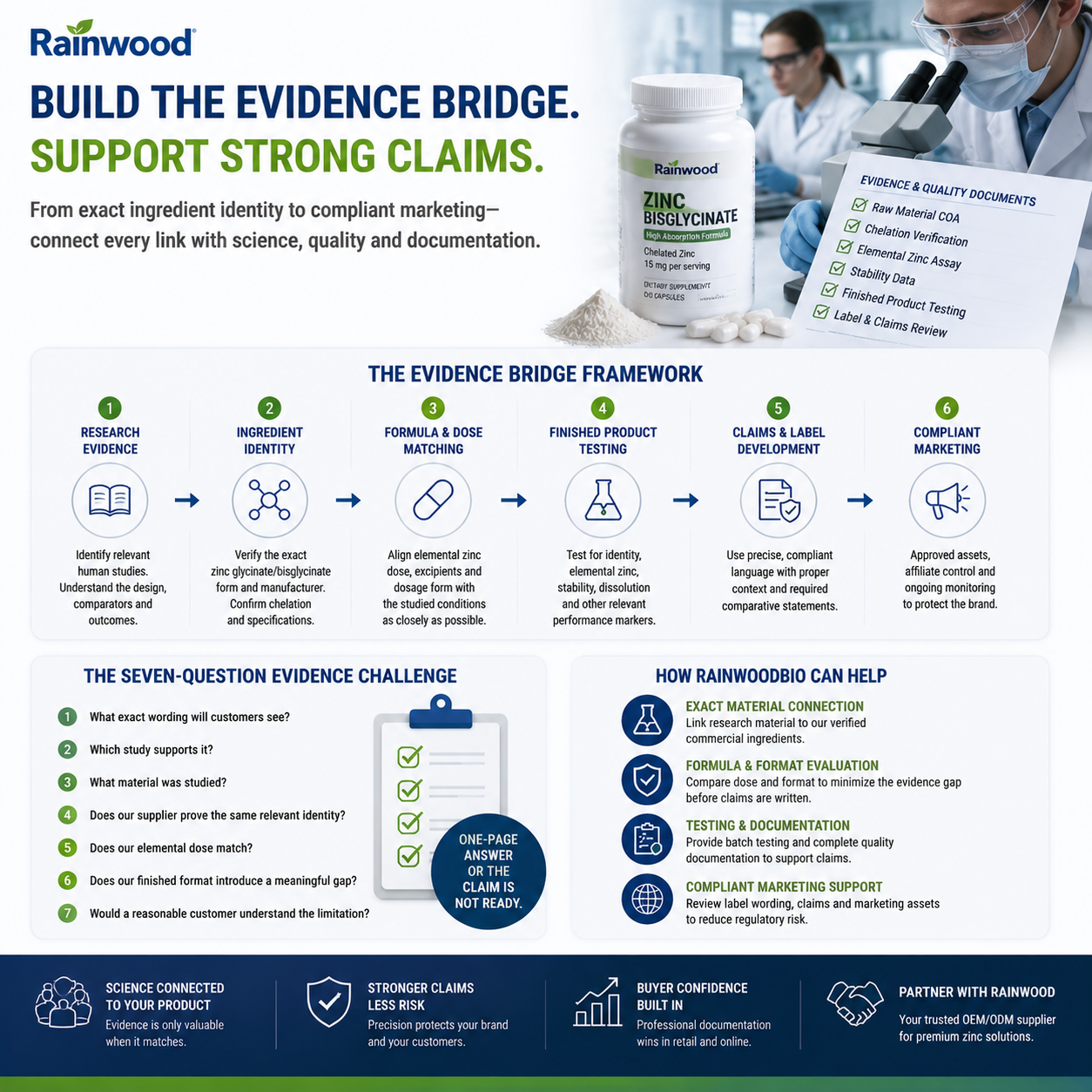
For a high-absorption zinc concept, the useful project file should connect:
- exact raw-material identity;
- elemental zinc specification;
- relevant study material;
- finished dosage form;
- compliant label wording;
- batch testing; and
- controlled sales assets.
RainwoodBio can help compare format and dose before the claim is designed. This matters because a study on one simple oral formulation should not be pasted onto a complex gummy or multi-mineral product without assessing the differences.
The seven-question evidence challenge
Before approving “high absorption,” ask:
1. What exact wording will customers see?
2. Which study supports it?
3. What material was studied?
4. Does our supplier prove the same relevant identity?
5. Does our elemental dose match?
6. Does our finished format introduce a meaningful gap?
7. Would a reasonable customer understand the limitation?
If the marketing team cannot answer in one page, the claim is not ready.
Send RainwoodBio your draft product page for a zinc formula and evidence-gap review. We will help identify which claims can be strengthened, which need qualification and what technical evidence the supplier should provide.
Frequently asked questions
1.Is zinc bisglycinate better absorbed than zinc gluconate?
One small human crossover study reported higher bioavailability under its specific conditions. Do not generalize the exact result to every ingredient or finished product without evaluating comparability.
2.Can I say “highly bioavailable”?
That depends on evidence, wording and market rules. Keep a claim-specific substantiation file and obtain regulatory review.
3.Does chelation guarantee no nausea?
No. Tolerance depends on dose, individual response, timing, other ingredients and format. Avoid guarantees.
4.Can I cite an in vitro study on the product page?
It may support education if clearly described, but it should not be presented as a human clinical outcome.
References
- Gandia et al., zinc bisglycinate versus zinc gluconate human crossover study: https://pubmed.ncbi.nlm.nih.gov/18271278/
- Kupiec et al., in vitro bioaccessibility of zinc supplements: https://pubmed.ncbi.nlm.nih.gov/37375717/
- NIH ODS, Zinc Fact Sheet for Health Professionals: https://ods.od.nih.gov/factsheets/Zinc-HealthProfessional/
- FDA warning letter citing online zinc disease claims: https://www.fda.gov/inspections-compliance-enforcement-and-criminal-investigations/warning-letters/benjaminmcevoycom-607149-05142020
*This article is for B2B educational purposes and does not constitute medical, legal or regulatory advice.*