 EN
EN
Meta title: Zinc Glycinate Supplier Qualification Checklist
Meta description: Qualify zinc glycinate beyond price and a generic COA. Use this pre-production gate for identity, elemental assay, chelation evidence, source control and finished-product testing.
The worst time to discover that your zinc glycinate specification is weak is after 50,000 bottles have been filled.
By then, the label is printed, the marketplace listing is live and the supplier has already been paid. Every unanswered question becomes your inventory problem.
A serious supplier qualification does not ask only, “Can you provide a COA?” It asks whether the supplier can repeatedly deliver the exact material, evidence and production performance your finished product requires.
Gate 1: define the exact commercial material
Write one approved identity containing:
- chemical or regulatory name;
- synonyms that may appear in documents;
- CAS and formula where justified;
- manufacturer legal name and site;
- manufacturer product code;
- grade;
- elemental-zinc range;
- glycine or ligand specification;
- hydration or moisture basis;
- carrier and processing aids; and
- intended markets.
Do not accept a specification titled only “Zinc Glycinate 20%.”
Download the zinc glycinate supplier questionnaire.
Gate 2: map every claim to evidence
Create a table for:
- zinc bisglycinate identity;
- chelated or reacted status;
- elemental content;
- bioavailability language;
- branded-ingredient status;
- non-GMO, allergen or vegan statements;
- country of origin;
- contaminant limits; and
- finished-product label claims.
For each claim, identify the document, test, issuing entity, batch relevance and expiry or review date.
A certificate folder is not useful if nobody knows which sentence each file supports.
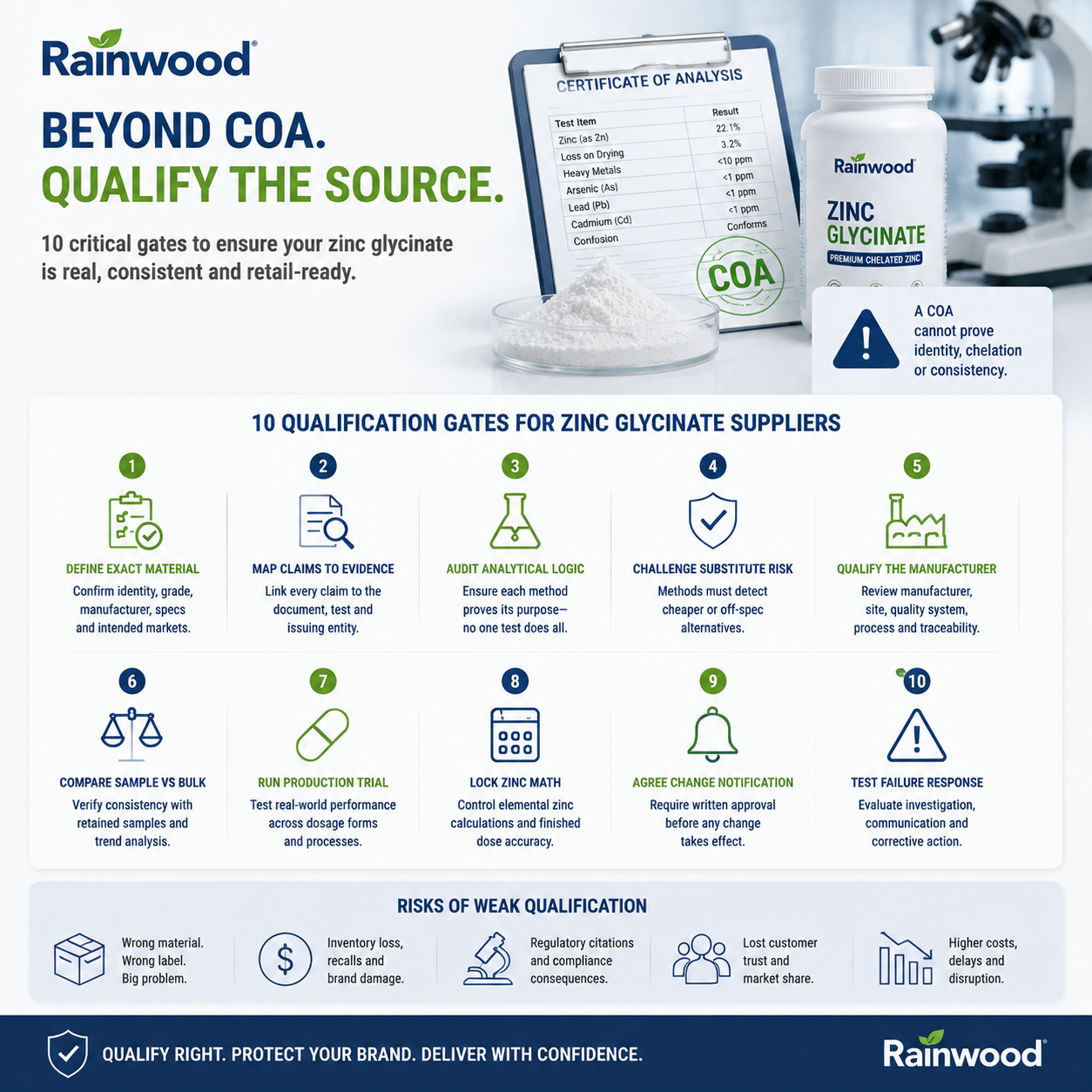
Gate 3: audit the analytical logic
Ask what each method proves.
- AAS or ICP can quantify elemental zinc.
- Moisture testing clarifies the assay basis.
- Suitable ligand testing contributes compositional information.
- Spectroscopic, diffraction or other justified techniques may support identity and chelation.
- Microbiological and contaminant panels address different safety or quality risks.
Do not let one result do five jobs.
Read why total zinc does not prove the chelate.
Gate 4: challenge the cheap substitute
The supplier’s method should be able to distinguish the approved material from plausible alternatives, including:
- zinc oxide plus glycine;
- another zinc salt;
- a lower elemental grade;
- material with extra carrier;
- a different manufacturer’s generic grade; and
- an off-ratio or incompletely reacted batch.
If the test plan cannot fail these alternatives, it offers little protection against substitution.
Gate 5: qualify the manufacturer, not only the trader
A polished distributor may have no control over reaction, drying, carrier addition or change notification.
Obtain:
- manufacturer identity;
- site address;
- quality-system evidence relevant to the product;
- process-flow summary;
- audit or questionnaire response;
- complaint and recall process;
- change-control commitment;
- capacity and lead time;
- original batch documents; and
- traceability route.
The trader can remain your commercial partner. The manufacturer must still be visible in the technical chain.
Gate 6: compare sample and bulk
The approved sample should have its own lot identity and document pack. When bulk arrives, compare predefined attributes and tests.
Keep retained samples from:
- development material;
- first commercial raw-material lot;
- first finished batch; and
- later trend batches.
Investigate differences in color, taste, solubility, particle behavior or processing. These observations do not prove fraud, but they can reveal changes that a total-zinc result misses.
Review the trademarked-chelate bait-and-switch.
Gate 7: run a production-reality trial
Raw-material approval is not finished-product approval.
Test whether the selected grade:
- flows into capsules;
- compresses into tablets;
- disperses in powder;
- survives gummy processing;
- creates metallic taste;
- interacts with colors, flavors or other nutrients;
- meets uniformity expectations; and
- remains within specification through shelf life.
A supplier can be technically correct that the material meets its raw specification while the ingredient still fails your application.
Gate 8: lock elemental-zinc math
Record:
- target elemental zinc per unit and per serving;
- supplier assay range;
- raw-material input calculation;
- batch-size calculation;
- overage policy;
- theoretical yield; and
- finished-product release range.
FDA has cited manufacturers for failures involving zinc master manufacturing records, declared quantities and finished-product specifications. Treat the formula record as a controlled manufacturing document, not a salesperson’s spreadsheet.
Use our elemental-zinc label guide.
Gate 9: agree on change notification
Require written approval before changes to:
- manufacturer or site;
- starting zinc source;
- glycine source;
- reaction process;
- carrier;
- elemental specification;
- analytical method;
- packaging;
- shelf life; or
- regulatory status.
Define notification timing and requalification requirements. “Equivalent” cannot be decided after the changed material reaches your factory.
Gate 10: test the supplier’s failure response
Ask for a mock scenario: a finished batch tests above zinc specification. Who investigates? Which retained samples are tested? How is root cause assigned? Who pays for rework, disposal or replacement? How quickly are documents provided?
The answer reveals more than another perfect COA.
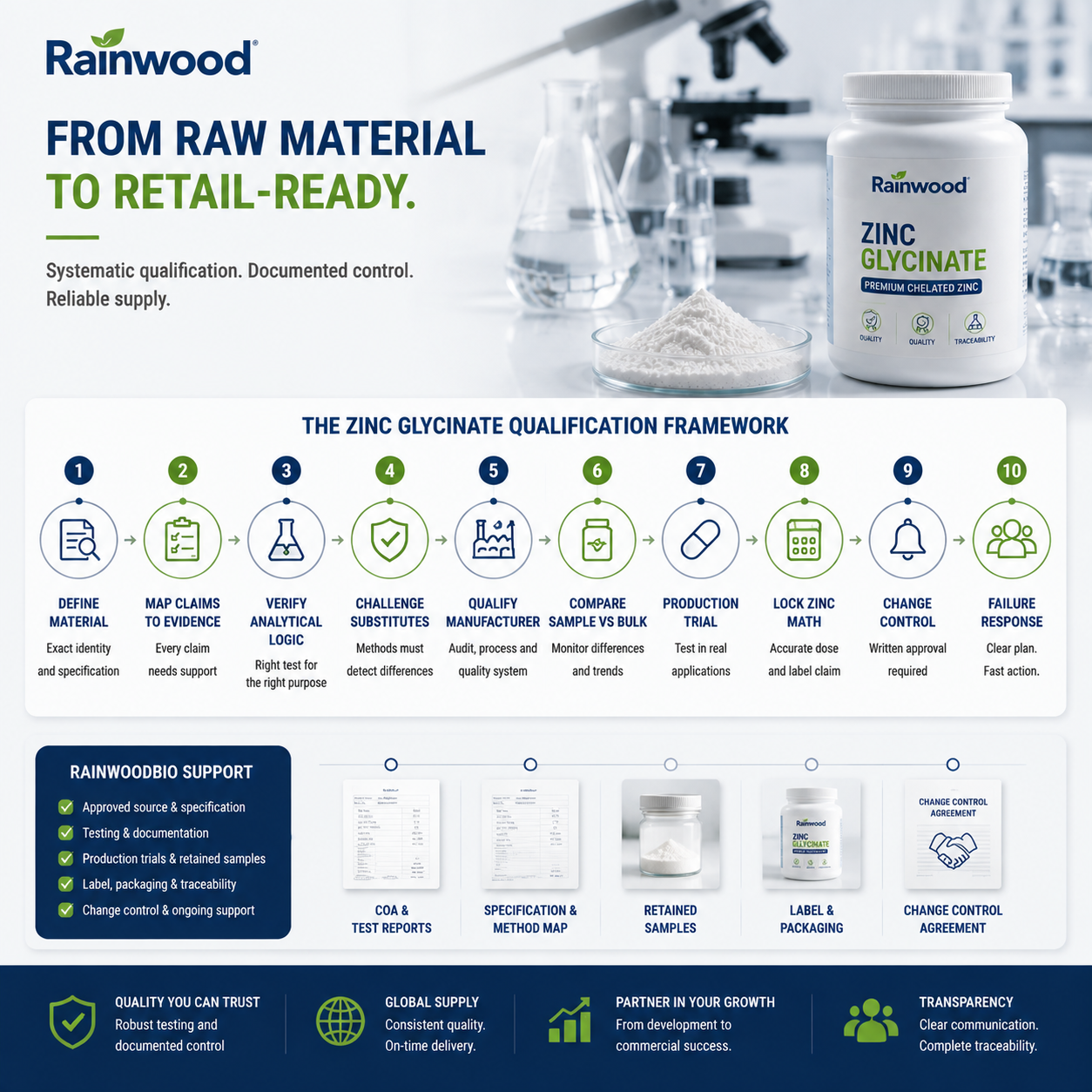
How RainwoodBio can organize the qualification package
RainwoodBio’s website describes work in mineral ingredients and private-label supplements since 2006, with supplier management, laboratory equipment, sample development, production and traceability capabilities.
For zinc glycinate, RainwoodBio can organize a project file containing:
- approved-source record;
- raw-material specification;
- test-method map;
- sample approval;
- formula calculation;
- production-trial record;
- finished-product specification;
- label and packaging version;
- retained samples; and
- change-control agreement.
The exact certification scope and analytical package should be verified for the relevant site, product and batch rather than assumed from a general company statement.
Explore RainwoodBio’s private-label manufacturing service.
The first-batch release meeting
Bring purchasing, quality, formulation, regulatory and marketing into one meeting. Review:
- whether the delivered source matches approval;
- whether the batch passes identity and composition;
- whether the finished dose matches the label;
- whether sensory and processing results match the sample;
- whether claims remain supported; and
- whether all deviations are closed.
No department should discover the final formula from the printed bottle.
Send RainwoodBio your current supplier pack for a pre-production zinc qualification review. We can help turn gaps into a prioritized document, sample and testing request before the first commercial batch.
Frequently asked questions
1.Is a third-party COA enough to qualify a supplier?
No. It is one evidence item. Qualification also covers source, process, specification, methods, application performance, change control and failure response.
2.Must I audit every manufacturer in person?
Use a risk-based approach. Questionnaires, document review, remote assessment, third-party audits and on-site audits can be combined depending on risk and volume.
3.When can routine testing be reduced?
Only after sufficient qualification, consistent history and documented risk assessment. Identity and legally required controls must still be maintained.
4.What should happen if the bulk differs from the sample?
Quarantine, investigate against predefined criteria and obtain cross-functional approval before use. Do not normalize unexplained differences.
References
- FDA Warning Letter to Sun Ten Laboratories: https://www.fda.gov/inspections-compliance-enforcement-and-criminal-investigations/warning-letters/stpca-inc-dba-sun-ten-laboratories-645336-04072023
- FDA, Current Good Manufacturing Practices for Dietary Supplements: https://www.fda.gov/food/dietary-supplements/current-good-manufacturing-practices-cgmps-dietary-supplements
- USP, Dietary Supplement Monographs Prioritized for Development: https://www.usp.org/sites/default/files/usp/document/get-involved/monograph-modernization/ds-prioritized-list-monographs-for-development.pdf
- RainwoodBio official website: https://www.rainwoodbio.com/
*This article is for B2B quality and procurement education. Qualification controls should be adapted by qualified professionals to the exact supply chain and destination market.*