 EN
EN

Meta title: The Hidden Copper Risk in 50 mg Zinc Formulas
Meta description: High-dose zinc looks powerful on a label, but long-term intake can interfere with copper absorption. Learn how brands can design a premium formula without dose inflation.
The easiest way to make a zinc supplement look stronger is to increase the number on the front.
10 mg becomes 15 mg. Then 25 mg. Then 50 mg—because competitors are doing it and shoppers often equate more milligrams with more value.
But zinc is not protein powder. More is not automatically more premium.
NIH’s Office of Dietary Supplements lists an adult tolerable upper intake level of 40 mg per day from all sources for healthy people. It also notes that 50 mg or more taken for weeks can interfere with copper absorption, reduce immune function and lower HDL cholesterol.
A “maximum strength” label can therefore create the exact nutritional imbalance a premium product should help customers avoid.
The front label ignores total daily intake
Your customer may already receive zinc from:
- food;
- a multivitamin;
- an immune formula;
- a beauty supplement;
- a sports product;
- fortified foods; and
- cold remedies.
A stand-alone 50 mg product does not enter an empty system. It stacks on top of everything else.
Use our zinc daily-intake review sheet before selecting the dose.
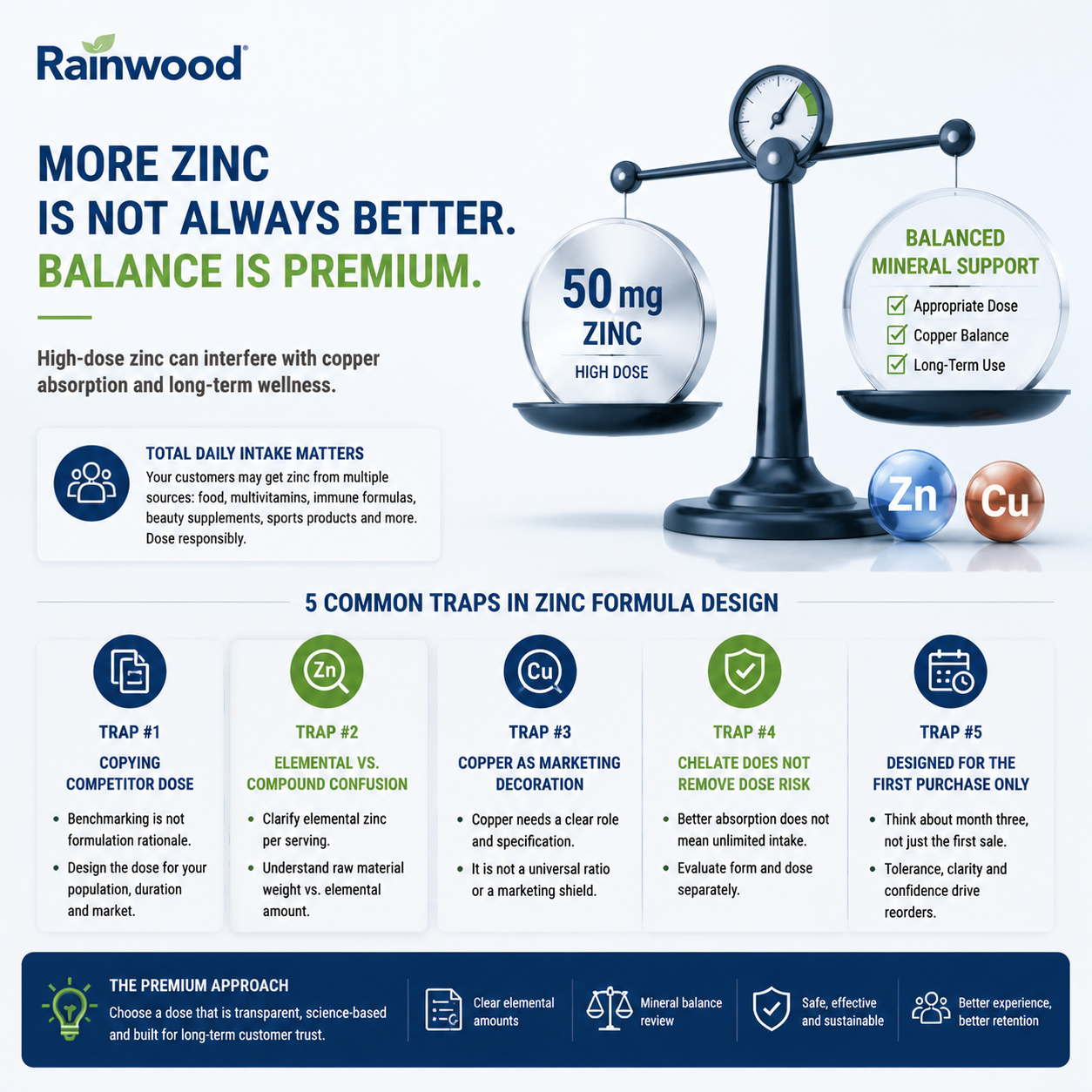
Trap 1: the brand copies a competitor’s number
Competitor benchmarking is useful for price, format and positioning. It is a dangerous substitute for formulation rationale.
You rarely know whether the competing product is intended for short-term professional use, whether its directions include specific limitations, or whether its dose was chosen only because a larger number won clicks.
Build the dose from:
- target population;
- expected dietary and supplemental exposure;
- intended duration;
- market reference values;
- allowable claims;
- tolerability;
- companion nutrients; and
- professional or consumer channel.
“The bestseller has 50 mg” is not a safety assessment.
Trap 2: compound weight makes a high dose look moderate
The elemental-versus-compound confusion cuts both ways. A concept sheet may say “50 mg zinc glycinate,” and the team assumes this means 50 mg elemental zinc. Alternatively, the label may promote 50 mg of raw material while the Supplement Facts declares a much smaller zinc amount.
Clarify both numbers before discussing copper:
- elemental zinc per serving and per day;
- total zinc glycinate raw material required.
Read 30 mg zinc glycinate versus 30 mg elemental zinc.
Trap 3: copper is added as marketing decoration
Some brands react to zinc-copper antagonism by adding a token amount of copper and declaring the problem solved.
The appropriate decision is not a universal zinc-to-copper ratio copied from a forum. It requires consideration of dose, duration, population, other products and market requirements. Adding copper also creates new questions around source, elemental calculation, interaction, taste, stability and testing.
If copper is included, give it a defined role and specification. Do not use it as a decorative shield for an unnecessarily aggressive zinc dose.
Trap 4: “gentle chelate” is used to dismiss dose risk
Zinc glycinate may be selected for absorption and tolerance considerations. That does not erase the biological consequences of elemental zinc exposure.
A better-tolerated form can even make chronic excessive intake easier because the customer experiences fewer immediate reasons to stop. Form and dose must be evaluated separately.
Avoid messages implying that chelation makes any amount safe.
Trap 5: the product is designed for the first purchase, not month three
High-potency language can win the initial click. Reorder depends on whether customers can use the product confidently over time.
Common reasons for poor continuation include:
- nausea or stomach discomfort;
- confusion about taking with food;
- concern after discovering the upper limit;
- overlap with other supplements;
- unclear duration; and
- professional advice to stop the product.
A product that creates anxiety after the customer reads the label is not premium. It is an expensive acquisition campaign feeding a weak retention engine.
Build three dose scenarios
Instead of arguing over one number, develop three concepts:
1. Daily maintenance: a moderate dose designed for routine consumer use.
2. Targeted high-potency: a stronger product with carefully defined market, directions and review.
3. Professional-channel formula: a product intended to be used with qualified guidance.
For each, compare:
- customer profile;
- elemental zinc;
- duration;
- total exposure;
- copper rationale;
- serving format;
- warnings or instructions;
- evidence and claims; and
- monthly cost.
The best commercial option may be the one customers understand and reorder—not the one with the biggest integer.
Explore custom mineral formula development.
Turn restraint into a stronger sales story
Moderate dosing does not need timid marketing.
Try this positioning:
“We refused the 50 mg arms race. Our formula is built around transparent elemental zinc, realistic daily use and a documented mineral-balance review.”
That statement challenges inflated competitors without accusing any brand of wrongdoing. It also gives sophisticated customers a reason to trust the product.
Show:
- the elemental amount clearly;
- why the dose was selected;
- days of supply;
- whether copper is included and why;
- how overlapping products should be considered; and
- where customers can obtain professional advice.
Keep disease claims out of the dose story
High dose plus aggressive immune language is a risky combination. FDA has issued warning letters involving zinc content associated with disease-treatment or prevention claims.
Do not imply that a larger amount prevents infections, cures colds, treats acne, raises testosterone or corrects a diagnosed deficiency without the appropriate regulatory pathway and evidence.
Use our supplement claim review checklist.
How RainwoodBio can make the formula commercially coherent
RainwoodBio publishes private-label capabilities across capsules, tablets, gummies and powder products, together with sample development and laboratory testing.
For a zinc glycinate project, RainwoodBio can help translate the dose decision into:
- approved elemental-zinc target;
- raw-material input calculation;
- optional copper concept review;
- realistic serving format;
- Supplement Facts data;
- finished-product testing plan;
- packaging and directions; and
- batch traceability.
The company’s published AAS capability is relevant to elemental-mineral verification, but the exact method, matrix and acceptance range should be agreed before commercial production.
The formula-approval questions
Do not approve the SKU until the team can answer:
- Why this dose?
- For whom?
- For how long?
- What other zinc sources might overlap?
- What is the copper rationale?
- Does the format encourage correct use?
- Can the label explain the decision without medical promises?
- What result releases the finished batch?
Request a zinc dose, copper and format feasibility review. RainwoodBio can compare multiple formula scenarios before you invest in samples and packaging.
Frequently asked questions
1.Is 50 mg zinc unsafe for everyone?
Not every use can be judged from one number, especially medical use under professional care. For general consumer products, total exposure, duration and the adult UL require serious review.
2.Should every zinc product include copper?
No universal rule fits every dose, duration and customer. Copper inclusion needs a clear formulation and regulatory rationale.
3.Does zinc glycinate avoid copper interference?
Do not assume the form eliminates an effect associated with excessive elemental zinc intake. Evaluate dose and duration separately from source.
4.What dose sells best?
The best commercial dose is one that meets the target customer’s need, supports defensible claims, fits the format and earns repeat use—not simply the largest number.
References
- NIH ODS, Zinc Fact Sheet for Health Professionals: https://ods.od.nih.gov/factsheets/Zinc-HealthProfessional/
- NIH ODS, Copper Fact Sheet for Health Professionals: https://ods.od.nih.gov/factsheets/Copper-HealthProfessional/
- FDA, Dietary Supplements Guidance and Regulatory Information: https://www.fda.gov/food/guidance-documents-regulatory-information-topic-food-and-dietary-supplements/dietary-supplements-guidance-documents-regulatory-information
- RainwoodBio Private Label Supplements: https://www.rainwoodbio.com/private-label-supplements
*This article is educational and does not provide medical advice. Dose and safety decisions should receive qualified market-specific review.*