 EN
EN
Meta title: How to Switch Zinc Glycinate Suppliers Safely
Meta description: A new zinc glycinate supplier can change elemental input, chelation evidence, taste, claims and stability. Use this controlled transfer plan before switching bulk supply.
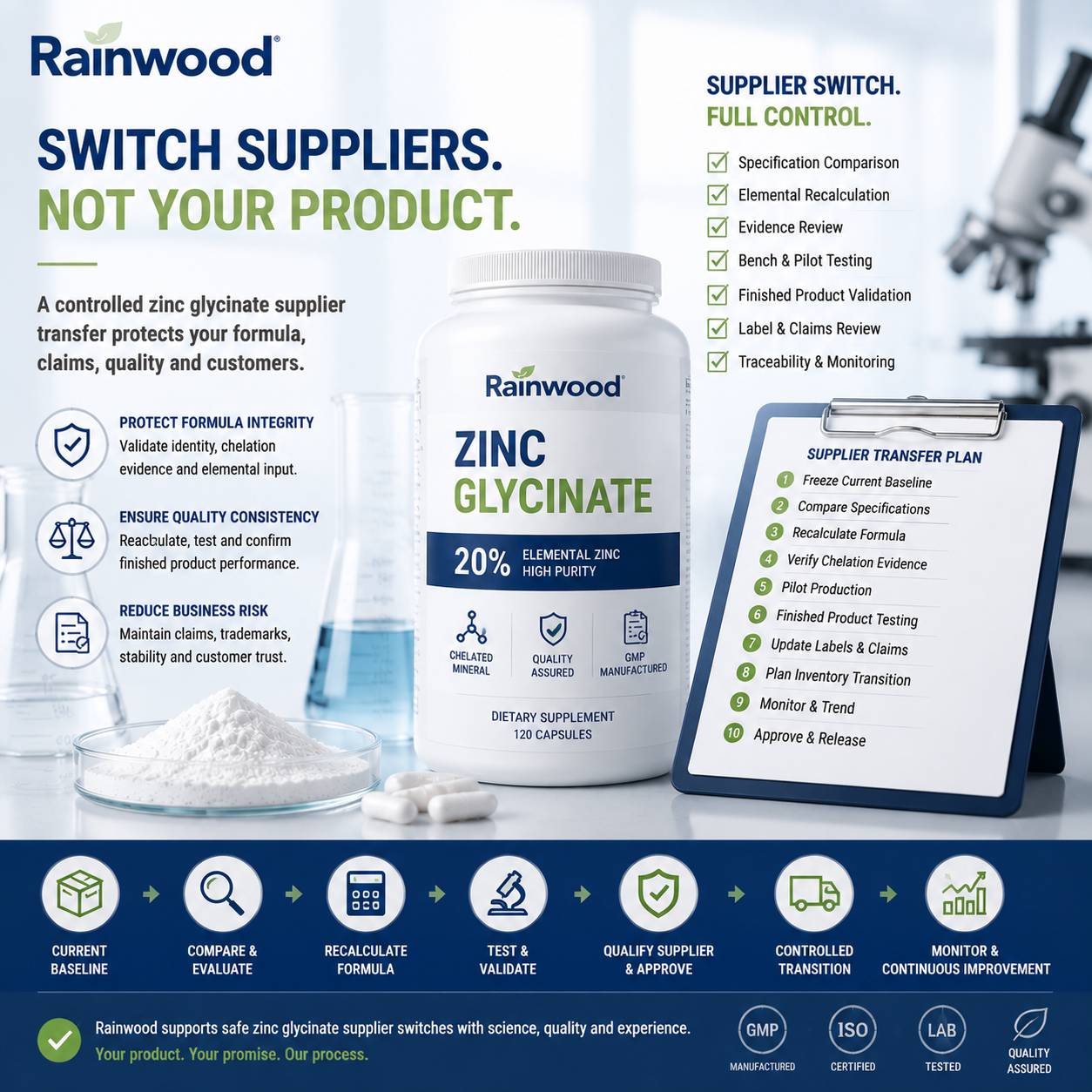
Your current zinc supplier raises the price, misses delivery or stops answering technical questions. A new supplier promises the same material, faster lead time and 20% savings.
It sounds like a purchasing decision.
It is actually a product change.
The new powder may differ in elemental standardization, carrier, moisture, particle properties, taste, reaction process, manufacturer evidence and trademark status. If you change the purchase order without revalidating the finished product, the label can remain identical while the product underneath it changes.
Step 1: freeze the current product baseline
Before requesting alternatives, assemble:
- current manufacturer and grade;
- approved raw specification;
- recent COAs;
- identity and chelation evidence;
- elemental input calculation;
- finished-product specification;
- batch records;
- stability data;
- complaint trends;
- label and claims;
- retained samples; and
- processing observations.
You cannot prove equivalence to a baseline nobody documented.
Use our zinc supplier-transfer checklist.
Step 2: separate “same name” from “same grade”
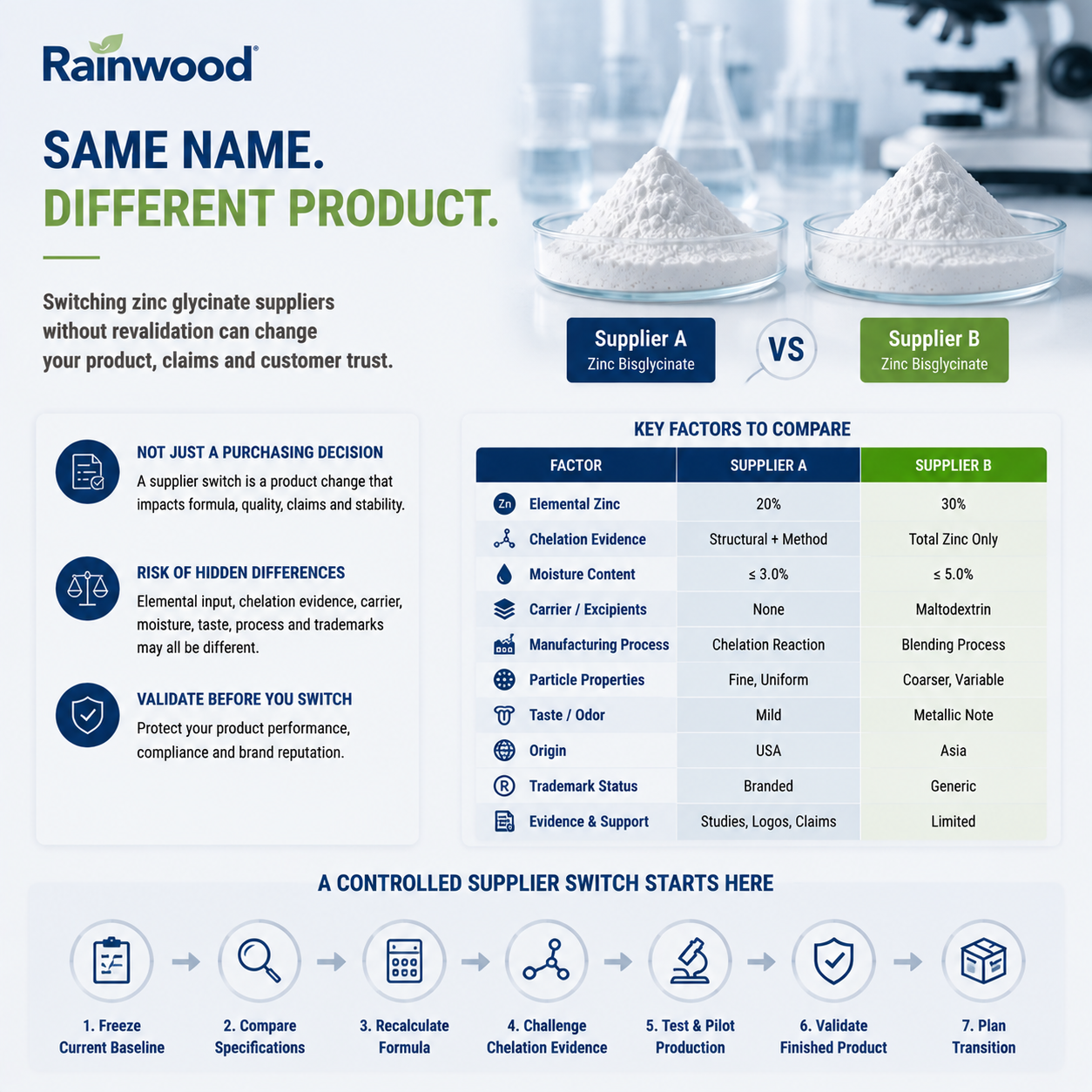
Both materials may be called zinc bisglycinate and still differ commercially.
Compare:
- exact identity and synonyms;
- manufacturer and site;
- elemental zinc range;
- glycine or ligand controls;
- moisture basis;
- carrier and excipients;
- process summary;
- free starting materials;
- identity methods;
- contaminant limits;
- shelf life; and
- country of origin.
Create a side-by-side gap table. Do not hide differences inside “meets specification” if the old specification never controlled them.
Step 3: recalculate the formula
A switch from 20% to 30% elemental material changes raw input. A switch in the other direction adds powder volume and can affect capsule fill or tablet compression.
Recalculate:
- raw material per unit;
- batch input;
- excipient adjustment;
- theoretical yield;
- overage;
- serving size; and
- finished-product target.
Read the elemental-zinc label math brands get wrong.
Step 4: challenge the chelation evidence
The existing supplier may have provided structural or branded-ingredient evidence. The new supplier may provide only total zinc.
Do not allow an acceptable AAS result to close an identity gap. Ask which evidence supports the new chemical form and whether the methods can distinguish a physical zinc-and-glycine blend.
If your marketing says “fully reacted,” “true chelate,” “patented” or “clinically studied,” revalidate each phrase against the new material.
Review why total zinc does not prove the chelate.
Step 5: audit trademark and evidence continuity
If the current ingredient is branded, switching to a generic grade can remove:
- permission to use the trademark;
- access to supplier studies;
- approved logos;
- claim language;
- formulation support; and
- distributor recognition.
A generic alternative may still be suitable, but packaging and product-page claims must be revised before supply changes.
Read the branded-chelate bait-and-switch warning.
Step 6: run a bench comparison
Blind-code old and new materials. Compare:
- appearance;
- odor;
- taste;
- solubility or dispersion under defined conditions;
- bulk density;
- flow;
- moisture;
- elemental zinc;
- identity evidence; and
- application-specific behavior.
Differences are not automatically failures. They identify what must be understood before scale-up.
Step 7: produce a controlled pilot
Use representative equipment and the recalculated formula. Do not hand-blend a tiny sample and call the transfer complete.
For capsules, evaluate flow, fill weight and uniformity. For tablets, evaluate compression, friability and disintegration. For gummies, evaluate flavor, texture, water activity and zinc distribution. For powders, evaluate segregation and serving uniformity.
Compare the pilot to retained current-product samples using predefined acceptance criteria.
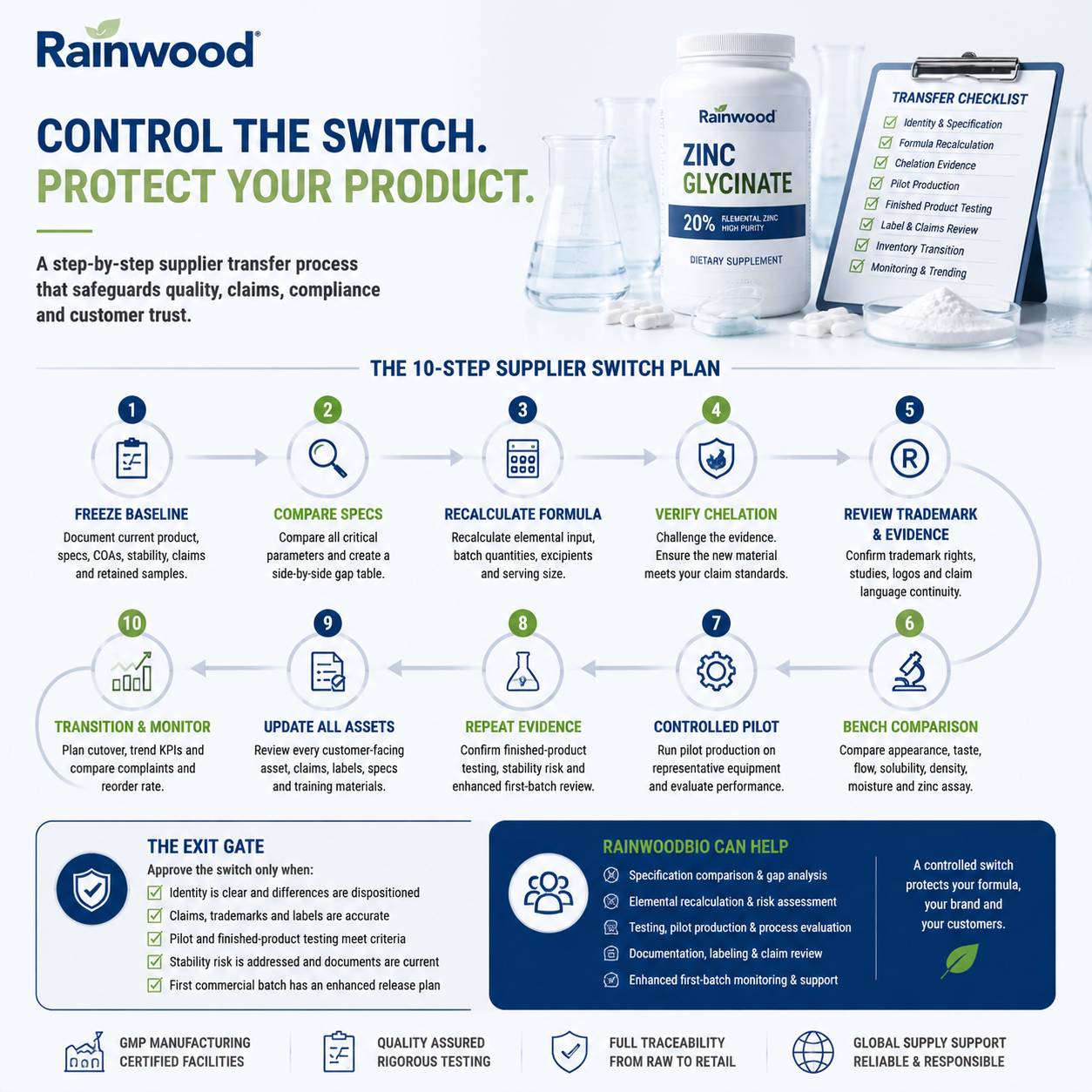
Step 8: repeat the finished-product evidence
At minimum, confirm the declared elemental zinc in the new finished matrix through an appropriate plan. Revisit identity, contaminants, microbiology, performance and stability according to the change risk.
Do not assume the old stability file fully covers a material with different moisture, carrier or particle behavior.
Place the first commercial batch under enhanced review and retain sufficient samples.
Step 9: update every customer-facing asset
Review:
- Supplement Facts;
- ingredient list;
- front label;
- trademark logos;
- product title;
- marketplace images;
- website copy;
- clinical references;
- FAQs;
- practitioner dossiers;
- distributor specifications; and
- customer-service scripts.
The bottle is only one place where the old supplier may still exist.
Step 10: plan the inventory transition
Avoid mixing old and new raw materials or finished lots without deliberate controls. Define cutover date, lot coding, warehouse separation, customer communication and complaint comparison.
For the first months, trend:
- assay;
- production deviations;
- sensory complaints;
- tolerance comments;
- returns;
- customer questions; and
- reorder rate.
The absence of immediate complaints is not proof of equivalence, but trending can reveal commercial consequences missed in the laboratory.
Do not switch for savings you cannot measure
Calculate total benefit after:
- requalification tests;
- pilot production;
- artwork changes;
- stability work;
- increased input weight;
- new packaging;
- transition waste;
- extra inventory; and
- risk of delayed launch.
A 20% lower raw-material price may save very little per bottle. A controlled switch can still be worthwhile, but the business case should use real finished-product economics.
Explore the hidden cost behind cheap zinc glycinate.
How RainwoodBio can manage the transfer
RainwoodBio publishes a workflow connecting supplier management, sample development, laboratory testing, production, packaging, documents and traceability. Those capabilities can be applied to a controlled zinc glycinate transfer.
The transfer file can include:
- old-versus-new specification matrix;
- elemental-input recalculation;
- source qualification;
- analytical-evidence review;
- bench comparison;
- pilot-batch results;
- finished-product release;
- artwork and claim review;
- retained samples; and
- enhanced first-batch monitoring.
RainwoodBio’s published multi-format capabilities also allow the team to see whether the new grade changes capsule, tablet or gummy feasibility before mass production.
The exit gate
Approve the switch only when:
- the new identity is clear;
- every material difference has a disposition;
- the formula calculation is updated;
- claims and trademark use remain valid or are revised;
- the pilot meets application criteria;
- the finished-product testing passes;
- stability risk is addressed;
- documents and artwork are current; and
- the first commercial batch has an enhanced release plan.
“Same name, lower price” is not an exit gate.
Send RainwoodBio the old and new specifications for a zinc glycinate supplier-switch assessment. We can help identify which differences affect formula, testing, claims and production before the cutover date.
Frequently asked questions
1.Can I switch if both suppliers meet 20% elemental zinc?
Possibly, but equal elemental content does not prove equivalent chemical form, carrier, process, taste, trademark status or application performance.
2.Must I change the label?
Not always. Review whether the source declaration, elemental amount, ingredient list, trademark and claims remain accurate.
3.Do I need a new stability study?
Use a documented risk assessment. Material changes may require new or bridging stability work for the exact finished product.
4.How should I handle the first commercial lot?
Use enhanced sampling, testing, retained samples and cross-functional review, then trend production and complaints.
References
- FDA, Current Good Manufacturing Practices for Dietary Supplements: https://www.fda.gov/food/dietary-supplements/current-good-manufacturing-practices-cgmps-dietary-supplements
- FDA Warning Letter to Sun Ten Laboratories: https://www.fda.gov/inspections-compliance-enforcement-and-criminal-investigations/warning-letters/stpca-inc-dba-sun-ten-laboratories-645336-04072023
- USP, Zinc Glycinate listed among prioritized dietary supplement monographs: https://www.usp.org/sites/default/files/usp/document/get-involved/monograph-modernization/ds-prioritized-list-monographs-for-development.pdf
- RainwoodBio official website: https://www.rainwoodbio.com/
*This article is for B2B supplier-transfer education. Technical, stability, labeling and regulatory decisions should be made for the exact material, product and destination market.*