 EN
EN

Meta title: Is Your Inositol Formula Really Clinically Proven?
Meta description: Learn how inositol brands stretch study headlines across different forms, doses, ratios and formulas—and how professional buyers can test the evidence.
“Clinically proven” may be the most profitable two-word shortcut in the inositol market.
It can also be the weakest sentence in your dossier.
The phrase often hides a chain of substitutions:
- a study used Myo-Inositol, but the product uses a mixed blend;
- a study used 2–4 grams daily, but the product delivers a fraction;
- a study used Myo-Inositol plus folate, but the label adds six other ingredients;
- a study investigated women with a defined condition, but the marketing promises results for everyone; or
- one positive outcome is promoted while null findings disappear.
The paper can be real while the product claim is still misleading.
Headline trick #1: “inositol” replaces the exact studied material
The literature includes Myo-Inositol, D-Chiro-Inositol, combinations, different ratios and multi-ingredient formulas.
A shared family name does not make every form clinically interchangeable.
Record:
- exact material;
- manufacturer or branded source where reported;
- dose;
- ratio;
- dosage form;
- companion ingredients; and
- dosing schedule.
Then compare them with the commercial product.
Use our inositol evidence-to-formula checklist.
Headline trick #2: the ratio matches but the dose does not
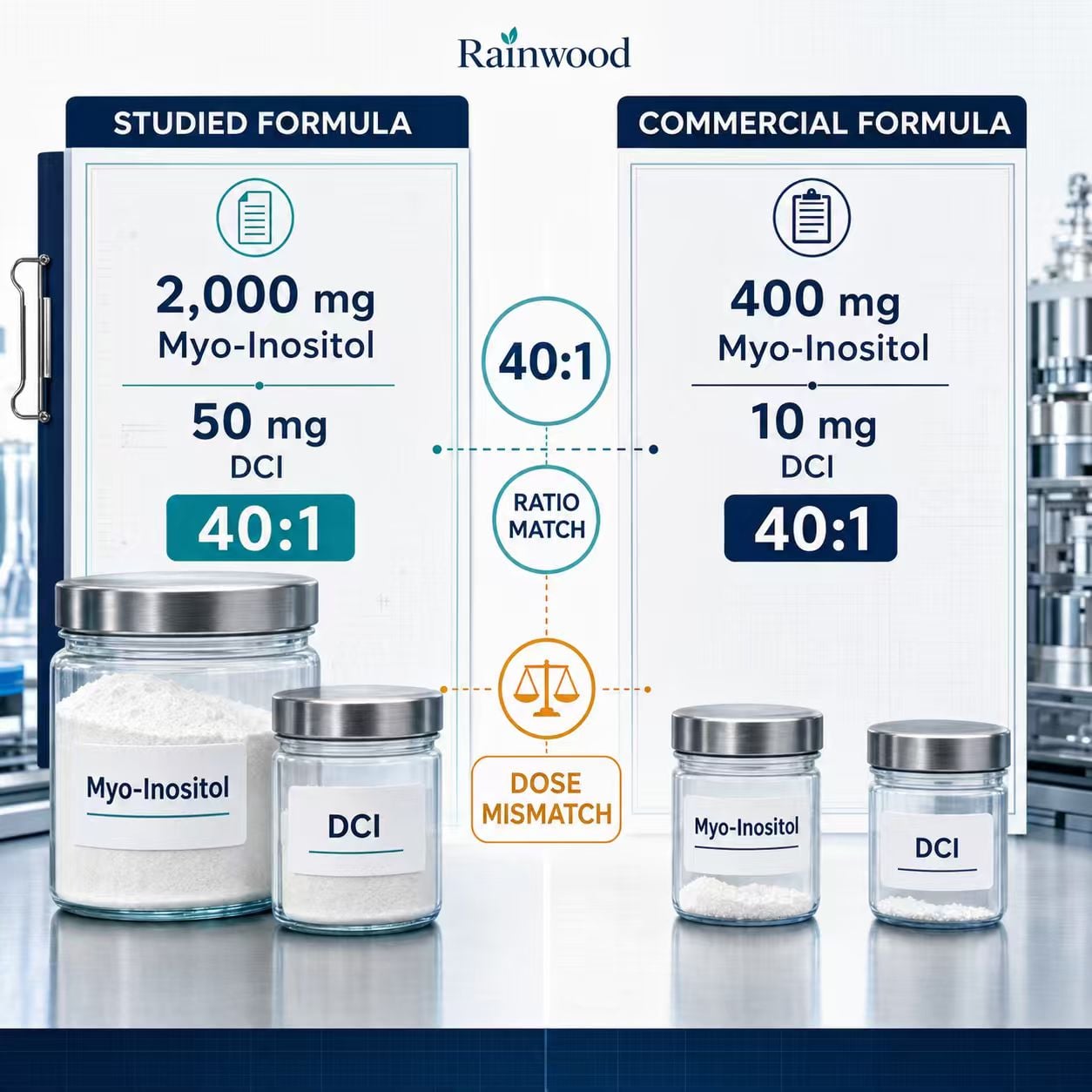
A paper may use 2,000 mg Myo-Inositol plus 50 mg DCI. A product may use 400 mg plus 10 mg.
Both are 40:1.
The smaller product cannot borrow the study simply because the ratio survives.
Match absolute daily quantities before discussing clinical relevance.
Headline trick #3: one positive endpoint becomes a universal benefit
The 2024 systematic review prepared for the international evidence-based PCOS guideline evaluated 30 trials. It found possible benefits for some metabolic measures and potential benefits for some reproductive outcomes, while inositol may have no effect on other outcomes. Its overall conclusion was that evidence was limited and inconclusive.
That balanced conclusion rarely fits on an Amazon image.
A responsible evidence summary includes:
- primary outcome;
- secondary outcomes;
- null findings;
- magnitude;
- uncertainty;
- study duration;
- participant number;
- comparison group; and
- adverse events.
Do not market only the endpoint that makes the bottle look inevitable.
Headline trick #4: “non-inferior to metformin” becomes “better than medication”
Different reviews and trials have produced different comparisons and levels of certainty. A statement about one outcome cannot be converted into a claim that a supplement replaces prescription treatment.
Avoid:
- “natural metformin”;
- “works better than medication”;
- “replace your prescription”; and
- “drug-free treatment for PCOS.”
These phrases are powerful precisely because they cross into dangerous territory.
Headline trick #5: the disclaimer is asked to repair the headline
If the headline communicates treatment, a disclaimer does not reverse the dominant message.
FDA’s warning letter to an inositol seller cited claims involving PCOS fertility, blood sugar, anxiety and depression. The existence of research did not turn those disease claims into lawful supplement advertising.
The seven-question evidence stress test
For every proposed claim, answer:
1. Was the exact ingredient studied?
2. Was the daily amount comparable?
3. Was the ratio comparable?
4. Were companion ingredients comparable?
5. Does the customer resemble the study population?
6. Is the promoted outcome actually reported?
7. Are limitations and conflicting evidence understood?
If three answers are “no,” “unknown” or “not exactly,” stop calling the finished product clinically proven.
Turn uncertainty into stronger marketing
Evidence nuance does not have to make content boring.
Use aggressive, supportable angles:
- “Why 40:1 alone does not prove your dose”
- “What most ‘clinically studied’ labels leave out”
- “The difference between a research ingredient and a marketing blend”
- “Five study details your supplier hopes you never compare”
These hooks create curiosity without inventing results.
Professional customers often trust the brand that admits what the paper does and does not show.
Read the paper behind the supplier’s sales slide
A supplier presentation may reduce a full study to one percentage, one graph and one bold conclusion. Before the brand repeats it, retrieve the complete publication and check:
- whether the trial was randomised and blinded;
- sample size and dropout rate;
- preregistered or stated primary outcome;
- baseline differences;
- duration;
- comparator;
- statistical versus clinical importance;
- multiple comparisons;
- adverse-event reporting;
- funding;
- author relationships; and
- whether the result was replicated independently.
Also check whether the paper studied a finished commercial product, a raw ingredient, or a combination that cannot be separated into individual effects.
A mouse study can create an exciting mechanism section. It cannot become a guaranteed human outcome. An open-label study can identify a signal. It cannot carry the same weight as a well-controlled trial.
The strongest brands do not hide these distinctions. They turn them into a buying filter competitors struggle to pass.
Demand a claim-specific evidence file
One folder labelled “inositol studies” is not a substantiation system. For every major message, record the exact wording, target market, intended audience, formula match, daily amount, study population, endpoint and important limitation. Add the owner who approved the claim and the date of the review.
This makes exaggeration visible before it becomes packaging. If the paper studied Myo-Inositol alone, the file cannot quietly be used to prove an unrelated multi-ingredient blend. If the study used a different daily intake, the gap must be explained rather than erased with a bold headline.
The file also makes future updates faster. When a marketplace challenges a claim or new evidence appears, the team can locate the relevant decision without rebuilding the reasoning from scattered PDFs and sales slides.
Build three layers of communication
Keep separate:
1. Scientific file: complete evidence, limitations and methods for internal and professional review.
2. Education: balanced explanation of what researchers are investigating.
3. Advertising: product-specific messages supported for the target market.
When these layers are mixed, a cautious scientific sentence often becomes an aggressive treatment claim by the time it reaches an ad.
How RainwoodBio can support the evidence bridge
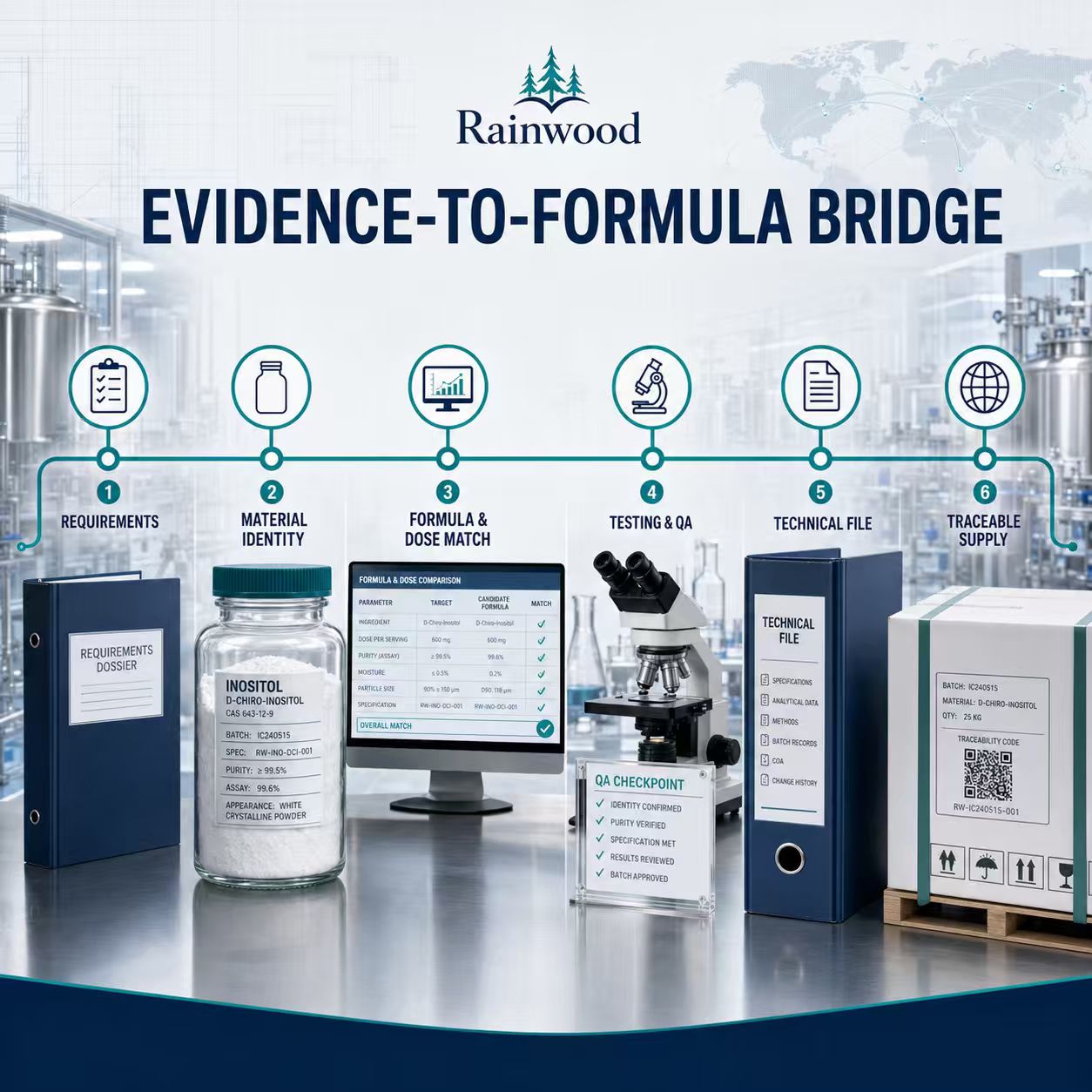
RainwoodBio’s workflow can connect requirement confirmation, raw-material identity, formulation, testing, technical documents and traceability.
For a professional inositol product, that means organising:
- exact commercial formula;
- source and specification;
- study-material comparison;
- dose rationale;
- claim matrix;
- batch release evidence; and
- controlled educational content.
Explore RainwoodBio’s professional supplement development service.
Frequently asked questions
1.Can a brand say “clinically studied”?
Only when the statement accurately describes the relevant ingredient or product and does not imply a stronger result than the evidence supports.
2.Does a 40:1 study support every 40:1 product?
No. Absolute dose, ingredient identity, formula, population and outcome also matter.
3.Are systematic reviews always more reliable than individual trials?
They provide a broader evidence synthesis, but quality depends on included studies, methods, heterogeneity and evidence certainty.
4.Can RainwoodBio supply clinical substantiation?
RainwoodBio can help organise ingredient and formula information. Qualified scientific, regulatory and legal reviewers should approve final claim substantiation.
Make the evidence survive a professional buyer
Send RainwoodBio the proposed formula, market, claims and studies.
Request an inositol evidence-to-formula gap analysis.
References
- Fitz et al., *Inositol for Polycystic Ovary Syndrome: A Systematic Review and Meta-analysis* (2024).
- Greff et al., *Inositol Is an Effective and Safe Treatment in PCOS: Systematic Review and Meta-analysis* (2023).
- US Food and Drug Administration, *Warning Letter to FDC Nutrition Inc.* (2021).
- US Federal Trade Commission, *Health Products Compliance Guidance*.
*This article provides general scientific-communications information and is not medical advice.*