 EN
EN
Meta title: What Is Really Inside Your Bulk Inositol Drum?
Meta description: Investigate whether bulk inositol is fermented, corn-derived, carob-derived, soy-derived or merely re-labeled—and what that means for quality and claims.
“Natural.” “Fermented.” “Corn-derived.” “Carob-derived.” “Soy-free.”
These words can add thousands of dollars to an inositol purchase without proving what is actually inside the drum.
Origin stories sell because buyers associate them with purity, sustainability and premium positioning. Suppliers know that. The dangerous ones sell the story first and search for supporting documents later.
For importers and wholesalers, the real question is not which origin sounds best. It is whether the source, manufacturing route, final identity and commercial claims form one traceable story.
The source adjective is not the ingredient identity
Myo-Inositol can be produced through routes involving plant phytate or carbohydrate fermentation. D-Pinitol is associated with botanical sources such as carob and soy. D-Chiro-Inositol is a different defined material.
A source statement never replaces:
- exact chemical name;
- CAS number;
- specification;
- identity method;
- assay;
- impurity profile;
- original manufacturer; and
- lot traceability.
If the seller’s product page says “Myo D-Chiro Inositol,” the specification says “Chiro-Inositol,” and the description says “D-Pinitol,” the origin story is irrelevant until identity is resolved.
Start with a bulk inositol identity and source specification.
Trap #1: “corn-derived” is used as a shortcut for non-GMO
Corn origin and non-GMO status are separate claims.
Ask for:
- source-material declaration;
- GMO status and basis;
- identity-preservation or segregation information where relevant;
- processing description;
- allergen statement;
- country of origin;
- original manufacturer; and
- statement that applies to the supplied lot or product code.
Heavy processing may remove detectable protein or DNA, but that does not automatically answer a brand’s chosen non-GMO certification or customer promise.
Trap #2: “fermented” hides the fermentation details
Fermentation can be an efficient manufacturing route. It can also become a fashionable word detached from the actual process.
Ask:
1. What substrate is used?
2. Which production organism or enzyme system is involved?
3. Is the organism genetically modified?
4. How is the product separated and purified?
5. Which residuals or microbial risks are controlled?
6. What documentation supports vegan, allergen and non-GMO claims?
A supplier may consider parts of the process confidential. It should still provide enough controlled information for qualification and market review.
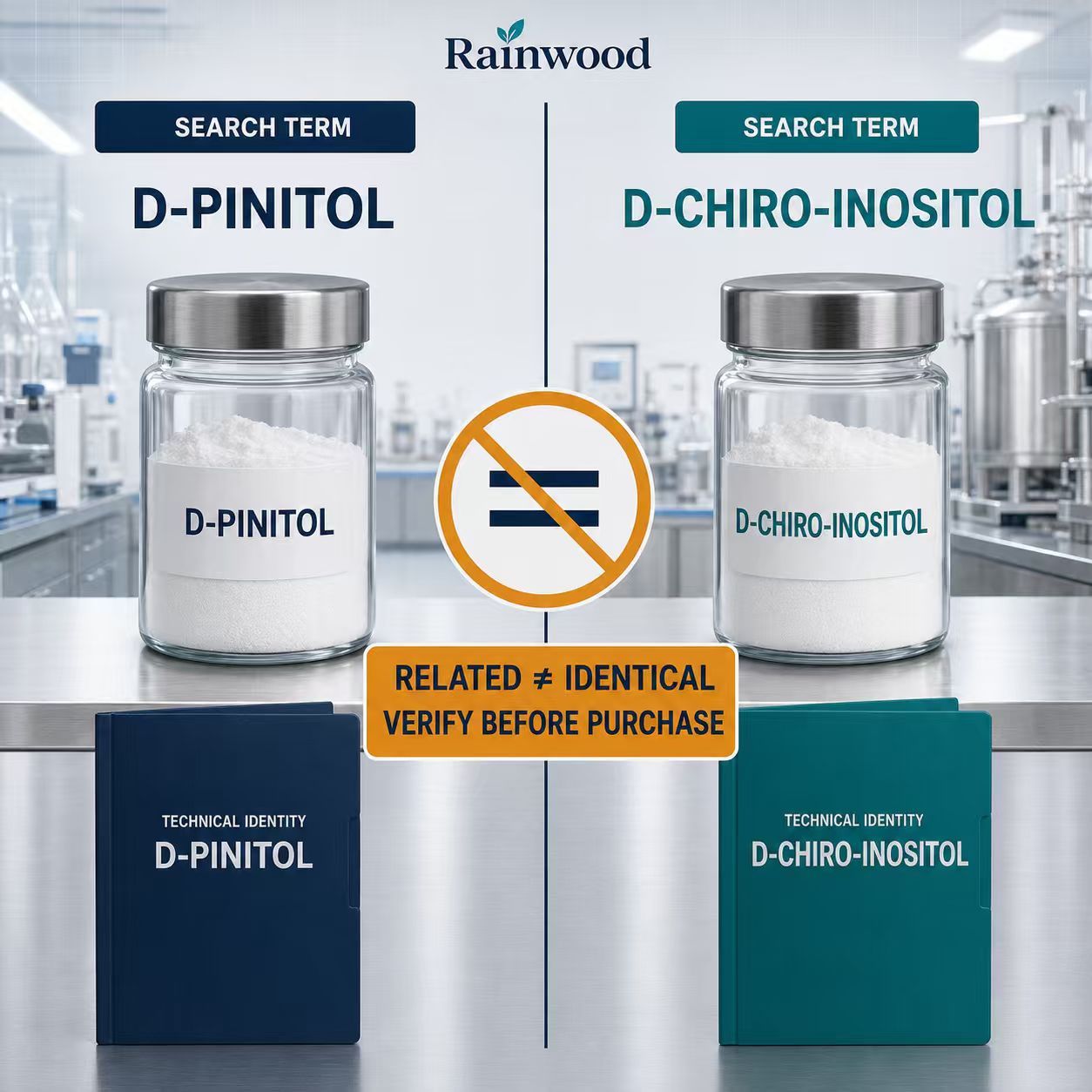
Trap #3: D-Pinitol is sold under a D-Chiro-Inositol search term
D-Pinitol is commonly described as 3-O-methyl-D-chiro-inositol. It is related to D-Chiro-Inositol, but it is not the same purchase article.
The mix-up can happen because:
- the names share “chiro-inositol” language;
- D-Pinitol can be associated with carob or soy;
- search engines reward broad keyword combinations;
- both materials are discussed in metabolic research; and
- buyers may not inspect molecular identity.
Demand separate identifiers, reference standards, assay methods and labels. If the material is D-Pinitol, sell it as D-Pinitol. Do not let an SEO title become a technical specification.
Trap #4: the distributor changes the name but not the drum
A trader may receive one bulk material and create multiple web pages for “inositol powder,” “Myo-Inositol,” “D-Chiro-Inositol” and “natural inositol.”
The warning signs include:
- identical COAs across different product names;
- the same CAS number used for several forms;
- product images reused across unrelated ingredients;
- missing original-manufacturer documents;
- vague factory address;
- inconsistent molecular formula;
- an assay method copied from a generic template; and
- inability to provide a sealed trial lot linked to production records.
This does not prove fraud. It proves that independent verification is overdue.
Trap #5: the origin claim creates an allergen contradiction
A product described as soy-derived may be highly purified, but a brand planning a “soy-free” statement must resolve the source, processing, residual protein and target-market labeling requirements.
Likewise, a “natural carob-derived” claim needs documentation connecting the supplied ingredient to that source. A generic supplier declaration written after the order is weaker than a controlled manufacturer statement linked to the product code.
Put source and allergen requirements in the purchase specification before production.
Follow the drum backward
Build a one-page supply-chain map:
1. raw-material source;
2. ingredient manufacturing site;
3. original manufacturer;
4. distributor or exporter;
5. repacking warehouse;
6. testing laboratories;
7. importer; and
8. finished-product manufacturer.
For each transfer, identify the lot number and document that preserves the link.
If the seller cannot name the original manufacturer, your “traceability” begins at a sales office.
Match tests to the process
The verification plan may include:
- identity against the correct reference standard;
- assay and related substances;
- optical or stereochemical control where justified;
- water or loss on drying;
- residual solvents;
- fermentation- or botanical-route considerations;
- heavy metals;
- microbiology;
- pesticides for relevant botanical sources;
- allergens;
- GMO documentation; and
- physical characteristics needed for manufacture.
Not every test belongs on every batch. Every important risk should have an answer.
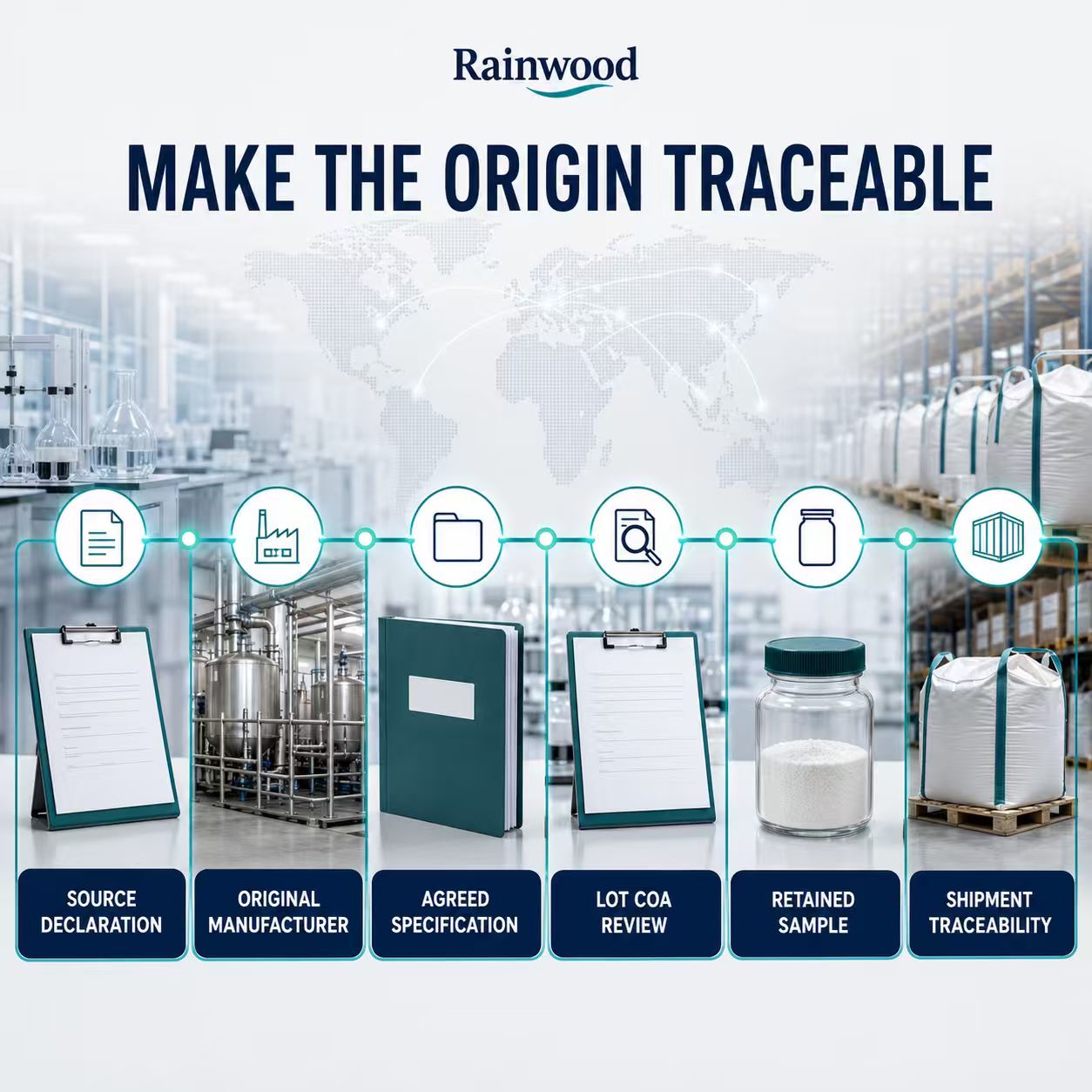
How RainwoodBio can make the origin story traceable
RainwoodBio’s published workflow includes raw-material procurement and supplier management, quality testing and release, warehousing, logistics and traceability.
For a bulk inositol project, those capabilities can support:
- exact source and identity confirmation;
- original-manufacturer documentation;
- agreed specification and test plan;
- lot-specific COA review;
- retained samples;
- packaging and storage requirements; and
- shipment-to-lot traceability.
Learn more about RainwoodBio’s ingredient sourcing and quality workflow.
The goal is not to choose the most fashionable source. It is to make every source claim provable when a customer, auditor or regulator asks.
Importer’s stop-order checklist
Stop the order if:
- the form is described inconsistently;
- the CAS number does not match the quoted material;
- D-Pinitol and D-Chiro-Inositol are treated as the same;
- the original manufacturer is hidden;
- “fermented” has no process statement;
- “non-GMO” has no basis;
- the allergen statement conflicts with the source;
- the COA cannot be linked to the shipped lot; or
- the price is dramatically lower but no technical difference is explained.
Frequently asked questions
1.Is fermented inositol better?
Not automatically. Evaluate exact identity, specification, process controls, documentation, consistency, market fit and price.
2.Is corn-derived inositol always non-GMO?
No. Source and GMO status are separate questions requiring appropriate documentation.
3.Is carob-derived material necessarily D-Pinitol?
Carob is associated with D-Pinitol sourcing, but the supplied material must still be identified and tested.
4.Can a trader be a reliable supplier?
Yes, if its role is transparent and it preserves manufacturer authorisation, storage control, documentation and lot traceability.
Make the supplier prove the story behind the price
Send RainwoodBio the proposed ingredient name, source claim, COA, quotation, quantity and destination market.
Request a bulk inositol source and traceability review.
References
- US National Library of Medicine, PubChem, *Myo-Inositol*.
- US National Library of Medicine, PubChem, *D-Pinitol / 3-O-Methyl-D-chiro-inositol*.
- NIH Office of Dietary Supplements, *Pinitol in Human Nutrition*.
- US Food and Drug Administration, GRAS Notice No. 1198, *Inositol (Myo-Inositol)*.
*This article provides general sourcing information. Source, allergen, GMO and identity claims require documentation appropriate to the specific material and market.*