 EN

Executive Summary & B2B Formulation Guidance
Compare CoQ10 gummies, tablets, capsules, and stick packs by dose, taste, stability, process loss, packaging, and customer use before artwork.
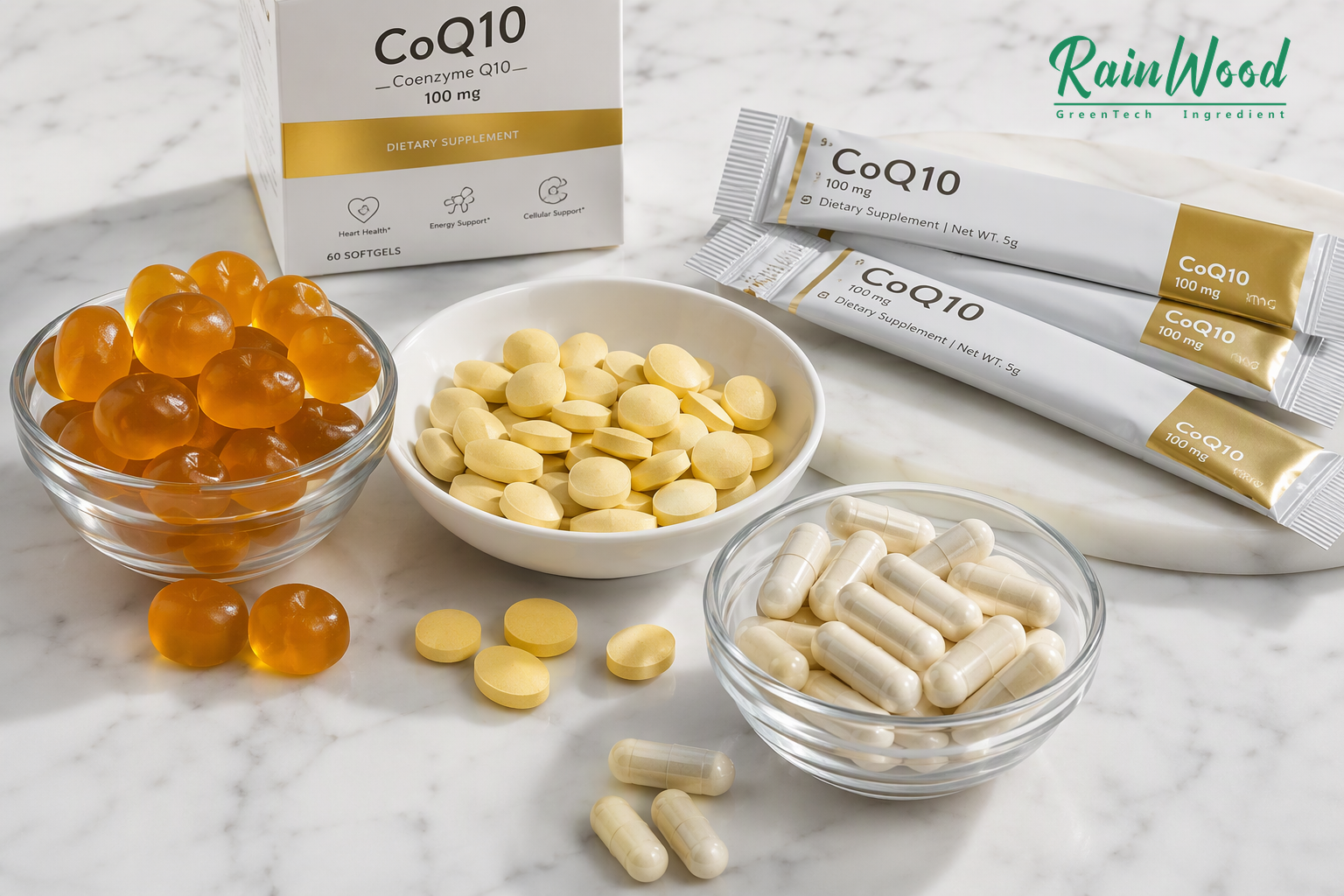
Figure 1: Commercial Showcase of Finished CoQ10 Dosage Forms: Gummies, Compressed Tablets, Hard Capsules, and Stick Packs
The artwork is already designed: a bright gummy, a small tablet, or a convenient stick pack. Then the formulator calculates the CoQ10 input and discovers that the serving is too large, the taste is difficult, or the package cannot protect the active. CoQ10 format decisions should happen before design because the dosage form changes the technical and commercial problem.
Start with the customer routine, not the trend
Gummies may attract first-time supplement buyers but add sugar, moisture, heat, flavor, color, and active-uniformity questions. Tablets may simplify shipping but require compression, disintegration, and taste controls. Stick packs may improve portability but need a realistic dispersion test and high-barrier film. A familiar format is not automatically the right format for CoQ10.
Define the customer, daily dose, unit count, preparation step, storage, shipping route, and target margin. Use the [INTERNAL LINK -> CoQ10 Capsule Capacity and Dose Math Blog] to establish the active requirement before selecting a format.
Gummies create a high-matrix challenge
CoQ10 is lipophilic and colored, while gummies contain water, sugars or polyols, gelling agents, acids, flavors, and heat exposure during processing. The formula must maintain active distribution through cooking, depositing, cooling, and packaging. The active may also create color or taste changes that become more obvious during shelf life.
Ask for the active form, carrier, processing temperature, hold time, gummy weight, and finished-unit assay plan. Test content uniformity across the first, middle, and last production units. If the product is sold as a “heart” or “energy” gummy, keep the claim review separate from the technical format review.
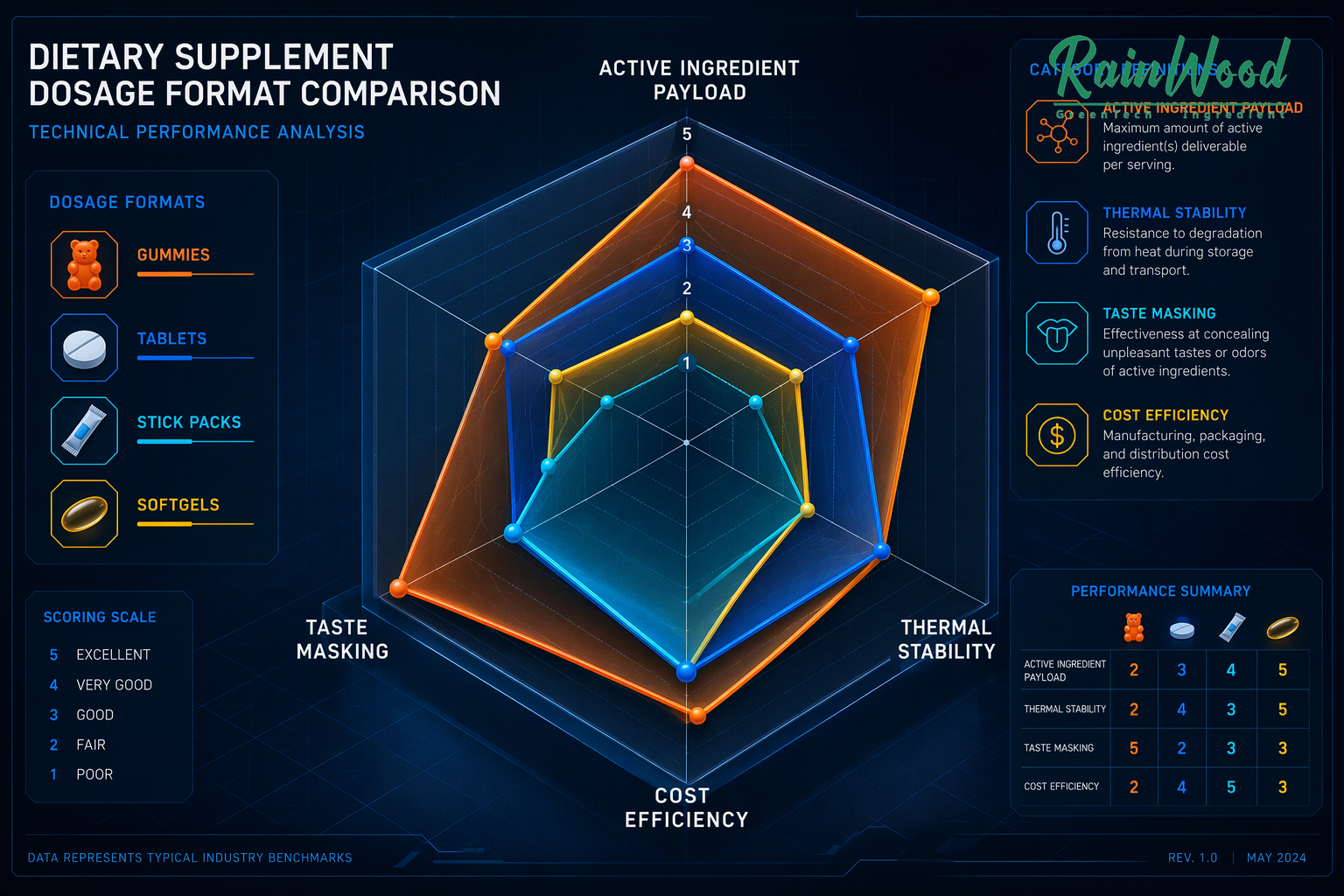
Figure 2: 3D Technical Radar Matrix: Comparing Gummy vs Tablet vs Sachet vs Softgel Across Active Loading, Heat Stability, and Cost
Tablets need more than compression force
A CoQ10 tablet may use a pure powder, granulated blend, carrier complex, or oil-adsorbed material. Compression can alter density, disintegration, friability, color, and active recovery. A tablet that looks strong can release poorly or show content variation if the blend segregates.
Request flow, granulation, compression, disintegration, friability, and finished assay data. Pilot the actual CoQ10 lot and record yield and process loss. The [INTERNAL LINK -> CoQ10 HPLC Method Comparison] should address whether the method works in the tablet matrix.
Stick packs need a true dispersion claim
A stick pack may be sold for water, coffee, smoothies, or direct consumption. Those uses require different tests. Measure wetting, dispersion, sediment, active recovery, taste, odor, color, and package seal. A product that disperses in laboratory water may not behave the same way in cold water or a thick beverage.
Define film barrier, seal strength, fill-weight variation, moisture limit, and storage. Single-dose sticks reduce repeated opening but can increase packaging cost and MOQ. The [INTERNAL LINK -> CoQ10 Water-Dispersible Formulation Blog] should be linked to the exact carrier and customer instruction.
Format economics can reverse the product ranking
Compare active per daily serving, unit count, raw input, process yield, package, shipping weight, testing, stability, returns, MOQ, and lead time. A gummy may have a higher customer acquisition appeal but lower active loading. A tablet may ship efficiently but require a larger serving. A stick pack may create a premium price but need a higher-barrier film.
Calculate the cost per released daily serving, not just cost per kilogram. Include rejected units and the cost of a stability or sensory failure. If the format changes after the sample, reopen dose math, claim review, package, and shelf-life assessment.
Artwork can lock you into the wrong promise
A label that says “one gummy daily” may be impossible if the active amount cannot fit without changing texture or taste. A “water-soluble stick” may require a carrier that changes serving weight. A tablet front panel may imply a medical benefit the evidence does not support.
Before artwork, approve the formula, serving, format, test panel, package, and allowed language together. The [INTERNAL LINK -> CoQ10 Compliance Dossier Blog] helps identify which claims require product-specific evidence.
How RainwoodBio can support format development
RainwoodBio publishes OEM options for gummies, tablets, hard capsules, softgels, and powder sachets, together with requirement confirmation, production control, testing and release, packaging, and traceability. For a CoQ10 format project, the buyer should request a feasibility comparison using the target dose, active form, customer routine, package, market, quantity, and timeline.
Review the [INTERNAL LINK -> RainwoodBio OEM Format Options] and RainwoodBio quality and release process information before approving the design.
Format approval checklist
Confirm:
- active form and amount per unit;
- realistic unit count and daily serving;
- taste, color, odor, and customer preparation;
- process temperature and active recovery;
- content uniformity and finished-product assay;
- package moisture, oxygen, and light protection;
- stability and in-use exposure;
- claim language and target-market review;
- MOQ, lead time, shipping, and complaint risk.
Send RainwoodBio the formula brief, target dose, format, label draft, package, market, quantity, and current supplier quote for a [INTERNAL LINK -> CoQ10 Format and Artwork Feasibility Review]. The goal is to resolve technical constraints before artwork becomes a sunk cost.
Put the format decision into a launch scorecard
Score each option on active delivered per day, unit count, taste or swallowability, preparation time, moisture and oxygen exposure, process recovery, finished testing, package cost, shipping weight, MOQ, lead time, and complaint risk. Add a separate column for the customer promise: convenient, portable, low-sugar, vegetarian, or easy to mix. The best format is the one that meets the buyer's priority without creating an unmanageable quality burden.
Freeze the scorecard only after the pilot uses the commercial CoQ10 lot and intended package. If a competitor changes its format or a retailer requests a new count, reopen the scorecard instead of editing artwork alone. This keeps the formulation, label, and customer experience aligned.
Send the formula brief, target dose, format options, label draft, package, market, and quantity for a [INTERNAL LINK -> CoQ10 Format Contact Us Page] review. Include the launch channel and customer routine so the comparison includes fulfillment, storage, and complaint consequences. Also state whether the product must be vegetarian, sugar-free, travel-friendly, or compatible with a subscription program. These requirements can change the formula and package. Confirm them before pilot production. Record the decision in the product brief for production and sales teams.
Frequently asked questions
Are gummies the best CoQ10 format for online brands?
Not automatically. They may improve appeal but introduce matrix, heat, moisture, taste, and active-uniformity challenges.
Can every CoQ10 powder be used in a stick pack?
No. Flow, dispersion, moisture, carrier, taste, and package requirements must be checked.
Is a tablet easier to ship than a softgel?
It may be more robust in some routes, but compression and disintegration risks still require finished-product testing.

Figure 3: Automated High-Speed Stick Pack Vertical Form-Fill-Seal Packaging Line for Micro-Encapsulated CoQ10
References
- Comparative Bioavailability of CoQ10 Formulations: https://pubmed.ncbi.nlm.nih.gov/12564745/
- Physicochemical Characterization of Water-Soluble CoQ10 Formulations: https://www.sciencedirect.com/science/article/pii/S0378517308005231
- Stability of Reduced and Oxidized CoQ10: https://pubmed.ncbi.nlm.nih.gov/33673604/
- RainwoodBio OEM service: https://www.rainwoodbio.com/oem
*This article is for B2B procurement and educational purposes. Product identity, formulation, safety, labeling, and regulatory requirements must be confirmed for the exact ingredient, finished format, and destination market.*
Explore RainwoodBio CoQ10 & Custom Formulation Capabilities
- Custom CoQ10 Hard Capsules & High-Potency Blends – Precision cGMP encapsulation for CoQ10 with PQQ, L-Carnitine, and Vitamin E co-factors.
- High-Absorption CoQ10 Softgels & Lipid Suspensions – MCT/Olive oil carrier systems with natural tocopherol stabilization.
- Water-Soluble CoQ10 Micro-Encapsulated Powders & Stick Packs – Enhanced bioavailability single-serve sachets and beverage-grade premixes.
- OEM / ODM Contract Manufacturing Services – End-to-end formulation development, pilot batch scaling, and US/EU regulatory compliance dossiers.
- Contact RainwoodBio Technical Sales – Request CoA, HPLC analytical protocols, pilot stability samples, or commercial quotation.
Table of Contents
- Start with the customer routine, not the trend
- Gummies create a high-matrix challenge
- Tablets need more than compression force
- Stick packs need a true dispersion claim
- Format economics can reverse the product ranking
- Artwork can lock you into the wrong promise
- How RainwoodBio can support format development
- Format approval checklist
- Put the format decision into a launch scorecard
- Frequently asked questions
- References